Arcade Hardware

Light guns in arcade cabinets: JAMMA, cabinet I/O and retrofits.

Firearms

Arcade Hardware · Deep Dive

Arcade Hardware

Back into the cabinet.

Light guns in arcade cabinets: JAMMA, cabinet I/O and retrofits.

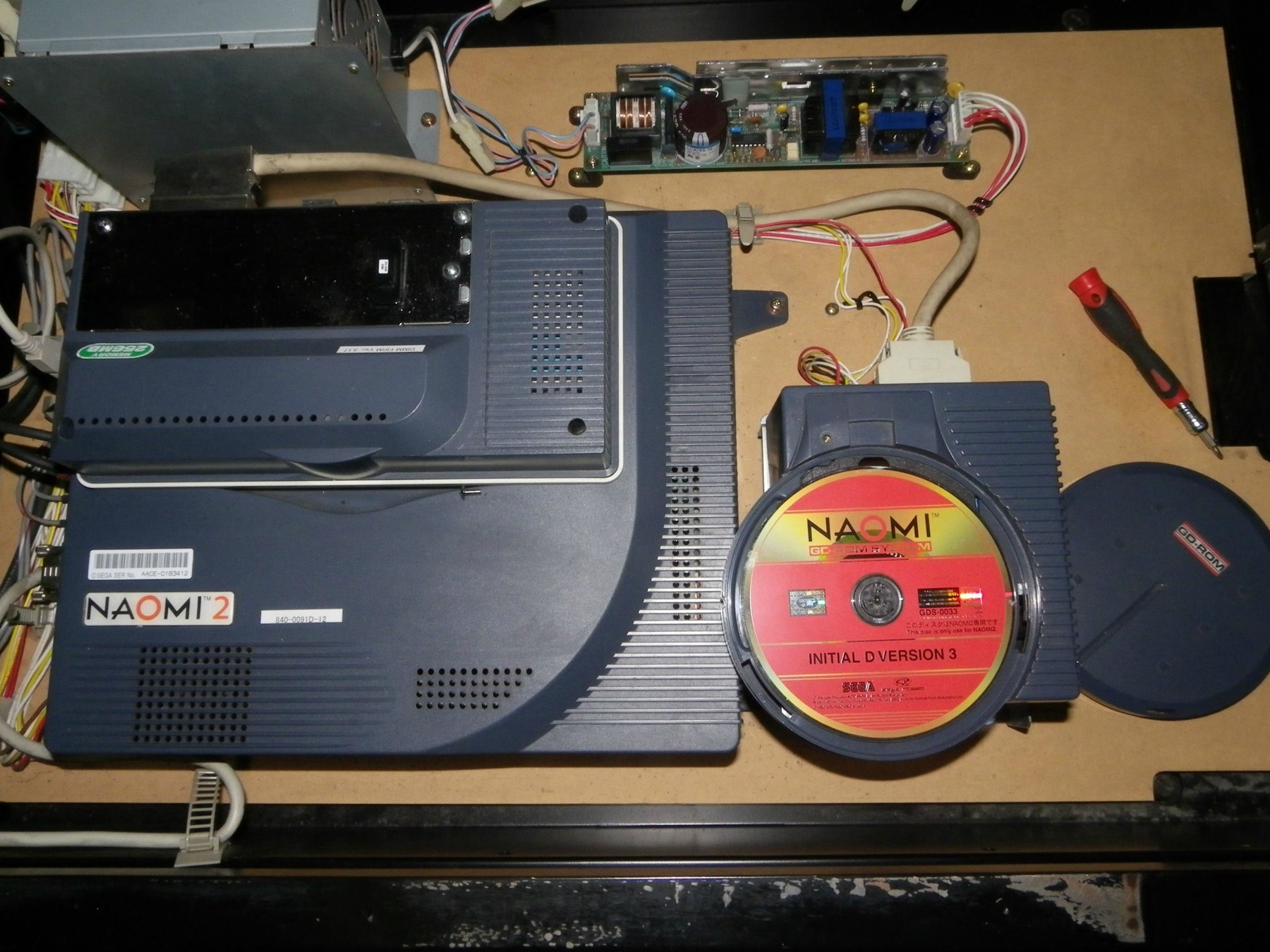
Photo: A Sega NAOMI 2 and its GD-ROM drive installed in an arcade cabinet by Mahcann · CC BY-SA 4.0

Search every volume:

?

How to search

sten gun
pages with both words
"sten gun"
the words together, as a phrase
sten OR sterling
either one (| works too)
sten -replica
leave out pages that mention “replica”

Without quotes, the last word also matches longer words that start with it (sten finds Stenophylla), and close word forms count (rifle finds rifles). Tick Exact words to match whole words only.

Whole deep dives are listed first, then the pages inside them.

    Volumes
    1. Vol 1 Real Boards, Not Emulators — What an Arcade Game Board Expects From a Gun, and Where This Dive Draws the Line The four things a cabinet's game board can be waiting for (an optical pulse timed to its own video, two potentiometer voltages, a JVS I/O board on RS-485, or the maker's own USB device), why a modern USB light gun speaks none of them, and the converter each one needs
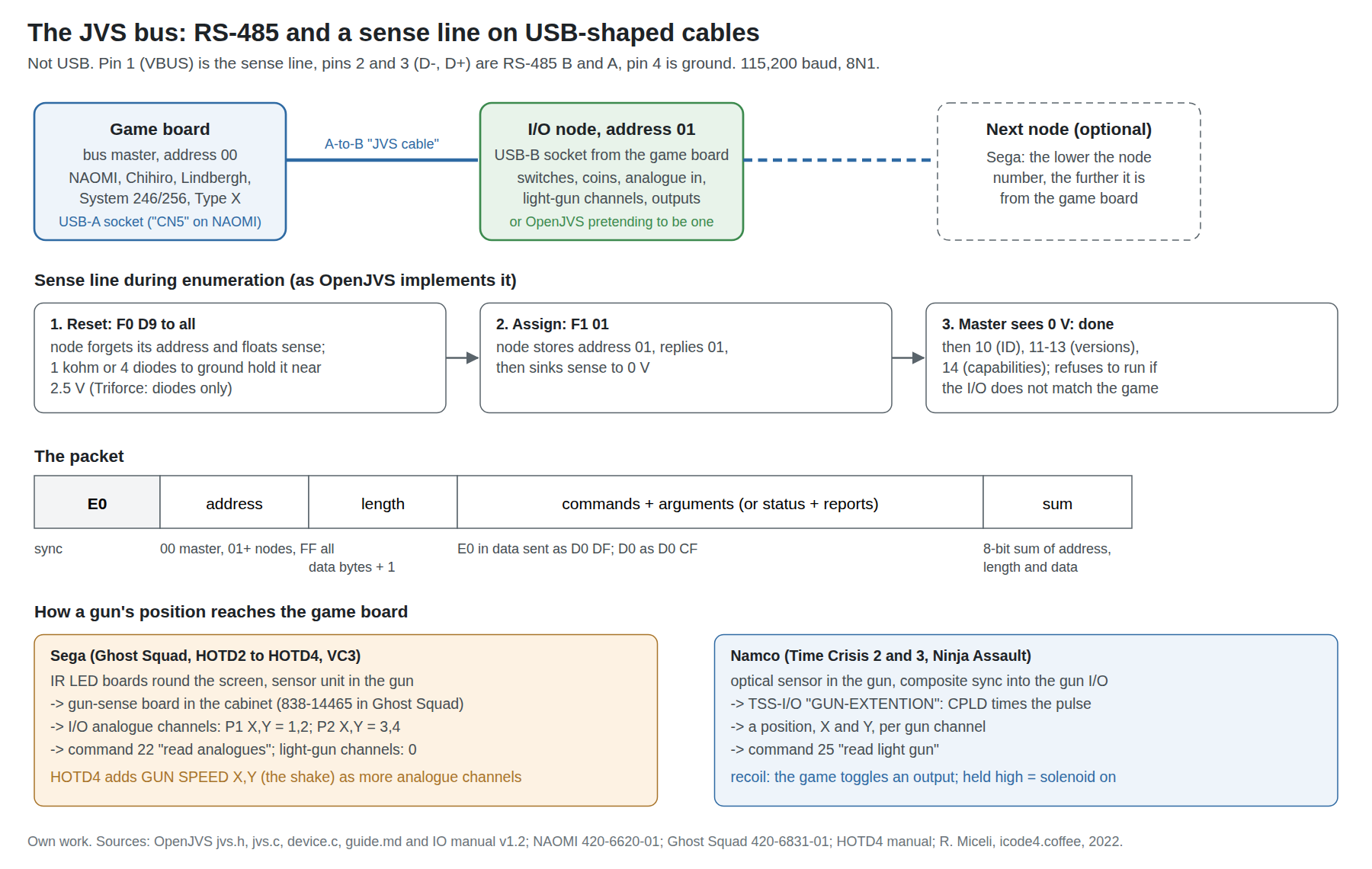
    2. Vol 2 JAMMA and JVS — The Two Wiring Standards, the JVS Packet, the Sense Line, and How Sega's and Namco's Guns Reach the Game Board Why a JAMMA edge connector has no gun on it; what JVS actually puts on its USB-shaped cable (RS-485 at 115,200 baud and a sense line, not USB); the commands a game board sends and the two ways a gun's position comes back; and what the I/O boards of Sega's and Namco's gun cabinets report about themselves
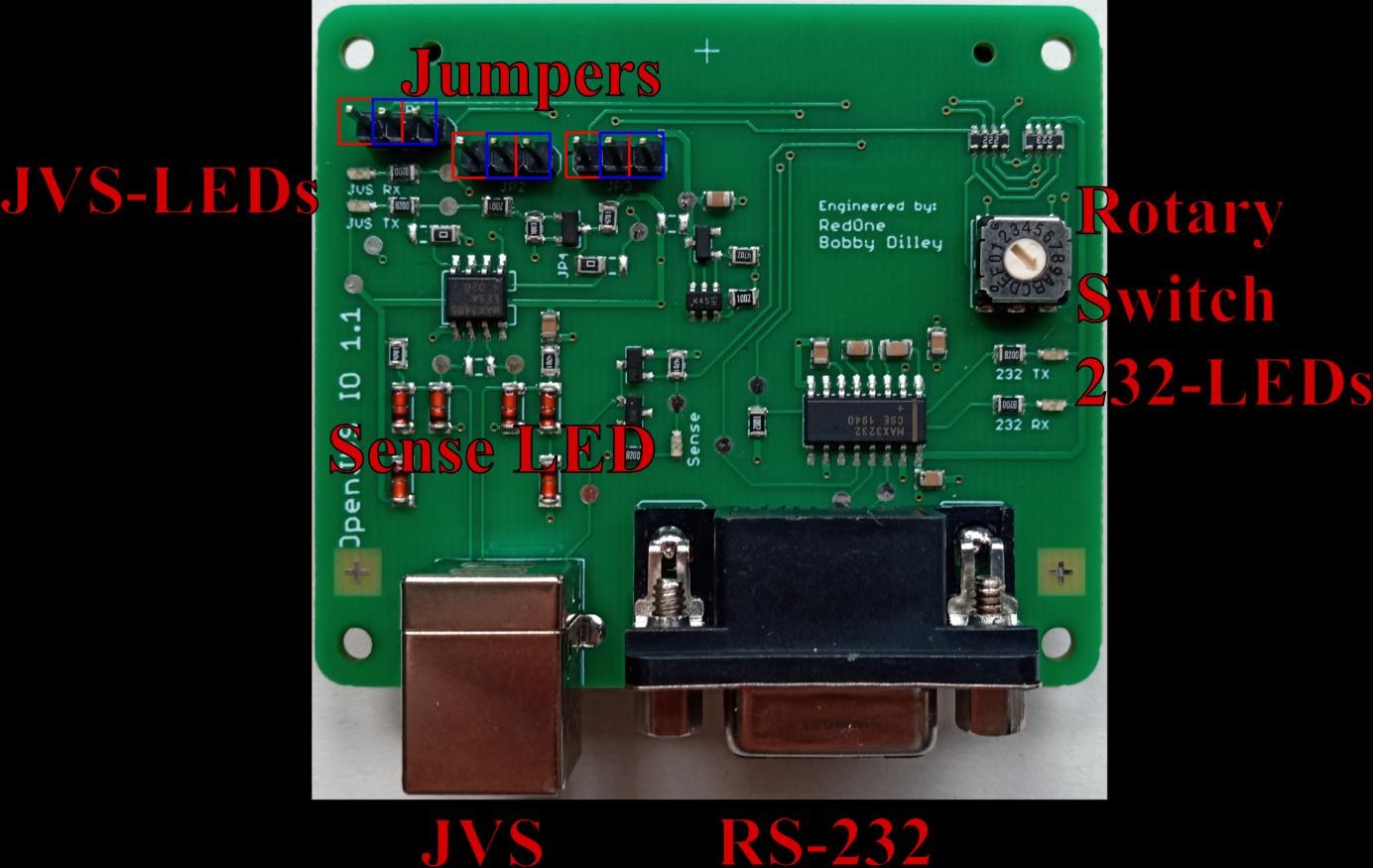
    3. Vol 3 OpenJVS — A Raspberry Pi Becomes the Cabinet's I/O Board The one working, open route for a modern gun on real JVS hardware: what OpenJVS is, the RS-485 and sense-line hardware it needs, how the project's three-node OpenFIRE gun maps onto its two-stage mapping, game-by-game notes for Sega's and Namco's gun boards, and two limits read in its source that decide what works: one gun position through the light-gun command, and every output write thrown away
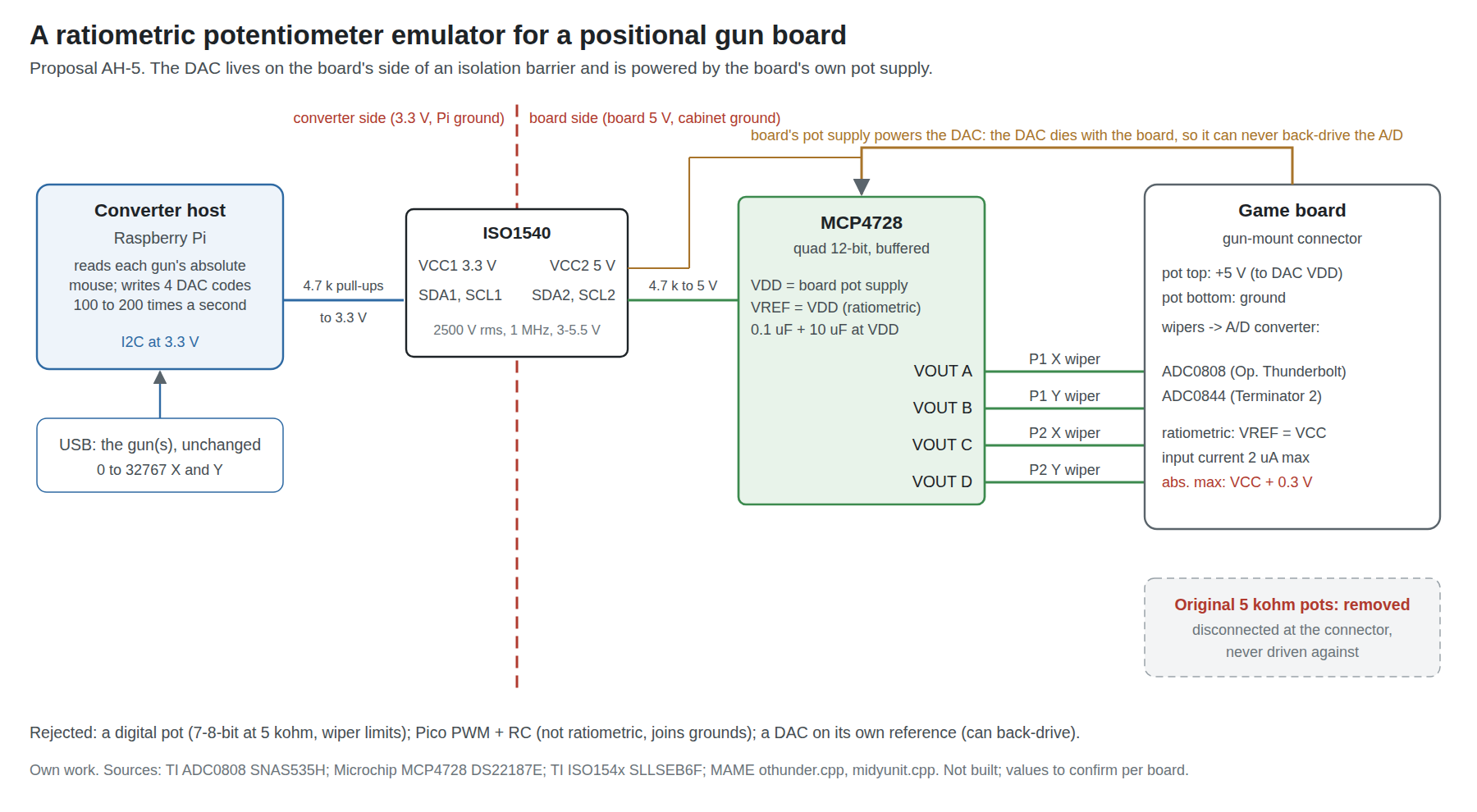
    4. Vol 4 Pre-JVS Boards — Replacing a Potentiometer With a DAC, and What Faking an Optical Pulse Would Take The JAMMA-era gun boards that no I/O emulator can reach: a ratiometric DAC design for the positional cabinets (Operation Thunderbolt, Space Gun, Terminator 2, the 2014 fixed guns), with its part choices and isolation, and the harder optical case, where a converter must count the board's own sync and fire a pulse at the right microsecond
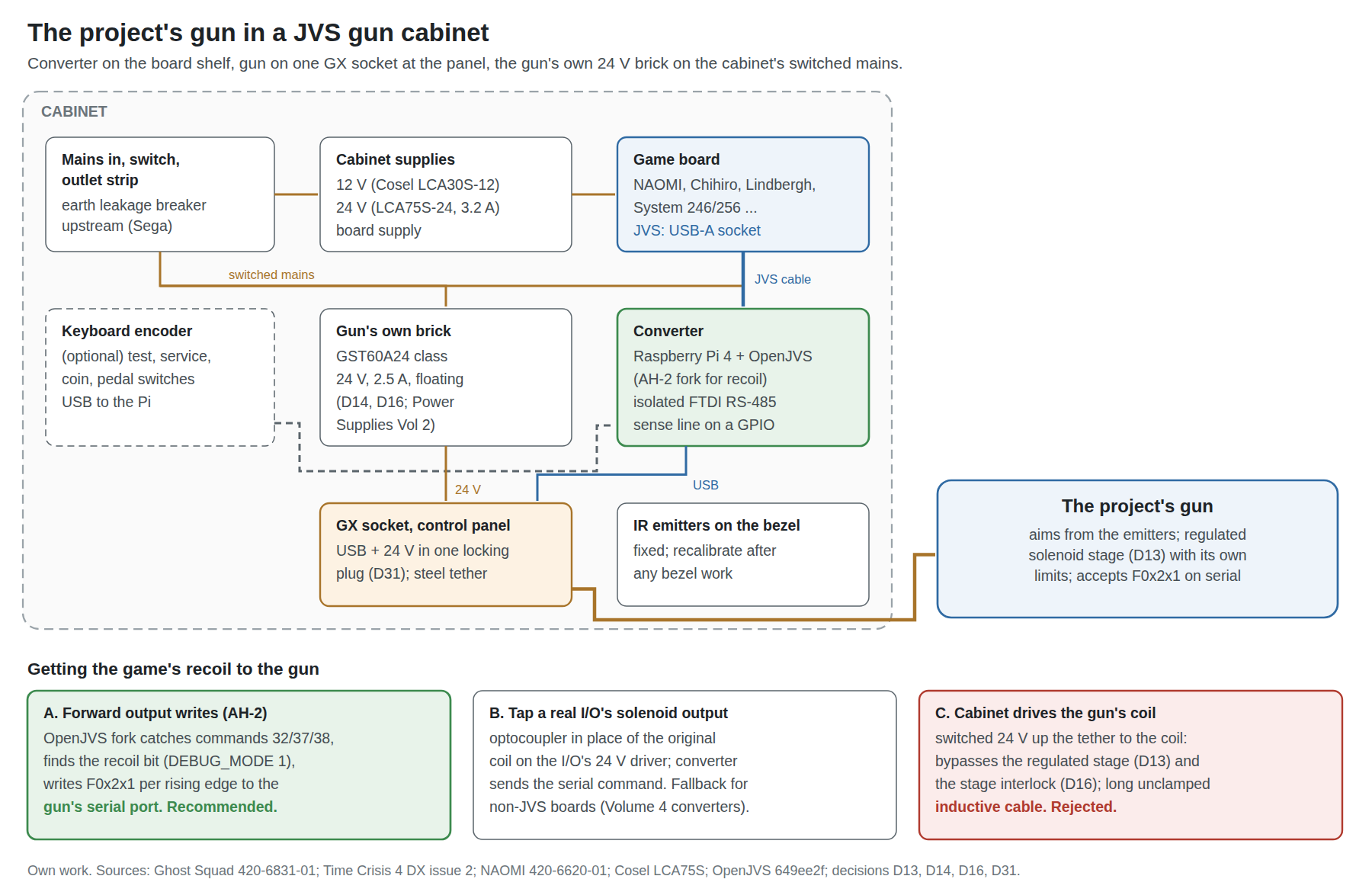
    5. Vol 5 Cabinet I/O, Power and Recoil — Coin and Start, the Cabinet's 24 V, Grounding, and Getting the Game's Recoil Back to the Gun What a gun cabinet supplies and switches (Sega's Cosel 12 V and 24 V supplies, Namco's +24 V solenoid feed, the fuses per gun), what goes dead when the I/O board is emulated, three ways to turn the game's solenoid command into a kick at the project's gun and why two of them lose, and where the converter, the gun's own 24 V brick and the GX socket go in a real cabinet
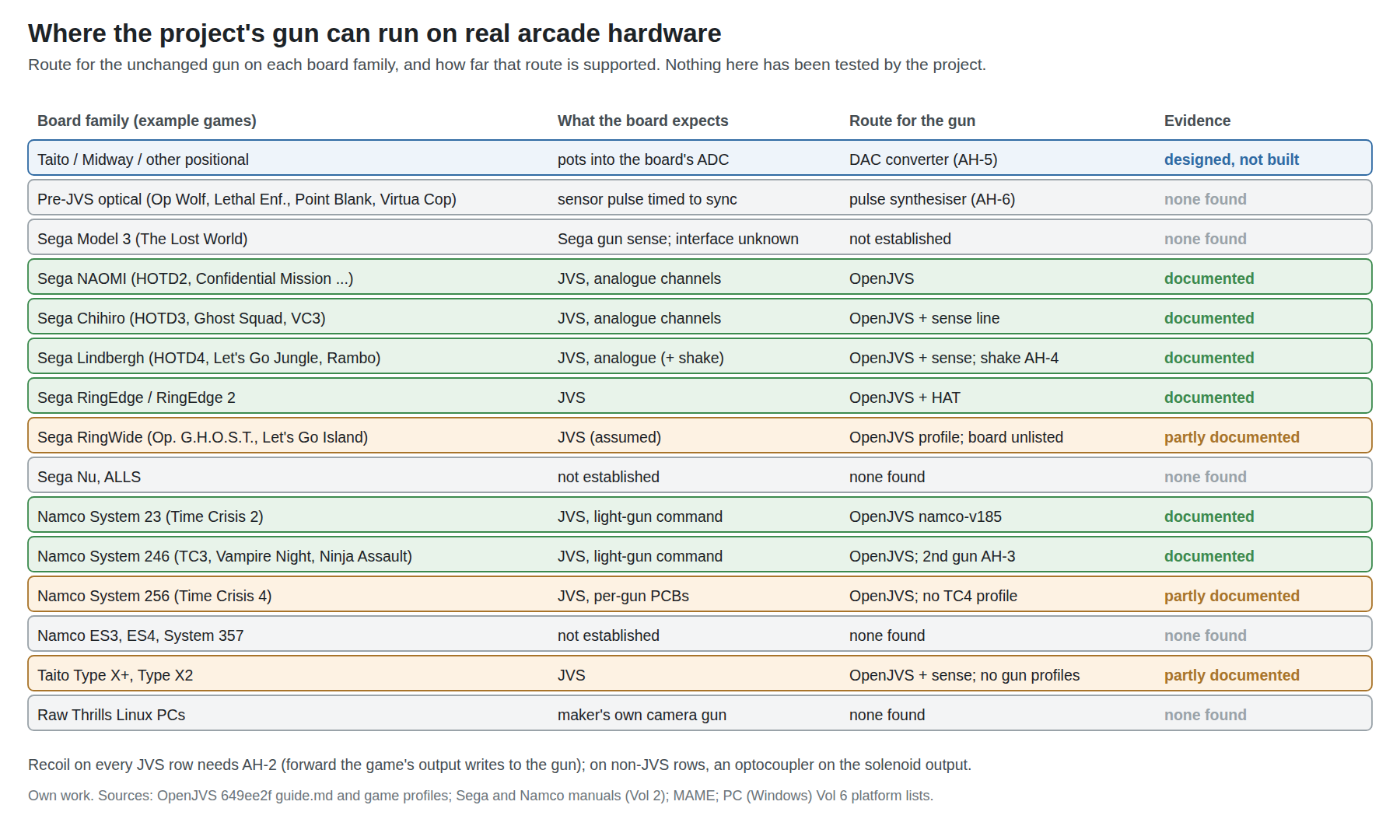
    6. Vol 6 CRT and LCD Cabinets, and Where It Runs — Displays, Emitters in a Cabinet, the Board-by-Board Table and the Proposed Decisions Why the project's gun stops caring about the display once it is on a converter, what still matters (the board's 15 or 31 kHz video, the scaler's delay, the old LED boards still glowing round the screen), the table of every arcade board family with its interface, the route for the project's gun and how well documented that route is, and the decisions this dive proposes