Arcade Hardware · Volume 6
CRT and LCD Cabinets, and Where It Runs — Displays, Emitters in a Cabinet, the Board-by-Board Table and the Proposed Decisions
Why the project's gun stops caring about the display once it is on a converter, what still matters (the board's 15 or 31 kHz video, the scaler's delay, the old LED boards still glowing round the screen), the table of every arcade board family with its interface, the route for the project's gun and how well documented that route is, and the decisions this dive proposes
6.1 The display stops mattering to the gun
For the original guns, the display decides everything: an optical gun needs the original CRT’s beam, a positional gun needs nothing, an infrared gun needs its emitters to stay put relative to the picture. Arcade Light Guns Vol 6 draws that decision family by family, and CRT Timing explains why a flat panel defeats a timing gun.
Once the project’s gun is on a converter, that question disappears for the gun. It measures its aim from its own emitters, inside the gun, and hands the converter a number; nothing it does depends on how the picture is drawn. So:
- A JVS game whose original gun was optical (Time Crisis 2 and 3) can, through OpenJVS, run on whatever display the board can drive, because the timing board it needed has been replaced along with the gun (Volume 3).
- A Sega infrared game keeps working on any display, as it always did; the gun-sense system is replaced, but it was never display-dependent. By Sega’s own list that covers everything from The Lost World and The House of the Dead 2 to Ghost Squad (Volume 2).
- A positional game keeps working on any display with the DAC converter (Volume 4).
- A pre-JVS optical game is the exception. Its board still times a pulse against its own raster, so it still needs either a CRT or a pulse synthesiser that has not been built (Volume 4).
6.2 What still matters: video frequency and delay
Two display questions remain, and neither is about the gun.
Will the display take the board’s video? Sega’s NAOMI manual: “NAOMI can not be used for the cabinet incorporating a monitor or projector not corresponding to 15kHz or 31kHz.”1 JAMMA boards and the System 246 put out 15 kHz RGB with composite sync (Miceli split the System 246’s composite sync from that signal2). An LCD needs a scaler that accepts 15 kHz RGB; the Lindbergh and later PC boards output VGA-class or better video directly. Choosing the scaler is the same problem as for the original consoles and is not repeated here.
How much delay does the chain add? A scaler or a television’s processing delays the picture by one or more frames. For the original optical guns that delay destroys the measurement. For the project’s gun it does not touch the aim at all: the gun reports where it points now, and the game puts the shot there. What the delay does is put the game’s response (the hit spark, the crosshair if shown) behind the player’s hand, which players feel as lag. PC (Windows) Vol 6 works the arithmetic for a PC, where the display’s presentation mode is worth one to two frames, more than the whole gun; the same holds in a cabinet. A CRT, where the cabinet still has one, adds nothing.
6.3 Emitters in a cabinet
The emitter layout the project uses (a square of four points, emitters at about 20 % and 80 % of the width, as close to the picture’s top and bottom edges as the bezel allows: decision P-IRT1) is in IR Point Tracking Vol 3. A cabinet changes three things:
- The bezel is not the picture. Arcade monitors sit behind a bezel and often a sheet of glass or acrylic, and on a CRT the picture’s edges are curved and may not be centred. The gun’s calibration maps the emitters to the picture, so the emitters need only be fixed and roughly placed; the four-point calibration absorbs the rest (Aiming Maths and Calibration). Glass in front of the emitters must pass their infrared.
- The marquee. Ultimarc’s warning for AimTrak, that its bar “will not work if the bar is located on the top of a cabinet which has a marquee” (Open-Source Firmware Vol 1), is a warning about a single bar too far from the picture. The project’s four emitters go on the bezel round the picture, not on the marquee.
- Projection cabinets. The deluxe Sega and Namco cabinets (House of the Dead 4, Time Crisis 4 DX, Vampire Night DX) use large projection screens with a mask round them; their own LED boards sit on that mask (Arcade Light Guns Vol 4). The mask is the natural place for the project’s emitters too. Time Crisis 4’s 60 cm minimum distance and angle limits were properties of Namco’s sensor, not of the screen; the project’s camera has its own limits, set in IR Point Tracking.
6.4 The old LED boards, and the neighbours
A converted Sega or Namco infrared cabinet still has its original LED boards round the screen: ten on The House of the Dead III and Ghost Squad masks, twenty filter positions on Time Crisis 4’s (Arcade Light Guns Vol 4). They are infrared emitters, and the project’s gun tracks infrared points. Left powered, they are extra points in the camera’s view, and a camera that expects four points and sees fourteen may lock onto the wrong ones.
The manuals give the way to turn them off without removing anything: Ghost Squad’s electrical assembly wires them through named harnesses, “WH SENSOR LED ELEC” and “WH SENSOR LED EXT”, from the gun-sense board.3 Unplugging the LED harness (or the gun-sense board’s supply) when the cabinet is converted removes them from the camera’s view and leaves them in place for a return to original. That is proposal AH-8. Whether the project’s camera, behind its own filter, would actually see Sega’s LEDs depends on their wavelength, which no manual states; the precaution costs nothing.
The reverse case matters in a room with more than one cabinet. Sega’s and Namco’s systems modulate their LEDs and move alternate cabinets to a second frequency to reject neighbours (the jumper both makers describe, Arcade Light Guns Vol 4). The project’s emitters are not modulated in the same way, so an unconverted Sega or Namco cabinet beside a converted one may see the project’s emitters as interference, and the project’s camera may see the neighbour’s LEDs. IR Point Tracking takes up modulation; for a home with one converted cabinet it does not arise.
6.5 Where it runs
The table below is the whole dive on one page. Route is what the project’s gun needs on that board. Evidence says how far the route is supported: documented (a project’s own documentation or source claims it), designed (worked out in this dive from datasheets and manuals, not built anywhere found), or none found. Nothing in the table has been tested by the project.
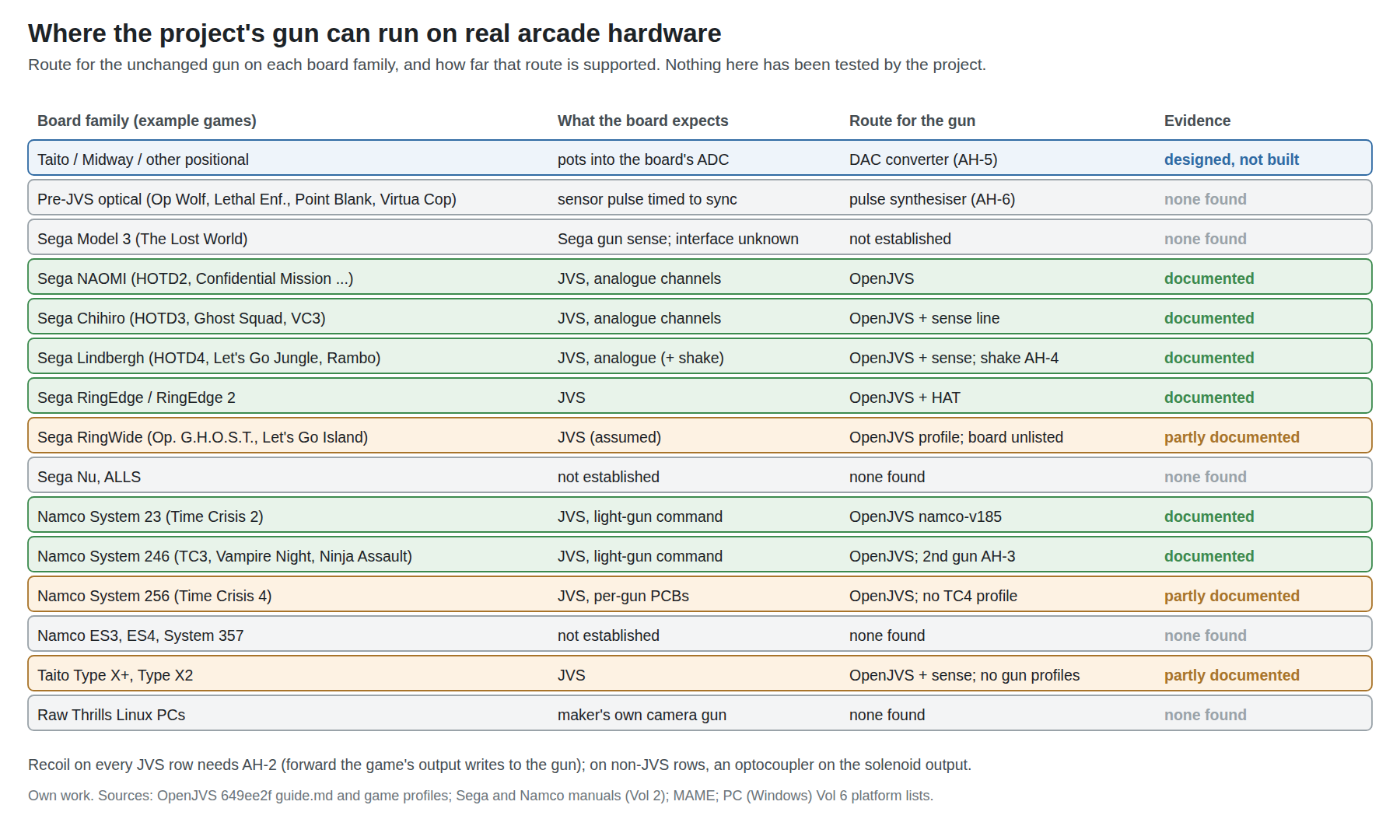
Table 1 — 6.5 Where it runs
| Board family | Gun games (examples) | What the board expects | Route for the project’s gun | Evidence | Recoil |
|---|---|---|---|---|---|
| Taito positional (Operation Thunderbolt, Space Gun) | Operation Thunderbolt, Space Gun | Two 5 kΩ pots per gun into an ADC0808 | DAC converter (AH-5) | Designed | Optocoupler on the solenoid output (route B) |
| Midway Y-unit (positional) | Terminator 2, Revolution X | Pots into an ADC0844 | DAC converter (AH-5) | Designed; ADC0844 datasheet not read | Route B |
| Other positional (SNK, Sega, 2014 fixed guns) | Beast Busters, Line of Fire, Laser Ghost, Alien3, Aliens Armageddon fixed, Deadstorm Pirates SE | Pots into the board’s ADC | DAC converter, per board | Designed; per-board voltages unchecked | Route B |
| Pre-JVS optical, timing on the board or a position board | Operation Wolf, Lethal Enforcers, Point Blank, Virtua Cop, Virtua Cop 2 | A sensor pulse timed against the board’s own sync | Pulse synthesiser (AH-6) | None found; bench experiment only | Route B |
| Sega Model 3 (infrared gun-sense) | The Lost World | Sega gun-sense system (per Sega’s list); board interface not established | Not established | None found (OpenJVS does not list Model 3) | — |
| Sega NAOMI | The House of the Dead 2, Confidential Mission, Death Crimson OX, Lupin the 3rd, The Maze of the Kings | JVS; aim as analogue channels | OpenJVS, generic-shooting | Documented (NAOMI 1 “Working”, no sense line; HOTD2 profile) | AH-2 |
| Sega Chihiro | The House of the Dead 3, Ghost Squad, Virtua Cop 3 | JVS; analogue channels | OpenJVS, sense line | Documented (board “Working”; profiles for all three) | AH-2 |
| Sega Lindbergh | The House of the Dead 4 (and Special, EX), Let’s Go Jungle, Rambo, 2 Spicy, Ghost Squad Evolution | JVS; analogue channels; HOTD4 adds shake channels | OpenJVS, sense line | Documented (board “Working”; profiles for HOTD4, LGJ, Rambo); HOTD4 shake not mapped (AH-4) | AH-2 |
| Sega RingEdge, RingEdge 2 | Transformers: Shadows Rising (RingEdge 2) | JVS | OpenJVS with the HAT | Documented for the board (“Requires JVS Hat”); no gun profile | AH-2 |
| Sega RingWide | Operation G.H.O.S.T., Let’s Go Island, Transformers: Human Alliance, Sega Golden Gun, Target Bravo | JVS (assumed) | OpenJVS (profile for Operation G.H.O.S.T.) | RingWide not named in OpenJVS’s board table; profile exists | AH-2 |
| Sega Nu, ALLS | Luigi’s Mansion Arcade (Nu), The House of the Dead: Scarlet Dawn (ALLS) | Not established | None found | Not in OpenJVS’s table | — |
| Namco System 23 | Time Crisis 2 | JVS; Namco gun I/O (TSS-I/O) via the light-gun command | OpenJVS, namco-v185 | Documented (“Time Crisis 2” working); one gun per board (a twin cabinet assumed to be two boards, as Time Crisis 3’s is) | AH-2 |
| Namco System 246 | Time Crisis 3, Vampire Night, Ninja Assault | JVS; Namco gun I/O | OpenJVS (namco-v185, namco-jyu) | Board documented (“Vampire Night” working); TC3 profile exists; Ninja Assault second gun blocked (AH-3) | AH-2 |
| Namco System 256 | Time Crisis 4 | JVS; per-gun PCBs | OpenJVS | Board “Working”; no TC4 profile; one user file suggests an attempt | AH-2 |
| Namco ES3, ES4, System 357 | Time Crisis 5 (ES3), Point Blank X (ES4), Deadstorm Pirates (System 357) | Not established | None found | Not in OpenJVS’s table | — |
| Taito Type X+, Type X2 | Gaia Attack 4, Haunted Museum, Music Gun Gun! 2 | JVS | OpenJVS, sense line | Boards “Working”; no gun profiles; which games are on which Type X model not checked | AH-2 |
| Raw Thrills Linux PCs | Terminator Salvation, Aliens Armageddon deluxe (camera guns, per their manuals); other Raw Thrills gun games not examined | The maker’s own camera gun (Aliens Armageddon: on a USB harness) | None found | — | — |
Board-to-game assignments are from the Sega and Namco manuals cited in Volume 2, Arcade Light Guns and the platform lists gathered in PC (Windows) Vol 6. Every row marked “none found” is where the game is better played in emulation, through the other Platform Support dives.
6.6 If a cabinet is bought: which one
The table points one way. A Sega JVS gun cabinet (NAOMI House of the Dead 2, Chihiro House of the Dead 3 or Ghost Squad, Lindbergh House of the Dead 4) has the best-documented route: the board is listed as working in OpenJVS, a profile exists, two guns work because Sega’s guns arrive as analogue channels, the display does not matter, and the original cabinet’s LED harness unplugs cleanly. The work left is AH-2 (recoil) and, for House of the Dead 4, AH-4 (shake). A Time Crisis 2 or 3 twin is the next best, one board per gun, with the striking bonus that a cabinet whose CRT has died could come back on an LCD. Pre-JVS boards are the worst first purchase: positional ones need the converter of Volume 4 built from nothing, and optical ones have no route at all.
This is a recommendation for a purchase nobody has decided on (question 1 for Jeff, in the dive’s notes).
6.7 Proposed decisions
The owner ruled on 2026-10-24: no cabinet or board is planned for now (D48); AH-4 is adopted for if a Lindbergh is acquired (D52); AH-5 is not built, and positional games are left to emulation (D51); AH-1 and AH-2 will be worked through before one is chosen (D49), and whether an OpenJVS fork may be published as a separate GPL program is open (D50). The rest remain proposals.
Table 2 — 6.7 Proposed decisions
| # | Area | Proposal | Why, and why not the alternatives |
|---|---|---|---|
| AH-1 | Architecture | One converter design: a Raspberry Pi as USB host for the unchanged gun, with a board-specific back end (JVS, DAC, or pulse synthesiser) | The gun stays one gun everywhere and every PC bench result carries over. An “arcade mode” in the firmware would fork the gun’s behaviour and still need different hardware per board |
| AH-2 | Recoil on JVS boards | Fork OpenJVS to forward the game’s output writes (32, 37, 38) to the gun’s serial port as one F0x2x1 per rising edge of the recoil bit; find each game’s bit with DEBUG_MODE 1 | Stock OpenJVS discards outputs. Tapping a real I/O needs the I/O OpenJVS replaces. Driving the gun’s coil from the cabinet bypasses D13 and D16 (Volume 5) |
| AH-3 | OpenJVS fork fixes | Make the light-gun command honour its channel (two guns on Namco two-gun I/Os); treat an edge-pinned aim as screen-out; carry FIRECon device files | Ninja Assault’s second gun cannot reach the game today; the App’s off-screen remap is a workaround, not a fix (Volume 3) |
| AH-4 | HOTD4 shake | Feed the gun’s IMU (D36) to HOTD4’s gun-speed channels, via a firmware motion report and an OpenJVS change; defer until a Lindbergh is in hand | Stock OpenJVS cannot turn a button into an analogue swing; mapping a button to a fixed value would not imitate a shake |
| AH-5 | Positional boards | MCP4728 quad DAC powered from the board’s own pot supply with VDD reference, ISO1540 isolation, written by the Pi | Digital pot: 7–8-bit at 5 kΩ. Pico PWM: not ratiometric, joins grounds. DAC on its own reference: can back-drive an unpowered board (Volume 4) |
| AH-6 | Pre-JVS optical boards | No general converter; a pulse-synthesiser experiment (RP2040 PIO, LMH1980 sync separator) only with a specific board on the bench and its original gun measured first | Sensor interfaces are undocumented and differ per board; no arcade implementation exists to follow |
| AH-7 | Cabinet wiring | Gun on its own GST60A24-class brick from the cabinet’s switched mains, through one GX socket on the panel with a steel tether; isolated FTDI RS-485 adapter (Waveshare FT232RNL isolated) and four signal diodes on the sense line | Cabinet 24 V: adequate but shared, aged and joins grounds. Non-isolated adapter: works, joins grounds. CP2102 adapters: the OpenJVS guide warns against them. A resistor on the sense line: fails on Triforce |
| AH-8 | Original LED boards | Unplug the cabinet’s gun-sense LED harness (and the gun-sense board) when converting a Sega or Namco IR cabinet | Left powered, they are extra infrared points in the camera’s view; unplugging is reversible |
| AH-9 | First cabinet, if one is bought | A Sega JVS gun cabinet (NAOMI, Chihiro or Lindbergh); Time Crisis 2/3 second; not a pre-JVS board | Best-documented route, two guns, display-independent (6.6) |
6.8 What could not be verified
- No row of the table has been tested by the project, and no third-party report of the project’s gun (or any OpenFIRE gun) on a real arcade board was found.
- Whether RingWide works with OpenJVS (a profile exists; the board is not in the table).
- Which Taito Type X model each Type X gun game uses.
- The wavelength of Sega’s and Namco’s LED boards, and whether the project’s camera would see them.
- The interface between Sega’s Model 3 gun-sense system and the Model 3 board.
- Whether Sega Nu, ALLS, Namco ES3/ES4 or System 357 accept any JVS I/O emulator; none is listed by OpenJVS.
Sources
Further sources for the table: OpenJVS docs/guide.md and docs/openjvs/games/* at commit 649ee2f (read 2026-10-24); the manuals and sources listed in Volumes 2 to 5.
Footnotes
-
Sega Enterprises, NAOMI Service Manual, 420-6620-01, 1st printing February 2001, §1 (monitor frequency note), Internet Archive
manualzilla-id-6037988— read 2026-10-24. ↩ -
Ryan Miceli, “Light Gun Hacking Part 1: Using Namco light guns in Unity”, icode4.coffee, 27 October 2022, https://icode4.coffee/?p=655 — read 2026-10-24. ↩
-
Sega, Ghost Squad Deluxe owner’s manual, 420-6831-01, 1st printing November 2004, ASSY ELEC CTF-4100 and cabinet harness parts lists (pp. 166, 180), central Library text
sega-ghost-squad-arcade-owners-manual— read 2026-10-24. ↩
Comments (0)