The AK-47 · Volume 9
Reading an AK

There is no serial-number registry that will identify a Kalashnikov. There is no equivalent of the Springfield month-end tables that date an M1 receiver to a production window. What there is instead is a set of physical features — receiver construction, trunnion shape, rivet layout, markings, barrel profile, furniture — which taken together narrow a rifle down to a pattern, usually to a country, and sometimes to a factory and a year. Taken singly they narrow it down to very little, and this is where most variant folklore begins.
This volume is the identification method the rest of this arm hangs off. The national volumes that follow assume it, and refer back to it rather than repeating it.
9.1 Read the Receiver First
Every other question is easier once the receiver is settled, because receiver construction sorts the whole family into two groups that were never built the same way.
A milled receiver is machined from a steel forging or from bar stock. It has no rivets in its side walls. The buttstock enters a machined socket rather than a riveted tang. The clearest single tell is the lightening cut — a long rectangular relief milled into the receiver wall above the magazine well. On the Type 2 receiver the cut runs parallel to the bore; on the Type 3, which is by a wide margin the most common milled pattern, it is slanted. A milled rifle is heavier than a stamped one by roughly a pound, and it feels it.
A stamped receiver is folded from sheet steel and held together by rivets and by two trunnions, one at each end. The rivet heads are visible on the outside of the receiver walls. There is no milled lightening cut; in its place, most stamped patterns carry a small dimple pressed into each side wall above the magazine well, which locates and steadies the magazine.
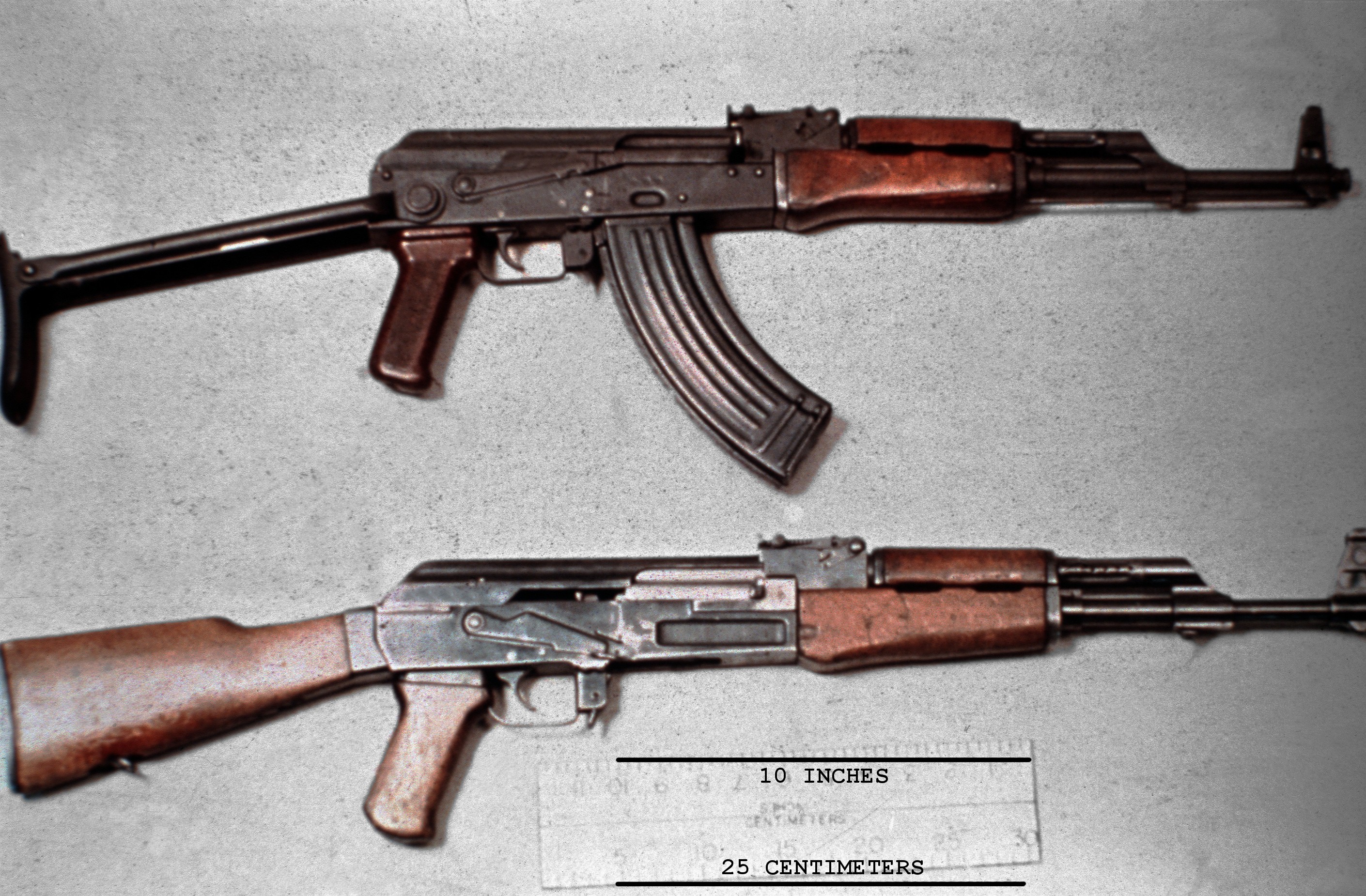
The distinction is not a chronology of quality. The original 1948-pattern receiver was stamped, the 1950s production receivers were milled because the stampings of the day would not hold together, and the AKM returned to stamping once the metallurgy and the tooling caught up. The mechanism volumes earlier in this dive cover why.
9.2 The Front Trunnion
The front trunnion is the machined steel block at the front of the receiver. The barrel is pressed into it, and it carries the locking recesses the bolt turns into. On a stamped rifle it is the part that takes the firing loads; the sheet-steel receiver largely holds everything in alignment around it.
Trunnion shape is one of the more reliable national tells, because it is expensive to change and it is visible without disassembly:
- The AKM-pattern trunnion is essentially flat-sided where it meets the receiver.
- The RPK-pattern trunnion is noticeably bulged — thicker through the barrel boss, so that the receiver walls swell visibly around it just behind the handguard. It was designed for the heavier-barrelled squad automatic, and it is the feature that gives the Yugoslav rifles their distinctive profile (Vol 11).
A bulged trunnion visible through the receiver is a genuine, load-bearing difference rather than a cosmetic one, and it is worth learning to see. It is not by itself proof of origin: several countries and several US manufacturers have used RPK-pattern trunnions, for several different reasons.
9.3 Rivets
On a stamped rifle the rivet layout — how many, where, and in what pattern — varies between national patterns, and collectors use it heavily. The trigger-guard rivets, the selector-stop rivet, and the rivets that hold the front and rear trunnions are the ones usually cited.
Two cautions belong here, and they are the reason this section is short.
First, rivet pattern identifies a receiver, not a rifle. On any US-assembled parts-kit build the receiver is American and the trunnions and internals are not (Vol 16), so the rivet layout describes the American shop that built it.
Second, published rivet charts are collector work. They are genuinely useful and they are not primary documents, and the fine distinctions between production runs of one country are the parts most likely to be wrong. Treat a rivet pattern as evidence that narrows the field, not as a verdict.
9.4 Markings
Markings are the closest thing to documentary evidence a Kalashnikov carries. On most patterns the factory mark, and where present the year, sit on the left side of the receiver near the front, or on the flat of the front trunnion where it shows through the receiver.
The factory marks that recur across this arm:
Table 1 — The factory marks that recur across this arm
| Mark | Maker | Volume |
|---|---|---|
| Arrow in a triangle | Izhevsk (Izhmash) | Vol 10 |
| Five-pointed star | Tula | Vol 10 |
| ”66” in a triangle | Chinese state factory | Vol 12 |
| Triangle enclosing an arrow | Cugir, Romania | Vol 13 |
| ”10” in concentric circles | Arsenal, Kazanlak, Bulgaria | Vol 13 |
| ”11” in a circle | Radom, Poland | Vol 14 |
Each is treated, with its caveats, in the volume that owns it. The Chinese mark in particular does not mean what its number appears to mean, and Vol 12 explains why.
One marking is specific to rifles in the United States and is often the fastest read in the whole process: an imported firearm is required to be marked with the importer’s name and city. A rifle stamped with an American importer’s details in Vermont or Georgia entered the country as a complete firearm; the absence of such a mark on a rifle with foreign parts points toward a parts-kit build on an American receiver. That single distinction sorts most of the American AK market, and Vol 16 is built on it.
9.5 Barrel and Gas System
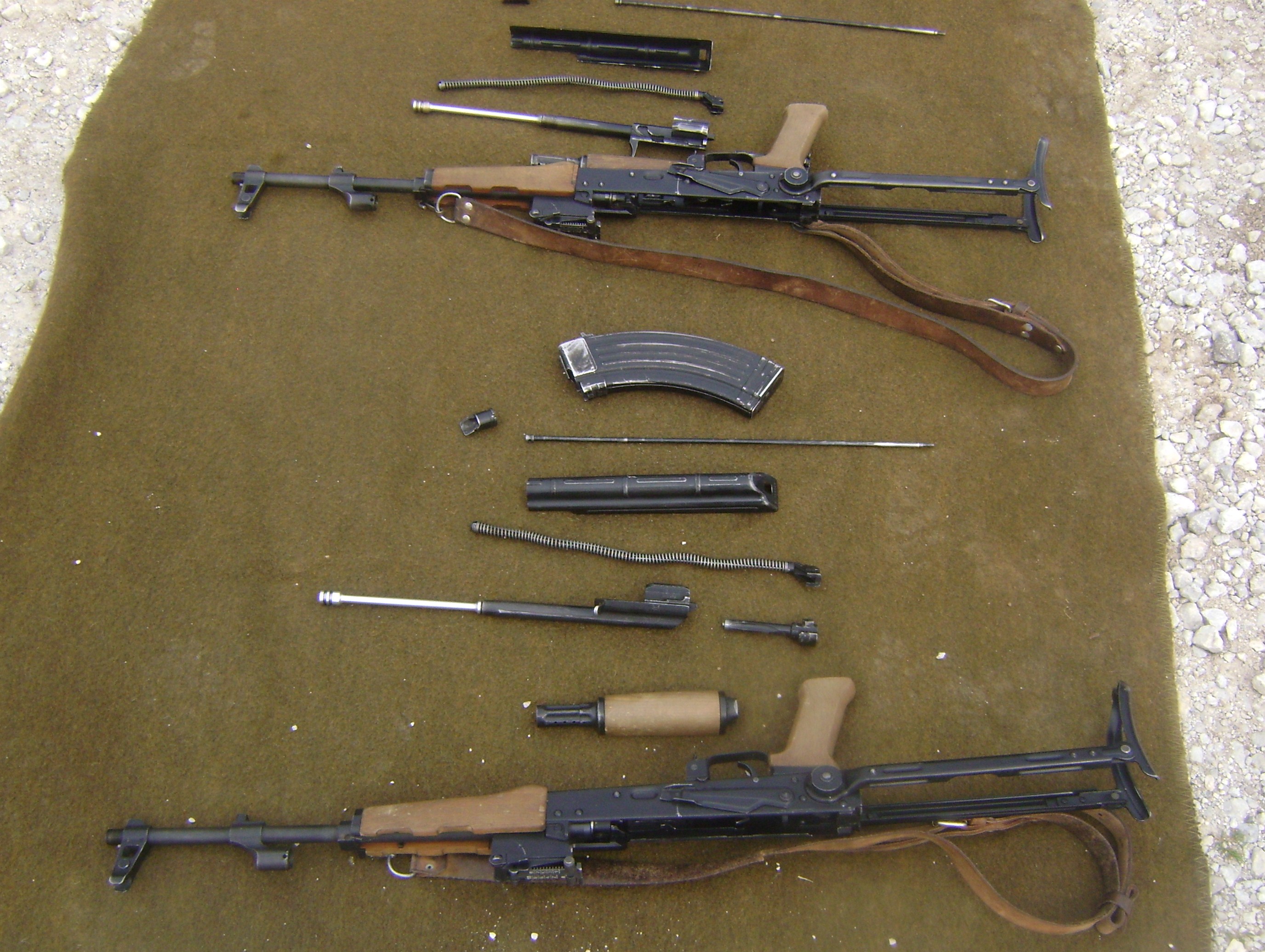
Barrel length, profile and muzzle threading vary by pattern and are worth measuring rather than estimating. So is the gas block: whether it is straight or angled, whether it carries a bayonet lug, and — the feature that matters most for one national family — whether it carries a gas cut-off valve and a folding grenade-launching sight. A rifle with a hinged ladder sight on the gas block is launching rifle grenades, and that points to Yugoslavia (Vol 11).
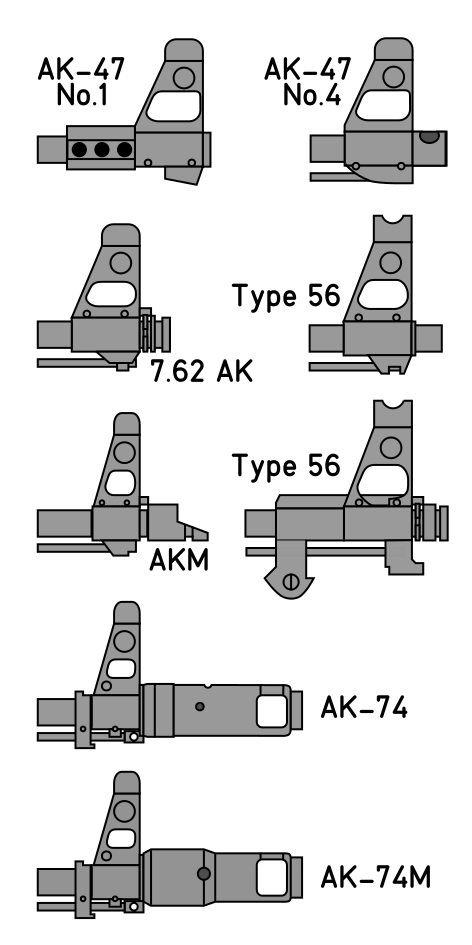
Chrome lining is frequently cited as a national tell. It is a real difference with real consequences for corrosion and for cleaning regimes, but it is not visible without looking down the bore in good light, and claims about which national patterns are lined are among the most confidently repeated and least well sourced in the literature. Where this arm makes such a claim it says what it rests on.
9.6 Furniture
Furniture is the first thing anyone notices and the last thing that should be trusted, because it is the easiest thing to change. It is still informative:
- Laminated birch in reddish-brown to blond, on most Soviet and Warsaw Pact rifles.
- AG-4 and similar moulded resin in plum, orange-brown or black on later Soviet production. This material is routinely called “bakelite” and mostly is not; it is generally a resin-impregnated fibre laminate.
- Pebble-grain plastic in a distinctive stippled brown, the hallmark of East German production (Vol 14).
- Perforated sheet-steel handguards on Hungarian rifles (Vol 14).
- A wooden vertical foregrip below the handguard on Romanian rifles (Vol 13).
Furniture answers “what was this fitted with when photographed,” which is a different question from “where was this made.”
9.7 What Identification Cannot Do
Three limits are worth stating plainly, because the identification literature tends not to.
Mixed rifles are normal, not anomalous. Soviet and Warsaw Pact arsenals refurbished rifles in bulk, replacing parts across serial numbers and refinishing what came back. A rifle with non-matching numbers is not necessarily a fake or a Frankenstein build; it may simply have been through an arsenal.
Parts-kit rifles are national mixtures by design and by law. An American-built rifle on a foreign kit is required to contain a minimum number of American parts (Vol 16). Reading its Romanian or Yugoslav parts as the identity of the rifle gets the answer exactly backwards.
“How to spot a fake” heuristics are not certainties. Much of what circulates — this rivet means that factory, this finish means that decade — is pattern-matching against small samples, repeated until it sounds like fact. Where a feature genuinely settles a question, this arm says so. Where identification is honestly ambiguous, it says that instead, and there is more of the second than the collector literature usually admits.
Comments (0)