The AK-47 · Volume 6
How It Works — Long-Stroke Piston, Rotating Bolt, Deliberate Slack
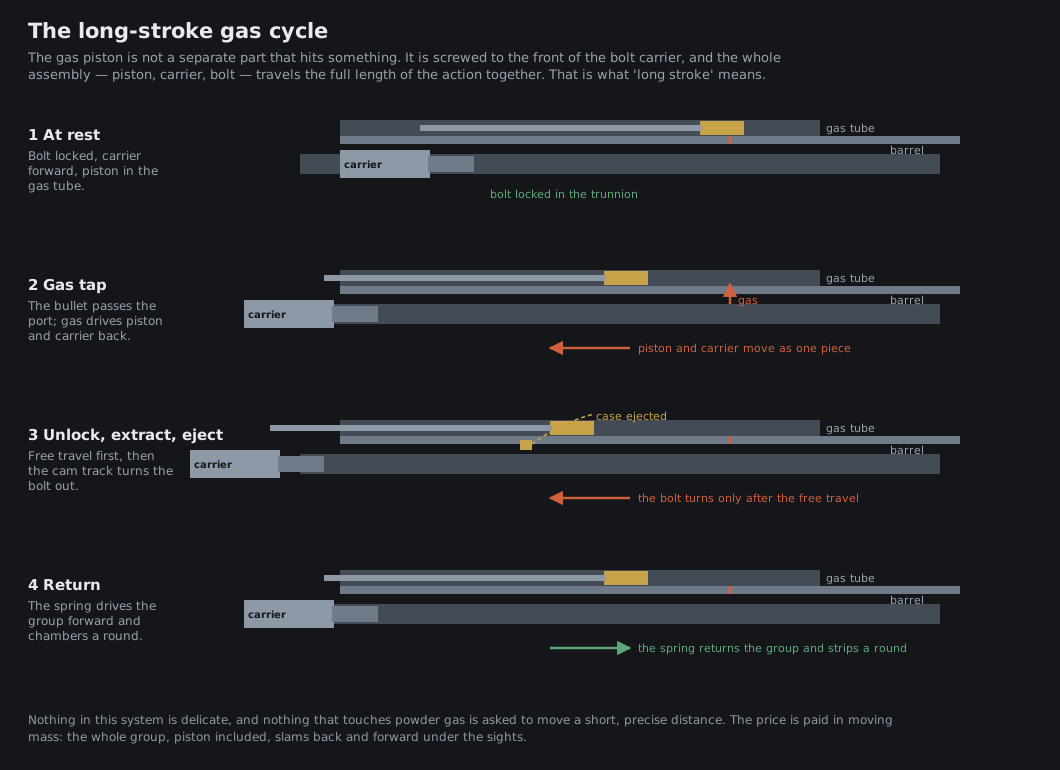
Mechanically the AK is three things and a decision. The three things are a long-stroke gas piston, a rotating bolt with two lugs, and a hammer-fired trigger group that drops out as a unit. The decision is to build all of them loose.
None of the three is original to Kalashnikov. What is original is the combination, and the willingness to give up precision in every one of them in exchange for tolerance of dirt.
6.1 The Gas System
Gas is tapped from the barrel through a port into a gas block partway along the barrel, angled rearward into the gas tube that sits above the barrel under the upper handguard.
Inside the tube is the gas piston, and the defining fact of the AK’s mechanism is that the piston is not a separate part that strikes something. It is screwed to the front of the bolt carrier and forms one rigid assembly with it. When gas drives the piston back, it is driving the carrier back; there is no intermediate rod, no separate operating spring for the piston, and no moment at which one part hits another.
That is what “long stroke” means: the piston travels the whole distance the carrier travels, roughly the full length of the receiver, and it goes all the way forward again with it.
The consequences are worth separating from the folklore.
What it genuinely buys. There is nothing to get out of alignment between piston and carrier because they are one part. The system develops a lot of force and applies it directly, which is useful for shoving a dirty bolt out of a dirty chamber. Gas relief holes — in the gas cylinder on the AK, moved to the gas block on the AKM — vent excess pressure so the system is not over-driven when fouled.
What it costs. The whole assembly is heavy and it moves the full length of the action twice per shot. A long-stroke system carries more reciprocating mass further than a short-stroke one, which is more disturbance to the sights during a burst and one of the reasons a short-stroke rifle like the SKS is measurably steadier. Volume 7 takes that up.
A note on a number that circulates freely: the AK’s gas port diameter is often quoted precisely, but armourers report a wide spread across factories — commonly somewhere in the range of about 0.128 to 0.177 inch depending on maker and pattern. No authoritative Soviet figure was located for this dive, and the port size quoted for one country’s production should not be assumed to apply to another’s. Treat any single figure as unconfirmed.
6.2 The Bolt
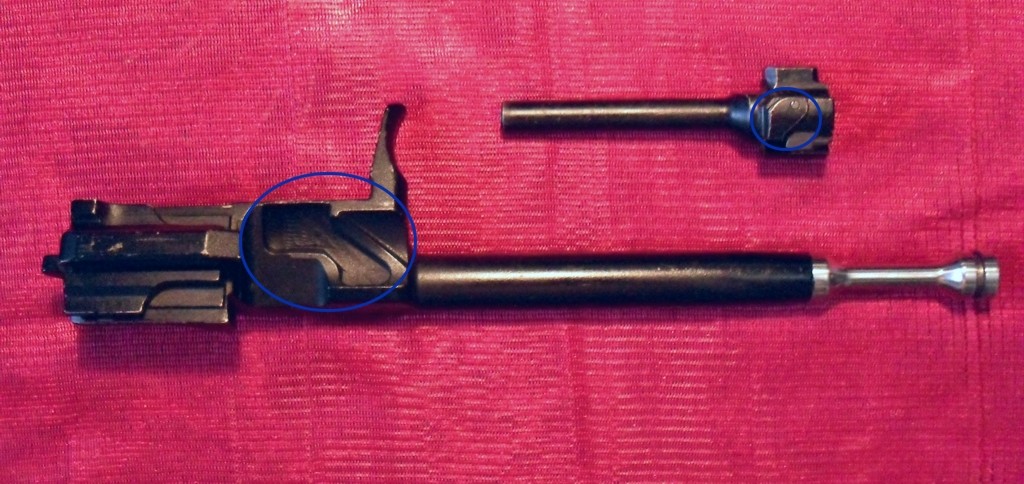
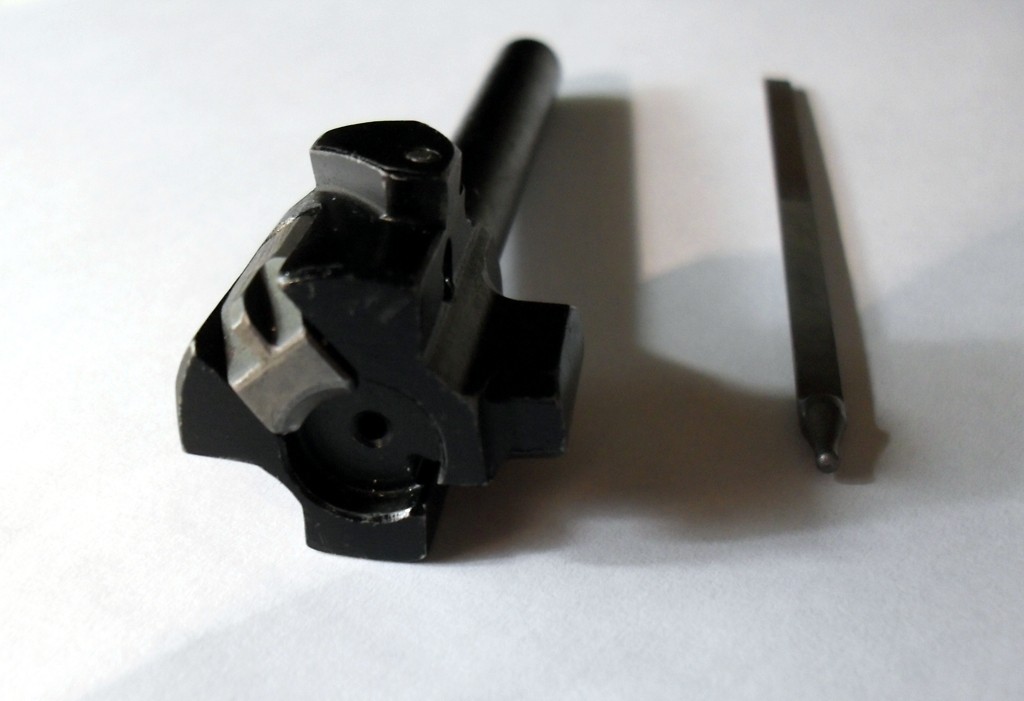
The bolt does not tilt, as the SKS’s does, and it does not have many small lugs, as an AR-15’s does. It has two large lugs and it rotates to lock them into a trunnion — on the milled rifle, a feature of the receiver itself; on the AKM, a separate trunnion riveted into the sheet shell.
Rotation is driven by a single cam pin on the bolt riding in a track milled into the underside of the bolt carrier. The track has a flat section followed by a ramp, and that shape is the rifle’s entire timing scheme.
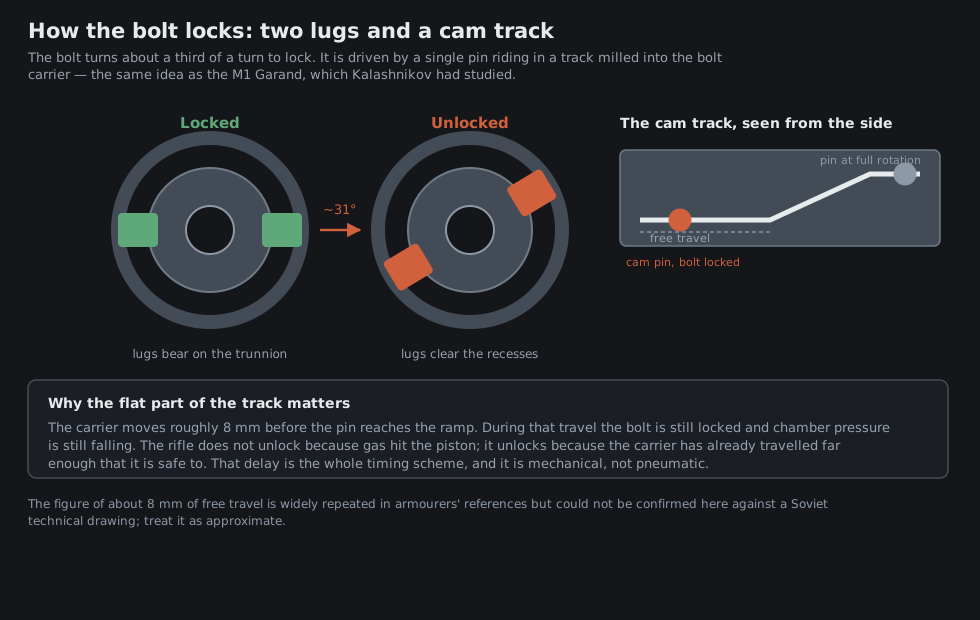
When gas drives the carrier back, the pin travels along the flat part of the track first. During that travel the bolt is still locked and chamber pressure is still falling. Only when the pin reaches the ramp does the bolt begin to rotate, and the carrier then drags the unlocked bolt rearward with it.
Two points follow, one mechanical and one conceptual.
Mechanically, the locking surfaces are enormous. Two lugs of that size bearing on a steel trunnion is an unsubtle solution with a great deal of margin in it, which is why the same architecture scaled happily to the RPK light machine gun and, in enlarged form, to the PK.
Conceptually, the rifle does not unlock because gas hit the piston. It unlocks because the carrier has already travelled a set distance. The delay is geometric, not pneumatic, and it is why a fouled gas system changes how hard the action is driven without changing when it unlocks.
The figure usually given for that free travel is about 8 mm. It is widely repeated in armourers’ references and could not be confirmed here against a Soviet technical drawing; it is quoted as approximate.
6.3 The Trigger Group and the Safety
The trigger group is a conventional hammer, sear and disconnector arrangement, and on the AKM it gains the retarder described in Volume 5.
The safety selector is the single most-criticised and most-underrated control on the rifle. It is a long stamped lever on the right side, moved with the firing hand, noisy, and requiring the shooter to break grip. Those complaints are all fair.
What it also does is close the charging-handle slot. In its uppermost position the lever covers the long opening in the right side of the receiver through which the charging handle protrudes — the largest single ingress path into the action. The lever is a dust cover that happens to be the safety, which is exactly the kind of doubled-up, no-extra-parts thinking that runs through the whole rifle.
Its three positions, from top: safe, automatic, single. The order surprises Western shooters, who expect semi-automatic before automatic. The Soviet logic was that the position a soldier most needs to find without looking — and cannot select by accident when sweeping the lever all the way down — is single shot.
6.4 The Deliberate Slack
“Loose tolerances” is the phrase always used about the AK, and it is imprecise in a way that matters.
The rifle is not built carelessly. Its critical dimensions — headspace, bore, the locking lug bearing surfaces, the trunnion location — are controlled. What is deliberately generous is the clearance in the parts that have to move past each other while dirty:
- The bolt carrier rides on narrow rails with small bearing area, rather than in a close-fitting tube. Small bearing surfaces are self-clearing; debris is pushed aside rather than accumulated in a race.
- There is real clearance between the carrier and the receiver walls, so a layer of fouling does not bind the group.
- The magazine is not a precision fit either. It rocks into a front catch and locks at the rear, and it is held by steel-on-steel engagement rather than by a close fit in a magazine well.
Reported factory variation in non-critical dimensions runs to the order of fifteen thousandths of an inch across parts and makers — a figure from armourers’ practice rather than from a Soviet standard, and one that varies by factory, so it is offered as an indication rather than a specification.
The right way to state the design philosophy is therefore not “the AK is built loosely”. It is that the AK is built with clearance where clearance buys dirt tolerance, and with control where control buys function — and that it accepts the accuracy cost of the first without much argument.
6.5 What the Top Cover Is Not
One structural point is worth isolating because it explains a great deal about the rifle’s accessories.
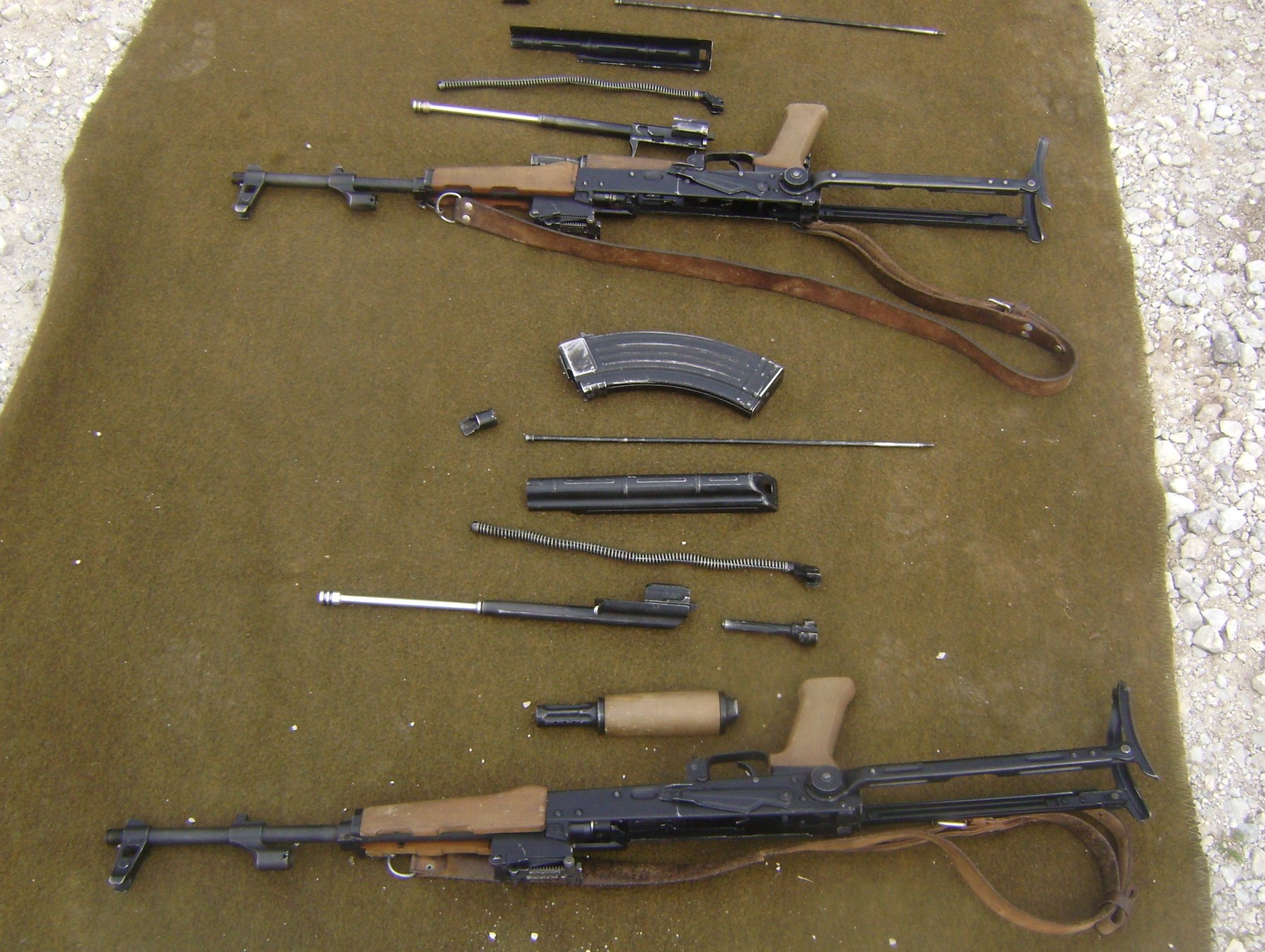
The AK’s top cover is a stamped lid. It is not a stressed part, it is not indexed precisely to the receiver, and it comes off every time the rifle is cleaned. That is why the rear sight is mounted on the barrel’s rear sight block and not on the cover, and it is why every attempt to mount an optic on a standard AK top cover produces a zero that will not survive disassembly.
It is also why the serious optic mounting solution on an AK is a side rail riveted to the left side of the receiver — a fixture on a part that does not move — rather than anything attached to the lid. The mechanism dictates the accessory, seventy years later.
Comments (0)