The AK-47 · Volume 15
The Rest of the World
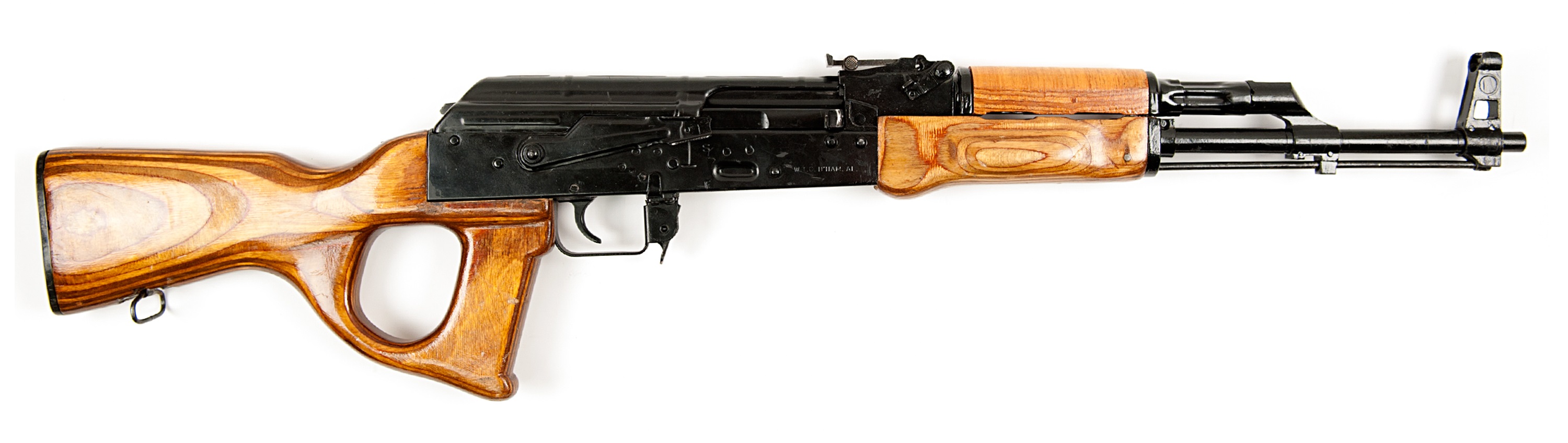
The Kalashnikov was built under licence, without licence, and by reverse-engineering, in more countries than any other modern service rifle. This volume takes four producers that matter for identification and two that are usually miscategorised. The four are Egypt, Iraq, North Korea and — through the previous volumes’ national patterns — the wider export trade. The two are Finland and Israel, which are not AKs and are constantly described as though they were.
15.1 Egypt: Maadi and Factory 54
Egyptian production ran at Factory 54 of the Maadi Company for Engineering Industries, in Cairo. Kalashnikov production is dated from 1959, with Soviet technical assistance: Soviet blueprints, Soviet tooling, and Egyptian engineers trained in the Soviet Union.
That relationship ended abruptly in 1972, when Soviet advisers were expelled. The tooling and the trained workforce stayed, and production continued without them — which is the reason Egyptian rifles are frequently described as among the closest things to a genuine Soviet AKM produced outside the Eastern Bloc, and are praised particularly for their barrels. As with the Bulgarian reputation in Vol 13, this is a strong and consistent market judgement rather than a measured result, and is recorded as such.
The service designation is the ARM — Automatic Rifle Misr, Misr being Egypt. Egyptian rifles reached the United States early and in quantity as the Maadi ARM and RML, and have a fair claim to being the first Kalashnikovs widely available to American buyers.
Reporting indicates that Factory 54 closed in 2024, ending seventy years of arms production. That report comes from the collector press and is recorded here as unconfirmed.
15.2 Iraq: Tabuk — a Yugoslav Rifle in Arabic
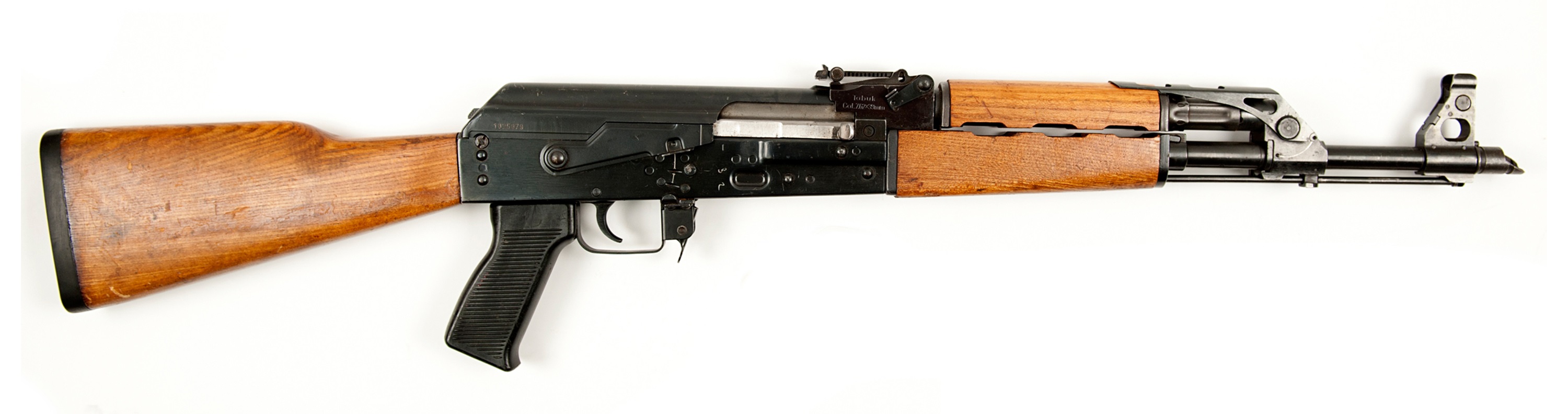
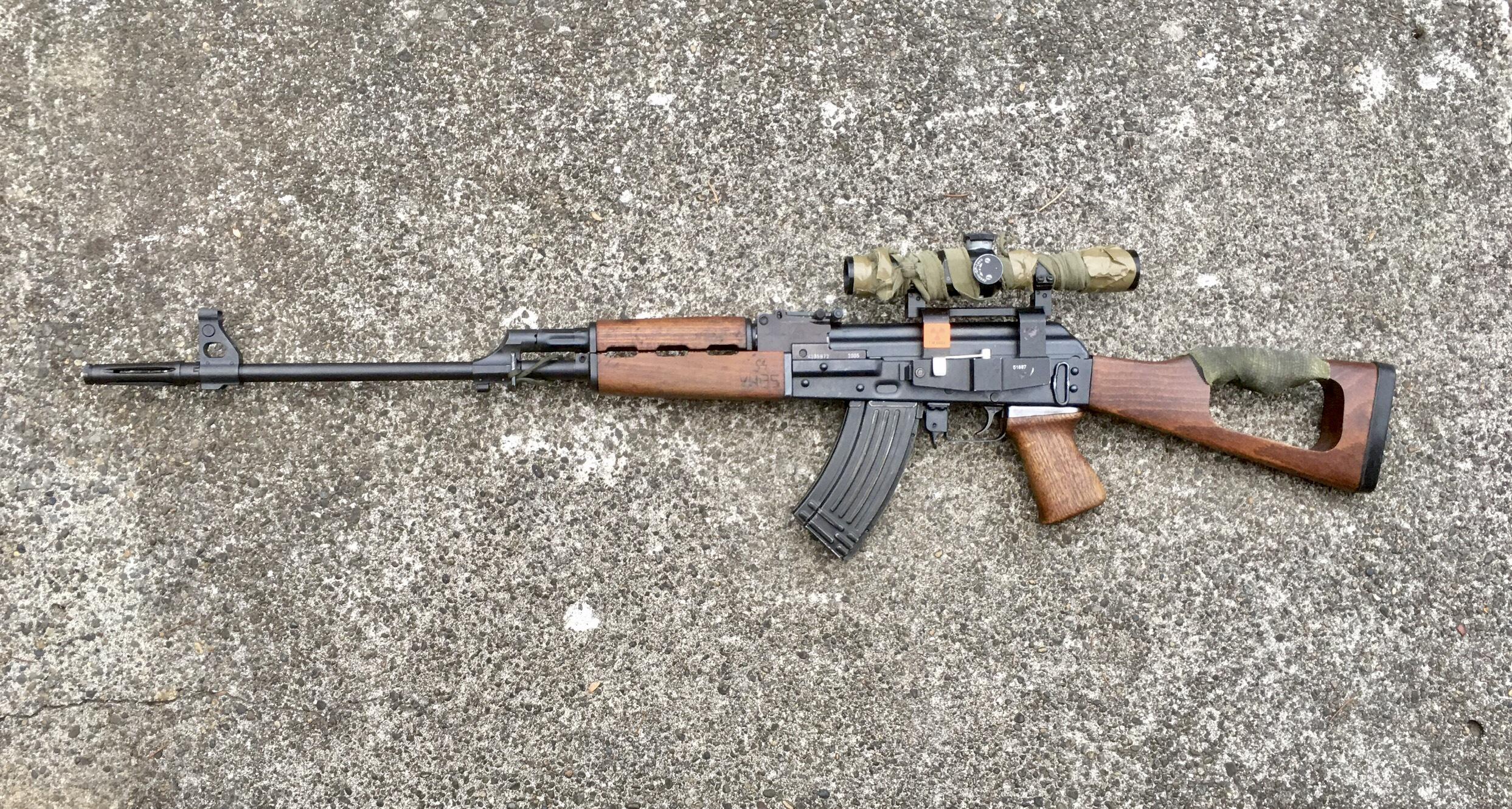
The Iraqi Tabuk is the best illustration in this arm of why national origin and design pattern are different questions.
Tabuk rifles were produced at the Al-Qadissiya Establishments on machinery sold to Iraq by Zastava Arms of Yugoslavia. Accounts date the agreement to 1979, with a plant built by 1980 south of Baghdad. The rifles that came off that tooling are, in the words of one account, exact copies of the Yugoslav M70B1 — which means an Iraqi Tabuk carries the Yugoslav design features of Vol 11, including the reinforced receiver and the bulged RPK-pattern trunnion, because it is a Yugoslav design built in Iraq.
The Tabuk designated marksman’s rifle — routinely and misleadingly called a sniper rifle — is the same lineage with a longer and thinner barrel, reported at about 23.6 inches. It is a long-barrelled, scoped M70 derivative and it is not a Dragunov, despite being described as one constantly. The two are unrelated designs that happen to occupy the same role.
The practical identification point: a rifle with Yugoslav structural features and Arabic markings is likely Iraqi, not Yugoslav. Reading the trunnion alone gets this one wrong.
15.3 North Korea: Type 58 and Type 68
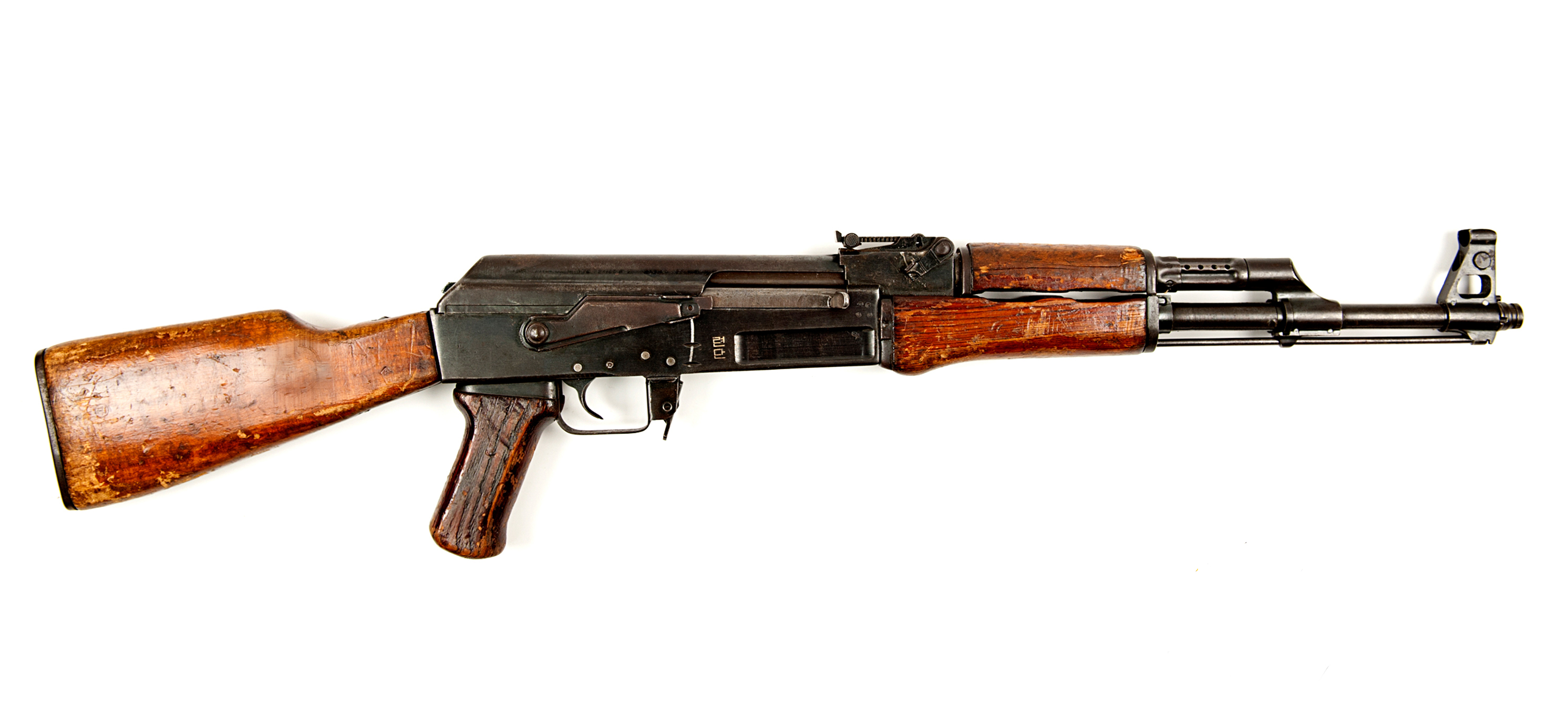
North Korean production follows the Soviet two-generation pattern exactly:
- The Type 58 is the milled rifle, a copy of the Soviet milled pattern.
- The Type 68 is the stamped rifle, following the AKM, with conversion beginning in 1968.
Markings are the identification. Type 58 receivers carry a North Korean star, the expression “58 Type” and a serial number; Type 68 markings are described as a five-pointed star within a circle with “Type 68” in hangul. A further distinction is reported between domestic and export rifles: domestic Type 58 markings show an upright circled star with the Hangul “Type-58”, while export rifles carry a circled star that is not upright and omit the model expression.
Two mechanical details make the Type 68 more than a relabelled AKM, and they are the most interesting thing about North Korean production:
- The Type 68 trigger group omits the Soviet hammer-delay components. The AKM’s rate-reducing delay mechanism is simply not there.
- The trip sear is a sheet-metal stamping, and the trigger is the earlier double-hook design associated with milled-receiver rifles rather than the AKM’s.
So the Type 68 is an AKM-pattern rifle carrying an older fire-control architecture — a combination that does not occur in Soviet production and that would confuse anyone identifying the rifle from its internals alone. A further and more minor tell is a roller on the sling swivel, reported as common on Type 68s and not on Type 58s.
North Korean rifles are effectively absent from the American civilian market, which means most readers will meet them only in photographs and in captured-weapons displays. Identification claims about them are correspondingly harder to check.
15.4 Finland and Israel: Cousins, Not Kalashnikovs
The last two are in this volume to be excluded from the rest of it.
15.4.1 Rk 62 and the Valmet Rifles
Finland bought a licence for the milled AK-47 and developed its own rifle from it. Prototypes designated Rk 60 went to trials in 1960; the Rk 62 — built by Valmet, hence the export name Valmet M62 — followed.
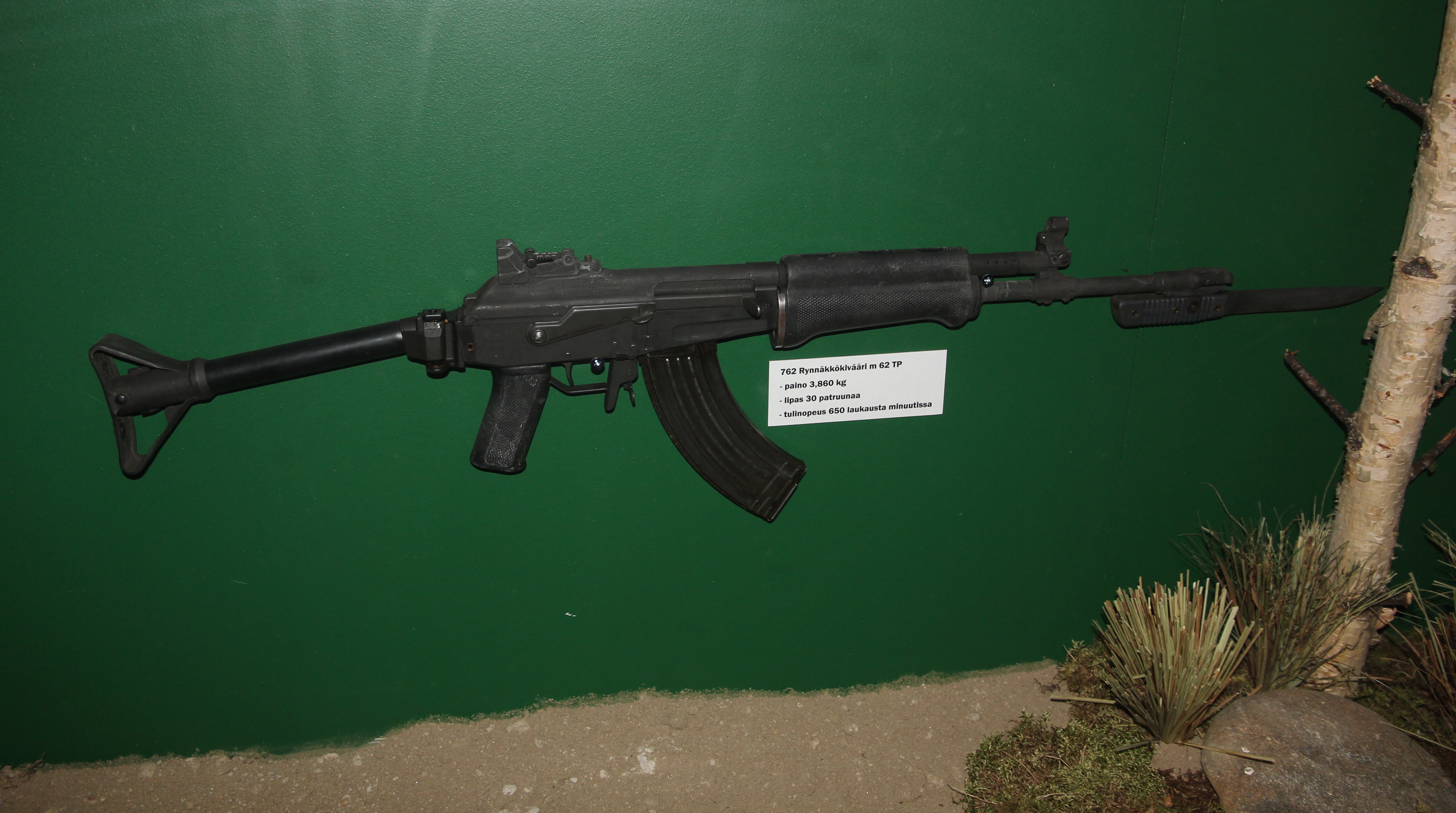
Mechanically it is a Kalashnikov: long-stroke piston, rotating bolt, the same cycle. Externally it is a different rifle. The milled receiver was retained long after the Soviets went to stamping, and is credited with greater rigidity and better accuracy at a cost in weight. The buttstock is a distinctive T-shaped tube, there is no conventional wooden handguard, and the sights are Finnish rather than Soviet. The Rk 76 is the stamped-receiver development, which shed a great deal of that weight.
The Finnish rifles are best understood as a Kalashnikov action rebuilt to a different standard for a different army, not as an AK variant in the sense that the rifles in Vols 10–14 are variants.
15.4.2 The Galil
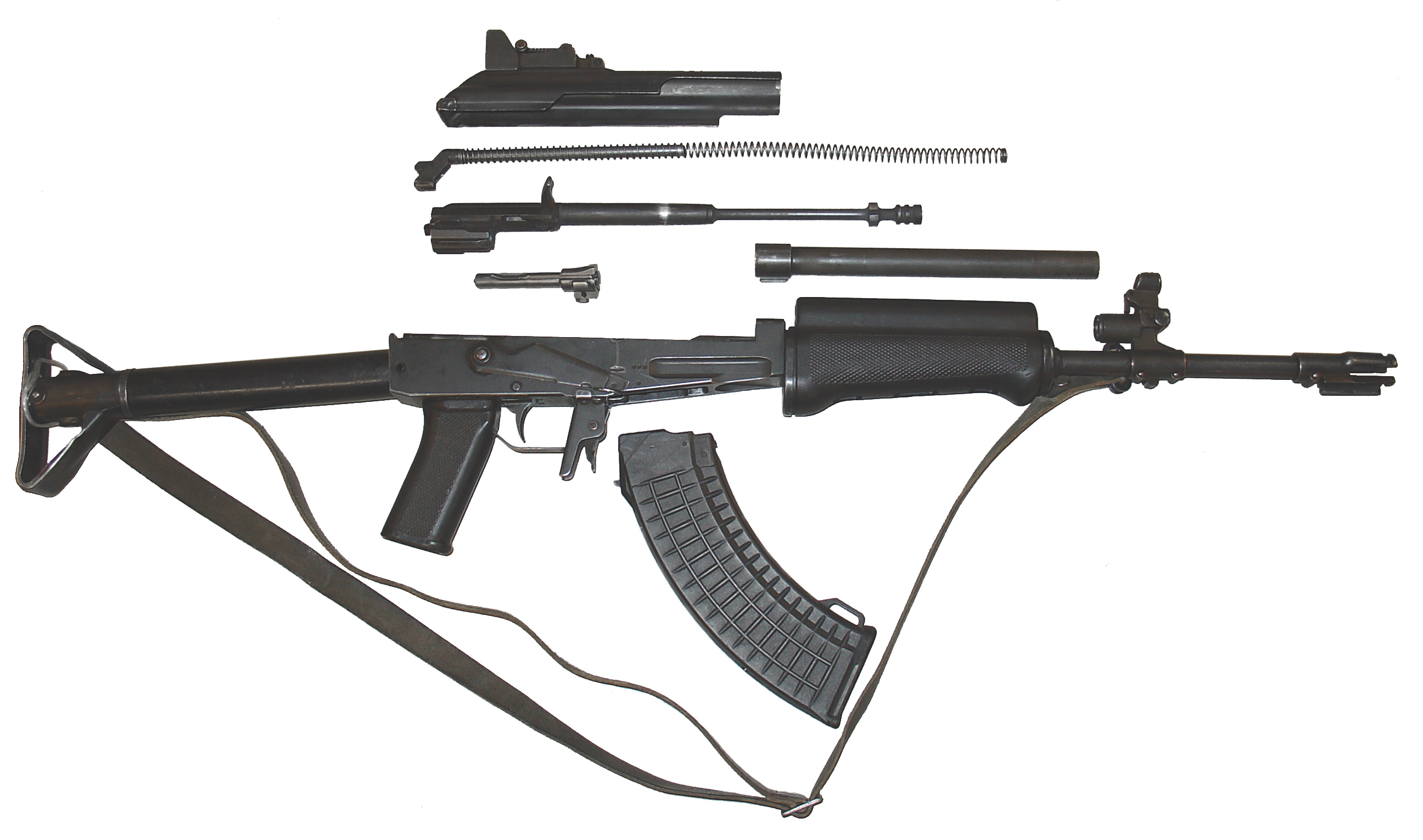
The Israeli Galil is a step further out, and its descent is specific and documented: it was designed on the basis of the Valmet, not directly on the Soviet rifle. Early prototypes were built using Rk 62 receivers and Finnish tooling, and the production rifle kept the milled receiver, the long-stroke piston and the rotating bolt.
The Galil is therefore a grandchild of the Kalashnikov by way of Finland, chambered primarily in 5.56×45 and configured to Israeli requirements. Calling it “an Israeli AK” is not quite wrong and is not useful: it obscures the actual line of descent, which runs Izhevsk → Finland → Israel and not Izhevsk → Israel.
15.5 What This Volume Is Not
This is a survey of producers that matter for identification, not a complete list of them. Kalashnikovs have been made or assembled in a great many further countries, and rifles from those programmes routinely appear in photographs mislabelled as Soviet or Chinese. Where a rifle cannot be placed from its markings and its structure, the correct answer is that it cannot be placed — which is the position Vol 9 takes and the one this arm returns to whenever the evidence runs out.
Comments (0)