The AK-47 · Volume 20
Headspace — Set It First, and Use CIP Gauges
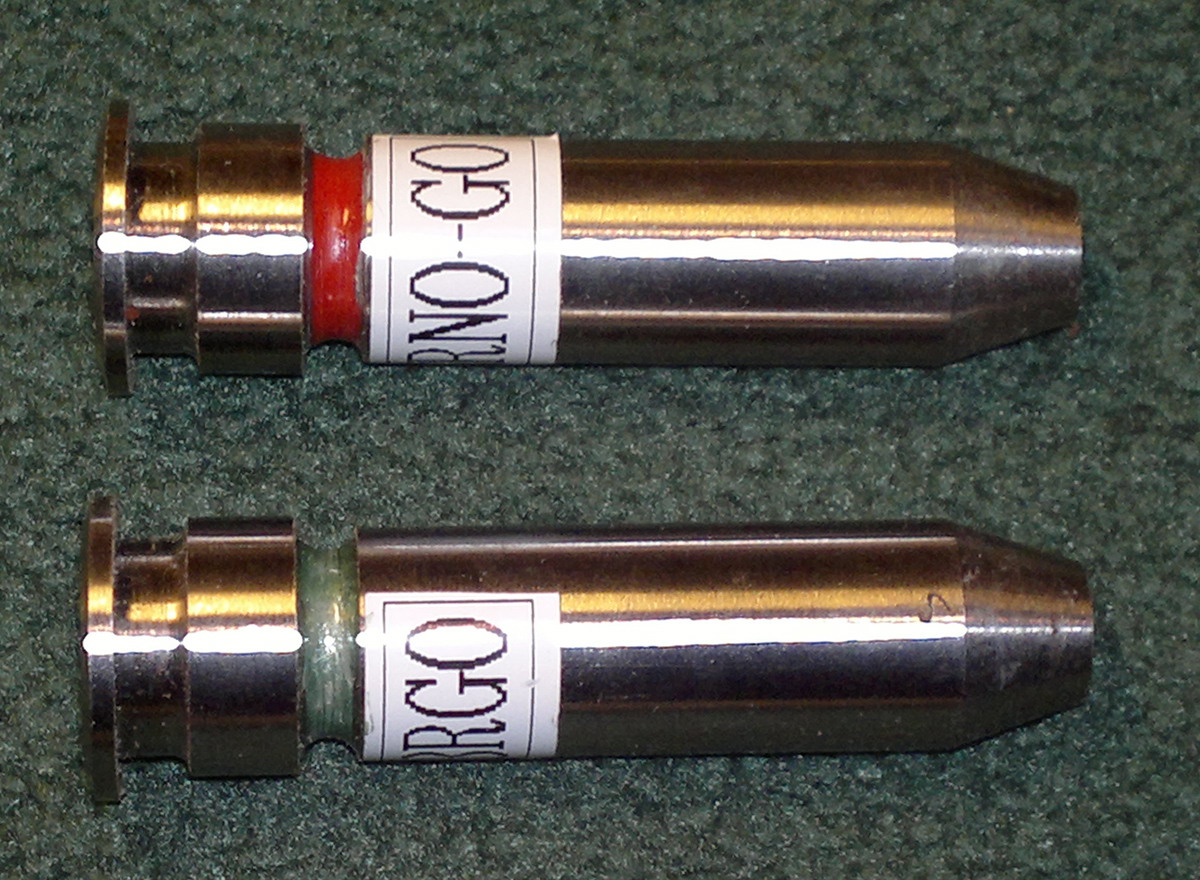
Headspace is the first thing decided on this build and the last thing checked, and everything mechanical in Vols 21 to 23 is located from it. That ordering is not a preference. The barrel’s final axial position in the receiver is whatever position produces correct headspace, and the cross-pin hole is drilled after that position is found — so the pin hole cannot be a fixed distance from anything. It is a consequence of a measurement that has not been taken yet.
20.1 What Is Being Measured
The 7.62×39 cartridge is a rimless bottleneck case, so it locates in the chamber on its shoulder. Headspace is the distance from the bolt face to a datum point on the chamber shoulder, and a gauge is a steel dummy cut to a specified length at that datum. Too short a chamber and the bolt will not close on a correctly made cartridge. Too long, and the case is unsupported at the head: it stretches on firing, which at best shortens case life and at worst separates the case and vents gas into the action.
The usable band between those two failures is about four thousandths of an inch wide.
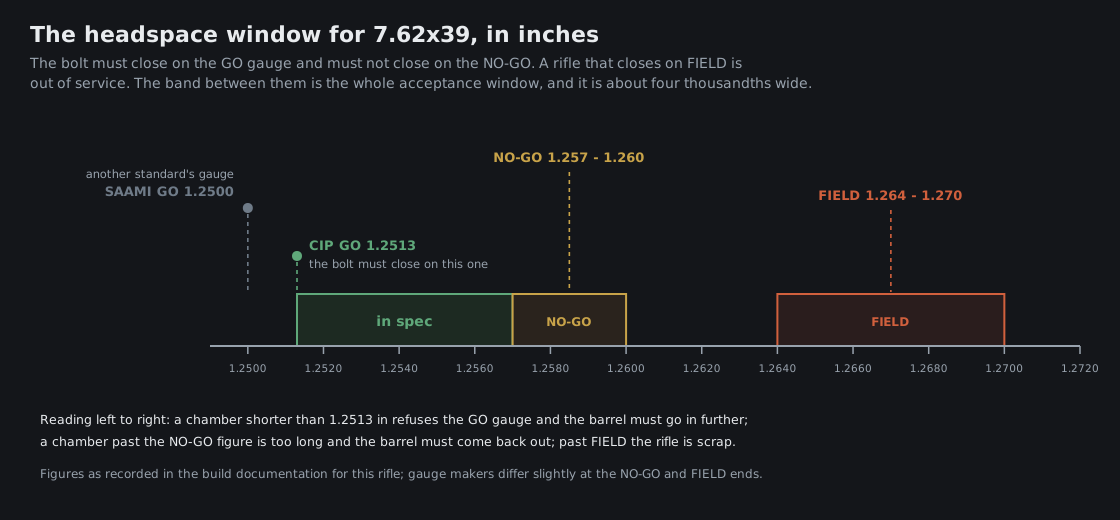
Table 1 — What Is Being Measured
| Gauge | Figure | Required result | If it fails |
|---|---|---|---|
| GO | 1.2513 in | The bolt must close | Press the barrel further in |
| NO-GO | about 1.257 – 1.260 in | The bolt must not close | Back the barrel out slightly |
| FIELD | about 1.264 – 1.270 in | The bolt must not close | The rifle is not serviceable |
The NO-GO and FIELD figures are given as ranges because gauge makers differ slightly at those ends. The GO figure is the one that matters most on a build, because it is the one the barrel is pressed to.
20.2 Why CIP Gauges and Not SAAMI
This is the single most consequential paragraph in the volume, so it is worth being exact about the mechanism rather than repeating the slogan.
AK-pattern rifles and their barrels are made to CIP specification — the European standard — and not to SAAMI, the American one. The two organisations specify the 7.62×39 chamber differently, and gauges are made to match their own standard. Using the wrong standard’s gauge on a correctly made chamber produces a false verdict.
The difference is usually quoted as a length: a CIP GO gauge for 7.62×39 is 1.2513 in, and the SAAMI figure quoted in the build documentation for this rifle is 1.2500 in. Length alone does not explain a false failure, because a shorter GO gauge should be easier for the bolt to close on, not harder. The explanation is in the second dimension, and it is the one the length-only framing leaves out: the two standards specify different shoulder angles. Figures circulated among AK builders put the CIP chamber shoulder at about 16° 42′ against SAAMI’s 17° 30′, with the CIP GO gauge referenced to a 0.3622 in datum diameter and the SAAMI gauge quoted nearer 1.252 in overall.
The consequence follows from the geometry. A SAAMI gauge, cut with a steeper shoulder, will not seat fully into the shallower CIP chamber. It stops on the shoulder cone before it is home, stands proud of where it should be, and the bolt does not close — on a rifle whose headspace is correct. A CIP gauge in a SAAMI chamber does the opposite: it sinks in further than it should and reads as excessive headspace on a chamber that is fine.
So the rule is not arbitrary and it is not about a thousandth of an inch of length:
A gauge and a chamber must come from the same standard, because they disagree about the shape of the shoulder as well as the distance to it.
Two honest caveats belong with that. First, the exact SAAMI figure differs between sources — the build documentation records 1.2500 in, while gauge-maker figures quoted in the AK community give 1.252 in — and this dive has not resolved the discrepancy against either standards body’s own published drawing. Second, the shoulder-angle figures above come from builder and gauge-maker discussion rather than from the standards themselves. Neither caveat changes the operating instruction, which depends only on the fact that the standards differ: use CIP gauges on this rifle.
20.3 The Procedure
- Strip the rifle to the bare receiver and barrel. Gas tube off, bolt carrier and bolt available but out of the receiver. The bolt has to be free to close under its own weight, with nothing else in the action influencing it.
- Insert the GO gauge into the chamber from the breech end.
- Lower the bolt and carrier onto it. The bolt must close freely — not forced, not helped, not persuaded with the carrier. If it will not close, the barrel is not far enough in; press further and test again.
- Remove the GO gauge and insert the NO-GO. The bolt must not close. If it does, the barrel has gone too far and must be backed out.
- When both tests pass, the barrel is at its final position. It does not move again.
The force question in step 3 is not fussiness. Headspace gauging is a go/no-go judgement made by feel, and a bolt that can be made to close with pressure is a bolt that has not closed. Any consistent extra force applied to the carrier makes an out-of-spec chamber read as in-spec, which is the exact error the gauge exists to prevent.
20.4 Why It Is Set First, and How the Barrel Gets There
The press-in is deliberately convergent. The barrel is pressed in small increments — on the order of 0.100 in — and headspace is checked between them, because the press can always take the barrel further in and cannot take it back out. The one movement that is difficult to undo is the last hundredth of an inch of an over-press, and recovering from it requires the back-out tool described in Vol 19: threaded into the muzzle, pulling the barrel back out against a brass face.
The specific instruction from the build documentation is worth quoting in substance: do not let the barrel shoulder bottom against the receiver face before headspace has been confirmed. Bottoming the shoulder removes the adjustment and leaves whatever headspace the stack of tolerances happens to produce.
Once both gauges give the right answer, the barrel’s axial position is fixed, and it becomes the reference for everything that follows. Vol 22’s X-axis measurement — the position of the cross-pin hole along the barrel — is taken from the journal shoulder in the position headspace put it in. A different amount of pressing means a different pin hole position. There is no standard dimension to copy, and that is a direct consequence of doing this step first and properly.
Sources
- The builder’s project notes and build reference for this rifle: CIP GO, NO-GO and FIELD figures, press-and-check procedure, back-out tool.
- CIP and SAAMI maximum-pressure figures for 7.62×39, used in Vol 23: 355.0 MPa and 310.3 MPa respectively.
- Gauge dimensions and shoulder-angle figures as discussed by AK builders and gauge makers; flagged above as unverified against the standards bodies’ own drawings.
Comments (0)