The AK-47 · Volume 18
Receiver Choice — Milled, and Why That Changes Everything Downstream
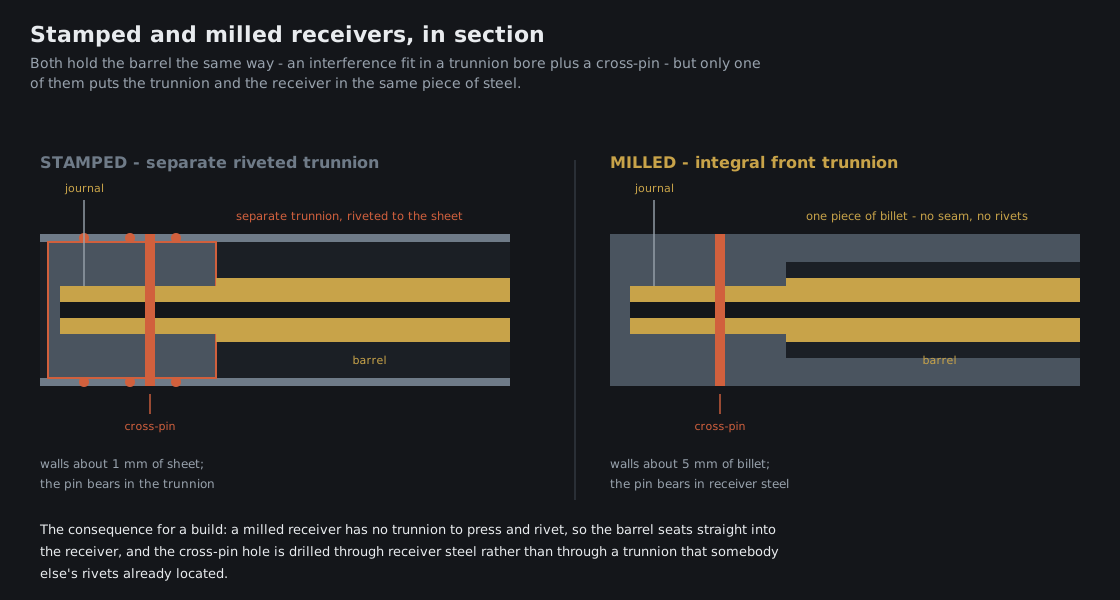
The AK was designed twice: once as a machined rifle and once as a pressed one, and the second design is the one that won. Vols 1 to 8 tell that story properly — the Type 1 stamped receiver that failed in production, the milled Type 2 and Type 3 that carried the rifle through the 1950s, and the AKM that finally made stamping work in 1959. What matters for a build is that both patterns are still made, that the choice between them is available at the point of buying a receiver, and that the choice determines the next four volumes of work.
The build documented here uses a milled receiver with an integral front trunnion, in the Yugoslav M70 pattern, for an underfolder rifle in 7.62×39. Vol 11 covers the M70 family as rifles. This volume covers what the receiver is, dimensionally, and what follows from it on the bench.
18.1 What “Integral Trunnion” Actually Means
On a stamped rifle the receiver is a folded sheet-steel box, on the order of a millimetre thick. Sheet that thin cannot hold a barrel: there is no material to bore a press-fit socket into and nothing to take the cross-pin. So a stamped rifle carries a separate front trunnion — a solid block, machined with the barrel socket and the locking recesses, dropped into the front of the sheet and fixed there with rivets. The trunnion is the structure; the sheet is the skin around it.
A milled receiver is cut from a single piece of steel, and the front of that piece is the trunnion. Nothing is riveted, nothing is pressed in, and there is no seam between the part that holds the barrel and the part that holds everything else.
The consequences are immediate and they are not all in the milled receiver’s favour:
- Weight. A milled AK receiver is substantially heavier than a stamped one with its trunnion. This is the reason the Soviets abandoned milling in the first place.
- Cost and material. Most of the billet becomes chips.
- No riveting. For a builder this is the large one. A stamped build requires a riveting jig, correctly formed rivets, and a trunnion located square in a flexible sheet box. A milled build requires none of it.
- Bearing. The barrel cross-pin passes through five millimetres or so of solid receiver steel on each side, rather than through a trunnion that is itself held in sheet.
- Nothing to locate from. This one cuts the other way, and Vol 22 is largely about it. On a rebuild where the trunnion carries factory holes, those holes locate the pin. A milled receiver with no cross-hole offers no such reference.
18.2 The Receiver Documented Here
The receiver used on this build is a commercially made milled M70-pattern receiver with the front trunnion integral, set up for the underfolding stock. The dimensions that matter for everything downstream, as recorded in the build documentation for this rifle:
Table 1 — The receiver used on this build is a commercially made milled M70-pattern receiver with the front trunnion integral, set up for the underfolding stock. The dimensions that matter for everything downstream, as recorded in the build documentation for this rifle
| Feature | Figure | Why it matters |
|---|---|---|
| Trunnion bore diameter | about 23 mm (0.906 in) | The socket the barrel journal presses into |
| Barrel journal length | about 42.65 mm (1.68 in) | Sets where along the barrel the cross-pin can land |
| Barrel-to-bore interference | 0.0005 – 0.001 in | The press fit; measured on both parts before pressing |
| Cross-pin hole | none, as delivered | Both trunnion walls are solid; see Vol 22 |
| Pattern | Yugoslav M70, underfolder | Determines pin diameter and component fit |
The interference figure is worth reading twice, because it is the whole retention scheme. Five ten-thousandths to one thousandth of an inch of interference across a journal 23 mm in diameter and 42.65 mm long is what holds the barrel in the rifle. The cross-pin discussed in Vols 22 and 23 is a backstop, not the primary retention.
18.3 Why a Yugoslav Milled Pattern Is Not Just a Milled AK
Three pattern-specific differences carry through into the machining volumes, and mixing them up with standard AKM practice is the most likely way to get a dimension wrong.
The barrel pin is 0.277 in (7.04 mm), not the AKM’s 0.278 in. A thousandth of an inch sounds like nothing. On an interference fit it is most of the interference: the pin is held by 0.001 to 0.0015 in of interference in a 7.00 mm reamed hole, so an error of a thousandth in the pin’s diameter is the difference between a press fit and a slip fit, or between a press fit and a split trunnion wall. Vol 22 works this through.
The handguard retainer is trapped. On this pattern the handguard retainer band is a plain sliding band with no pin, and it goes onto the barrel from the chamber end. Once the gas block is pressed on, the band cannot pass it. Vol 21 is about the build order this forces.
The rifle is an underfolder. The stock pivots from the rear of the receiver rather than socketing into it, which is a receiver-pattern decision rather than a barrel one, but it means the rear trunnion and the receiver were bought as one decision along with everything above.
There is also a family resemblance worth stating precisely, because it is frequently overstated: the Yugoslav rifles were built with heavier front-end structure than a standard AKM, associated with the rifle-grenade role the M70 family was designed for. The comparison belongs to Vol 11, and the figures there should be preferred over any impression formed from handling a receiver. What can be said from the bench is narrower and sufficient: this receiver’s trunnion bore, journal length and pin diameter are its own, they were measured, and they are the numbers the rest of these volumes use.
18.4 What the Receiver Decides
Reading forward, the receiver choice has already settled most of the remaining questions:
- There is no riveting, no trunnion alignment jig and no sheet-metal work anywhere in this build. Vol 19’s tooling list is a machining list, not a sheet-metal list.
- The barrel goes directly into the receiver, so headspace is set by how far the barrel is pressed into the receiver itself — Vol 20.
- Everything that goes onto the barrel has to be on it before the press-in, because afterwards there is a receiver in the way — Vol 21.
- The cross-pin hole has to be created from nothing, in both receiver walls, with the barrel already pressed and headspaced — Vol 22, which is the hardest operation in the build and the only irreversible one.
- And the question of what the pin actually engages in the barrel — a groove, or a hole through the journal — turns out to be the one place where the build’s own source documents disagree with each other. Vol 23 works out which one the geometry permits.
Sources
- The builder’s project notes and build reference for this rifle: receiver type, trunnion bore, journal length, interference band, pin specification.
- Vol 11 of this dive for the Yugoslav M70 family; Vols 1 to 8 for the milled-to-stamped production history.
Comments (0)