The AK-47 · Volume 5
The AKM (1959) — The Rifle Everyone Means
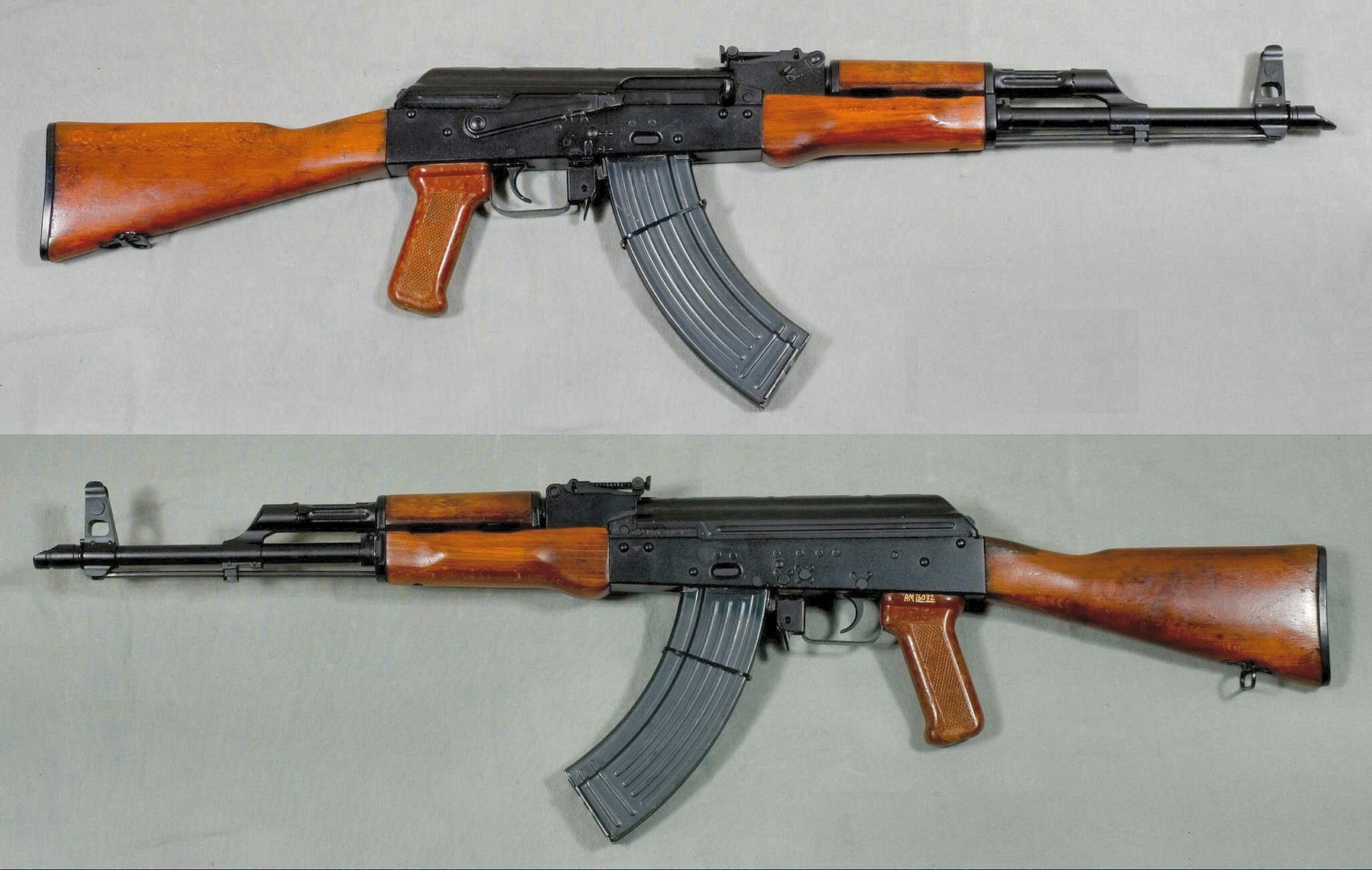
The AKM is the most consequential weapon in this dive and it is usually treated as a detail. The name says “modernised” — Avtomat Kalashnikova Modernizirovanniy — which sounds like a product refresh. It is not. It is the version that made the design manufacturable at the scale the world associates with it, and around ten and a quarter million were built in the Soviet Union alone, against a milled AK production that was a fraction of that.
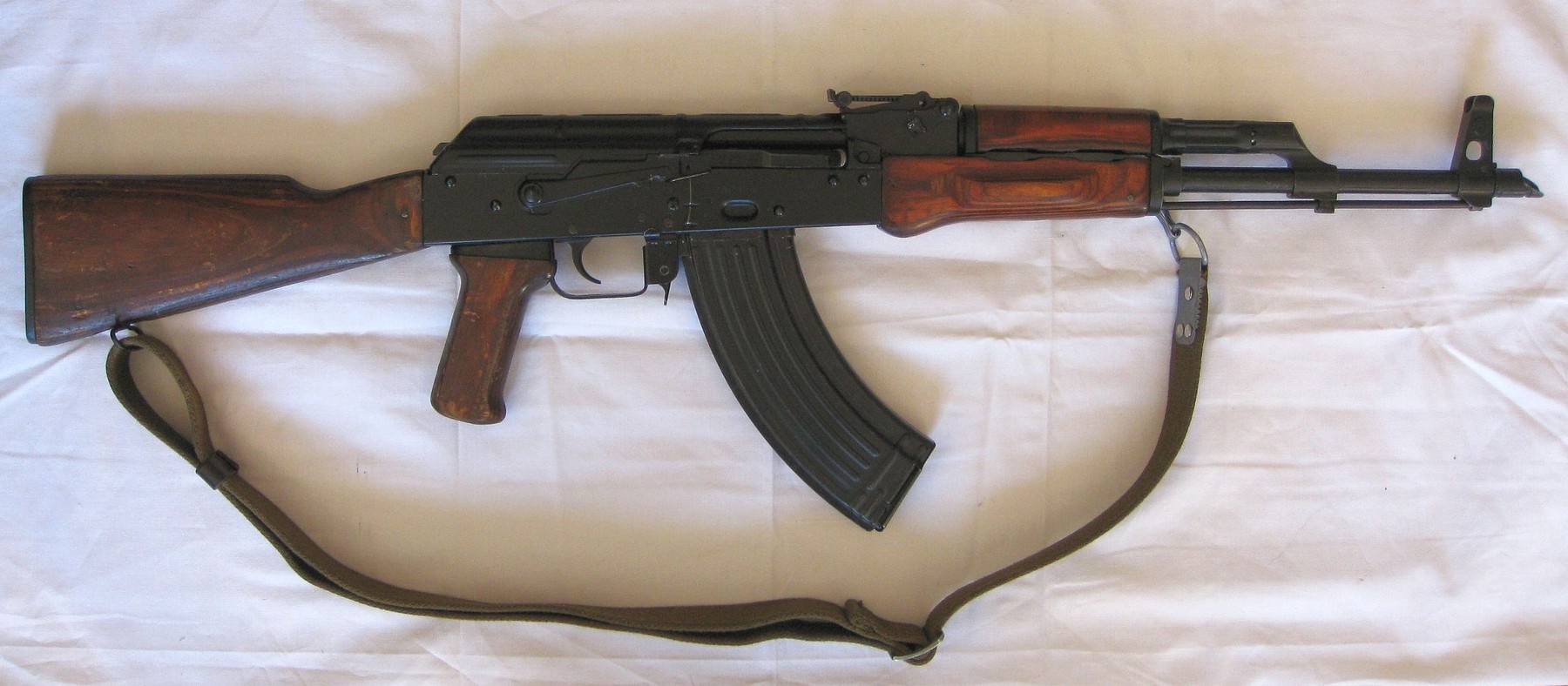
If a rifle in a photograph has a slanted muzzle device and a riveted sheet receiver, it is an AKM or a derivative of one, and the great majority of rifles labelled AK-47 anywhere are exactly that.
5.1 The Receiver, Again
The central change is the one Volume 4 set up: the receiver goes back to being stamped from 1 mm sheet steel, with the front barrel trunnion and rear stock trunnion riveted into the U-shaped shell.
What made it work this time was not a new idea. It was better sheet steel, better presses, reinforcing ribs pressed into the receiver walls in both directions, and rails that are riveted rather than welded in. The barrel is now pinned into the front trunnion rather than screwed directly into the receiver as it was on the milled rifle — a consequence of the receiver no longer being a solid part.
The top cover is likewise thinner than the AK’s, and carries longitudinal and latitudinal reinforcing ribs to make up for it. Those stamped ribs are the easiest identification feature on an AKM cover.
5.2 The Weight Claim Does Not Survive Arithmetic
The AKM is widely described as being “roughly one-third lighter” than the AK-47, and Wikipedia’s AKM article states the weight was reduced by approximately 1 kg (2.2 lb).
Set that against the weights those same references give:
Table 1 — Set that against the weights those same references give
| AK-47, Type 3 milled, without magazine | 3.47 kg (7.7 lb) |
| AKM, without magazine | 3.1 kg (6.8 lb) |
| Difference | 0.37 kg — about 11 % |
Eleven per cent is a worthwhile saving on a rifle a conscript carries all day. It is not a third, and it is not a kilogram. The larger figures appear to come from comparing loaded weights, or from including the magazine change — the early steel magazine ran 0.43 kg empty, the later AKM steel magazine 0.33 kg, and the ribbed “bakelite” magazine about 0.24 kg — which stacks a magazine saving on top of a receiver saving and then reports the total as if it were the rifle.
Both the “one-third lighter” and the “1 kg” claims are repeated in otherwise careful sources. They are quoted here so that the arithmetic is visible rather than the claim.
5.3 The Slant Compensator
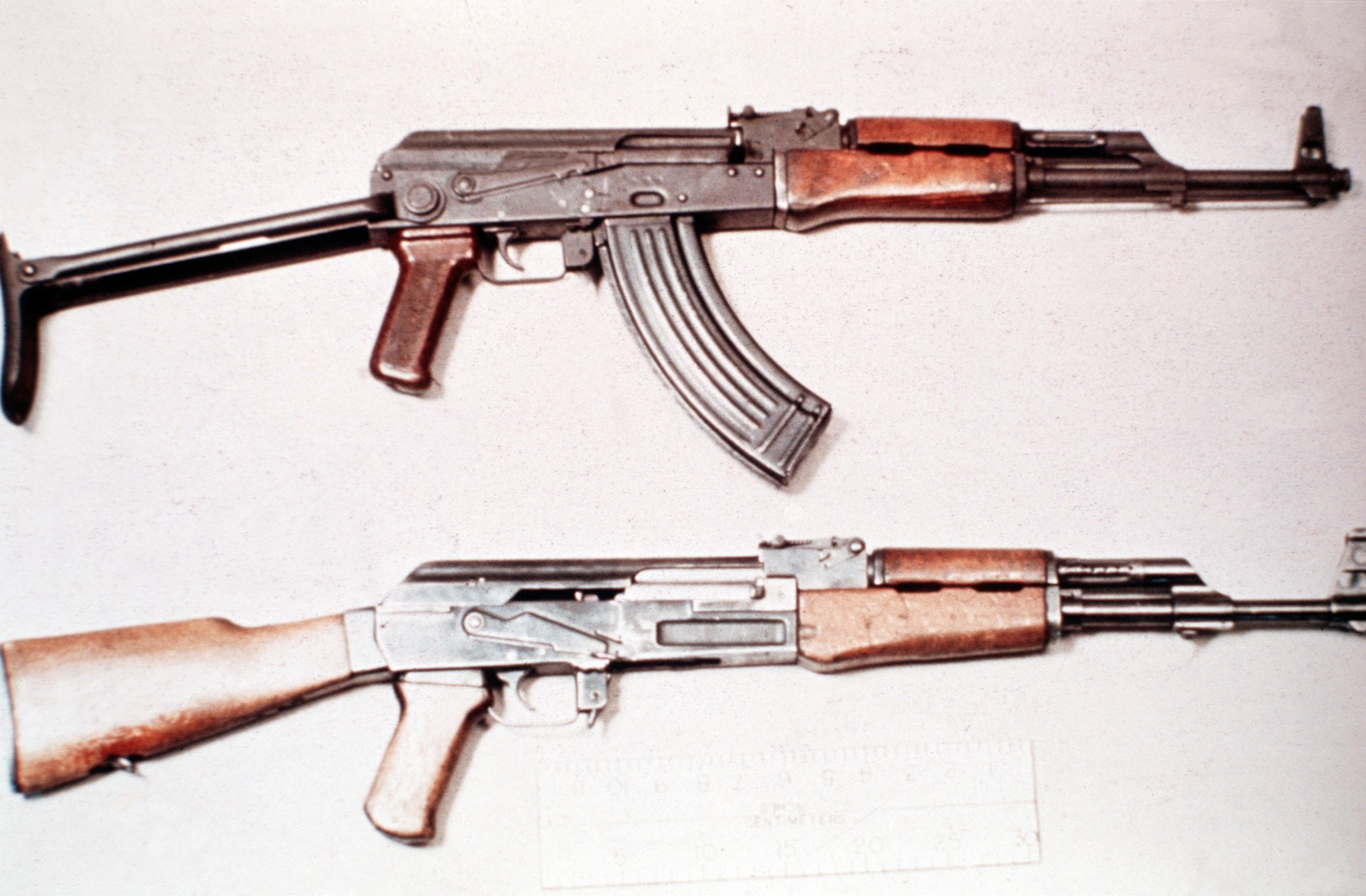
The AKM’s muzzle carries an angled, slant-cut compensator that vents expanding gas upward and to the right, pushing the muzzle down and left to oppose the rifle’s natural climb under automatic fire for a right-handed shooter.
It is a genuinely effective device for a nearly free one — no moving parts, a few grams of steel, and it screws onto threads that were already there. Some early AKM production retained the plain muzzle nut carried over from the AK, so a slant brake is a reliable indicator of an AKM but its absence does not prove an AK.
5.4 The Rate Reducer Is Not a Rate Reducer
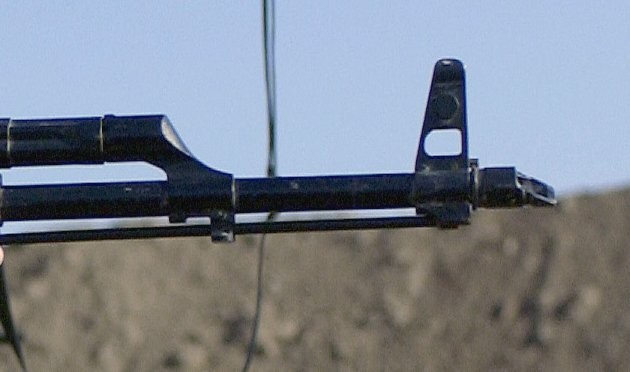
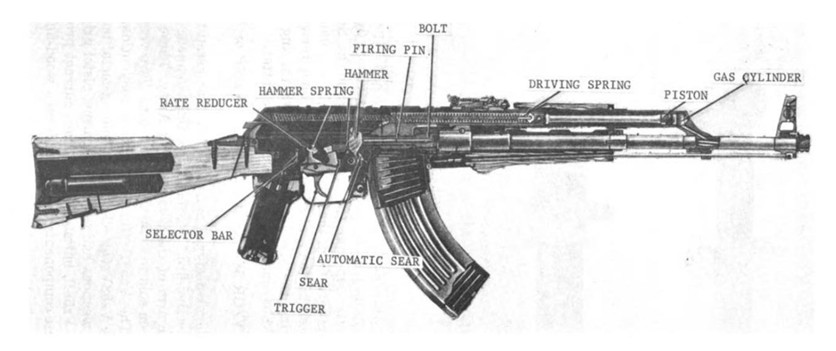
The AKM adds a part in the trigger group commonly called the “rate reducer” or “hammer retarder”, and the name has misled a great many people, including some who should know better.
It does not exist to slow the cyclic rate. The AKM’s cyclic rate is essentially the same as the AK’s, around 600 rounds per minute. Its actual job is to guarantee that the hammer cannot reach the firing pin until the bolt is fully locked.
The problem it solves is specific to automatic fire. As the bolt carrier runs forward it pushes the hammer down ahead of it; without a retarder the hammer can follow the carrier forward and fall before the bolt has finished rotating into the trunnion. A discharge with the bolt not locked, in a rifle cycling at ten rounds a second, wrecks the rifle and injures the firer. The retarder holds the hammer for a few milliseconds — long enough for lock-up to complete — and then releases it.
It has a second, real benefit: it reduces trigger bounce, the hammer-follow that degrades a burst, which is a measurable accuracy gain in automatic fire.
5.5 The Rest of the Change List
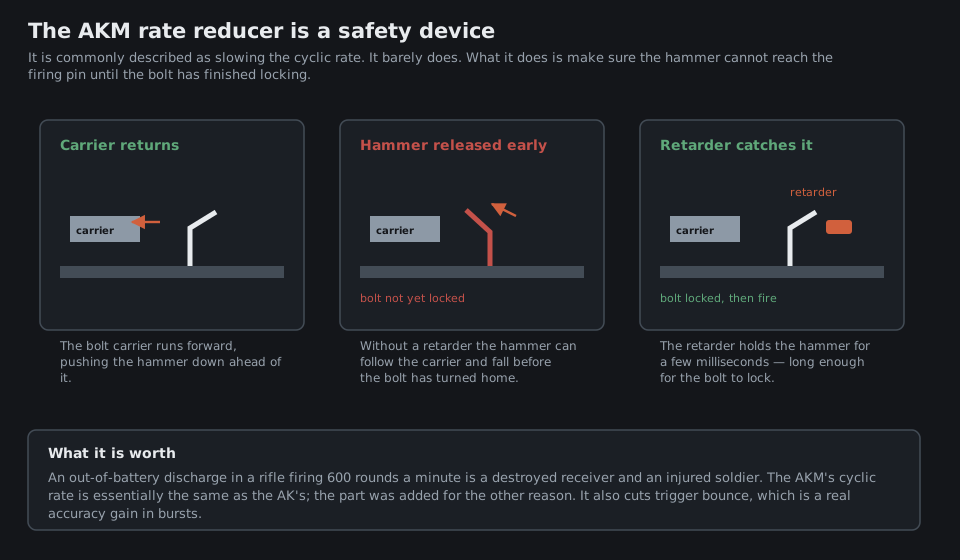
The AKM is a long list of small, cheap, sensible changes, which is what modernisation programmes look like when they are done well:
- Bolt carrier — a lightening cut milled into the right side; the charging handle slimmed in profile.
- Firing pin — changed from a round, fluted pin to a flat one.
- Gas relief ports — on the AK these sit in a row along the gas cylinder; on the AKM they move forward to the gas block, arranged radially.
- Rear sight — graduated to 1,000 m in 100 m steps rather than the AK’s 800 m, with the leaf’s position teeth moved from the right edge of the ramp to the left. The extra 200 m is optimism rather than capability, and is discussed in Volume 7.
- Furniture — buttstock, lower handguard and upper handguard in birch plywood laminate, which is more stable in wet conditions and cheaper than solid wood.
- Buttstock — hollowed to save weight, and made longer and straighter, which lowers the line of recoil relative to the shoulder and helps keep bursts on target.
- Trigger — a single notched hammer-release arm in place of the AK’s two parallel arms, and a hammer modified with a protrusion to engage the retarder.
- Gas block — no cleaning-rod capture or sling loop, but an integral bayonet support collar.
- Bayonet — the 6H3 or 6H4 pattern, which forms a wire cutter when coupled with its scabbard.
- AKMS — the underfolding stock variant, with a locking mechanism that secures both stock arms rather than only the left as on the earlier AKS-47.
5.6 Production and Dates
The AKM was introduced in 1959 and Soviet production ran to about 1977, when the AK-74 had taken over (Volume 8). Licensed and unlicensed manufacture has continued essentially ever since.
The Soviet production figure that circulates for the AKM is 10,278,300. That number has the suspicious precision of a single accounting record rather than a survey, and it should be treated as one source’s figure rather than an established total — but it is the right order of magnitude, and it dwarfs milled AK production.
5.7 Why It Matters More Than the Name Suggests
Three reasons, in increasing order of importance.
It is the rifle that was actually issued — to the Soviet Army, to the Warsaw Pact, and to the client states that received tooling. Nearly every national AK derivative is an AKM derivative.
It vindicated the original 1948 design decision ten years late, which is the point Volume 4 makes: the stamped receiver was never a bad idea, it was an idea ahead of the presses available to build it.
And it is the reason the identification problem exists. A weapon described in a news report, a museum caption, a court document or an arms-trafficking study as an AK-47 is, in the overwhelming majority of cases, an AKM or something descended from one. The AK-47 is a rifle of the 1950s that was replaced before most of the world had ever seen one.
Comments (0)