The AK-47 · Volume 2
Kalashnikov, Zaitsev, and the 1943–47 Competition
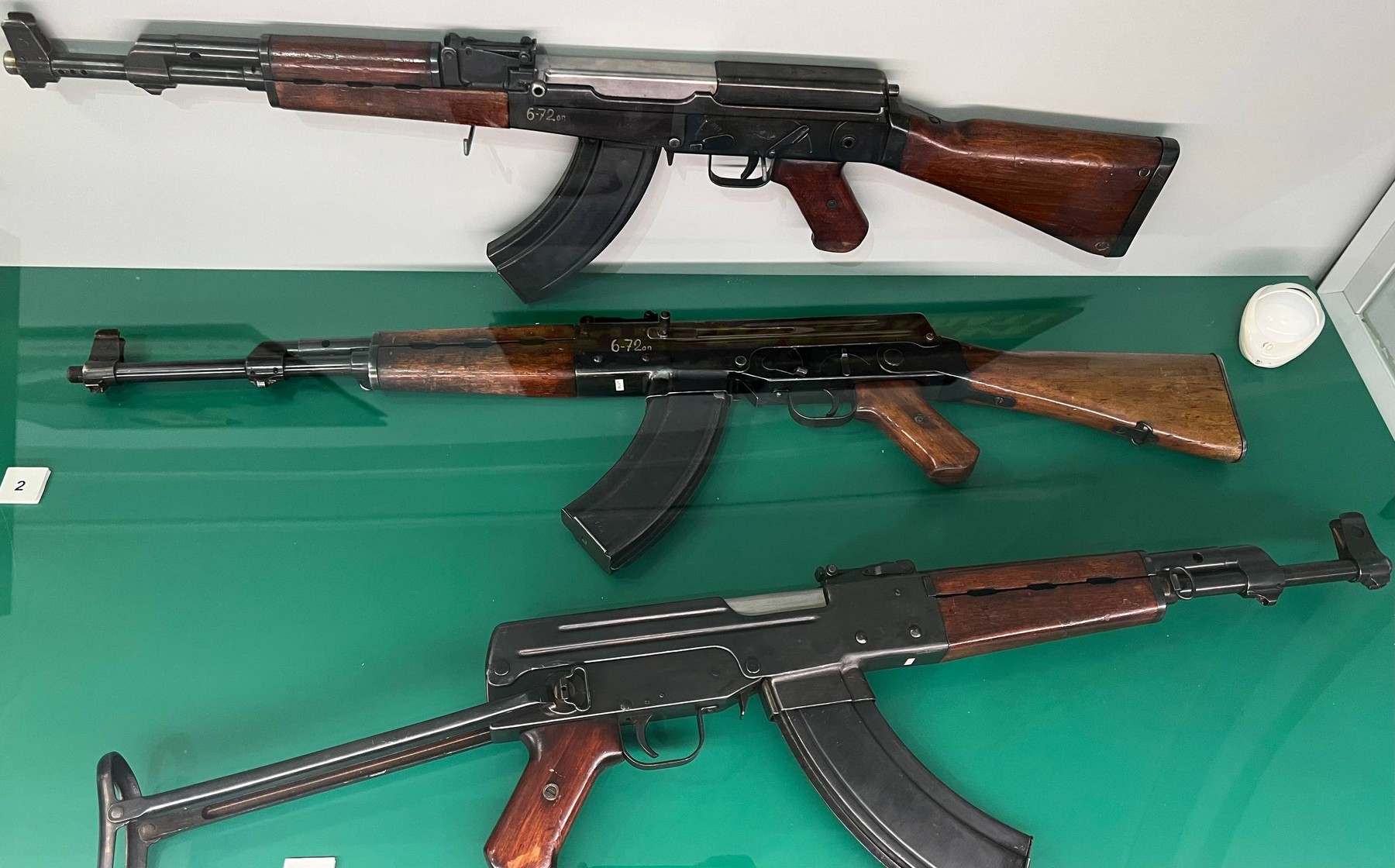
The story of the AK’s design is told, almost everywhere, in a form that is convenient rather than accurate: a wounded sergeant sketches a rifle in a hospital bed, teaches himself gunmaking, and singlehandedly produces the most successful weapon of the century. Every element of that sentence has a factual seed and every element is misleading.
The real story is a seven-year institutional competition involving several design bureaux, a state cartridge programme, at least three designers whose names belong on the rifle, and a late redesign that Kalashnikov initially resisted.
2.1 The Hospital Bed
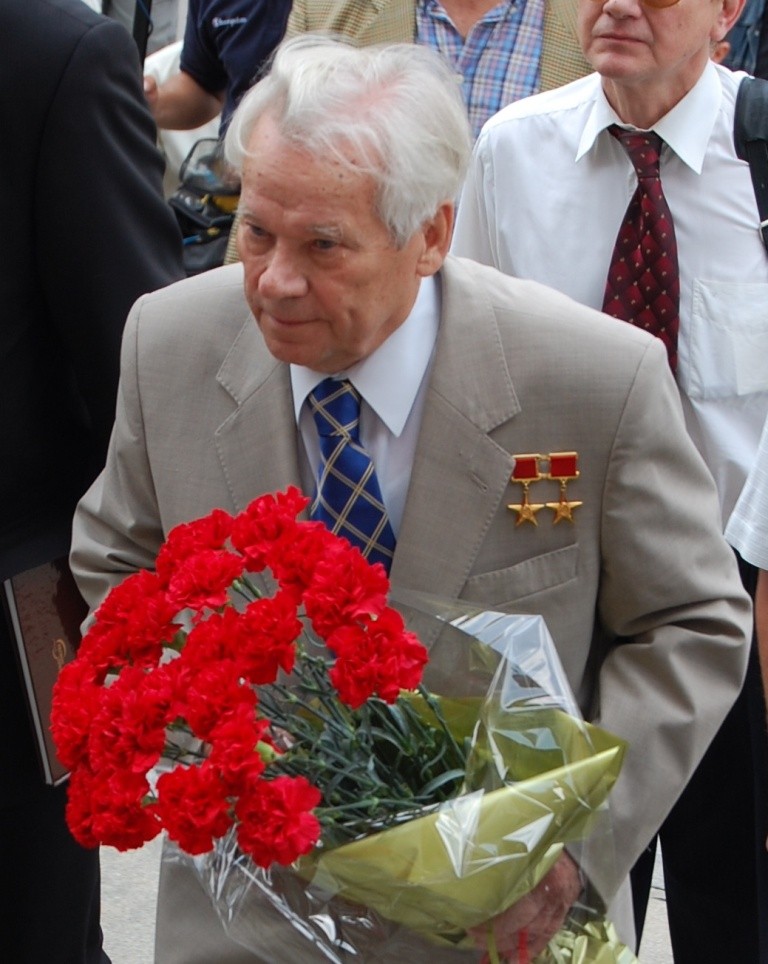
Kalashnikov was a tank commander, wounded at the Battle of Bryansk in October 1941 and hospitalised until April 1942. He did begin thinking about small arms there, prompted — by his own account — by fellow soldiers complaining about their rifles jamming. That much is true and it is the seed of the legend.
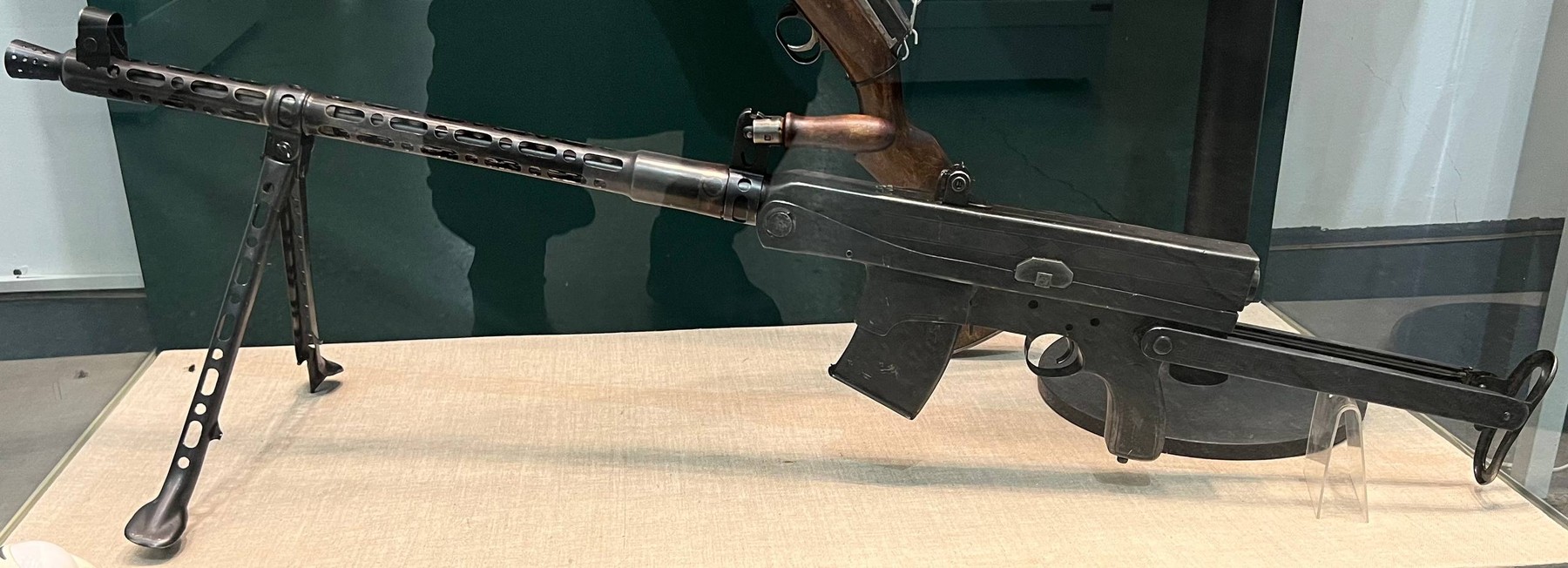
What follows is where the popular version fails. He did not emerge with the AK. He emerged with a submachine gun design that was not accepted, but which was good enough to get him recognised and posted to design work. Over the next five years he produced a series of unsuccessful or partly successful weapons — a light machine gun in 1943, a self-loading carbine, a submachine gun — inside a state design apparatus, with draughtsmen, machinists, test ranges and engineers around him.
The correction is therefore not that the hospital story is invented. It is that the hospital is the beginning of a professional career, not a substitute for one.
2.2 1943: The Decision That Preceded the Rifle
The AK exists because of a decision taken about ammunition, not about rifles.
On 15 July 1943 an early Sturmgewehr — taken from the Eastern Front — was demonstrated to the People’s Commissariat of Armament. German intermediate-cartridge weapons had been appearing in Soviet hands since the Cholm fighting of early 1942, and the conclusion drawn was not “copy this rifle” but “we need a cartridge like that one, and then a family of weapons to fire it.”
The cartridge programme began in earnest in July 1943 and produced an adopted round in December 1943 (Volume 3). At the same meeting, Soviet planners decided the new cartridge would be served by a family: a self-loading carbine, an automatic rifle, and a light machine gun. The carbine became the SKS. The light machine gun became the RPD. The automatic rifle took four more years and three competitions.
2.3 Sudayev and the AS-44
The first serious Soviet assault rifle was not Kalashnikov’s. It was Alexei Ivanovich Sudayev’s AS-44, tested in 1944–45.
Sudayev was the most accomplished Soviet small-arms designer of the war, the man behind the PPS submachine gun — arguably the best submachine gun any combatant fielded. The AS-44 went through troop trials and was not adopted; the principal complaint was weight. Sudayev was working on a lighter version when he died in August 1946 of a gastric ulcer, aged 34.
It is not possible to say what would have happened had he lived, and this dive will not pretend otherwise. What can be said is that the 1946 competition that Kalashnikov entered was one Sudayev would certainly have entered too, and that the field he beat did not contain the designer most contemporaries would have expected to win.
2.4 Losing First: The 1944 Carbine
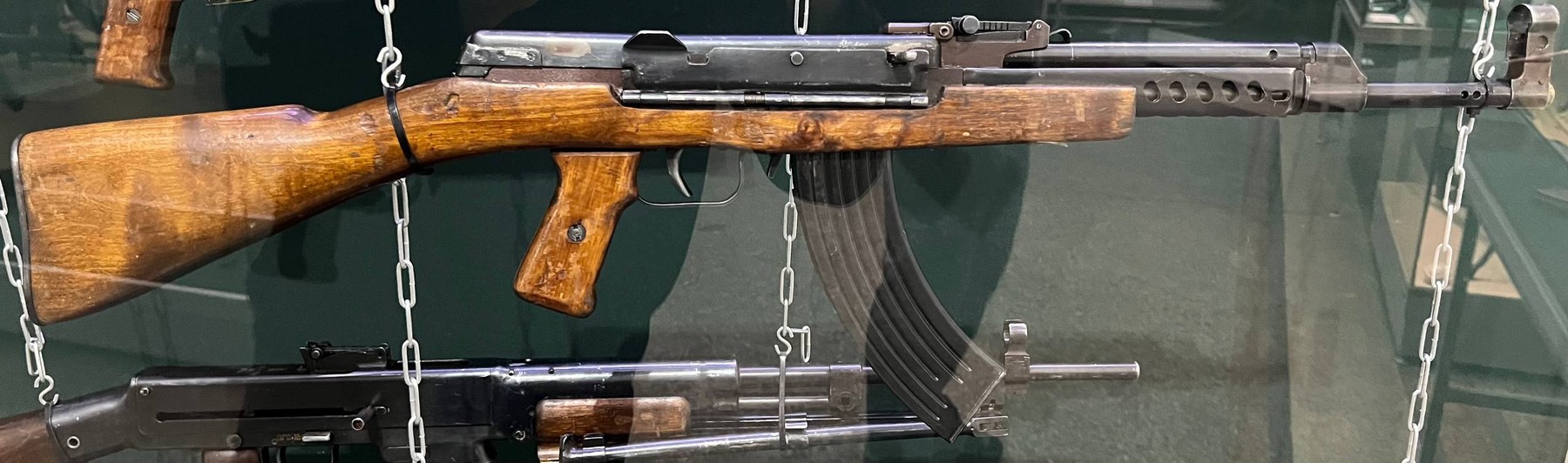
Kalashnikov’s first entry into the new-cartridge programme was a self-loading carbine in 1944, gas-operated, long-stroke, and openly influenced by the American M1 Garand, which he admired and had studied.
It lost. The winner was Simonov’s design, which became the SKS.
That loss matters to the AK’s design because the carbine’s long-stroke gas system and general layout survived into his later work — and because the experience of losing a state competition on reliability grounds shaped what he brought to the next one.
2.5 The AK-46, and the Redesign He Did Not Want
A fresh competition for an automatic rifle opened in 1946. Kalashnikov entered under the alias “Mikhtim”, a contraction of Mikhail Timofeyevich, and his entry — retrospectively the AK-46 — looked very little like the rifle the world knows:
- a short-stroke gas piston, separate from the bolt carrier
- a two-part receiver, with the trigger unit in its own housing
- separate safety and fire-selector controls, on the left side
It performed well enough to stay in the competition, and by the usual account it had the support of Vasily Lyuty, the military engineer running the trials, who argued for giving the design another chance after early problems. Vladimir Deikin, another military engineer, secured Kalashnikov access to facilities and range time at Kovrov against the resistance of designers already established there. Kalashnikov himself later named Zaitsev and Deikin as his major collaborators of those years.
Then, in late 1946, one of his assistants at Kovrov proposed throwing most of it away.
Aleksandr Zaitsev — a design engineer, a wartime reconnaissance veteran, and better formally educated than Kalashnikov — argued for a fundamental redesign to improve reliability. The receiver halves should be combined into one. The controls should be simplified into the single right-hand paddle that covers the charging-handle slot. The short-stroke piston should go, replaced by a long-stroke piston made integral with the bolt carrier.
Kalashnikov, by his own and Zaitsev’s accounts, did not want to do it. The rifle was already outperforming its competitors and a late redesign risked everything. Zaitsev’s own written recollection is blunt: “I suggested the Kalashnikov assault rifle be entirely redesigned. I managed to convince him I was right.”
He was right. The redesigned rifle — the AK-47 — was completed in November 1947.
This is the most substantive correction in the volume. The features that distinguish the AK from every other rifle in that competition, and that account for its reliability, are the features Zaitsev proposed. Soviet publicity presented Kalashnikov as the sole source of the design ideas; the record does not support that, and Kalashnikov himself, in his memoirs and in interviews, repeatedly credited his team.
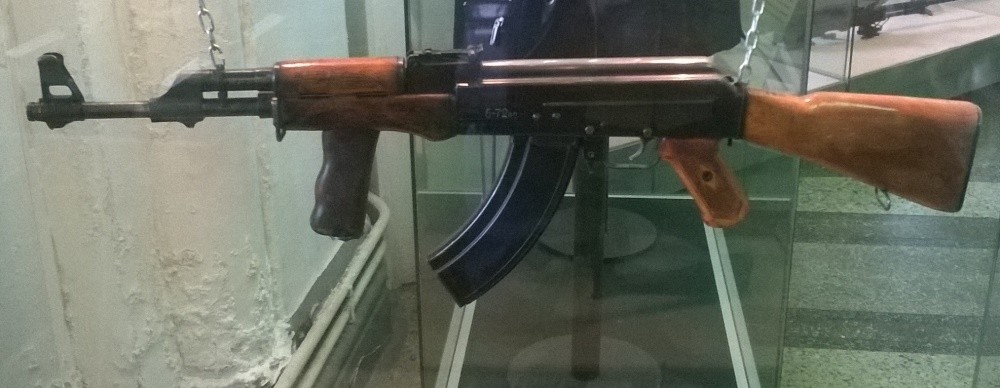
2.6 The Trials, and the Rifle That Was Beating It
Final testing ran at the Shchurovo proving ground from 27 December 1947 to 11 January 1948. Three designs were in contention: Kalashnikov’s, A. A. Dementyev’s KB-P-520, and A. A. Bulkin’s TKB-415.
Bulkin’s rifle was, on some accounts, leading the competition into late December. It matched the Kalashnikov for simplicity, ease of stripping and maintenance, and both it and Dementyev’s rifle were slightly better in automatic-fire accuracy from unstable positions. The Kalashnikov’s weakness in the trials was precisely the thing it is still criticised for: accuracy, especially in full automatic.
What decided it was endurance. The requirement was for 15,000 rounds through every rifle; both Bulkin TKB-415 rifles failed outright at under 7,000 rounds each. The Kalashnikov was the most durable and reliable of the three, and it won on those grounds.
There is a persistent claim that Kalashnikov borrowed from Bulkin’s TKB-415 — and separately that he borrowed from Simonov’s AVS-31. Neither claim is settled. The similarities that are pointed to are real but are also common currency in Soviet design of the period, and no document has been produced that shows a transfer. The honest position is that this is contested and unresolved, and this dive does not assert either way.
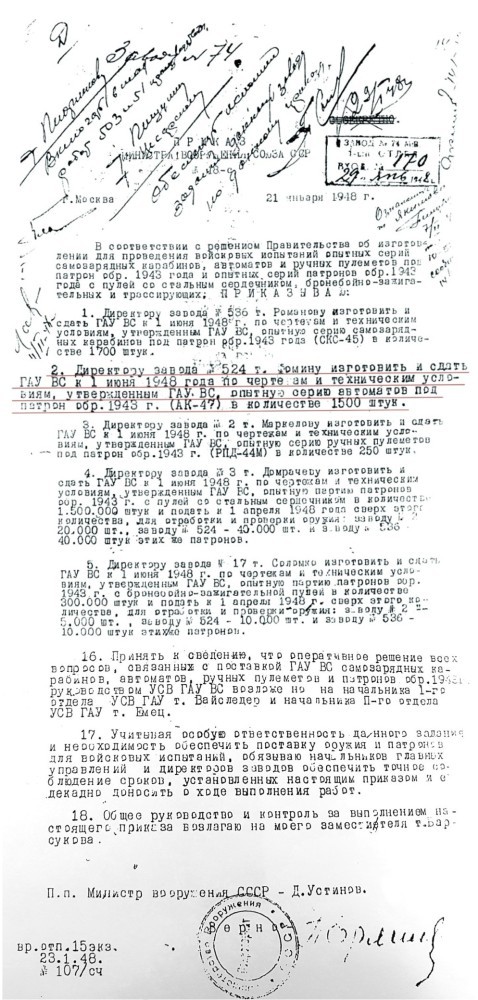
Production of an experimental batch of 1,500 was ordered on 21 January 1948. The rifle was adopted in 1949.
2.7 The Rifle Did Not Fight in the Second World War
This needs stating plainly because film, television and video games have put the AK in the hands of soldiers at Stalingrad, in Berlin, and on both sides of a war that ended two and a half years before the winning prototype existed.
The timeline forecloses it entirely. The war in Europe ended in May 1945. The AK-46 prototypes were built in 1946. The redesigned AK-47 prototypes were completed in November 1947, tested from December 1947, ordered into experimental production in January 1948, and adopted in 1949. Not one AK was carried in the Second World War by anybody.
The confusion is understandable — the cartridge programme and the Kalashnikov carbine of 1944 were wartime, and Soviet wartime designs were field-tested at the front. But the rifle itself is entirely postwar.
2.8 “It Is a Copy of the StG 44”
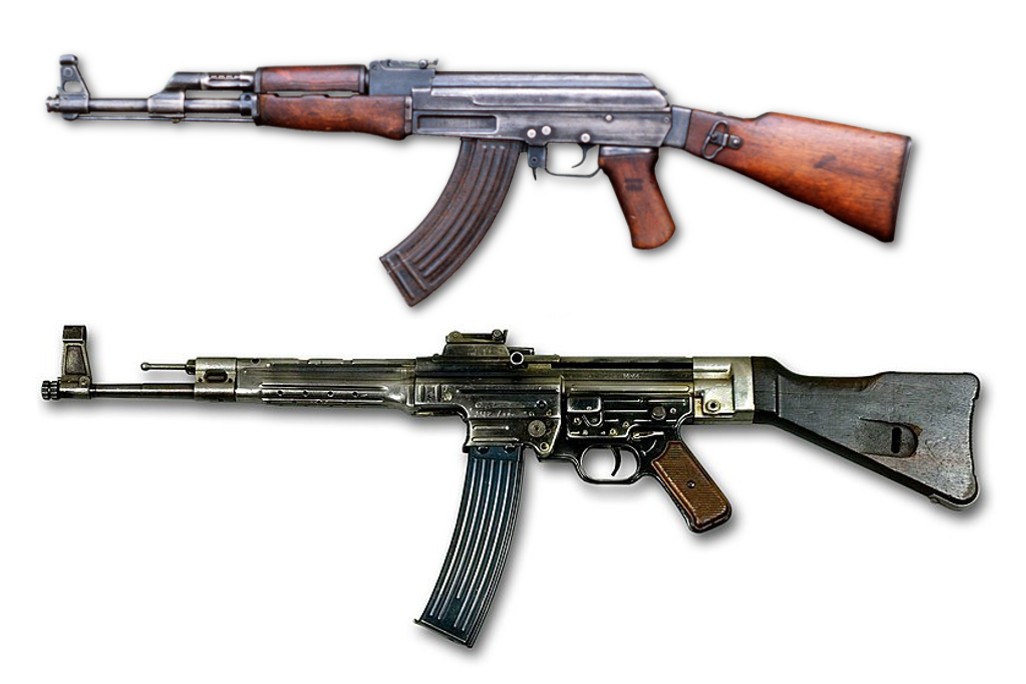
This is the most durable claim about the AK, and the evidence runs against it on the mechanics while supporting a weaker version of it on the concept.
Against the copying claim:
- The StG 44 locks with a tilting bolt. The AK locks with a rotating bolt with two lugs. These are different solutions to the central problem in the rifle, and neither is derived from the other.
- The StG 44’s receiver is a long stamping with the trigger group hinged below it; the AK’s is a shorter receiver with a trunnion, a removable top cover and a drop-in trigger group.
- The AK’s rotating bolt, its long-stroke piston and its general layout have a clear ancestor — the M1 Garand, which Kalashnikov studied and openly admired, and which he had already drawn on for his 1944 carbine.
- The Germans’ philosophy was to stamp everything possible. The Soviets, in 1951, moved the AK away from stamping and onto a milled receiver (Volume 4) — the opposite of what a German-derived programme would have done.
For a weaker, defensible version:
- The StG 44 demonstrated the concept — a selective-fire shoulder weapon firing an intermediate cartridge — and the July 1943 demonstration of a captured example is a documented trigger for the Soviet programme.
- The cartridge lineage is closer. The 7.92×33 Kurz’s influence on the Soviet decision to build an intermediate round is real, though Anthony G. Williams has argued the M43 is dimensionally so different from any German round then in existence that it cannot be called a copy of one (Volume 3).
Kalashnikov’s own framing is worth quoting because it concedes the useful part without conceding the false part: “before attempting to create something new, it is vital to have a good appreciation of everything that already exists in this field.” That is a description of studying the StG 44. It is not a description of copying it.
2.9 Hugo Schmeisser at Izhevsk
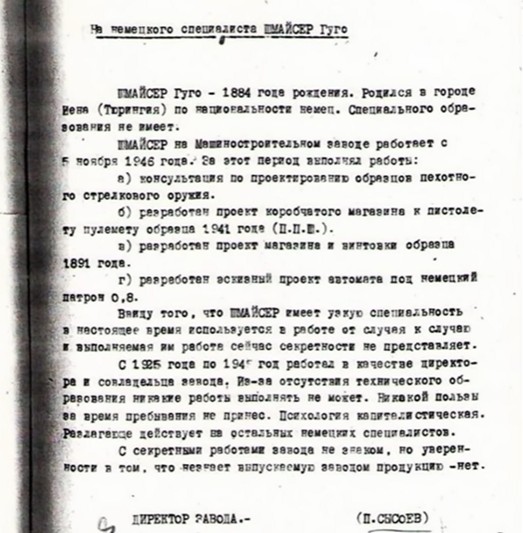
Hugo Schmeisser — who led the design group at C. G. Haenel that produced the StG 44 — was removed to the Soviet Union in October 1946 and worked at Factory No. 74 in Izhevsk, later Izhmash, as one of sixteen Germans in a special department created for them. He returned to Germany on 9 June 1952 and died the following year.
That he was in the USSR while the AK was being finalised is the whole basis of the claim that he designed it. The record does not support the claim, on three separate grounds:
Geography. The AK was designed and tested at Kovrov and at the Shchurovo proving ground — several hundred miles from Izhevsk. Kalashnikov himself only moved to Izhevsk in 1948, after the design had won its competition, when serial manufacture for troop trials was ordered.
Access. When production of the adopted AK was transferred to Factory No. 74 in 1949, the orders governing the German specialists there explicitly prohibited them from access to classified developments, including the AK.
The Soviets’ own assessment of him. The surviving characterisation written at Izhevsk is not the document a decisive contributor generates. It records that “due to a lack of technical education, he cannot perform any work”, that “his presence here brought us no value”, and complains of his effect on the other specialists. The projects actually listed against his name are magazines for the PPSh-41 and the Mosin-Nagant, and a sketch of a rifle in the German 7.92×57 calibre — none of them connected to the AK.
Two caveats are owed. First, these assessments were written inside a system with its own politics, and a hostile file is not automatically an accurate one; Schmeisser appears to have been uncooperative, which is a different thing from being useless. Second, the Germans’ broader presence at Izhevsk did contribute to Soviet manufacturing practice, and stamping expertise in particular is an area where German influence on later Soviet production is plausible. What is not supported is the specific claim that Schmeisser designed, co-designed, or contributed to the AK.
2.10 What the Record Actually Supports
The AK-47 was designed by a team inside a state competition, led by Mikhail Kalashnikov, whose decisive reliability features were proposed by Aleksandr Zaitsev, whose path through the trials was cleared by Vasily Lyuty and Vladimir Deikin, which beat a rifle that was ahead of it until the endurance stage, and which drew its mechanism more from an American rifle than a German one while owing the German weapon the idea of the category.
That is a less satisfying story than the hospital bed. It is also considerably more interesting, and it is the one the documents support.
Comments (0)