The AK-47 · Volume 7
Accuracy and Reliability — What the Slack Buys, and What It Costs
Two claims are made about the AK more than all others: that it cannot shoot straight, and that it never stops working. The first is roughly true and usually overstated. The second is not true, is less true than the first is, and has been tested.
The difficulty in writing this volume honestly is that the good evidence is thin. There is a great deal of anecdote, a great deal of internet testing of varying quality, and a small amount of documented comparative work. What follows separates them.
7.1 What the Accuracy Figures Actually Say
The most widely cited comparative figures give:
Table 1 — The most widely cited comparative figures give
| Range | AK-47 | M16 |
|---|---|---|
| 100 m | 5.9 in (15 cm) | 4.3 in (11 cm) |
| 300 m | 17.5 in (44 cm) | 12.6 in (32 cm) |
The same source notes that at 300 metres, expert shooters firing AKs from prone or bench rest “had difficulty putting ten consecutive rounds on target.”
Two things to notice. The AK is worse, and it is worse by roughly 35–40 per cent in group size rather than by the order of magnitude the folklore implies. A 15 cm group at 100 m is about 5 MOA — poor by any sporting standard, entirely adequate for a man-sized target inside 300 m, which is what the rifle was built for.
Practical bench testing of civilian-market AK derivatives has produced better numbers than that. Small Arms Review’s testing of Egyptian, Yugoslav and Romanian rifles found that, with the exception of a Chinese Type 56, “on average the AKs produced groups smaller than one and a half inches” at 50 yards — about 3 MOA. The Type 56 improved substantially once its “sugar scoop” compensator was replaced.
7.2 The Soviets Did Not Measure Accuracy the Way the West Does
Any comparison across sources has to deal with this, and most do not.
Soviet practice used R50 — the radius of a circle containing the inner 50 per cent of hits, measured separately for vertical and horizontal dispersion. It is not the same quantity as a Western extreme-spread group size, which is measured across the two widest shots of the whole string and is therefore driven by the outliers R50 deliberately discards.
Published Soviet figures for the AK at 800 m give a vertical R50 of about 49 cm and a horizontal R50 of about 34 cm. Those numbers cannot be compared directly with a five-shot extreme-spread group without conversion, and the conversion depends on assumptions about the distribution. Quoting a Soviet R50 figure as though it were a group size overstates the rifle’s accuracy; quoting a Western group size against a Soviet requirement overstates its inaccuracy.
7.3 Why It Shoots as It Does
The dispersion has at least five contributors, and the famous one is not the largest:
The cartridge. The M43’s bullet is short, blunt and slow, with a poor ballistic coefficient. A meaningful share of the dispersion at distance is the ammunition, not the rifle — and surplus military ammunition is not match ammunition by any measure.
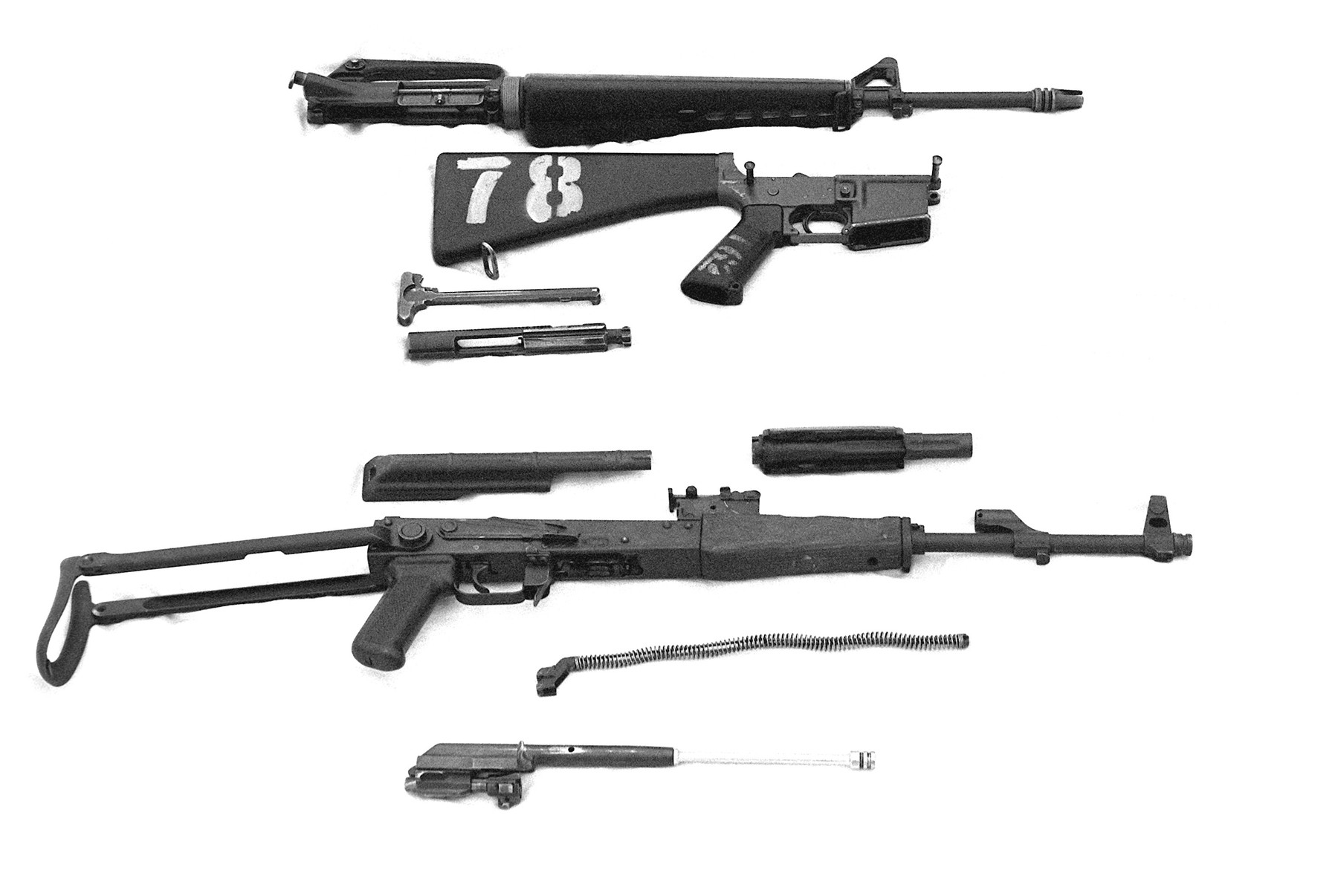
Reciprocating mass. The long-stroke system sends a heavy assembly the full length of the receiver and back, twice per shot. That is a large disturbance to the sights in automatic fire and a real one even in semi-automatic.
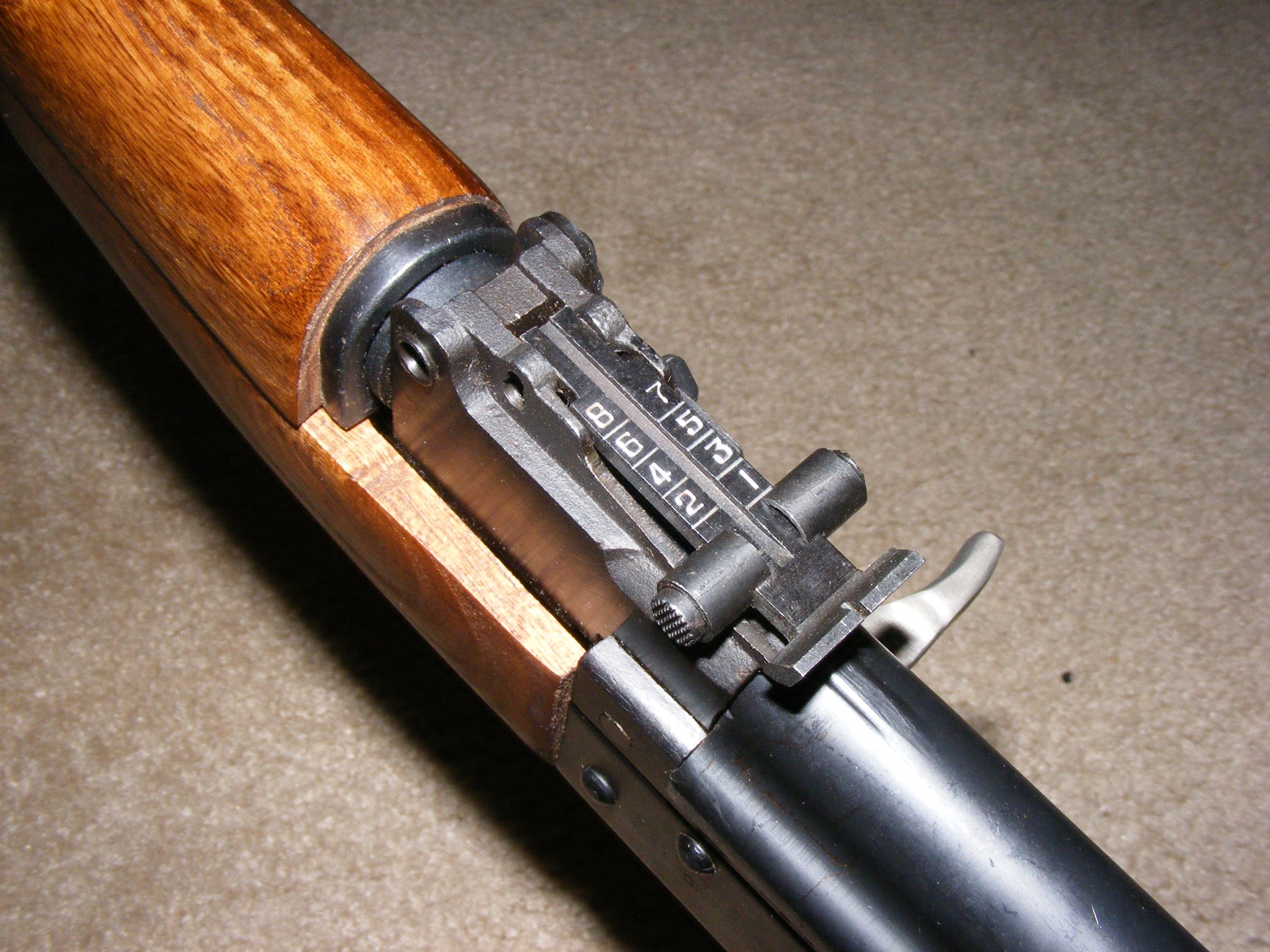
Sight radius and sight quality. 378 mm is short, the rear notch is coarse, and the front post is a simple hooded blade. Under field conditions the sights are a larger contributor than the mechanism.
The trigger. A conscript-proof military trigger with substantial creep.
Clearance in the action. The barrel-to-receiver relationship is solid on a milled rifle and adequate on a riveted one; what varies is everything downstream. This is the reason usually given first, and it belongs about fifth.
The 1947–48 trials recorded exactly this. The Kalashnikov design was behind both Bulkin’s and Dementyev’s rifles for automatic-fire accuracy from unstable positions, and won on endurance instead. The accuracy criticism is not a later discovery; it was known at adoption and accepted as the price.
7.4 The Sight Graduations Are Optimistic
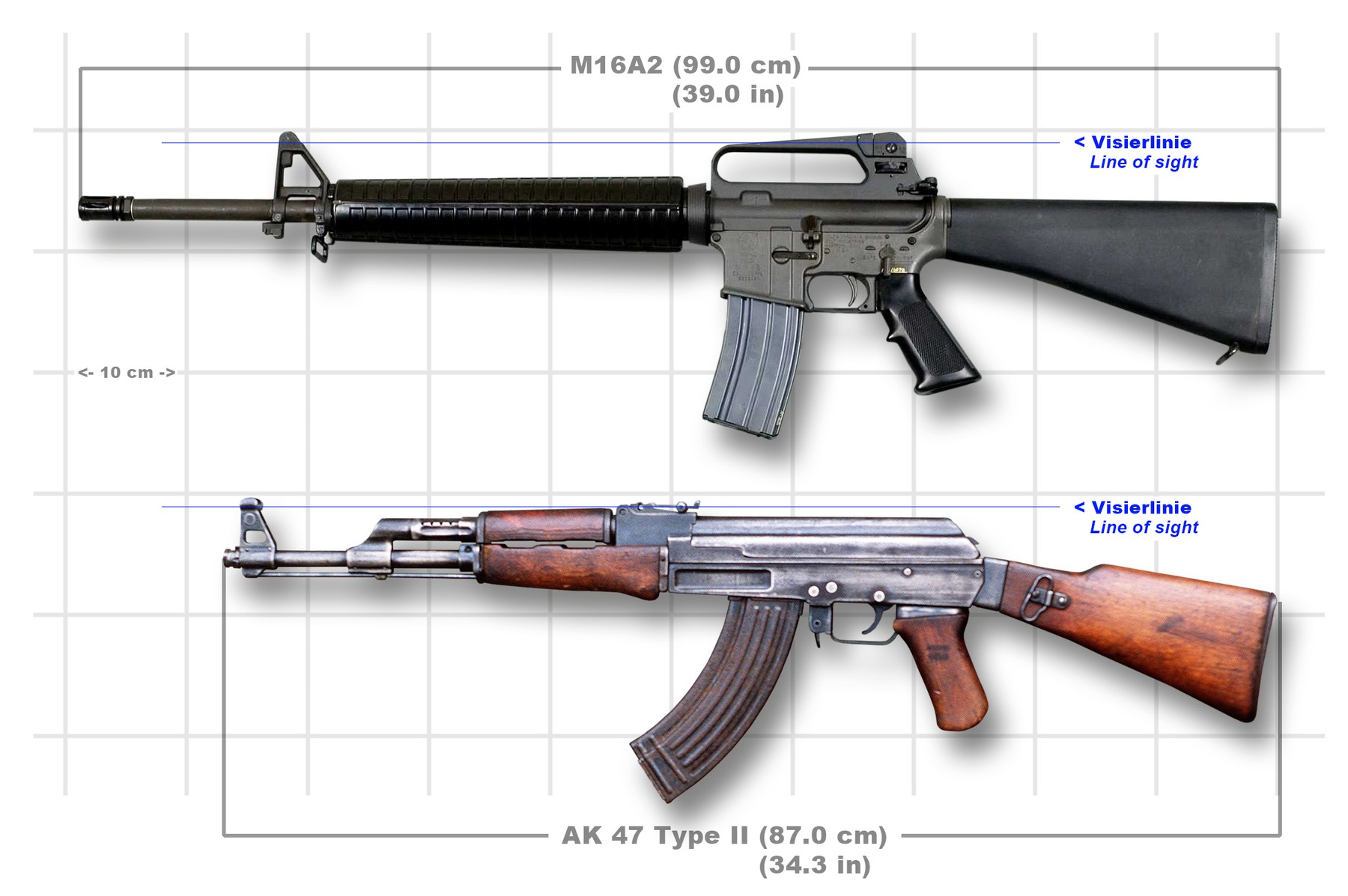
The AK’s tangent sight goes to 800 m and the AKM’s to 1,000 m. The effective range is commonly given as about 350 m.
This is not a contradiction so much as a different theory of what sights are for. Soviet doctrine expected massed automatic fire from a squad to be useful as suppression at ranges where individual hits were not expected, and the graduations support that. A soldier using the 1,000 m setting on an AKM is not aiming at a man; he is putting rounds into an area.
The practical consequence for anyone shooting one is that the “П” battle-sight setting — the leftmost position, standing for postoyannyy, constant — is the one that matters. It gives a trajectory that stays within a torso-height band out to roughly 300 m without adjustment, which is the entire realistic envelope of the rifle and the cartridge.
7.5 Reliability: What Is Actually Documented
The strongest documented evidence for the AK’s reliability is also the oldest, and it is not anecdote.
The 1947–48 Shchurovo trials required 15,000 rounds through every competing rifle. Bulkin’s TKB-415 rifles failed completely at under 7,000 rounds each. The Kalashnikov passed and was judged the most durable and reliable of the three. That is a controlled comparative test against serious competitors, and it is the reason the rifle was adopted.
Against that, two corrections are owed.
The rifle was not born reliable. Early Type 1 production had real problems, and the reputation was built over a decade of fixing them (Volume 4). The AK that the world knows is the AKM, tenth-year hardware.
Chrome lining matters more than is usually credited. AK barrels and chambers are chrome-lined, which is why the rifle tolerates corrosive-primed ammunition and long neglect without the bore pitting out. A substantial part of the “it survives anything” reputation is a plating process, not a mechanism.
7.6 The Mud Test, and What It Really Showed
The folklore claim is that an AK works no matter what is done to it. The best-known attempt to test that publicly was InRange TV’s mud testing in 2015, and its result surprised nearly everyone.
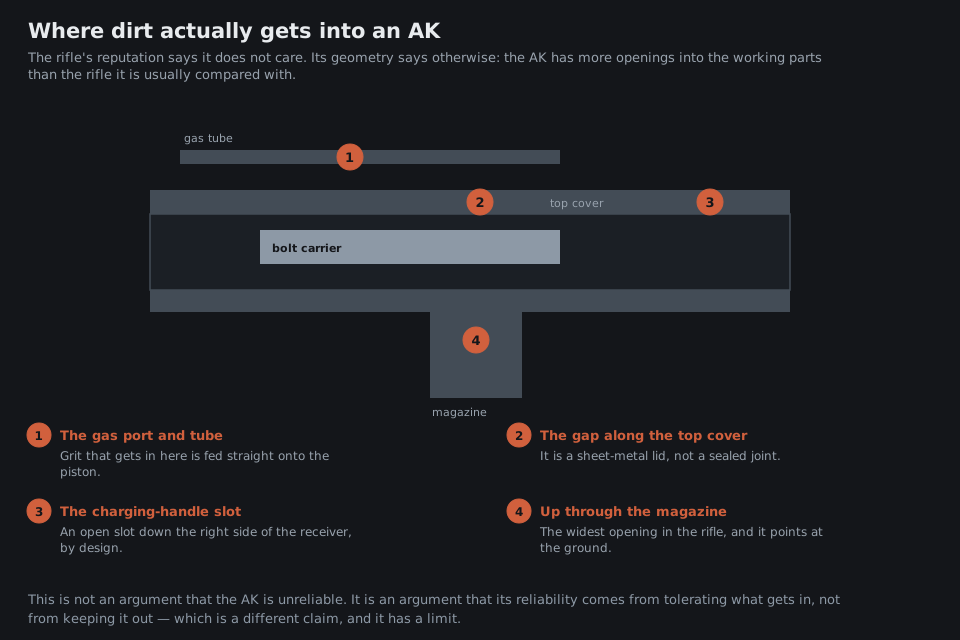
The AK failed. Not by breaking: nothing seized, no lug sheared, the trigger kept resetting. So much mud entered the action that it slowed the bolt carrier enough to stop the rifle cycling. In the same test series an AR-15 ran, including with mud poured directly into an open dust cover.
The explanation offered is geometric and it is the one this dive endorses. The AK has an open slot down the right side for the charging handle and a substantial gap between the top cover and the bolt. Mud gets in, and once it is in, the same generous clearances that let a fouled action keep moving also allow enough sludge to accumulate to rob the carrier of velocity. The idea that “loose tolerances make it more reliable” turns out to be an unreliable generalisation: the tighter-fitting rifle kept more of the mud out in the first place.
Three caveats, stated because this test gets over-quoted in the other direction now:
- It is one test series, by two individuals, on a small number of rifles, outside any military protocol. It is evidence, not a standard.
- Mud is one environment. Sand, dust, cold, ice and neglect are different problems, and the AK’s reputation was earned in more of them than mud.
- The testers’ own framing is the fair one: “Every gun has a failure point, you just have to reach it.”
The point is not that the AK is fragile. It is that the claim “it always works no matter what” is a claim about an absolute, and absolutes are falsifiable — this one was falsified on video, and the rifle is still extremely good.
7.7 Where the Reliability Genuinely Comes From
Stripping the folklore leaves a short, defensible list:
- Power. The long-stroke system develops plenty of force to shove a dirty bolt through a dirty cycle.
- Margin in the lockwork. Two very large lugs into a steel trunnion, with a geometric unlocking delay that does not care how fouled the gas system is.
- Clearance where it counts. Narrow carrier rails with small bearing areas that shed debris rather than packing it.
- Chrome-lined bore and chamber, tolerating corrosive ammunition and deferred cleaning.
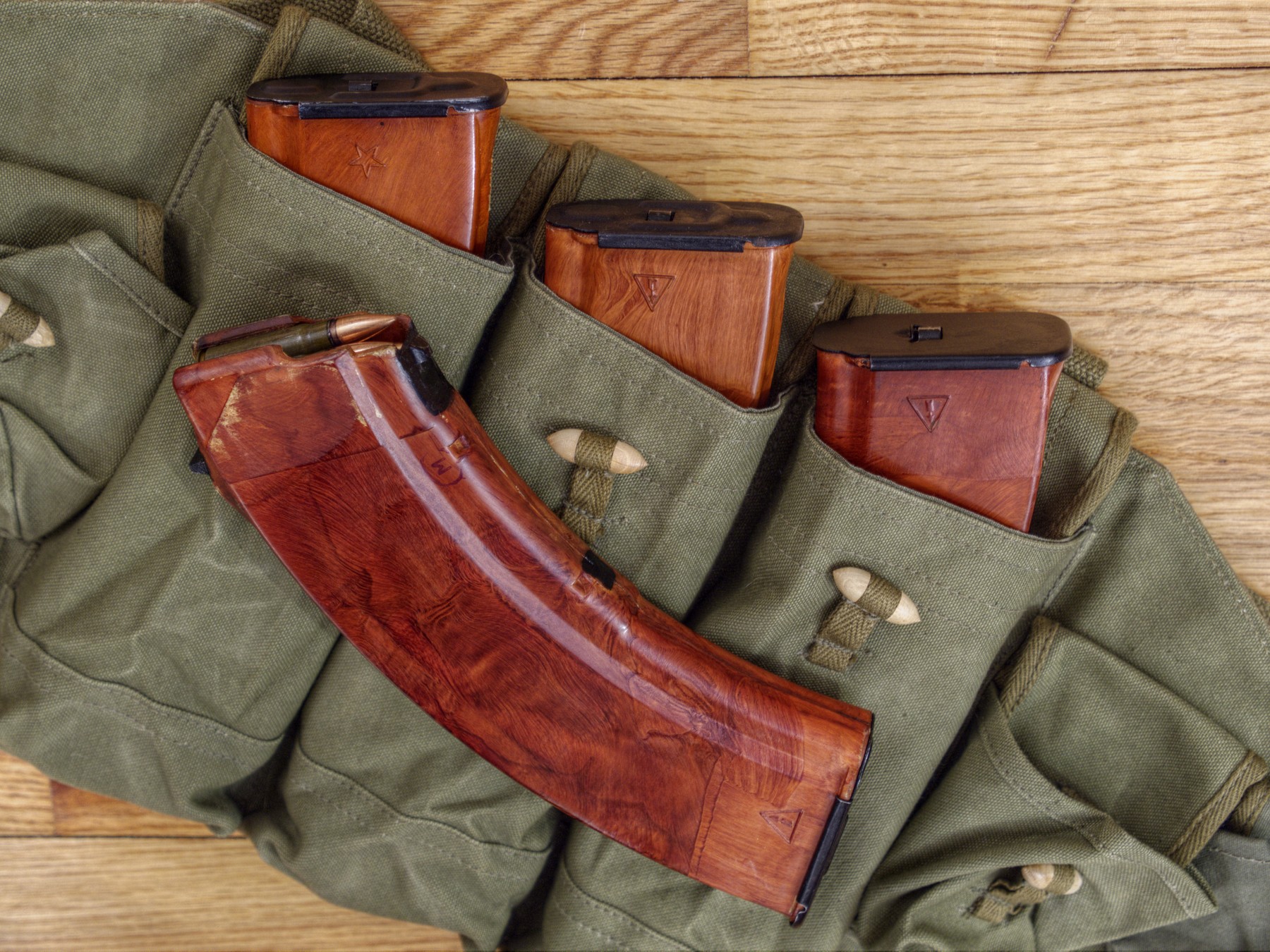
- Steel magazines that survive being dropped, stood on and buried — a genuine and underrated advantage over the aluminium magazines that caused the early M16 so much grief.
- Simplicity of maintenance. Five groups, no tools, nothing a conscript can reassemble wrongly in a way that fires.
7.8 The Honest Summary
The AK is a roughly 4-to-5 MOA rifle firing a mediocre cartridge through short, coarse sights, which is entirely sufficient for the job it was designed for and insufficient for most of the jobs its owners imagine for it.
It is extremely tolerant of fouling, neglect, corrosive ammunition and rough handling, more tolerant than almost any contemporary, and it has a documented failure point in heavy mud that arrives sooner than its reputation allows.
Both of those sentences are less satisfying than the slogan. Both are supportable.
Comments (0)