The AK-47 · Volume 13
Romania and Bulgaria
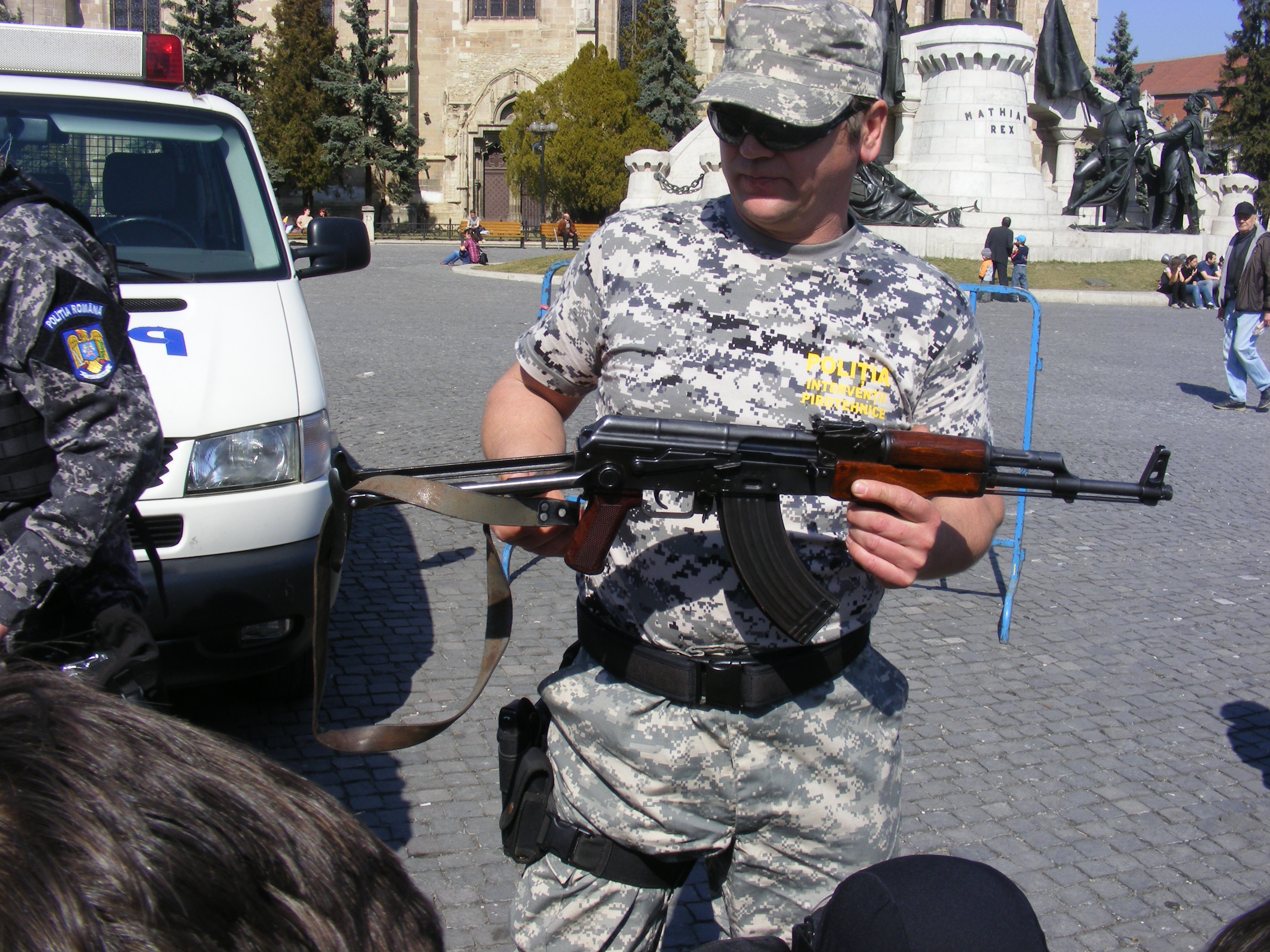
Romania and Bulgaria matter out of proportion to their size, for opposite reasons. Romania built the rifles that became the American parts-kit market and the entry-level American AK — more Romanian Kalashnikovs have passed through American hands than any other foreign pattern. Bulgaria built the rifles that the same market treats as the standard of quality. Both claims are worth examining rather than repeating.
13.1 Romania: Cugir
Romanian production centred on the Cugir arms works — Uzina Mecanică Cugir — in Alba county, a plant whose arms-making history runs back into the Austro-Hungarian period. Its mark is a triangle enclosing an arrow, which on a Romanian receiver sits with the year and the serial.
The service rifle is the Pistol Mitralieră model 1963, universally shortened to PM md. 63: a Romanian-built AKM. As first produced it was, in the words of one summary, indistinguishable from an ordinary AKM. The feature everyone knows came a little later.
13.1.1 The Foregrip
During the mid-1960s a laminated wooden vertical foregrip was added below the handguard, angled rearward, and the stated purpose is consistent across sources: to give the rifleman something to pull down and back on, controlling muzzle climb in automatic fire.
Two points of hygiene about it:
The nickname by which it is universally known in the American market — the “dong” — is a collector’s term, not a designation. It appears in no military document and it is worth knowing only because parts are sold under it.
The PM md. 65, the underfolding-stock version, carries the same idea with a necessary modification: its foregrip is canted forward rather than back, so that the folded stock clears it. This is consistently reported and is an easy and reliable way to tell the two apart in a photograph; it has not been confirmed here against a Romanian manual.
Later Romanian rifles — md. 80, md. 90, and the 5.45×39 PA md. 86 — continue the line, and the MLI-84 is the Romanian squad automatic of RPK type. These are named here for orientation; this arm does not attempt a full Romanian model history.
13.1.2 Why Romania Dominates the American Market
Romanian rifles are not the best-regarded Kalashnikovs and they are overwhelmingly the most common in the United States. The reason is supply, not merit: Romanian surplus and Romanian commercial production were available in quantity at the moment the American parts-kit and import market wanted volume, and Cugir remained a going concern producing semi-automatic rifles for export rather than only a source of cut-up surplus.
The rifle that resulted — the WASR series, Cugir-made and American-imported — is the subject of Vol 16, because what it is cannot be explained without the import law that shaped it.
13.2 Bulgaria: Arsenal, Kazanlak
The Bulgarian state arms works at Kazanlak was designated Factory 10 in 1948. Its institutional ancestry is older — an artillery arsenal founded at Ruse in 1878, moved to Sofia and then to Kazanlak in 1924 — and it trades today as Arsenal.
Kalashnikov production began at Kazanlak around 1956. The early rifles are described as assembled from Soviet-supplied parts under licence, with genuinely Bulgarian production of components following by the mid-1960s. That progression — assemble first, manufacture later — is the normal Warsaw Pact pattern and is worth keeping in mind before attributing every part in an early Bulgarian rifle to Bulgaria.
13.2.1 The Double-Circle 10
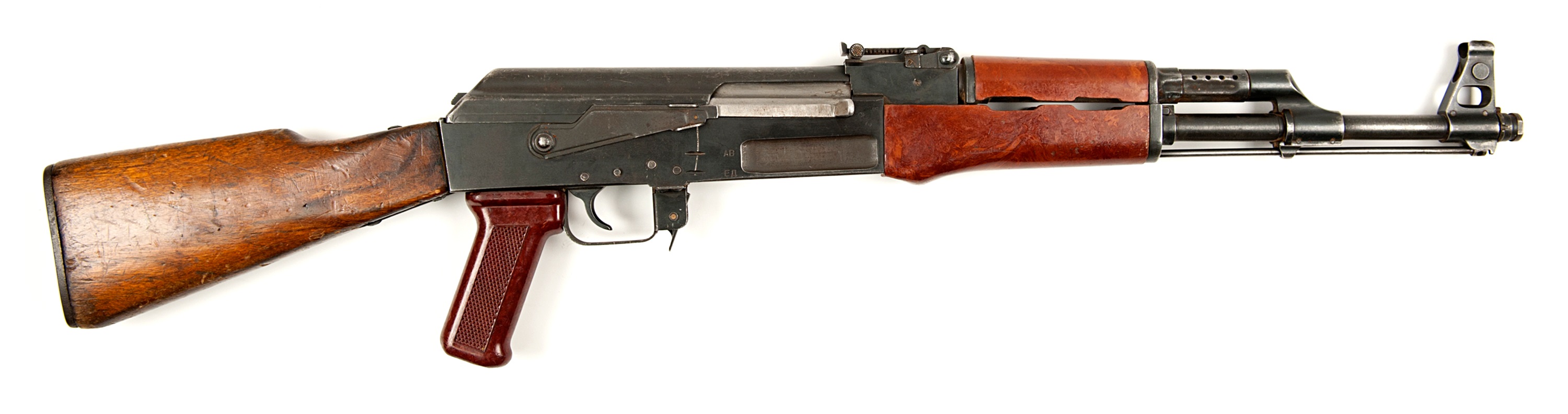
The Bulgarian factory mark is “10” inside concentric circles, the “double circle 10”, found on the front trunnion and on the left side of the receiver near the front. It is one of the least ambiguous marks in this survey: distinctive in shape, consistently applied, and not easily confused with any other national mark.
13.2.2 Designations
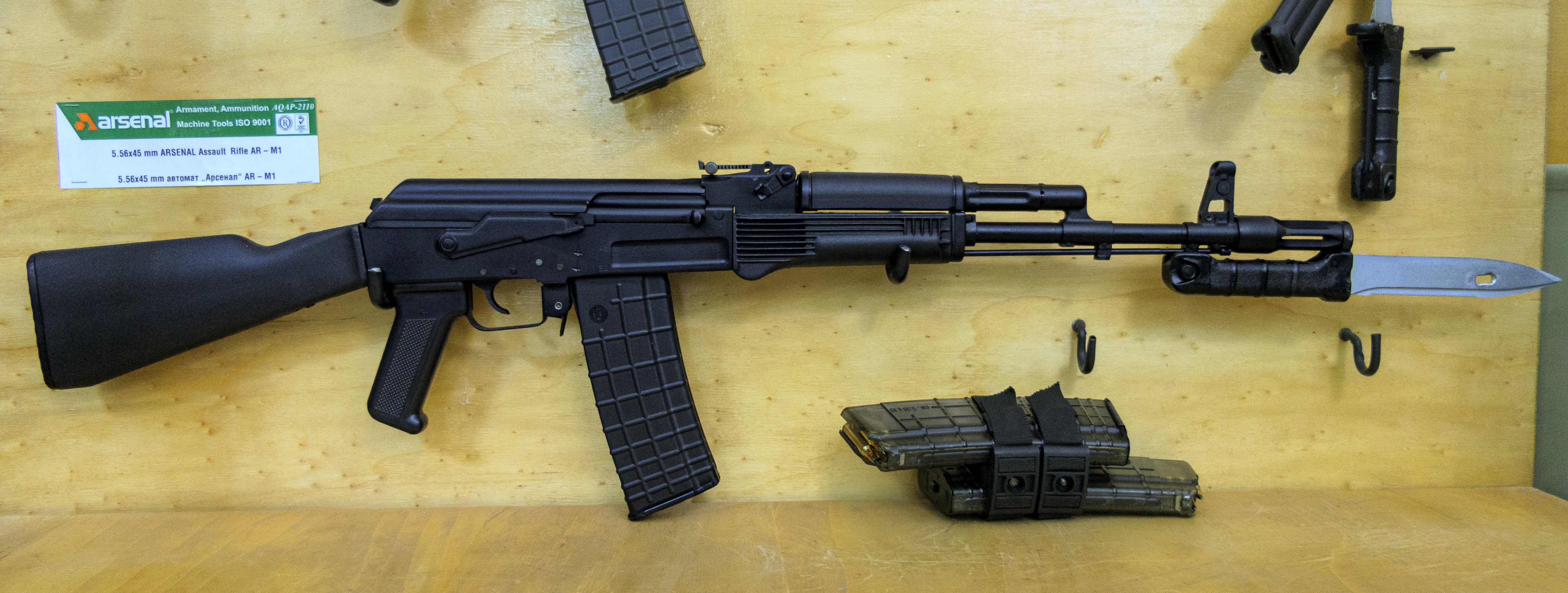
Bulgarian nomenclature follows the Soviet sequence with a K for Kalashnikov: AKK for the milled fixed-stock rifle, AKKS for the underfolder, and the AKKM/AKKMS pair for the AKM-pattern stamped rifles. Modern Arsenal production is sold as the AR-M1 family and its relatives, in both 7.62×39 and 5.56×45.
13.2.3 The Reputation, Examined
Arsenal’s rifles are consistently described as the best-made Kalashnikovs available outside Russia, and Arsenal’s American operation has built a business on that reputation.
It deserves a caveat that the enthusiast literature rarely gives it. The reputation is a market consensus, not a measured result. No comparative testing was found for this arm — no published accuracy comparison across national patterns under controlled conditions, no service-life data, no metallurgical comparison. What exists is a strong and durable agreement among people who handle many of these rifles that Bulgarian fit, finish and consistency are superior, which is real evidence of a kind but is not the same thing as a measurement.
The honest formulation is that Bulgarian rifles are widely and consistently judged the best-finished of the exported Kalashnikovs, and that this arm found no data either confirming or contradicting it.
13.3 Identification Summary
Table 1 — Identification Summary
| Romania | Bulgaria | |
|---|---|---|
| Plant | Cugir | Arsenal, Kazanlak (Factory 10) |
| Mark | Triangle enclosing an arrow | ”10” in concentric circles |
| Signature feature | Wooden vertical foregrip (md. 63/65) | None visual — read the mark |
| Designations | PM md. 63, 65, 80, 90; PA md. 86 | AKK, AKKS, AKKM, AKKMS; AR-M1 |
| US presence | Dominant — kits and WASR rifles (Vol 16) | Premium segment; Arsenal Inc. |
Bulgaria is the case that proves the general rule of Vol 9: with no distinguishing silhouette feature, a Bulgarian rifle is identified by its marking, and a rifle whose marking has been obliterated by a refinish or replaced by an American receiver may not be identifiable as Bulgarian at all.
Comments (0)