The Reloading Bench · Volume 9
Dies, Shellholders and Toolheads
Choosing the tooling that actually touches the case, and the small parts that quietly move a setting
Dies do the work. A press is a frame that applies force and holds alignment; every dimension that ends up on a finished cartridge was established by a die. That makes die selection a more consequential decision than press selection for anything except throughput — and it is the decision most often made by buying whatever three-die set sits beside the press on the shelf.
This volume covers which dies exist, what distinguishes the families, and the small components — shellholders, lock rings, toolheads — that determine whether a setting made today is the same setting next month. How to set a die for a measured shoulder bump, how much to bump, and what moves the setting belong to the Headspace dive, which treats them properly and is not duplicated here.
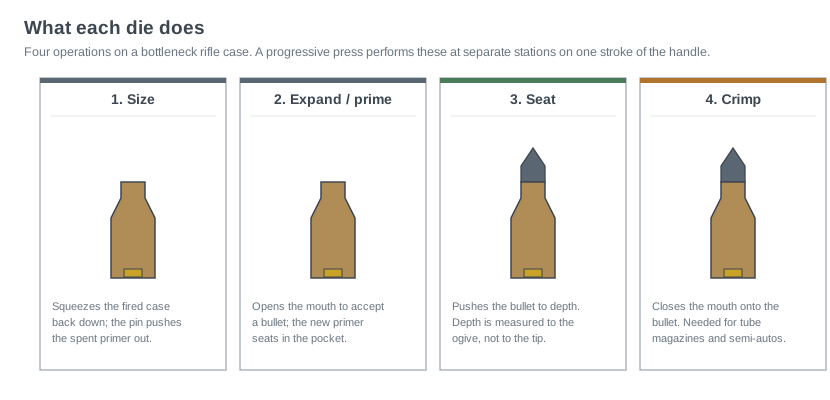
9.1 The Operations, and Which Die Performs Them
A conventional rifle die set contains a sizing die that squeezes the fired case back toward specification and, through a decapping assembly, pushes out the spent primer; and a seating die that pushes the bullet to depth and can usually also apply a crimp. Pistol sets add an expander die that opens and flares the mouth to accept a bullet, and typically separate the crimp into its own die.
Two components inside the sizing die deserve naming because both cause trouble.
The expander ball is a lobe on the decapping rod that pulls back through the neck on the upstroke, setting inside neck diameter. It works, and it works by dragging a steel ball through the neck after the neck has already been squeezed down — which stretches the neck back out, adds runout, and does the job in the least controlled way available. Dies that omit it, or setups that replace its function, exist for that reason.
The decapping pin removes the primer. On a press set up with a large decapping pin, a small-primer case will not simply fail to deprime — it can stop the machine. Volume 2 covers why this is a live problem for .45 ACP specifically, which exists in both primer sizes, and Volume 10 turns it into a sorting procedure.
9.2 Full-Length, Neck-Only and Body Dies
The most consequential die choice for rifle work is how much of the case gets sized.
A full-length die sizes the body, the shoulder and the neck in one stroke. It returns a fired case to something close to factory dimensions, which is what makes ammunition that chambers in any rifle of that cartridge, and it is the correct default for anything fed through a semi-automatic.
A neck-sizing die sizes only the neck, leaving the body and shoulder as the chamber formed them. For a bolt gun firing its own brass, this works the case less, extends case life, and keeps the case fitted to that one chamber.
A body die sizes the body and shoulder without touching the neck — the complement to a neck die.
The trap in neck-only sizing is that it is not a permanent strategy. The body and shoulder grow with each firing, slowly, and a case that has only ever been neck-sized will eventually chamber stiffly and then not at all. The correct response is a body die or a full-length pass at intervals, and the wrong response is to interpret the stiff bolt as a pressure sign. The Headspace dive’s treatment of partial sizing and its traps is the reference for this.
9.3 Bushing Dies and Mandrels
Controlling how much the neck is sized, rather than accepting whatever the die does, is what separates ordinary rifle loading from precision rifle loading.
A bushing die uses an interchangeable ring of a chosen bore as the neck-sizing element, so the amount of interference with the bullet is selected rather than inherited. It sizes from the outside, which means variation in neck-wall thickness is pushed inward, where it affects the grip on the bullet.
An expander mandrel works the other way: the neck is sized down, then a mandrel of chosen diameter is pushed through from inside, setting inside diameter directly and driving thickness variation outward where it does no harm. For brass of uneven neck thickness — which includes most range-pickup brass — this is the more forgiving approach.
Either removes the need for the expander ball. Volume 20 covers what neck tension does once it is under control, and why bullet pull is a better predictor of velocity consistency than most things people measure.
9.4 Small-Base Dies, and When an AR Actually Needs One
A small-base die sizes the case body slightly smaller at the base than a standard die.
The honest position is narrower than the marketing: small-base dies are for tight chambers, and they are not a general requirement for semi-automatic rifles. The research for this dive found no authoritative source making them necessary for the M1 Garand; the requirement there is full-length sizing verified with a case gauge, which is a different thing. For an AR-pattern rifle, the question is answered by gauging finished rounds rather than by assuming — if correctly full-length-sized cases pass a case gauge and chamber freely, a small-base die is buying nothing and working the brass harder than needed.
9.5 Carbide, and the Straight-Wall Exception
Pistol sizing dies are commonly carbide, with a ring of tungsten carbide as the sizing surface. Carbide is slick and hard enough that straight-walled pistol cases can be sized without lubricant, which removes an entire messy step from high-volume loading. This is a large part of why bulk pistol loading on a progressive is as fast as it is.
The exception matters for this bench, and it catches people: there is no carbide sizing die for .450 Bushmaster. The case carries a slight taper — roughly two hundredths of an inch across its length — and a carbide ring cannot size a tapered case. So despite looking like a straight-walled pistol cartridge scaled up, .450 Bushmaster is a rifle-loading process: every case must be lubricated. That is the reason Volume 8 keeps it off the progressive entirely.
9.6 The Die Families, and What Distinguishes Them
The major makers differ in real ways rather than in branding.
Redding is the reference for bushing systems and for micrometer-adjustable seating stems, which let a seating depth be dialled to a repeatable number and written down rather than found by trial each time.
Forster dies are known for their seating design, in which the bullet is aligned in a sleeve before it meets the case — which addresses runout at the point where runout is introduced. The Co-Ax press extends the same idea to the press itself, dispensing with shellholders in favour of floating jaws so that case and die find their own alignment; it was $376.99 from Graf’s, read 2026-09-17.
Hornady dies are conventional and well made, and the maker’s elliptical expander is an attempt at the expander-ball problem from within the standard design.
RCBS sets are the volume default and the baseline against which the others are described.
Whidden makes bushing dies and die bodies for precision work, including dies cut to a chamber’s own dimensions.
Lee dies are the least expensive and include the collet crimp design covered in Volume 20, which is genuinely useful and not simply a cheap alternative. One specific caution, from the research: at least one Lee .300 Blackout die set sizes already-formed brass rather than forming it from a parent case. A die set named for a cartridge is not necessarily a forming die set — read the maker’s description of the operation, which Volume 16 makes the same point about.
9.7 What a Die Cannot Fix
Concentricity — runout — is the amount by which a loaded round’s bullet sits off the axis of its case. Good dies reduce it and no die eliminates it, because some of it arrives with the brass: uneven neck-wall thickness will produce runout in any die, since the die works on the outside of the neck and the bullet sits against the inside.
The order of operations that actually helps is unglamorous: consistent brass first, then a sizing approach that does not add runout, then a seating die that aligns the bullet before it enters the neck. Buying an expensive seating die to correct brass that was never sorted is spending at the wrong end of the process.
9.8 Shellholders, and a Setting That Moves Without Being Touched
A shellholder grips the case rim and sits in the ram. It looks like a commodity part and is not quite one.
Shellholder deck height — the distance from the ram face to the case head — varies between makers, and sometimes between examples. Because a full-length die’s shoulder position is set by how far the case is pushed into the die, and that distance depends on where the case head sits, changing shellholders can change the shoulder bump without anything else being adjusted. A setting recorded against one shellholder is a setting for that shellholder. The Headspace dive lists this among the variables that move a die setting, and it is the one most likely to be overlooked because the part is cheap and looks interchangeable.
Two practical consequences: keep a caliber’s shellholder with its dies, and if a bump measurement changes unexpectedly, check the shellholder before concluding the die moved.
9.9 Lock Rings and Recording a Setting
The lock ring fixes the die’s position in the press. Designs differ in how well they hold that position and in whether they mark the die body.
A ring clamped by a cross-bolt or a split clamp grips without a screw bearing on the die’s threads. A ring with a set screw bearing directly on the threads will hold, and will eventually mark them. Some designs use an O-ring to allow the die to seat consistently against the press while the ring stays put.
Whatever the type, the setting is only useful if it is recorded. A number written against the caliber — and against the shellholder, for the reason above — is what makes the next session begin with loading rather than with rediscovery. Volume 23 covers where that record lives.
9.10 Toolheads, and Where the Economics Bite
On a turret or a progressive, the dies live in a removable head, and this is where caliber changes become cheap or expensive.
A toolhead per caliber means each caliber’s dies stay mounted, set and locked. Changing caliber becomes swapping a head rather than resetting four dies, which is the difference between a two-minute change and a half-hour one — and, more importantly, it means a setting survives.
The costs are specific and worth budgeting separately from the press. All read 2026-09-17: a Dillon RL550 caliber conversion was $99.95, an XL750 conversion $175, and a Square Deal B conversion $195; a Frankford Arsenal shellplate was $89.99 with a toolhead at $123.99; Lee shellplates run around $25, though that figure is user-reported rather than from the maker.
Those numbers are why Volume 8’s recommendation notes that conversions are not a rounding error, and they cut against the XL750 relative to the RL550C — the XL750’s conversions cost more. The countervailing argument, and the one Volume 8 finds decisive, is that the XL750’s fifth station holds a powder-check die permanently on every caliber.
9.11 Stuck Cases
A case sized without lubricant, or with too little, will seize in the die. The case head then tears off the case when the ram is lowered, leaving the case body in the die.
A stuck-case removal tool taps the case body, drills and threads it, and draws it out with a bolt against a bridge. It is an inexpensive tool that is needed rarely and urgently, which makes it worth owning before it is needed. The alternative is a ruined die.
Since .450 Bushmaster on this bench has no carbide option, it is the caliber most likely to produce a stuck case, which is another argument for keeping it on the auxiliary single-stage where a seized die does not stop a production run.
Comments (0)