The Reloading Bench · Volume 18
Powder — Classes, Burn Rate, Metering, Shelf Life
Why the grain's shape decides which measuring tool can work at all, and why a burn-rate chart is a search index rather than load data
Propellant carries the most published information of any component and the least room for improvisation. It is also the one whose physical form, rather than its chemistry, decides most of what happens at the bench: whether a volumetric measure can throw a usable charge, whether a magnum primer is wanted, and whether the equipment in Volume 19 is a necessity or a luxury. Storage — the cabinet question, the quantity thresholds and the law — is Volume 4’s material and is not written here.
18.1 What Smokeless Powder Is
The authoritative taxonomy is SAAMI’s own, in Smokeless Powder: Properties & Storage, and it is worth using in place of the hobby’s looser vocabulary. Its definition is plain: smokeless powders “are essentially mixtures of chemicals designed to burn under controlled conditions at the proper rate to propel a projectile from a firearm.”
The division by chemistry has two members in small-arms practice. “Single-base smokeless powders derive their main source of energy from nitrocellulose, also known as ‘Guncotton.’ The energy sources for double-base smokeless powder are nitrocellulose and nitroglycerin.” Triple-base propellants, adding nitroguanidine, are an artillery class; no small-arms canister triple-base powder could be identified for this dive.
One property explains much about how the material must be treated: “oxygen from the air is not necessary for the combustion of smokeless powders since they contain sufficient built-in oxygen to burn completely, even in an enclosed space.” Smothering is therefore not a fire-control option, and a sealed container is not a safe one.
18.2 Three Physical Forms
SAAMI names three, and this is the taxonomy the volume hangs on: thin circular flakes or wafers; small cylinders, perforated and unperforated, the family the trade calls extruded or stick; and small spheres or flattened spheres, the ball family. Cut-sheet propellant is generally unavailable in the United States but appears in some foreign-loaded ammunition, and “while the physical form is different, the chemistry, nature, and hazards are the same.”
One tidy mapping must be disowned, because it is repeated as a rule and is not one. “Extruded means single base, ball means double base” is false. It is a weak correlation: there are as many double-base extruded powders as single-base ones, Alliant’s line is largely double base, and the Vihtavuori N-series are double base. Chemistry and shape are independent choices, and reasoning from one to the other produces confident errors.
18.3 How Each Form Meters
This is the most practical distinction in the volume, because it decides whether a fixed-volume measure can produce a consistent charge weight at all.
A volumetric measure fills a cavity of fixed volume — a rotating drum or sliding bar — and dumps it. The volume is highly repeatable; the mass is not, because kernel packing varies with kernel shape. Long extruded kernels bridge the drum throat and are sheared by the drum edge; spheres flow and pack consistently.
The best documented comparison located, covering the Redding BR-30, the RCBS Uniflow and a Harrell’s measure, gives the effect a number.
Table 1 — How Each Form Meters
| Form | Metering behaviour | Measured throw standard deviation | Practical consequence |
|---|---|---|---|
| Spherical / ball | Best — flows and packs consistently | 0.1 to 0.2 grain | The choice for progressive and volumetric loading and high-volume pistol work |
| Extruded / stick | Worst — kernels bridge the throat and are sheared | 0.2 grain or slightly higher | Wants trickling or a dispenser for precision rifle work |
| Flake | Poor — less uniform density, and flakes hang up | Not separately measured in the sources located | Common in shotshell and fast pistol powders, where small charges make the same absolute error a larger relative one |
A practitioner summary from the same testing puts it more bluntly: in over thirty-five years, no thrower had been found that consistently threw extruded powders precisely, with Harrell’s judged about the best available. That is one experienced voice rather than a measurement, but it agrees with the numbers.
The consequence links two volumes. If a load calls for a spherical powder, a good volumetric measure is a complete solution and the expensive weighing equipment of Volume 19 buys very little. If it calls for an extruded powder — most medium and slow rifle powders in common use — a measure alone will not hold a tight charge weight however good it is, and the choice of propellant has quietly made the choice of scale.
A trade runs the other way, and it is a neat inversion. Spherical powders carry heavier deterrent coatings to control burn rate, which makes them harder to ignite than extruded powders. That is the origin of the magnum-primer recommendation for ball powders in Volume 17: the form that meters best is the fussiest about lighting, especially in the cold.
18.4 Burn-Rate Charts and How to Read One
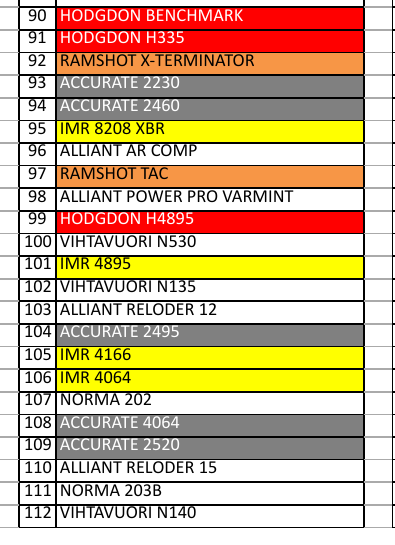
The canonical reference is Hodgdon’s Relative Burn Rate Chart, whose 2024 edition covers the Hodgdon, IMR, Winchester, Ramshot and Accurate family alongside competitors. Its usefulness is real and narrower than it looks. Hodgdon describes it as a way to “identify not-yet-tried powders that have similar burn rates”, and gives the use case in the trade’s idiom: someone may call a powder a 4350 or a Varget burn speed, and the chart finds powders a bit faster or slower. That is a search function.
The most useful part is the negative test, and it is Hodgdon’s own point: “if a powder is not listed, there is a good chance that it is either too fast (resulting in high pressure or too much air space in the case) or too slow (resulting in low pressures and low velocities) for that load combination.” A powder absent from a cartridge’s published data is absent for a reason.
Five limitations make cross-brand ordering approximate. Burn rate is relative, not absolute, so a chart cannot show the gaps between neighbours in proportion. The scale is non-linear, so adjacent powders may be nearly identical or substantially different. The ordering changes with the cartridge, and with bullet weight within one cartridge, because burn rate is pressure-dependent and cartridges work in different pressure regimes. Lot-to-lot variation shifts a powder’s position. And manufacturers determine burn rate by different methods, so cross-brand placement interpolates between incompatible measurements.
Hence the rule that matters more than anything else on the page: do not substitute a powder on the basis of a burn-rate chart. The chart tells a loader which published data to go and look for. It is a search index, not load data, and adjacency is not equivalence.
One instance shows how that fails. The M1 Garand dive documents a genuine disagreement over whether a particular powder suits that rifle, where the powder sits immediately beside an accepted one on the chart and was nonetheless rejected as too slow by one authority. Gas-port pressure, not chamber pressure, is what that rifle’s operating rod cares about, and burn-rate adjacency does not carry port-pressure equivalence with it. That dive is the canonical treatment of the Garand’s powder window and its specific recommendations are not reproduced here.
18.5 Temperature Sensitivity
Here the marketing claims hold up well under measurement, which is unusual enough to say plainly.
The best-instrumented test located was published by PrecisionRifleBlog on 8 March 2025, and the method is the reason to trust it: ammunition acclimated to four temperature points from 5 to 108 degrees Fahrenheit, eight hours of equilibration at each following a 2022 Journal of Ballistics study, ten rounds per temperature fired in an underground hundred-yard tunnel, with temperature logged and point of impact measured on target.
Table 2 — Temperature Sensitivity
| Load | Cold | Hot | Change | Rate | Point-of-impact shift |
|---|---|---|---|---|---|
| 6mm Dasher, Varget | 2,821 fps at 5 °F | 2,835 fps at 108 °F | 14 fps over 103 °F | 0.136 fps per °F | None detected |
| 6mm Creedmoor, H4350 | 3,088 fps at 5 °F | 3,102 fps at 105 °F | 14 fps over 100 °F | 0.140 fps per °F | None detected |
Average group size across all temperature conditions for the Dasher load was 0.298 MOA. A hundred-degree swing produced no detectable change in where the rifle shot at a hundred yards.
The contrast makes the number mean something. Handloader documented an ordinary powder gaining 87 fps from 70 to 115 degrees Fahrenheit — about 1.9 fps per degree, roughly fourteen times the rate above. Three families are marketed on this property, named by Hornady engineers as relayed in that article: Hodgdon Extreme (H4350, Varget, H4381, H1000, Retumbo), Alliant’s temperature-stable line (Reloder 16, 23, 26 and 15.5, the last noted unavailable at the time of writing) and Winchester StaBall (StaBall 6.5, HD and Match).
One caveat travels with all of these figures. The Courtney paper below criticises conditioning ammunition to temperature and then firing it through a room-temperature rifle, and describes a temperature-controlled box holding rifle and cartridge together with remote triggering. The point is fair: what matters on a cold morning is the whole rifle-and-cartridge system, not the powder’s coefficient in isolation. The figures above are powder figures.
18.6 Lot-to-Lot Variation
The most rigorous handloading experiment located in this dive’s research is a lot-variation study, and its method is what makes it usable. Courtney and Courtney, under BTG Research, took four lots of Varget acclimated in one storage area for over a year and loaded them into .223 Remington with two bullets and .308 Winchester with a third, ten rounds per lot per load. Critically, shots from the four lots were interleaved one per lot in rotation, so barrel heating and fouling could not confound the comparison, with the same loader, brass, primer and bullet lots, day, shooter and chronograph.
Across the four lots, the .223 load with the heavier bullet spread 23.4 to 45.6 fps above the slowest; with the lighter bullet, 7.9 to 15.3 fps. The authors are honest about the limit: the modest correlation between the two loads’ lot rankings “suggests that factors other than lot to lot variations contribute significantly to the measured velocity variations.”
The comparison that lands comes from the same authors’ earlier work on H4831, where lot-to-lot variation exceeded 100 fps in .25-06 and .300 Winchester Magnum. Decoding lot numbers separated two effects cleanly: different packaging dates, shipping and storage histories of the same factory lot accounted for only 12 to 17 fps, while different factory runs accounted for over 100 fps.
So one marketing claim survived and another did not. Varget’s lot consistency was found “consistent with Hodgdon’s marketing claims”; H4831’s was not. The claim is powder-specific rather than line-wide, and flattening it either way loses the finding.
What follows is a discipline rather than a number, in Hodgdon’s own words: “for all brands of powders use only the components shown. If the reloader makes any changes in components or gets new lot numbers, he should begin again with the starting loads and work up to maximum cautiously.” A new lot is a new component. Volume 21 covers what working up means and why the rule is not excessive caution; the habit belonging here is to record the lot number, the field most often omitted and among the most consequential.
18.7 Shelf Life Is Stabiliser Life
Deterioration has a mechanism, and knowing it makes the warning signs make sense rather than needing to be memorised.
Nitrocellulose is made by nitration and retains traces of acid. That residual acid slowly decomposes the nitrocellulose, and the decomposition is autocatalytic — its products are themselves acidic, so the reaction accelerates. Manufacturers add stabilisers, diphenylamine and related compounds, to scavenge those products. Shelf life is therefore really stabiliser life: powder is stable until the stabiliser is consumed, after which degradation runs away. Heat consumes stabiliser faster, which is why cool storage is the mechanism by which powder lasts decades rather than a nicety. A frequently quoted account of that chemistry comes from a manufacturer storage document that returned an access error on direct retrieval, captured only through a search index, and is not quoted here as verified.
SAAMI’s description of the signs is the part to act on: “deteriorating smokeless powders produce an acidic odor similar to vinegar and may produce reddish-brown fumes. (The acidic smell should not be confused with common solvent odors such as alcohol, ether and acetone.) Properly dispose of deteriorating smokeless powders immediately.”
Table 3 — Shelf Life Is Stabiliser Life
| Sign | Confidence | Note |
|---|---|---|
| Sharp acidic or vinegar odour on opening | Established, from SAAMI | The most reliable sign. Normal solvent smells — alcohol, ether, acetone — are not this |
| Reddish-brown fumes | Established, from SAAMI | Nitrogen oxides; advanced decomposition |
| Reddish-brown or amber dust, or a rust tint to the kernels | Common practice | Reported consistently across sources |
| Rust inside a metal can or on its lid | Common practice | Acidic off-gassing attacking the container |
| Clumping or caking | Common practice | Moisture ingress or deterioration |
The claim that properly stored powder lasts indefinitely is roughly right, and the trade’s framing is more accurate: powder starts deteriorating the day it leaves the mill, and cool, dry, dark storage in the original container makes that slow enough to be irrelevant over a human lifetime. Decades-old powder in good condition is ordinary. The test is the smell test, not the date on the can.
Two rules are absolute in the published guidance. SAAMI: “never salvage powder from old cartridges and do not attempt to blend salvaged powder with new powder or attempt to blend two types of powder to make a ‘custom’ blend. Don’t accumulate old powder stocks.” For disposal, Alliant specifies burning in small shallow piles, a maximum of one pound per pile, at an isolated location — not down a drain, not in household waste. The common suggestion that small quantities make a garden fertiliser is endorsed by no manufacturer source located here and is not recommended.
One consequence is a safety matter rather than a performance one, stated explicitly: exposure to elevated temperatures “produces an acidity which accelerates further reaction and has been known, because of heat generated by the reaction, to cause spontaneous combustion.” That is why the temperature rule is a safety rule, and the strongest argument against the attic, the uninsulated garage and the car trunk. What to do about it is Volume 4.
18.8 What Confinement Does, and the Word to Avoid
Getting this right matters more than any other paragraph here, because the popular version is wrong in a way a knowledgeable reader catches immediately.
Smokeless powder does not detonate. SAAMI is explicit: it “does not detonate like high explosives as it has a controlled rate of burn and differs considerably in its burning characteristics from common ‘black powder.’” What it does instead is stated just as plainly: “all smokeless powders are extremely flammable; by design, they are intended to burn rapidly and vigorously when ignited.” And the behaviour creating the hazard: “the burning rate of smokeless powder increases with increased pressure”, so that “if burning smokeless powder is confined, gas pressure will rise and can eventually cause the container to burst. Under such circumstances, the bursting of a strong container creates effects similar to an explosion.”
The mechanism is a chain: confinement raises pressure, pressure raises the burning rate, that raises pressure further, and the container fails catastrophically as a pressure vessel, producing blast and fragmentation. The practical danger is identical to an explosion; the mechanism is not one. A welded steel box full of powder is a bomb casing, not a bomb.
That distinction has experimental backing rather than resting on a definition. The 1974 programme run by SAAMI with the Chicago Fire Prevention Bureau at Olin’s Winchester-Western plant near East Alton, Illinois had mass explosion as an explicit objective — to burn packed ammunition in a fire-resistant structure providing close confinement and determine whether heat and pressure build-up increased the rate and intensity of burning “or possibly causes mass explosion.” It covered 111 cases and 145,500 rounds containing approximately 272 pounds of smokeless propellant and 9.2 pounds of priming composition, with 67,000 rounds in the structure burn. Popping began about a minute after ignition and lasted twenty minutes; no missile problems were encountered, firefighters worked in standard turnout gear, and cases were found up to 135 feet away. On loose ammunition in the open: “when not strongly and tightly confined, smokeless propellant powders burn relatively slowly and do not explode”, and bullets “are not projected at velocities higher than you could throw them by hand”, the whizzing of newspaper accounts being primer cups popping from shells.
The ignition sources named are worth listing because one is non-obvious: flame, including a primer flash; electrical sparks or sparks from welding and grinding; heat from an appliance, hot plate or incandescent bulb, or a fire directed against or near a closed container even when the powder is not exposed to flame; and impact, friction and static discharge.
18.9 The Bench Rules That Actually Matter
These are published manufacturer and association guidance rather than this dive’s opinions.
Never substitute a powder — only the exact powder named in the data, not the one beside it on a chart. Never exceed a published maximum, which is tied to the components, barrel and test equipment that produced it; Volume 21 covers why the maximum does not transfer between rifles while the starting load does. Start at the published starting load and work up, beginning again on any component or lot change.
Store only in DOT-approved original containers: “do not transfer the smokeless powder from an approved container into one which is not approved.”
One powder on the bench at a time. The canonical wording: never have more than one can on the bench at any time; when finished, pour the unused portion back into that can, seal it and return it to storage before bringing another. That prevents two errors at once — mistaking which powder went into a batch, and pouring leftovers into the wrong can. The attribution of that wording to a named publisher could not be confirmed; it was captured through a search index across several manufacturer safety pages and is given as consensus guidance rather than a quotation.
Static discipline: ground the equipment and avoid static build-up on the person, since static discharge is among the named ignition sources. No smoking, no open flame, no sparks where powder is stored or used, including welding and grinding, and no hot plates or incandescent bulbs nearby. Clean up spills promptly. Give it undivided attention — the NRA’s formulation is to reload only with full attention available, no phone and no television. Wear safety glasses.
18.10 Availability, Briefly and Carefully
Supply in 2026 is uneven, and the sources describing it are mostly vendor blogs with a direct interest in conveying scarcity. They report production continuing while popular powders appear in small batches and sell out quickly, with primers harder to find than powder because primer manufacture involves precision explosive handling and capacity expands slowly. No recovery timeline from those sources is printed here, since none is independent and none publishes production figures. One piece of corroboration comes from a source with no commercial interest: the Courtney study noted that supply and demand issues had caused component shortages, and that only four unique lots of Varget could be acquired for testing.
The durable consequence is a habit rather than a forecast. Volatility raises the value of recording lot numbers, and it is the one legitimate argument for buying a powder in the largest single lot that can be safely and lawfully stored — one lot means one verification rather than several. That is an accuracy argument rather than a price one, and the quantity limits bounding it are Volume 4’s subject.
Comments (0)