The Reloading Bench · Volume 5
Presses I — Single-Stage and Turret
Frame geometry, linkage and priming decide more than the badge does — and then the machines that use them
Frame geometry decides more about a press than the name cast into it does. Every press here performs the same act — it pushes a case into a die and pulls it back out — and the differences between them are differences in how that force is carried, how much mechanical advantage exists where the force peaks, whether the stroke ends against a mechanical stop or against the operator’s hand, and where the primer is seated. Those four questions explain most of the price spread in the category.
Prices below were observed on 2026-09-17, each given with the source it was read from. Reloading prices move quickly, and several figures rest on a single readable source because the largest US reloading retailer could not be read at all during the research pass.
5.1 The Load Path Is the Whole Design
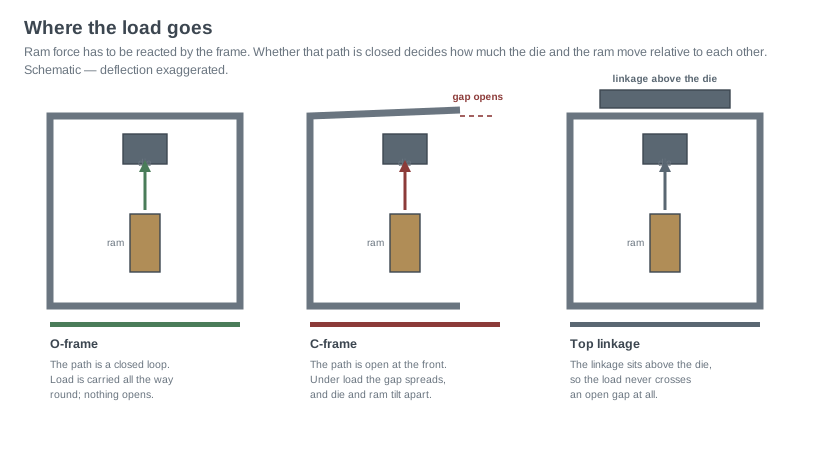
An O-frame closes the load path. Ram, frame and die sit inside a continuous loop of iron, so sizing force is carried around a ring rather than trying to open a gap. This is why nearly everything sold as a heavy-duty single stage is an O-frame: RCBS describes the Rock Chucker Supreme as heavy-duty cast iron with a central pivot giving leverage to size tough cases, and Lee describes the Classic Cast as rigid cast iron in a classic O design for maximum strength.
A C-frame is open on one side. It gives better access and visibility and is cheaper to cast, but the open side can deflect under load, and that deflection is the mechanism behind runout complaints on light C-frames. RCBS’s cheaper entry kit, the Reloader Special-5 Explorer, is a C-frame.
The instructive exception is the Redding Ultramag, a deliberate C-frame that answers the objection by moving where force is applied: its leverage system connects to the top of the frame rather than the lower half, delivering the reaction load at the same height as the die instead of trying to spread the C open. Redding claims more mechanical advantage over a greater distance than any other press, and tons of pressure without frame deflection or misalignment. That is a manufacturer claim, no independent measurement of it was located, but the geometry is sound and it is why a C-frame is acceptable in this one case.
A third approach splits the difference. The Redding Big Boss II is a cast-iron O-frame with a 36 degree offset — the frame rotated toward the operator, buying C-frame access without opening the load path. Hornady’s Lock-N-Load Classic uses the same idea in an alloy frame set at what Hornady calls a unique angle for visibility and access.
5.2 Linkage, and the End of the Stroke
Every serious press multiplies handle force through a compound linkage — a toggle reaching maximum mechanical advantage near the top of the ram stroke, which is exactly where sizing force peaks. Hornady calls its version Power-Pac Linkage, solid steel arms on steel pins; Redding’s T-7 gets over 3.8 inches of ram travel from its linkage. The strongest published claim belongs to the Forster Co-Ax: three times the mechanical advantage of an ordinary C press, achieved through the yoke and floating guide rods rather than through a longer handle. Leverage and handle length are separable variables.
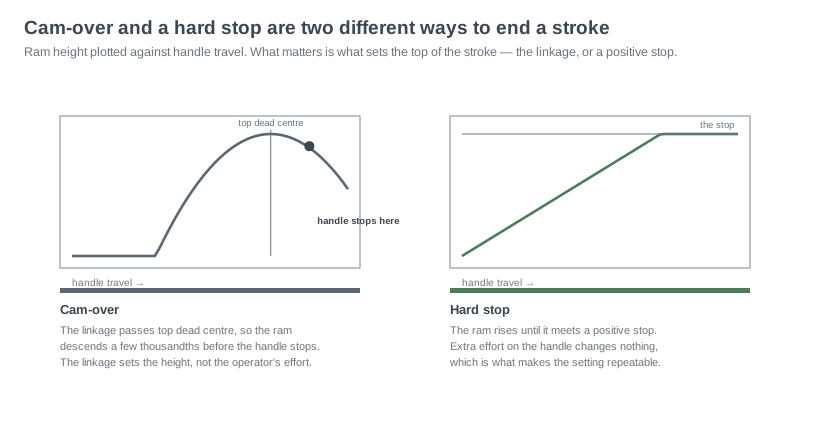
Cam-over means the linkage travels slightly past top dead centre, so the ram’s last motion is downward again and die contact is made against a mechanically locked toggle rather than against hand pressure. The benefit is a repeatable shoulder bump that does not depend on the operator feeling for the end of the stroke. A positive ram stop takes the opposite approach — the ram meets a mechanical limit and stops there — and Redding specifies the T-7 that way.
The Area 419 ZERO shows this is a real design choice. Area 419 advertises a firmer linkage giving bottom-of-stroke firmness for cam-over capability as a Gen 2 change, while Gen 1 was reviewed by Ultimate Reloader as a hard-stop press, its hands-on finding a very pronounced stop when the ram hits the bump stop. That is a genuine generational change in how the machine behaves at the end of every stroke.
5.3 Ram, Stroke, Window and Handle
Three published numbers describe what a press will accept: ram diameter governs stiffness and bearing area, stroke governs how long a case can be worked, and the window governs what fits between ram and die. The Lee Classic Cast has the largest mainstream ram at 1-1/8 inch with over twelve square inches of bearing surface; the ZERO Gen 2 a precision-ground 1.25 inch ram with under .0006 inch diametric clearance, 4.4 inches of stroke and 4.75 inches of opening; the Big Boss II 1 inch, 3-13/16 inch and 4-1/2 inch; the T-7 1 inch, 3-11/16 inch and 4-3/4 inch; the Ultramag 4-1/8 inches of usable stroke and a 4-3/4 inch opening.
Two gaps should be stated rather than filled. RCBS publishes no ram diameter for the Rock Chucker Supreme and no figure for it could be confirmed; the 4.25 inch window is the only dimension given. And Lee publishes no numbers at all for the Classic Cast’s stroke or opening, claiming the largest opening in the industry and the longest stroke without quantifying either — against the Ultramag’s 4-3/4 inch and the ZERO’s 4.75 inch, that claim could not be confirmed. Lyman likewise publishes a 1 inch ram for the All-American 8 and no stroke.
Handle geometry is where the frame reaches the operator’s shoulder. RCBS sells the Rock Chucker’s handle as ambidextrous and pairs it with large mounting points and a long handle specifically so the press is not pulled off the bench while sizing; Lyman’s All-American 8 has an ambidextrous ball handle; the Co-Ax clears either hand and offers a short handle accessory at $24.00, reduced from $32.00, per Forster. Lee’s 48-tooth ratchet clamp is the useful detail here, because 48 teeth means handle angle is settable in 7.5 degree increments where most competitors offer two or three positions. The Ultramag is described in retailer specification text as having a bottom right hand handle; Redding’s own page does not state handle side, and whether a left-hand option exists could not be confirmed.
5.4 Priming, Spent Primers and Die Threads
On-press priming diverges more than the specification tables suggest. The Co-Ax makes the strongest mechanical claim: its top-mounted device holds the seater always at right angles to the case head, so in Forster’s words primers will not flip or tip and will seat straight, level and at uniform distance, and the design cannot crush primers or allow protrusion. The geometry rather than the claim is the point — a seater square to the case head has no way to tip a primer.
The Redding presses share a Smart Primer Arm that swings into position during the stroke and out of the way when idle, with both large and small assemblies now supplied on the Big Boss II and priming at end of stroke on the Ultramag for maximum sensitivity. The Lee Classic Cast primes at the bottom of the stroke, two arms supplied. The Hornady Lock-N-Load Classic ejects the spent primer at the top of the stroke and seats the new one at the bottom where leverage is best. The Lyman All-American 8 uses a straight-line tube feed with large and small tubes and a heavy steel blast shield — worth a sentence, because a tube system stacks primers in a column and the shield is what stands between that column and the operator’s face.
Two negatives matter more than any positive. The Forster Co-Ax XL, the company’s current flagship at $1,297.50 reduced from $1,730.00 and out of stock on 2026-09-17, has no priming system at all, stated plainly by Forster as a design difference, so a buyer moving up to it needs a separate bench primer. And the ZERO Gen 2 added a primer tray detent implying a provision, but the exact mechanism could not be confirmed.
Spent-primer routing dominates daily annoyance. Lee drills the ram completely through so primers drop straight to a bin; Redding routes them through the hollow ram into a flexible tube on the T-7, Ultramag and Big Boss II; Forster has a positive catcher. Die threads are nearly standardised — 7/8-14 is near-universal, while the Rock Chucker Supreme and the Lee Classic Cast both take the larger 1-1/4-12 natively and adapt down with a bushing or included adapter, and the ZERO ships a 7/8 inch turret with a hybrid option. Die families and selection are Volume 9’s subject.
5.5 The Rock Chucker Supreme — the Named Benchmark
The Rock Chucker Supreme is the press every other single stage is described against, and it is a $240 to $260 press in September 2026: $259.99 direct from RCBS and $239.99 at Scheels, both seen 2026-09-17. The street price sitting below the manufacturer’s own direct price is a small counterintuitive data point worth keeping. Published specifications are a cast-iron O-frame with a 4.25 inch operating window, 1-1/4-12 threads natively and 7/8-14 with a bushing, on-press priming, an ambidextrous handle and a long handle with central pivot.
Four things make it the default, and only two are about the press. It is strong enough to be the last press a hobbyist buys — a cast-iron O-frame with that window will full-length size from .223 up through the magnums. Accessories and knowledge are ubiquitous, because decades of production mean every mounting plate, roller handle and bench-mount kit is made for it and every troubleshooting question has been answered somewhere. Its price position sits under the Co-Ax, the T-7 and the All-American 8, and far under the ZERO. And there is a kit pathway: RCBS sells it as the core of a master reloading kit, which is how a very large share of American handloaders began — so the consensus is partly self-reinforcing habit rather than a purely technical verdict, and saying so is more useful than pretending otherwise.
Two parts of the history are commonly inverted. RCBS was founded in 1943 by Fred Huntington, who built a swaging machine to turn spent .22 rimfire cases into bullet jackets, working in the boiler room of his father’s Oroville laundromat. The company name comes from the rock chuck, the varmint around Oroville that Huntington wanted ammunition for — so the press is named after the company’s founding animal rather than the company after the press. Ownership ran Omark Industries in 1976, Alliant Techsystems in 2001, a spin-off under Vista Outdoor in 2015, and acquisition by Hodgdon Powder Company in 2024. That last is the most under-reported fact here: the benchmark single-stage press is now a Hodgdon product.
The introduction year is genuinely disputed and is not printed here. One review site states the press has been made since 1967; forum owners describe the original arriving in the early 1970s and report buying units late in 1970 or early in 1971 with crinkle finish and bicycle grip handles. Neither source could be read in full, and the Wikipedia article on RCBS does not mention the press at all. Three generations are commonly described — the original, the Rock Chucker II, and the Supreme — the II replacing light green crinkle paint with dark green epoxy and the Supreme’s headline change being the taller window for magnum cases. Dates for the II and the Supreme could not be confirmed, and the more useful observation is that RCBS appears never to have published a clean model chronology at all.
5.6 Forster Co-Ax — What the Floating Design Actually Does
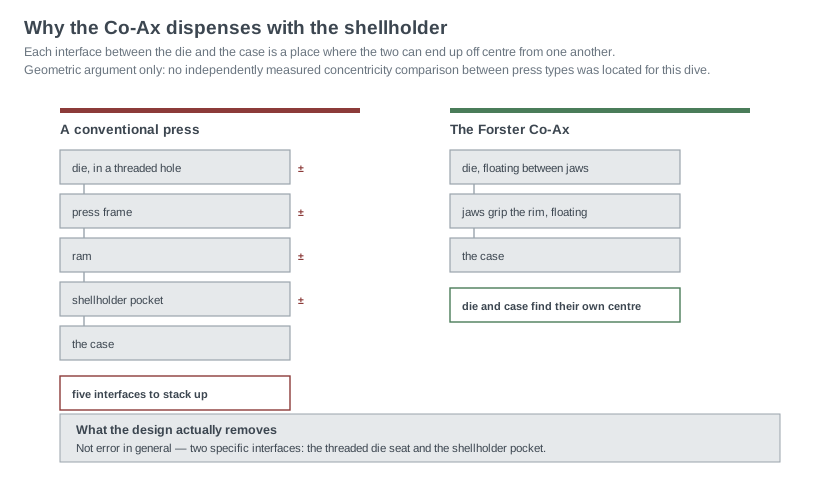
Two separate things float on a Co-Ax, and popular writing conflates them. First, the die floats: dual floating guide rods hold it so it can move laterally, and Forster claims no torque on the press head with forces remaining in equilibrium at all loads. Second, the shellholder jaws float with it — Forster’s own wording is that the jaws are designed to float with the die, permitting the case to centre precisely in the die. The self-aligning “S” jaws replace a conventional shellholder entirely, so an existing shellholder collection does not transfer.
The consequence is the part worth understanding. On a conventional press the case is centred by a shellholder whose pocket has a tolerance relative to the ram, which has one relative to the frame, which has one relative to the die threads. Every interface contributes runout. On the Co-Ax the case is centred by the die itself, and most of that chain leaves the alignment path. It is a genuinely different idea rather than a tighter version of the same one.
What the improvement measures is far less established than the mechanism. A user report claims the press took concentricity from .005 inch on a Rock Chucker to .001 inch or less — one user, one press, one die set, no stated method, recorded here as a commonly repeated anecdote rather than as data. No independent measured runout comparison between a Co-Ax, a turret and a conventional single stage could be located anywhere in the research for this dive. That is a real gap in the public record, and it is measurable at a private bench with a concentricity gauge, one lot of brass and one die set.
Die changes are snap-in and snap-out in about two seconds, the press takes standard 7/8 by 14 dies, Forster claims compatibility with over ninety calibers from 17 CCM through 9mm Luger, and the frame is a cast-iron O. Model letters B-1 through B-5 exist, later letters adding clearance under the yoke handle, a larger primer drop tube and retaining pins in the jaw housing — differences documented on a forum rather than by Forster, with model years for each letter unconfirmed.
The price needs flagging rather than resolving. Forster’s own page lists the press as starting at $590.00, while Graf & Sons lists $376.99 for the same manufacturer part number, both seen 2026-09-17; a Brownells snippet showed presses starting at $385.99, though that page returned an error and could not be read. A 36 percent spread on one part number is not ordinary dealer discounting. Either the manufacturer figure is a list price the trade does not honour, or the configurations differ — Forster also lists an optional wood stand at $88.00 and a cover at $18.00, so bundling is possible. Which explanation is correct could not be confirmed, and the dealer price is the real-world number.
5.7 Redding, Lee and Hornady
The Big Boss II is $261.99 at Graf & Sons, seen 2026-09-17 — the original Big Boss plus the spent-primer collection system previously found only on the T-7 and Ultramag, with the 36 degree offset frame as its distinguishing feature. A second figure of $281.92 appeared in a retailer snippet whose page could not be read.
The Ultramag is $405.99 at Graf & Sons, seen 2026-09-17, with a $489.99 figure in a snippet of unclear origin — the spread is unresolved. High-grade cast iron, top-mounted long-link linkage, a 4-3/4 inch opening, 4-1/8 inches of usable stroke, priming at end of stroke, spent primers through a hollow ram; Redding calls it the largest and strongest press available for the toughest reloading chores. For the two awkward cartridges on this bench that geometry is the strongest mechanical answer in the tier: .450 Bushmaster has no carbide sizing die, so every case is lubricated and sized in steel, and a long stroke with the reaction load delivered at die height is what a large, hard-sizing case wants, while .30-06 wants the stroke and window for length. Volume 8 weighs that against everything else.
The Lee Classic Cast is $260.00 direct from Lee, seen 2026-09-17: cast-iron O-frame, the biggest ram in the group, drilled completely through for primer disposal, the 48-tooth adjustable handle, 1-1/4-12 threads with a 7/8-14 adapter included, standard shellholders via a rotatable ram insert, bottom-of-stroke priming. At that price it sits directly against the Rock Chucker Supreme and the Big Boss II while having the largest ram of the three; its weakness relative to those two is brand perception and resale rather than anything in the specification sheet.
Hornady publishes no price for the Lock-N-Load Classic. Two dealer figures were verified, both for the kit rather than the bare press: $395.00 reduced from $440.99 at Graf & Sons, and $315.00 reduced from $399.99 at Titan Reloading, which labels it overstock clearance pricing while supply lasts. The Titan figure is a clearance price rather than a market price, and the bare-press street price could not be confirmed at all. Beyond the offset alloy frame, the Positive Priming System and Power-Pac Linkage, its strategically important feature is the Lock-N-Load Quick Change Bushing System, allowing die changes in seconds without readjustment — the same standard used on the Lock-N-Load AP progressive of Volume 6, so a die set up on one machine transfers to the other with its adjustment intact.
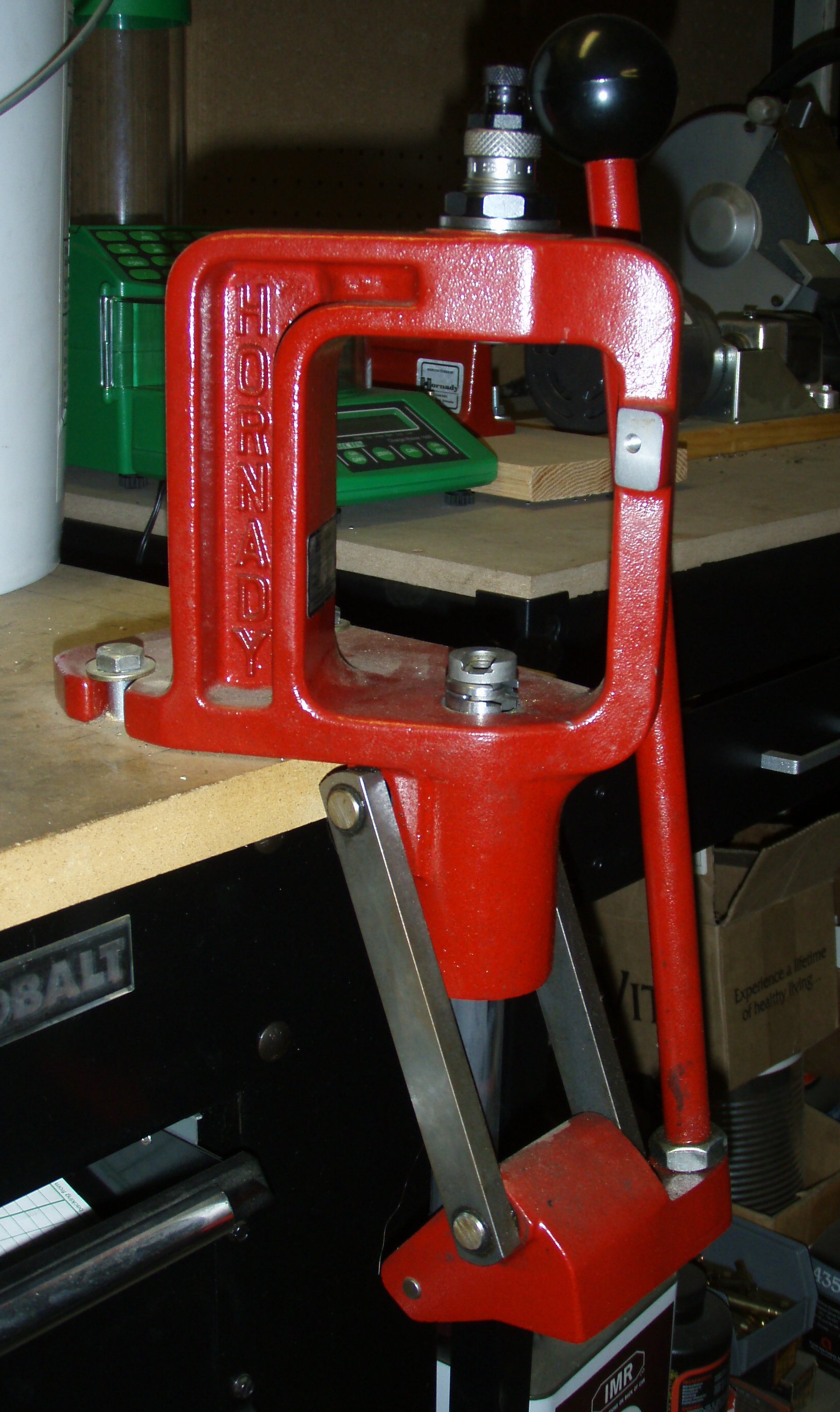
5.8 Area 419 ZERO — a Turret in a Single-Stage’s Clothes
The ZERO Gen 2 is $1,400.00 direct from Area 419, seen 2026-09-17. Gen 1 was $1,200 in 2020 and is discontinued, so the nominal increase over six years is a real-terms decrease. Several large retailers also list it at prices that could not be read. Specifications are billet aluminium and stainless steel, 35 pounds, fourteen bearings including a self-lubricating linear sleeve, capacity to .338 Lapua Magnum, and a steel and 7075 aluminium turret with an oversized ball detent and a stated repeatability of less than .0005 inch variance. Gen 2 adds the cam-over linkage, a smoother stroke, the primer tray detent and a torque tool storage slot, and is backward compatible with Gen 1 stands, trays and shellholders — though Area 419 notes die adjustment may be needed because the linkage changed, so a Gen 1 owner’s settings do not transfer untouched.
The categorisation point matters more than the specifications. The ZERO has nine die stations and is described by Area 419 and by reviewers as a turret, with the explicit design intent of stopping dies being screwed in and out on the reasoning that indexed dies eliminate the variation repeated installation introduces. It belongs in both halves of this volume, and reads most cleanly as the point where the turret concept is re-aimed at precision rather than at speed. One magazine performance claim — a headspace standard deviation of zero and an extreme spread of .001 inch on fire-formed brass — comes with no stated methodology and is recorded as manufacturer-adjacent rather than as a measurement.
5.9 A Correction Worth Printing
Mighty Armory does not make a reloading press. The name arises often enough in press discussions that the error propagates, and an earlier working brief for this dive listed the company as a single-stage maker. Its catalogue is dies and die accessories, and its Gold Match sizing line is CNC machined from tool steel, sizes and decaps in one operation, and offers shoulder bump settable from zero to roughly .005 inch by adjusting the die in the press. It sells press-specific sets for Dillon, Hornady and Mark 7 machines. Die prices could not be confirmed. One aside applies to every press in this volume: the company recommends a wax lubricant when sizing on single-stage and turret presses.
5.10 Turrets — the Honest Case, For and Against
A turret’s only real advantage is that the dies stay set. On a single stage a four-die pistol sequence means either four die changes per batch, with the readjustment risk that carries unless the press has a bushing system, or four separate passes through the whole batch. A turret holds all four. The secondary benefits follow: fewer lock-ring resets means fewer chances to drift a shoulder bump or a seating depth, and one bench footprint does the work of a die rack.
Three places it does not win, none of which should be hedged. Rigidity — a turret head is a second interface between die and frame, and a rotating one, where a single stage threads the die into solid iron. Redding’s answer is a rigid seven-station turret in cast iron, Lyman’s is cast iron too, and Area 419’s is steel and 7075 with a published repeatability figure; that last number exists precisely because the objection is real. No independent measurement of turret-induced runout on the T-7 or the All-American 8 could be located, which is the second gap in this volume’s evidence. It is not a progressive — one pull still equals one operation, and a Lee Classic Turret with auto-index completes a cartridge in four pulls, the same handle count as a single stage, with only the die handling saved. Throughput for bulk pistol is in the low hundreds per hour against the several hundred a progressive manages, so for 5.56, 9mm, .40 S&W and .45 ACP volume it is the wrong tool.
Where a turret wins outright is the case this bench presents on its precision side: a handful of bottleneck rifle cartridges, loaded in modest batches, where two complete die sets want to stay in the machine between sessions.
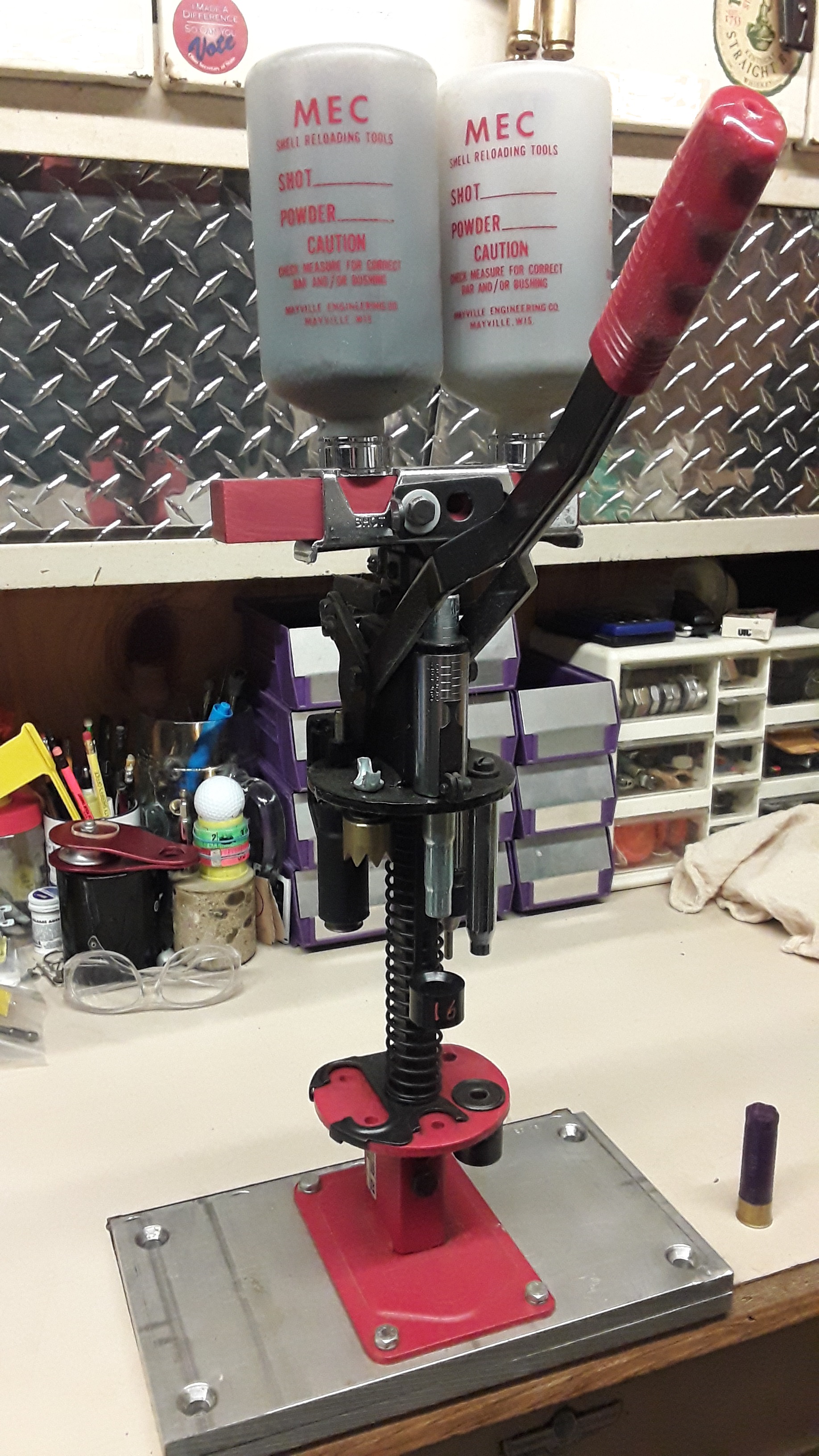
5.11 The T-7, the All-American 8 and the Lee Classic Turret
The Redding T-7 is $391.99 at Graf & Sons, seen 2026-09-17: seven stations, heavy-duty cast iron, compound linkage with over 3.8 inches of ram travel and a positive ram stop, 1 inch ram, 4-3/4 inch opening, 3-11/16 inch stroke, tubular spent-primer collection, standard dies and universal shellholders, and the Smart Primer Arm borrowed from the Ultramag. There is no auto-index — the head is turned by hand, which for careful rifle work is arguably the feature rather than the omission. Seven stations is the number that matters, because a full rifle sequence for two cartridges fits at once. A $519.99 figure in an unreadable snippet is a kit price rather than a press price, and the difference between two catalogue item numbers that both appear for this press could not be confirmed.
The Lyman Brass-Smith All-American 8 is $399.95 direct from Lyman, seen 2026-09-17: eight stations holding two complete four-die sets or up to four two-die sets, rigid cast-iron frame and turret, 1 inch ram, compound linkage, 23 pounds, the ambidextrous ball handle, and the tube primer feed with its blast shield. Against the T-7 it offers one more station and a tube feed for a few dollars more, and the genuine differentiator is priming philosophy rather than station count: a tube feed is faster per cartridge but stacks primers, while a single-primer arm is slower and inherently safer because there is no column to stack.
The Lee Classic Turret is the auto-index machine: $260.00 direct from Lee for the four-hole turret version and $185.99 at Graf & Sons, both seen 2026-09-17, under two part numbers whose relationship could not be confirmed. The kit is $389.00 and carries a real trap for a rifle buyer, because the charging die a rifle cartridge needs is sold separately. Construction is the steel linkage of the Classic Cast on an iron base, with a maximum cartridge overall length of 3.313 inches — ample for .30-06, so length constrains nothing on this bench. The auto-index mechanism is documented better by users than by Lee, whose page states only that the press has the feature: a removable auto-index rod ratchets the turret one station per stroke, so four pulls yield a cartridge, and removing the rod converts the press to a manual turret. That removability is the feature to emphasise, because one press then covers bulk-ish pistol with the rod in and careful rifle with the rod pulled.
Its throughput claim is the cleanest small illustration of how rated figures are built, and Volume 6 uses it again for that reason. Lee claims 250 or more rounds per hour; the timed trial behind that number reached 249 and explicitly excludes renewing primers, cases and powder. User-reported sustained figures run 150 to 200 on pistol, with one 9mm loader reporting about 170. The manufacturer’s figure is achievable as a sprint with the consumables already loaded, the sustained number is materially lower, and the gap is entirely refilling.
One further note on the segment: no current RCBS turret press could be found on RCBS’s own single-stage or progressive category pages, the company’s historical offering having been the Turret Press and Pro-2000 family. Whether RCBS sells any turret in 2026 could not be confirmed, though absence from both of its own category pages is suggestive.
5.12 What Is Left to Decide
This volume describes machines and mechanisms; it does not choose between them. Which press takes the precision role, which takes bulk, whether a third auxiliary press earns its bench space, and what the arrangement costs once dies, conversions and toolheads are counted honestly is Volume 8. Volume 6 takes up the progressives, and Volume 9 covers the dies all of these presses exist to hold.
Comments (0)