The Reloading Bench · Volume 10
Picking Up Brass — Sourcing, Sorting, and What to Reject
The component that is not consumed has to come from somewhere, and most of it arrives unqualified
Brass is the one component that arrives without a specification sheet. Primers, powder and bullets come in labelled boxes from a maker who states what is inside; cases arrive in a bucket off the ground, in a bag of mixed once-fired of unknown history, or in a box of fifty from a maker who does. Everything downstream — die setting, charge weight, case life, whether a batch is safe near maximum — depends on knowing which of those three is in hand. Sorting is not housekeeping: it is where an unqualified input becomes a known one, and the only step carrying a safety function as well as a precision one.
10.1 Where Brass Comes From
Four supply routes exist, and they differ less in price than in how much is known about what arrives.
New, unfired brass from a named maker is the only route where the case’s entire history is known: one lot, one machine, never fired, no unknown chamber in its past. This is what load development wants. Practitioner ranking — consistent across precision-shooting sources but without laboratory data behind it — puts Lapua, Alpha Munitions, ADG and Peterson in a top tier, Norma below them, and the general-purpose makers in a bulk tier the sources do not characterise. That ordering is reputational, not measured.
One number in those discussions does change a bench decision. Peterson case capacity is reported as roughly four percent below Lapua — far larger than the charge-weight resolution most handloaders work to. A charge developed in one premium brand and transplanted into another is a different load. Brass brand is a load-development variable, not a preference.
Once-fired brass bought in bulk has the widest quality spread. What is being bought is a population, not a component: mixed headstamps, an unknown number of chambers, an unknown pressure history, and an unknown fraction fired in something generous. That last point reaches Volume 9’s die selection — once-fired brass of unknown origin, particularly anything possibly fired in a machine gun or a loose chamber, is the standard justification for a small-base die. Brass fired in the loader’s own rifle almost never is.
Range pickup is the cheapest route and arrives with the least information attached. Own-fired brass, segregated by rifle and by firing count, is the end state a serious bench works toward — the only population where the number of firings is known rather than estimated, which is what makes the retirement criteria in Volume 15 usable at all.
No defensible price comparison between the four routes could be assembled here — brass pricing moves fast enough that a figure without a date and a named source is worse than none, and the research behind this dive priced equipment thoroughly and brass not at all. The economics are structural: new brass buys a known lot; bulk once-fired buys a population that must be culled first; range pickup costs labour instead of money.
10.2 Range Pickup — What the Labour Actually Buys
The cases are free and the processing is not. A bucket of mixed pickup has to be sorted by cartridge and headstamp, inspected case by case, culled, cleaned, deprimed and — for anything military — swaged. That is several hours of bench time per thousand cases, and a meaningful fraction will be rejected before any value is realised.
Three conclusions follow, and they are not the ones the phrase “free brass” suggests.
Range pickup is at its best for the high-volume pistol calibers, where the brass is cheap, the pressure low, the case life long and mixed headstamps tolerable. A mixed bucket of 9mm is a legitimate input to a progressive press; a mixed bucket of .308 is fine for plinking and poor for anything else.
Range pickup is close to worthless for load development — not because the cases are bad, but because the population is heterogeneous in exactly the variable that matters. Case capacity differs between makers: in the .308 class one account gives a Lapua case at 56 grains of water against a Federal at 53, the same charge producing five to six percent higher pressure in the smaller case. Mixed brass is fine for plinking and disqualifying for anything near maximum.
The .223/5.56 bucket at a public range is the one population where free brass carries a specific hazard, treated below.
10.3 Headstamp Sorting — What It Buys and What It Does Not
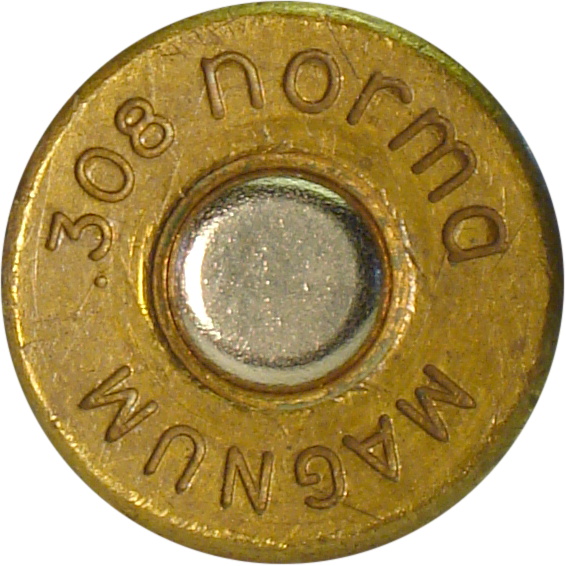
Headstamp sorting is the first sort, the cheapest sort, and the one with the largest single effect on variance, for the capacity reason above. It is also the sort carrying a safety function rather than merely a precision one, because it is where military crimped pockets, nickel plating, Berdan priming and unidentifiable cases all get caught.
What it does not buy deserves equal force, because the practice is routinely oversold. A headstamp identifies a maker and, on military brass, a year. It identifies neither a lot nor a firing history: two cases with the same headstamp may have come off different machines years apart and been fired once or six times. It reduces the variance of a mixed population; it does not produce a known lot. Only new brass does that. And in one case — the one that matters most on this bench — it does not even separate two cartridges.
10.4 Military Brass and the Crimped Primer Pocket
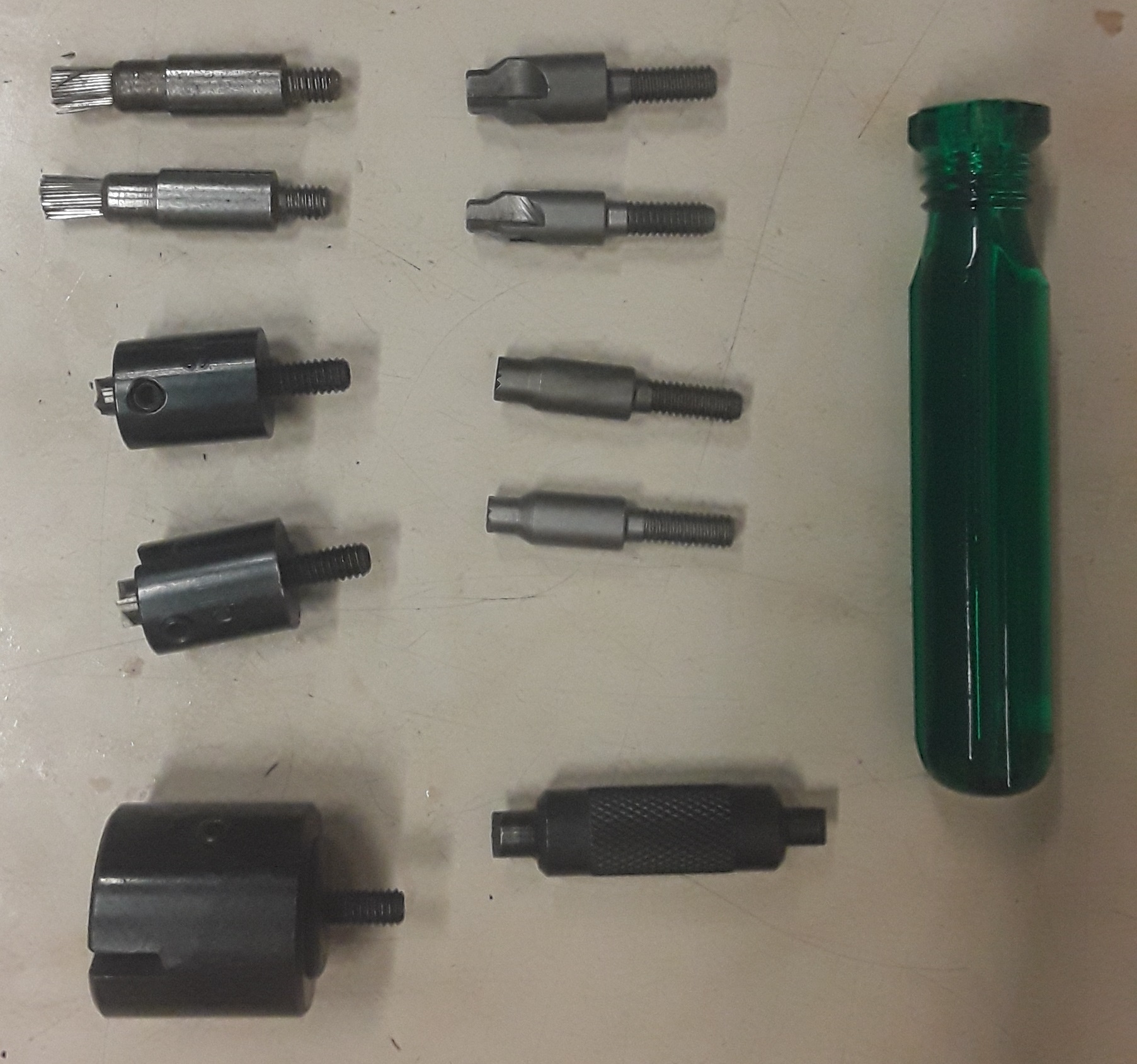
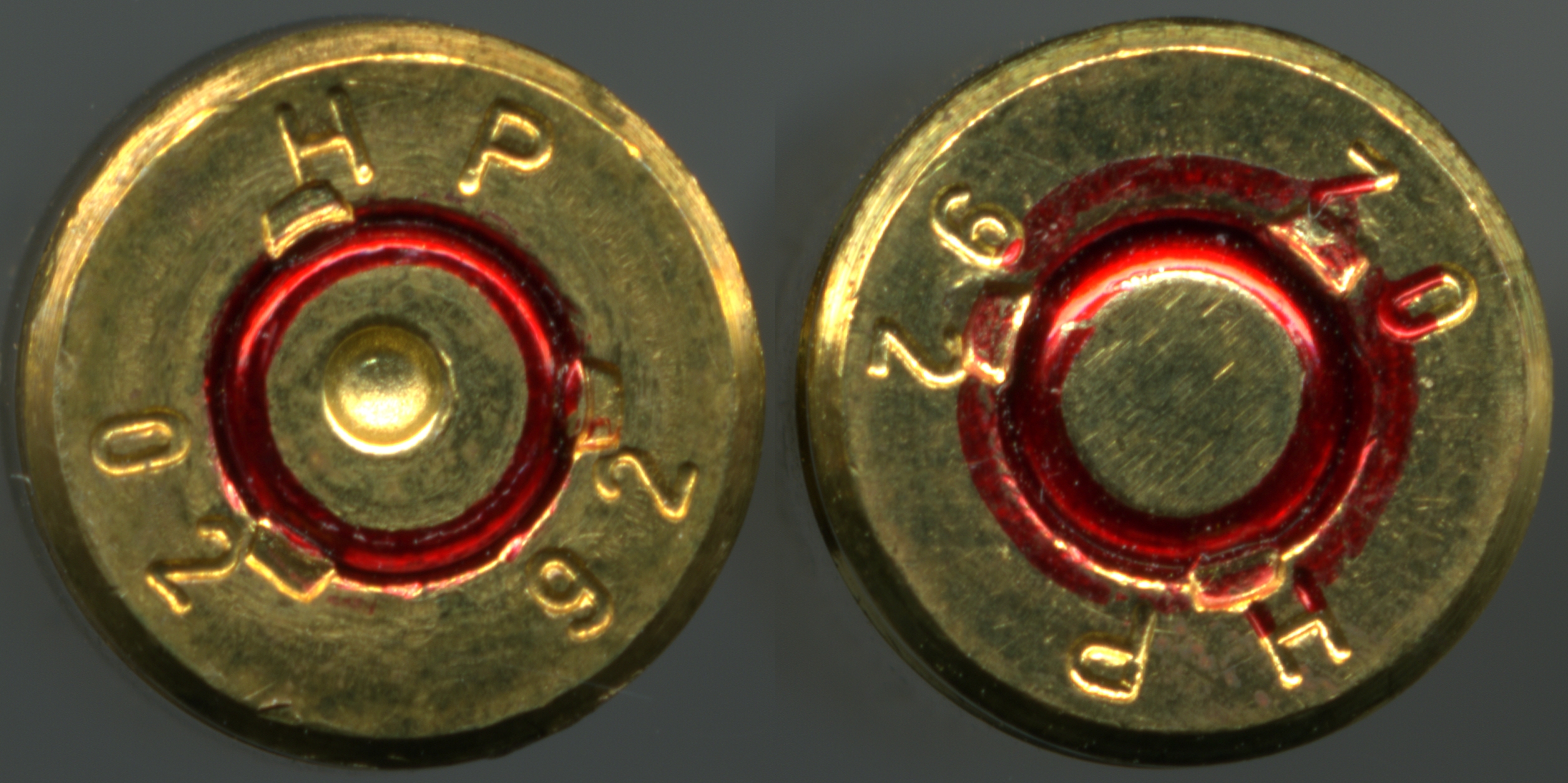
Military brass is identified by three markers, in decreasing order of reliability. The headstamp carries a manufacturer code plus a year rather than a commercial cartridge name — LC for Lake City — where commercial .223 typically reads “.223 REM”, and many NATO cases carry the circle-and-cross mark. The primer pocket carries a visible crimp or stake ring. And the case tends to have a thicker web and less capacity than commercial brass of the same cartridge, reported at around 1.0 to 1.5 grains of water in .223.
The crimp is a reliability feature for service use and an obstacle exactly once: it must be swaged or reamed before the first reload, after which the pocket behaves normally and never crimps again. The tooling and the swage-versus-ream argument belong to Volume 12.
Two per-caliber details are better known at the sorting bench than at the press. In .30-06, practitioners report that Lake City Ball brass has crimped pockets and Lake City Match brass does not — so “LC” alone does not settle whether a swage pass is needed. And the “always reduce the charge for military brass” rule does not survive checking: one account reduces for Lake City, another found military brass neither heavier nor lower in capacity than commercial, and Handloader’s own measurements ran the other way entirely, with Federal commercial cases averaging 207 grains against 200 for military. The sources genuinely conflict. The defensible position is that case weight is not a reliable proxy for capacity across headstamps, that the reduce-for-military rule is unsupported as a generalisation, and that the method which holds is to treat each headstamp lot as its own component and work up within it.
10.5 Berdan Priming as a Rejection Rule
Identification is trivial and definitive: look inside the case. One central flash hole is Boxer priming, with the anvil in the primer, and the case is reloadable. Two or more offset flash holes is Berdan priming, with the anvil formed into the case floor, and the case is not practically reloadable with ordinary tools. Volume 2 covers the mechanism; at the sorting bench it is a binary test taking a second per case and needing no measurement.
Berdan priming is common in military and surplus ammunition of European and former-Soviet origin — precisely what is most likely to be on the ground at a public range. It is a rejection rule, not a curiosity.
10.6 Steel, Aluminium and Nickel-Plated Cases
Steel cases are rejected. RCBS’s position is that reloading them is technically possible and practically pointless: they are often Berdan primed, and rigid steel does not return to its original dimensions after ignition.
Aluminium cases are rejected too, and here the sourcing is weaker than the practice. That aluminium-cased ammunition is not intended for reloading is universally understood, but no manufacturer statement to that effect could be retrieved for this dive — the RCBS article covering steel and nickel is silent on aluminium. The rule is given as the one the whole field follows, with the note that it could not be sourced to a maker here.
Nickel-plated brass is genuinely reloadable and genuinely a nuisance. Being Boxer primed it will reload, but RCBS warns the plating can crack and delaminate, leaving hard nickel flakes in dies and action that accelerate wear; practitioners report flaking after only a few firings. A subtler reason to keep it separate: plated and unplated cases spring back differently after sizing, adding a variable for no benefit.
10.7 The Two Sorts Specific to This Bench
Everything above applies to any bench. Two sorting problems are specific to the chamberings this dive is written around, and in both a sorting failure damages equipment or destroys a rifle.
10.7.1 .45 ACP exists in both primer sizes
For decades .45 ACP was universally a large pistol primer cartridge. Blazer, Federal and Speer — the same corporate parent — now produce small-primer .45 ACP brass, driven by lead-free priming compounds; Federal’s is headstamped NT for non-toxic. The boxes are not marked, so primer size is discovered during brass processing rather than at purchase.
The consequence is mechanical. A small-primer case fed to a press set up with a large decapping pin jams — at the sizing and decapping station, before priming, under load, and it can bend the pin. Beyond that, a small primer presented to a large pocket will not seat correctly and a large primer will not enter a small pocket at all; either way the round is scrap and the press stops. On a single-stage press this is a two-second annoyance. On a progressive it ends the run, and the practitioner consensus is blunt: sorting is mandatory for progressive presses.
One detail changes how the sort is done. Visual sorting is reported as only about eighty percent effective. The recommended method is to decap only, then sort with a gauge — a drill shank or a normalizing tool of the right diameter, used without damaging the pocket. That is a materially different procedure from eyeballing a bucket, and it is the one to use.
Two things belong beside the warning. There is no load-data consequence to primer size as such, and whether the lead-free small primers differ in ignition is contested, with no controlled data for .45 ACP located either way. The defensible handling is to treat the two as separate components, keep two stocks, and re-verify a load when switching. The cheapest fix is to sidestep the sort entirely: new or once-fired known-headstamp brass.
10.7.2 A .300 Blackout case formed from 5.56 keeps the 5.56 headstamp
This is the most important paragraph in the volume. .300 AAC Blackout brass is routinely made by cutting down .223 Remington or 5.56 NATO cases. The forming process never touches the head. A converted Lake City case therefore carries a Lake City 5.56 headstamp, and any sorting procedure that reads headstamps will file it as 5.56.
The general sources on the hazard do not state this clearly, and it is the case-prep half of the problem Volume 16 treats in full. SAAMI lists a .300 Blackout round in a .223 chamber as an unsafe combination; the mechanism is that the round chambers without force, the 5.56 throat drives the bullet back into its own case, the cartridge headspaces off the 5.56 chamber, and the rifle fires in battery with no warning. Rifles are destroyed this way.
Only two properties separate a formed .300 Blackout case from its donor: length and neck diameter. The Blackout case is markedly shorter with a visibly fatter neck. Both are measurable in seconds; neither is readable off the head. The sorting rule is therefore procedural rather than perceptual:
- Anything in a .223/5.56 batch that measures short and has a fat neck is a .300 Blackout case, whatever the headstamp says, and does not belong in that batch.
- The two cartridges get separate, labelled storage — never a shared bucket or tray.
- The two cartridges are never processed in the same bench session. This is the handloader-specific rule the general sources miss, and it exists precisely because one cartridge is made from the other.
10.8 The Reject List
Rejected outright, with no inspection argument:
- Berdan priming — two offset flash holes.
- Steel or aluminium cases.
- Any case with an internal circumferential groove ahead of the web. The wire test that finds it, the bright ring that hints at it, and the whole vocabulary for reading fired brass belong to the Headspace dive; this volume records only that a case failing that check is scrap.
- Split necks and cracked shoulders, and cracks anywhere near the web.
- Loose primer pockets — a primer that seats with finger pressure, or falls out, ends that case. There is no repair.
- Ejector swipes, or brass extruded into the ejector recess — that case was fired over pressure in somebody else’s rifle and its head has already been worked past yield.
- Corrosion, pitting or verdigris; heavy mechanical damage; mouths crushed beyond a light re-round.
- Unidentifiable headstamps, and anything whose parent cartridge cannot be determined.
- Anything short-with-a-fat-neck in a .223/5.56 batch.
One class sits at the boundary rather than in the list. Bulged .40 S&W brass, swollen at the unsupported web by a generous feed ramp, is not fixed by a conventional sizing die; a pass-through die addresses it, and whether that is a repair or merely cosmetic is disputed. Brass that bulged was worked past yield in the least-supported region of the case, and restoring its dimensions does not restore its strength. The default this dive adopts is to cull rather than bulge-bust.
10.9 Weight, Volume, and the Sorting Hierarchy
Weight sorting is the most popular sort after headstamp and the weakest. The literature splits: some sources report strong correlation between case weight and case volume while noting earlier work showing only about eighty percent; a documented sorting experiment reports no usable relationship. The mechanism explaining the disagreement is the line to carry — most weight variation is in the case head, not in the wall. Head mass adds weight without subtracting interior volume, so weight sorting sorts by where the brass is, which is only sometimes where the volume is. It works within a single lot from one machine — premium brass that arrived weight-sorted already.
Ranked by the strength of the evidence behind each, the hierarchy is:
- Headstamp and lot — largest effect, and the only sort with a safety function.
- Rejection on inspection — safety, not precision.
- Volume measurement by water weight, when loads are near maximum or under development — the capacity-to-pressure mechanism is established. Measure fired-and-sized cases, never virgin ones; one account separates the two by nearly 0.8 grain of water in the same brass.
- Neck-wall uniformity, turned only against a known chamber neck diameter — but mandatory for formed brass, where roughly ninety percent of cases are reported to need it.
- Weight sorting — a cheap ordering heuristic, not a volume measurement.
- Concentricity sorting — mechanism universally accepted, magnitude unquantified in the sources available here.
Steps one and two pay for themselves on every bench. The rest is precision work, and skipping it loses nothing but consistency. Skipping steps one and two eventually loads a Berdan case, a cracked case, or a .300 Blackout case into a 5.56 magazine — and only one of those three is merely annoying.
Comments (0)