The Reloading Bench · Volume 12
Case Prep — Deprime, Lube, Size, Swage, Uniform
The mechanical sequence, in the order the operations actually have to happen
Case preparation is a sequence, and most of the trouble people have with it comes from performing the right operations in the wrong order. The operations are simple: remove the spent primer, clean the case, lubricate it if it needs it, size it, open the primer pocket if the military crimped it, take the lubricant off again, and optionally cut the pocket and flash hole to a uniform geometry. What makes the order matter is that several of these steps enable or foreclose the next one.
This volume is the bench procedure and the equipment, not the theory. Case headspace, shoulder bump, how to set a die, how much to bump, the variables that move a setting, the neck- and partial-sizing traps, and the whole diagnostic vocabulary for reading fired brass belong to the Headspace dive, which treats them better than a summary here could. Die families and die selection are Volume 9; trimming is Volume 13 and annealing Volume 14, and both sit inside this sequence at points noted below.
12.1 The Sequence, and Why the Order Is Not Arbitrary
Depriming precedes cleaning if the primer pockets are to be cleaned at all, because a pocket with a spent primer in it is a sealed cavity — which is why a separate decapping die exists as a product category.
Cleaning precedes sizing, because grit carried into a die on a case body scratches the die permanently.
Lubrication precedes sizing for every bottleneck case and for one straight-wall case on this bench’s list — and that exception is narrower than most pistol loaders assume.
Swaging a crimped pocket precedes priming, and is conveniently done after cleaning, when the crimp is visible.
Lube removal precedes charging and priming, because lubricant contaminates powder and primers, and lube in a chamber raises bolt thrust.
Trimming follows sizing, because sizing lengthens the case, and annealing precedes sizing when it is done at all, because the point is to soften the brass before it is worked. Everything else is scheduling.
12.2 Universal Decapping
A separate universal decapping die is the cheapest genuinely useful tool in case preparation, and its value has little to do with the cost of the die. It decouples depriming from sizing, which buys three things: cases can be deprimed before cleaning; the sizing die can run with its decapping and expander assembly removed, which matters for the mandrel workflow below; and primer residue never enters the sizing die.
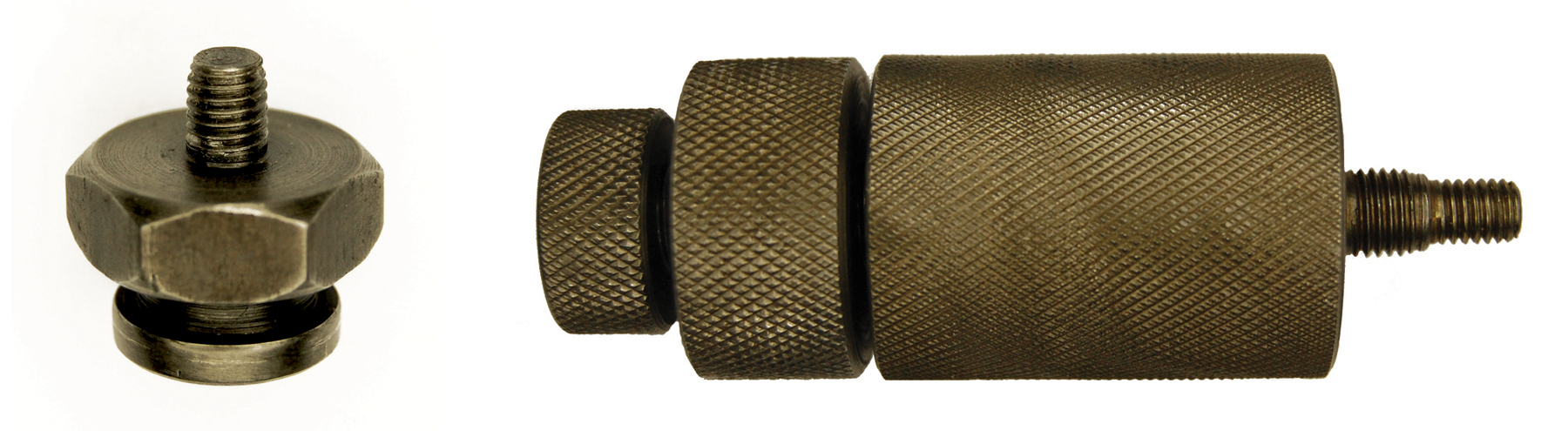
Prices checked 2026-09-17 on Lee’s own site. The Lee Decapping Unit is $15.98, fitting cases up to 0.560 inch diameter and 3.125 inches long, Boxer-primed brass only, and it sizes nothing at all. Spare pins are $4.00, an undersize pin for Lapua-type 1.5 mm flash holes $3.00, and caliber-specific guided decappers $5.00 each.
That “Boxer-primed brass only” line is not boilerplate: it restates Volume 10’s rejection rule, since a Berdan case has no central flash hole for a pin to pass through, so presenting one breaks the pin.
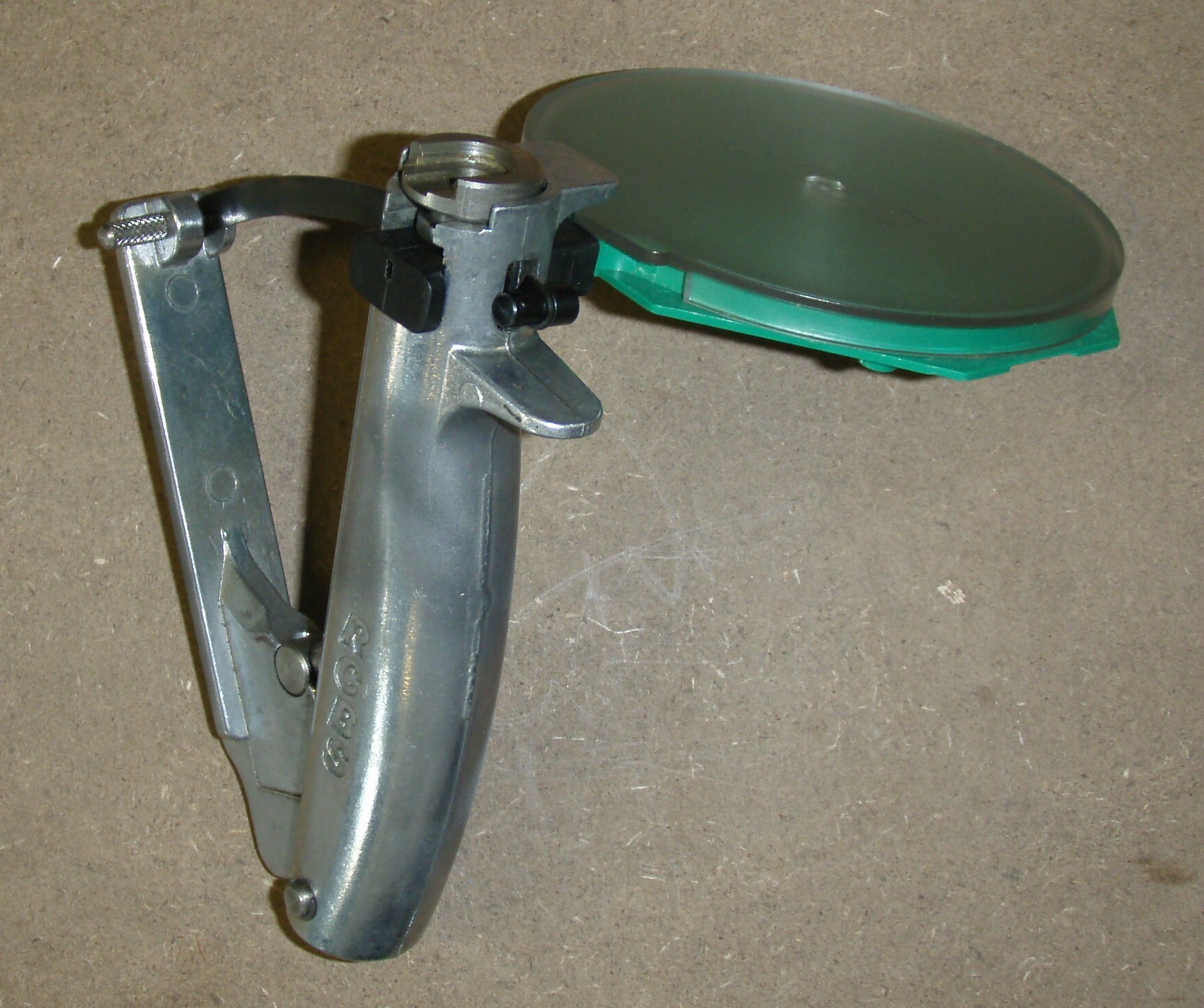
Hand deprimers exist for the same reason a hand primer does — depriming is the messiest and least valuable operation on a progressive press. The Frankford Arsenal Platinum Series Hand Deprimer is $65.99 and the Harvey Deprimer $69.95, both checked 2026-09-17.
The ordering question is settled by the cleaning method rather than by preference. Primer pockets only get clean if the primer is out, so the wet-with-pins workflow must deprime first; that is the only hard requirement. Dry tumbling with primers in has an overlooked advantage — the primer plugs the flash hole, so no medium can lodge in it, and the case can then be deprimed and sized in one press stroke. Depriming first is also what exposes a flash hole to a stainless pin, the hazard Volume 11 covers. Both orders are defensible.
12.3 Case Lubrication
Sizing is a drawing operation: a case body is pulled through a constriction smaller than itself, and the only thing between that and a galled, stuck case is a film of lubricant. Four delivery systems trade control against speed predictably.
Wax, applied by fingertip to each case, offers the highest control and the slowest rate; Hornady’s instruction for its own sizing wax is to dab it on finger and thumb and apply before sizing. Wax is essentially impossible to over-apply badly enough to dent a shoulder, and it is the standard choice for precision rifle work and for anything stubborn. Redding’s Imperial Sizing Die Wax in 2 oz appears at $18.80 from a retailer listing checked 2026-09-17 — a snippet rather than a fetched page, since the retailer 403s automated fetching.
A lubricated pad, with cases rolled across it, is fast for batches and easy to over-apply: too much lubricant in the shoulder area has nowhere to go when the die closes, and the result is a hydraulic shoulder dent.
Spray is fastest for volume and least even, pooling in the shoulder area to produce the same dent; dry-film sprays exist specifically to avoid it. Hornady describes One Shot as a micro-penetrating high-pressure dry film with no petroleum, Teflon or silicone, and publishes no prices.
Dry lube — graphite or mica — is for case necks rather than bodies: keeping neck friction consistent, and restoring the friction a wet clean stripped out with the interior carbon, the variable Volume 11 treats.
Representative maker prices, checked 2026-09-17: Dillon liquid case lube $16.95, Lyman Quick Slick paste $14.50, Frankford Arsenal case lube $15.99 — and a stuck-case remover at $43.99, which is the argument for taking lubrication seriously.
12.3.1 The lanolin mix
The home lubricant recipe is one of the best-documented pieces of handloading folk engineering, and it is practice rather than established fact — no manufacturer publishes it. Reported ratios run from one part liquid lanolin to ten or twelve parts 99 percent isopropyl alcohol, the most common, through one-to-nine and one-to-six.
One technical point should not be softened. Use 99 percent isopropyl, not 91 or 70 percent. The reason given is that the water in the lower grades can cause corrosion on brass and dies and dramatically slows evaporation. Given what Volume 11 establishes about brass and aggressive aqueous chemistry, that warning is consistent with the metallurgy rather than merely cautious.
12.3.2 Carbide, and why .450 Bushmaster is the exception
The distinction is absolute and established. Straight-wall pistol cases in carbide dies need no lubricant — the insert is smooth enough that lube is optional, and running 9mm, .40 S&W and .45 ACP dry is the largest single reason progressive pistol loading is fast and clean. Bottleneck rifle cases must be lubricated, carbide or not, or they will stick; the one exception is a collet neck die, which grips the neck rather than drawing the body through a constriction. Carbide in a rifle die buys wear life, not freedom from lubricant: Dillon’s carbide size-and-trim dies start at $265.00 against steel trim dies from $79.95, checked 2026-09-17.
Then the case that breaks the shape-based intuition, and it is on this bench’s own list. .450 Bushmaster has no carbide sizing die, so every .450 case must be lubricated despite the cartridge’s straight-wall shape. It is not a true straight-wall case — it carries about 0.020 inch of taper, and a carbide sizing ring is a straight cylinder that cannot impart taper. It needs a conventionally shaped steel die, and a steel die needs lubricant on every case.
The consequences are worth spelling out, because a loader arriving from pistol work will expect none of them. Lubrication and lube removal become process steps exactly as for .308, and sizing effort is higher without carbide’s low friction, so a skipped case is a live stuck-case risk rather than a stiff stroke. .450 Bushmaster is a rifle-loading process wearing a straight-wall case’s shape — which is why this dive puts it on the precision press alongside the bottleneck cartridges rather than on the bulk progressive with the pistol calibers it resembles.
12.4 Removing the Lube
Required, for two reasons that get conflated. Lubricant left on a case contaminates powder and primers; lubricant carried into a chamber raises bolt thrust, defeating the friction between case and chamber wall that normally carries part of the load.
The standard removals are a short dry tumble after sizing — ten to twenty minutes in corn cob — a wipe-down, or a pass through an ultrasonic. Aerosol dry films leave the least to remove and wax the most, the counterweight to wax’s control advantage. This is also where a dry tumbler earns its place on a bench that otherwise cleans wet.
12.5 Sizing, and the Boundary With the Headspace Dive
The press stroke that sizes a case is the centre of the process, and almost everything worth saying about how to set the die that does it is said elsewhere. The Headspace dive owns case headspace, fire-forming, measuring a shoulder position, setting the die, how much to bump, the variables that move a setting, the neck- and partial-sizing trap, and what good looks like; Volume 9 owns which die to buy. This volume’s contribution is narrower: what the operation does to the case, and what the bench must have in place for it.
What it does is work the brass. Full-length sizing returns body, shoulder and neck toward specification and works the case most; it is mandatory for gas guns, where reliable chambering outranks brass life — on this bench, the .30-06 Garand loads, the .308 in a gas rifle, and all of the .223/5.56.
What the bench must have is a case gauge, and for the gas-gun chamberings it is not optional. The reason is structural: there is no forcing the bolt on a semi-automatic rifle, so the rounds must fit. A bolt gun gives tactile feedback and a camming handle; a semi-auto gives a malfunction and, at worst, an out-of-battery event. The gauge replaces the feedback the action does not provide. Wilson and Sheridan are the common makers, and Sheridan’s slotted gauges show where a round is out of specification.
12.5.1 Expander balls and mandrels
One detail of the sizing stroke belongs to case prep rather than die selection, because it changes the order of operations. The expander ball is pulled back up through a neck that may already be off-axis, and so induces runout. The reported characterisation is that it is usually the single biggest source of runout and of case-length growth, and that removing it reduces runout — practice with a sound mechanism, but no controlled test was located.
The workflow that replaces it is three operations rather than one press stroke, and it depends on the universal decapping die above: deprime separately; full-length size with the decapping and expander rod removed, taking body and shoulder only; then set neck tension from the inside with an expander mandrel sized for the interference wanted, commonly one to three thousandths under bullet diameter.
A mandrel sets the neck’s inside diameter, so wall-thickness variation is pushed to the outside and bullet grip is more uniform — which is why mandrels pair naturally with unturned brass, and bushings, which set the outside diameter, with turned necks. One honest counter-observation from the field: a mandrel can itself induce runout if the case goes in misaligned. Prices for the 21st Century mandrels could not be established, so none are quoted.
12.6 The Crimped Military Primer Pocket: Swage or Ream
Military 5.56 and .30-06 brass, and some commercial brass, carries a crimp or stake ring around the primer pocket for reliability in service. It must be opened once, before the first reload, and does not come back. Two mechanisms exist and they are not equivalent.
Swaging displaces the crimp material by rolling it out of the way, and removes no brass. Dillon’s description of its own tool is that the case is supported internally, preventing damage to brass rims, while a hardened tool-steel swage rod — adjustable for large or small primers — smoothly rolls the crimp away with no reaming required. Reaming cuts the crimp away, and removes brass from the mouth of the pocket.
Prices checked 2026-09-17. The Dillon Super Swage 600 is $170.00: bench-mounted, compound cam lever, large and small swage rods, a .45 ACP adapter, and internal case support. The RCBS Swager Combo-2 is $42.99 press-mounted, and Frankford’s $157.99. On the reaming side, the Lyman Primer Pocket Reamer is $13.95.
The honest comparison is this. Swaging removes no metal and is therefore repeatable and non-thinning, but it needs a well-supported case head to avoid deforming the rim or the pocket floor — exactly what Dillon’s internal support and RCBS’s die body provide. Reaming is cheaper and faster to set up, but every pass takes metal out of a pocket whose depth is a pressure-sealing dimension, and one practitioner report has uniforming crimped pockets tending to make them loose. That matters, because a loose primer pocket is the most common retirement criterion for a rifle case — so a reaming pass can spend case life to save setup time.
No controlled comparison of the two methods was located. The market’s own answer is informative: the high-volume bench tools from Dillon, RCBS and Frankford all swage, and reamers are sold as inexpensive hand tools. The calibration target for a swage, as practitioners state it, is a roll that lets primers seat easily — less about a diameter figure than about removing the restriction.
Two operational notes. The Super Swage 600 covers .30-06, 5.56 and — with its adapter — military .45 brass from one tool, which is why it appears in Volume 8’s recommendation. And a warranty trap worth checking rather than assuming: swaging on a 650- or 750-class progressive is repeatedly reported to void the press warranty. That claim is user-sourced and could not be confirmed here, but it is plausible, since those machines have no swage station.
12.7 Uniforming and Flash-Hole Deburring
The last two operations in the sequence have the weakest evidence behind them, and saying so is more useful than the alternative.
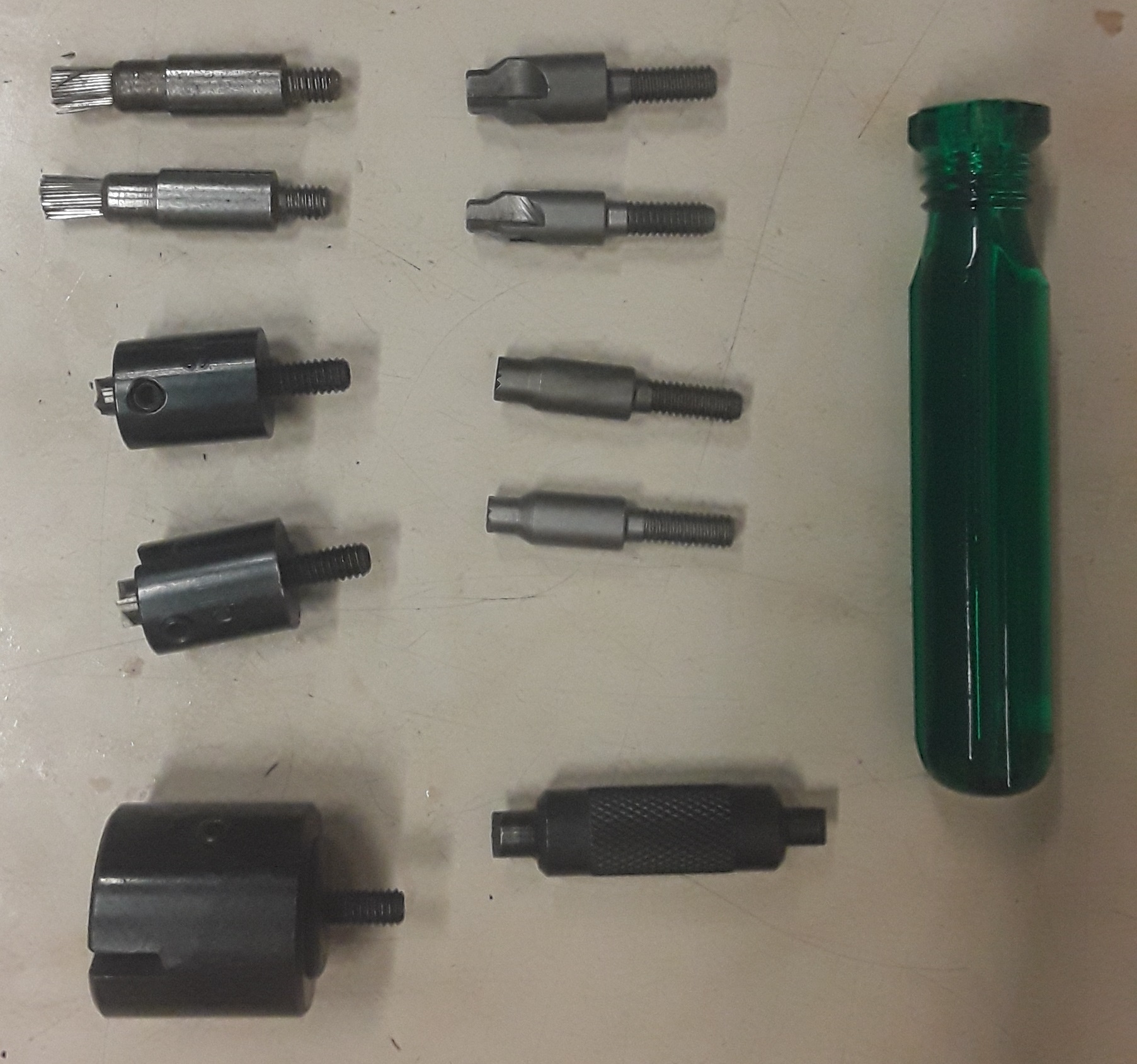
The tools, priced 2026-09-17. Lyman’s primer pocket uniformer is $28.95 and its flash hole uniformer $20.95; the K&M Professional Flash Hole Uniformer runs $27.30–$33.80, supplied at 0.080 inch for standard holes and 0.062 inch for Lapua 1.5 mm holes. One K&M design detail is worth knowing: its depth stop is referenced from the inside bottom of the case, so the case need not be trimmed to a consistent length — decoupling the operation from trim length.
The mechanism claimed is K&M’s own — a manufacturer’s rationale for its own product rather than independent evidence: punched flash holes leave irregular breakouts and burrs inside, causing shot-to-shot differences in primer flame fronts and so inconsistent pressure and velocity.
Do these operations measurably do anything? Not demonstrably, at any precision level most rifles can resolve, and the evidence offered in their favour is weak.
In favour: benchrest shooters have uniformed flash holes since 1969, and the practice persists in the highest-precision discipline in the sport. A frequently-cited anecdote reports a standard deviation falling from 33 fps to 11 fps after a first attempt at flash-hole uniformity — but it is uncontrolled, single-shooter and five-shot, and a five-shot standard deviation is not a measurement of anything, as Volume 22 develops at length. Against: experienced reloaders place both operations far down the list of things with a noticeable effect on accuracy, and a benchrest tester running side-by-side comparisons never found a significant advantage on paper.
What is defensible, and all that is defensible: a uniform pocket depth lets every primer seat to the same depth against solid brass, and seating depth plausibly affects ignition consistency; and a deburred flash hole cannot shed a burr into the case. Both are cheap, both are once per case, and neither has a demonstrated accuracy return outside benchrest — low-cost insurance with an unproven benefit, which is a respectable thing to buy as long as nobody is told it was measured.
12.8 Where the Sequence Ends
At this point the case is deprimed, clean, sized to chamber, free of lubricant, its primer pocket open and of known depth, its flash hole clear. What remains is length, hardness and assembly. Volume 13 takes the length question and the machines that answer it at rate; Volume 14 the hardness question, where annealing folds back into this sequence ahead of sizing; Volume 15 how many times the sequence can be repeated before a case is retired.
Comments (0)