The Reloading Bench · Volume 20
Bullets and Seating — Ogive, CBTO, Jump and Crimp
Why depth is measured to a curve rather than to the point, and when a crimp is genuinely required
Seating a bullet looks like the simplest operation on the bench. A press pushes a projectile into a case mouth until a die stops it, and the round is finished. Almost every judgement that makes the difference between ammunition that shoots and ammunition that merely functions is hidden inside that one stroke — where the bullet stops, what holds it there, and whether the mouth is closed onto it afterwards.
20.1 What a Bullet Is Made Of, and What That Demands
Cast lead bullets are the oldest form and remain in use because lead is cheap and castable at a bench. They are soft, which means they obturate to the bore readily and will strip in a fast twist or at high velocity unless a gas check — a copper cup swaged onto the base — is fitted. They also require lubrication, and the lubricant is part of the load rather than an accessory to it.
Plated bullets are a lead core with an electroplated copper skin. The plating is thin, so they tolerate less velocity than a jacketed bullet and object to aggressive crimping, which can cut through the plating.
Jacketed bullets are a lead core in a drawn gilding-metal cup. They are the default for rifle work and the reference case for published load data.
Monolithic bullets are turned or swaged from a single copper alloy with no lead core. For a given weight they are longer than a jacketed bullet, because copper is less dense than lead — which has a consequence developed below, since length and not weight is what a twist rate has to stabilise.
20.2 The Geometry That Matters
A bullet has more relevant surfaces than its weight suggests.
The bearing surface is the full-diameter cylindrical section that contacts the bore. Its length, more than the bullet’s total length, governs how much friction the bullet generates and therefore how a given charge behaves behind it.
The ogive is the curve from the bearing surface forward to the tip. Where that curve reaches bore diameter is the point at which the bullet first touches the rifling, which makes it the feature that actually positions the bullet relative to the chamber.
The meplat is the flat or point at the very front. It is the least consistently manufactured feature on a bullet, varying measurably from one to the next even within a box, and on a polymer-tipped bullet it is a moulded plastic insert.
The base may be flat or a boat tail.
Two of these — the ogive and the meplat — explain the single most important convention in this volume.
20.3 Overall Length and Base to Ogive Are Different Measurements
Cartridge overall length, COAL, is measured from the case head to the tip of the bullet. It is the dimension a magazine cares about, and the one every published load table quotes.
Cartridge base to ogive, CBTO, is measured from the case head to a defined point on the ogive curve. It is the dimension the chamber cares about, because the ogive is what meets the rifling.
The reason both exist is that the meplat is not a reliable reference. Sorting a hundred bullets of one make and measuring them will show tip-to-base lengths varying by several thousandths, because the tip is the end of a drawing operation and is not held to a tight tolerance. Seat a batch of those to a constant COAL and the ogives end up at inconsistent positions in the throat — which is the opposite of the intent. Seat them to a constant CBTO and the ogives are consistent while the tips are not, which is the right way round.
So seating depth is set and recorded to the ogive, and COAL is checked separately as a magazine-fit constraint. Volume 23 records both for exactly this reason.
Measuring CBTO requires a comparator — a bushing with a bore that contacts the ogive at a defined diameter, used on calipers. The same caution applies here as in the Headspace dive’s treatment of shoulder comparators: a comparator reading is a comparison, not an absolute dimension. The bushing bore determines where on the curve it contacts, so a reading from one bushing cannot be compared with a reading from another, and changing bushings invalidates a recorded history.
20.4 Jump, and Finding the Lands
The gap between where the ogive sits and where it would first touch the rifling is the jump, or freebore. A bullet seated long enough to contact the rifling is said to be jammed into the lands; seated shorter, it jumps a distance before engraving.
Locating the point of contact for a specific rifle and bullet is done with a purpose-made tool — the Hornady overall-length gauge is the common one — which pushes a bullet in a modified case forward in the chamber until it stops against the rifling. The resulting measurement is specific to that rifle, that bullet and that tool, and it moves as the throat erodes.
Two constraints bound the useful range.
The magazine bounds it from above. A round too long to fit the magazine is a single-loader, whatever it does for accuracy. For the .30-06 in an M1 Garand, this constraint is tighter and more particular than usual, because the cartridge has to sit in an en-bloc clip and then feed from it; the M1 Garand dive in this collection gives the clip-fit limit and the reasoning behind it, and that is the governing figure rather than anything derived from the chamber.
Pressure bounds it from below and above in a less obvious way. Seating a bullet deeper reduces the volume the powder burns in, which raises pressure at the same charge. That is why seating depth is one of the component changes that restarts a work-up, as Volume 21 sets out — it is not merely an accuracy adjustment.
20.5 Testing Seating Depth Honestly
Seating depth is worth testing, and in many rifles its effect on dispersion is larger and more repeatable than the effect of small charge changes. That makes it a better use of components than charge-weight ladders.
It is subject to exactly the same statistical discipline as everything else in Volume 22, and the temptation is the same. Three-shot groups at four seating depths will produce a winner, and that winner will be sampling noise more often than not. The honest version tests fewer depths with more rounds at each, alternates between them rather than firing them in blocks, and accepts that two depths which cannot be separated by the available sample are equivalent for practical purposes.
20.6 What Actually Holds the Bullet
Bullet retention comes from the neck gripping the bullet — neck tension — and not from the crimp. This is worth stating plainly because the reverse is widely assumed.
Neck tension is produced by sizing the neck slightly smaller than the bullet, so that seating the bullet expands it and the brass grips by spring-back. It is governed by how much the neck was sized down, by neck-wall thickness, and by how hard the brass is — which is why annealing changes it, and why Volume 14 treats annealing as a consistency measure rather than a longevity one.
Controlling it deliberately means controlling the inside neck diameter rather than the outside: either a bushing die, where the bushing is selected to give a chosen amount of interference, or an expander mandrel used after sizing, which sets the inside diameter directly and pushes thickness variation outward where it does no harm. Volume 9 covers the die families that do this.
The measurable consequence is bullet pull — the force needed to move the bullet — and it is one of the better predictors of velocity consistency, since a round that releases its bullet at a different force releases it at a different pressure.
20.7 Crimp, and When It Is Genuinely Required
A crimp closes the case mouth onto the bullet. It is not a substitute for neck tension and cannot be used as one.
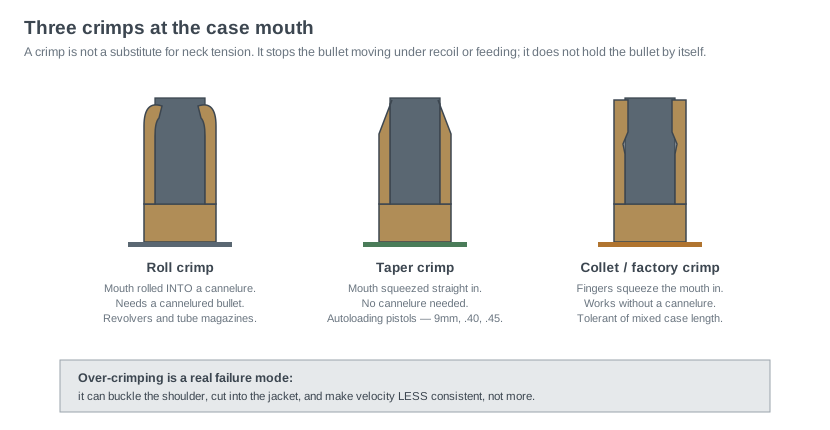
A roll crimp rolls the mouth into a groove cut around the bullet. It requires a bullet with that groove, and it requires consistent case length, since the amount of roll depends on how far the mouth reaches into the die.
A taper crimp squeezes the mouth inward on a cone without rolling it. It needs no cannelure and is the standard for autoloading pistol cartridges, where the mouth must remain able to feed and headspace.
A collet or factory crimp presses a short band of the mouth inward with fingers that close radially. It works without a cannelure and is the most tolerant of mixed case length, which makes it useful on range-pickup brass.
The cases where a crimp is genuinely necessary are specific:
Tube magazines, where cartridges sit nose to tail under spring pressure and recoil drives each into the one ahead.
Hard-recoiling autoloaders and revolvers, where inertia alone can move a bullet in its case.
Semi-automatic rifles feeding from a magazine with a violent bolt stroke, where a bullet can be pushed deeper on chambering. This is the setback problem, and it matters most in pistol calibers loaded for a progressive — a round whose bullet has been driven deeper has less volume behind it and therefore higher pressure, which is the mechanism rather than merely an inconvenience.
Over-crimping is a real failure mode and not a case of trying too hard in a safe direction. It can buckle the case shoulder, cut through a jacket or through plating, and make velocity less consistent rather than more, by varying the release force from round to round.
20.8 By Chambering
.308 Winchester and .30-06 in a bolt gun generally take no crimp at all, and benefit most from controlled neck tension and consistent CBTO. In the M1 Garand, no authoritative source located for this collection requires a crimp, and the clip-fit length is the binding constraint.
.300 AAC Blackout is the awkward case, because its two load regimes want different things. Heavy subsonic bullets are long, seated deep, and fed from a magazine by a gas gun — which is the combination most exposed to setback, and the strongest argument for a crimp in this cartridge.
.450 Bushmaster is a large-diameter straight-walled case in an autoloader, which puts it squarely in the crimp-required category.
9mm, .40 S&W and .45 ACP take a taper crimp, set to remove the flare and no more. Checking finished rounds in a case gauge is the practical verification, and it catches both insufficient crimp and the bulged brass that a conventional die will not correct — the .40 S&W problem that sends brass to the auxiliary single-stage in Volume 8.
20.9 Weight, Length and Twist
One conflation is worth closing the volume on, because it produces confident wrong answers.
Bullet weight is what the box advertises and what load data is indexed by. Bullet length is what a barrel’s twist rate has to stabilise. The two correlate loosely, and reasoning from weight to stability fails often enough to matter. The AR-15 5.56 dive in this collection works a case where holding weight constant and varying only length changes the stability factor several-fold, and where a heavier bullet of equal length is the more stable of the two.
This is where monolithic bullets bite. Being less dense than lead, a monolithic bullet of a given weight is longer than the jacketed bullet it replaces — so substituting one for the other at the same weight is a substitution to a longer projectile, and a twist that stabilised the first may not stabilise the second. It is also, being a component change, a substitution that restarts the work-up.
Comments (0)