The Reloading Bench · Volume 13
Trimming and the Length Question
What the tool indexes from, how fast it really is, and which of these chamberings needs it every cycle
Trimming is the one case-preparation operation whose theory is settled and whose practice is entirely a question of equipment. Why a bottleneck case grows, why the published trim-to length sits below the published maximum, what an over-long case does to pressure at the end of the chamber neck, and how much of a case’s growth is a symptom of something else — all of that belongs to the Headspace dive, which treats it properly and is not repeated here. What that dive does not cover, and what decides whether trimming is a pleasant twenty minutes or an evening lost, is the machine.
Two numbers have to be in hand first. The maximum case length is a specification. The trim-to length is a working figure set below it, conventionally about ten thousandths below maximum, so a batch trimmed today is still legal after a firing or two of growth and so the trimmer’s own variance does not push any case over. RCBS states that convention in its case-trimming overview. The per-cartridge figures appear at the end of this volume with their confidence marked, because several could only be found in aggregated secondary material — the copy of the industry standard held in this collection’s reference library carries chamber drawings rather than cartridge drawings, so case length and trim-to cannot be read from the primary source at all.
13.1 What the Tool Indexes From Is the Specification That Matters
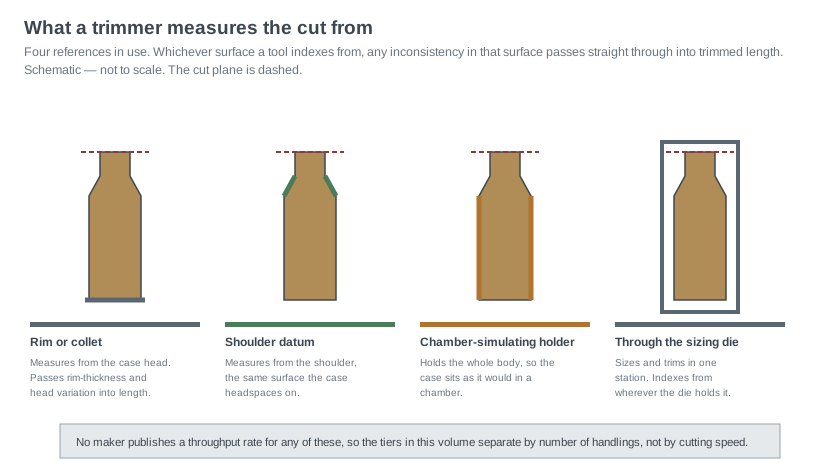
Every trimmer answers the same question differently: relative to what is the cut positioned? That single choice explains most of the price spread, most of the accuracy claims, and nearly all of the speed difference.
A trimmer can reference the rim or extraction groove, gripping the case in a collet or shellholder. Simple and cheap, and its weakness is that rim thickness varies between headstamps and lots, so a change of brass changes the trim length. Forster’s answer is a Brown and Sharpe-type collet, and the company claims to be the only maker holding the case that way, specifically so trim depth stays consistent when rim thickness varies.
A trimmer can reference the shoulder datum. Little Crow’s World’s Finest Trimmer documents this openly: it indexes off the shoulder datum, which is what lets it dispense with rim-grabbing collets and shellholders and run in a drill. Since the shoulder is also what a bottleneck case headspaces on, this puts the cut on the same reference the chamber uses.
A trimmer can reference the case body, held in a chamber-simulating holder. L.E. Wilson’s micrometer trimmer works this way: the case sits on its own body taper in a holder mimicking a chamber, with holder and cutter housing in a common rail so the two stay axially aligned.
Finally, a trimmer can reference the sizing die. Dillon’s trim die is a sizing die with a hole in the top, and the cut is positioned by the die-to-shoulder relationship rather than by anything touching the head — a genuinely different architecture, covered separately below.
13.2 Hand and Lathe Trimmers
The entry tier is genuinely usable and genuinely slow. Prices were checked on 2026-09-17 and the source is named, because pricing in this field drifts quickly.
Lee’s approach removes measurement from the operation. The Lee Deluxe Quick Trim is press-mounted at $30.00 with caliber-specific dies from $16.00 (leeprecision.com); Lee claims it needs “no calipers, measurement or adjustment,” trims and chamfers inside and outside simultaneously, and has a stop click-adjustable in thousandths. The older Lee Case Length Gauge with shellholder at $14.35 is the fixed-length version. Both are hand-powered, and the length is whatever the gauge says — fine for a cartridge whose trim-to figure is not in dispute, unhelpful for one where it is.
The classic lathe trimmers are the Forster Original at $126.00, reduced from $168.00 (forsterproducts.com), with claimed repeatability of one thousandth and a range of .171 to .459 inch covering better than a hundred cartridges; and the Hornady Cam Lock, which Hornady does not price publicly — retailer listings put it near $119.99 (Amazon, Sportsman’s). The Hornady tool’s useful feature is a micro-adjust cutter allowing thousandth changes without removing the case, and it ships with ten pilots, but it requires Hornady shellholders.
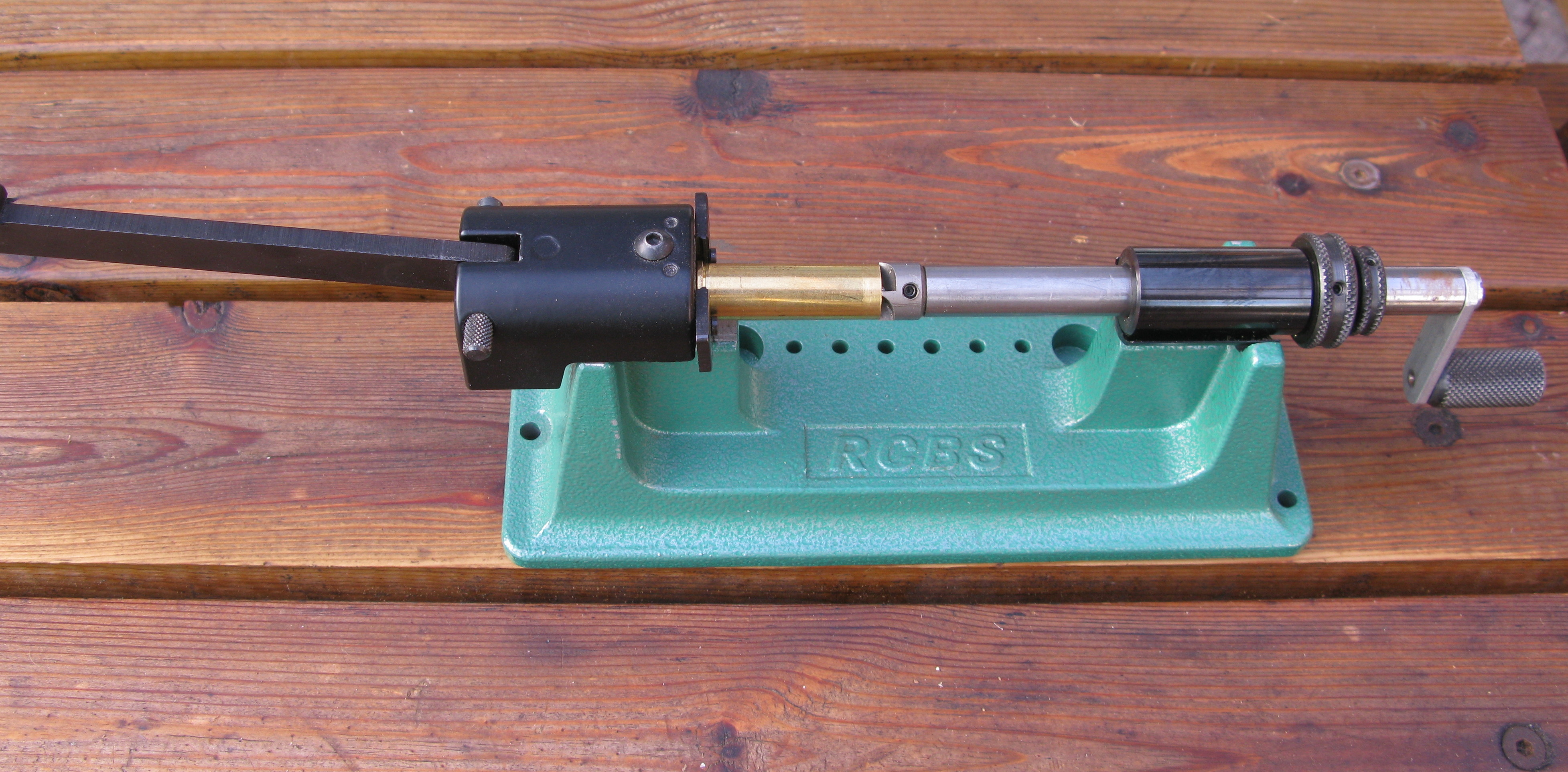
RCBS Trim Pro-2 is $169.99 manual and $419.99 as a power kit (shop.rcbs.com). The power kit is more interesting than the gap suggests: a high-torque low-rpm motor with a spring-fed self-feeding cutter, so the operator supplies no feed pressure and has a hand free for chamfering, deburring or pocket work while a case cuts. Nine pilots; cases with a rim over .625 inch need the separate high-capacity trimmer.
The precision end is the L.E. Wilson micrometer trimmer, whose price could not be confirmed — both the maker’s site and Midsouth refused automated retrieval — so no figure is printed. The design is worth knowing regardless: the chamber-simulating holder above, trim length on thousandth micrometer graduations, .17 caliber to .45-70, case holders sold separately as the recurring cost.
Multi-station prep centres sit alongside these rather than replacing them. Lyman’s Case Prep Xpress starts at $259.95. Frankford Arsenal lists a Universal Precision Case Trimmer at $111.99 and a Platinum Case Trim and Prep Center at $310.99, the latter covering, in the maker’s words, “any shouldered case from .17 Remington to .460 Weatherby” with three collets, six bushings, chamfer tools and pocket cleaners included. That Frankford unit consolidates the most operations for the least money, and is the sensible answer for a bench trimming a few hundred cases a season across mixed cartridges.
13.3 The Fast Trimmers
Above roughly a thousand cases a year the tool stops being a purchase and becomes a rate.
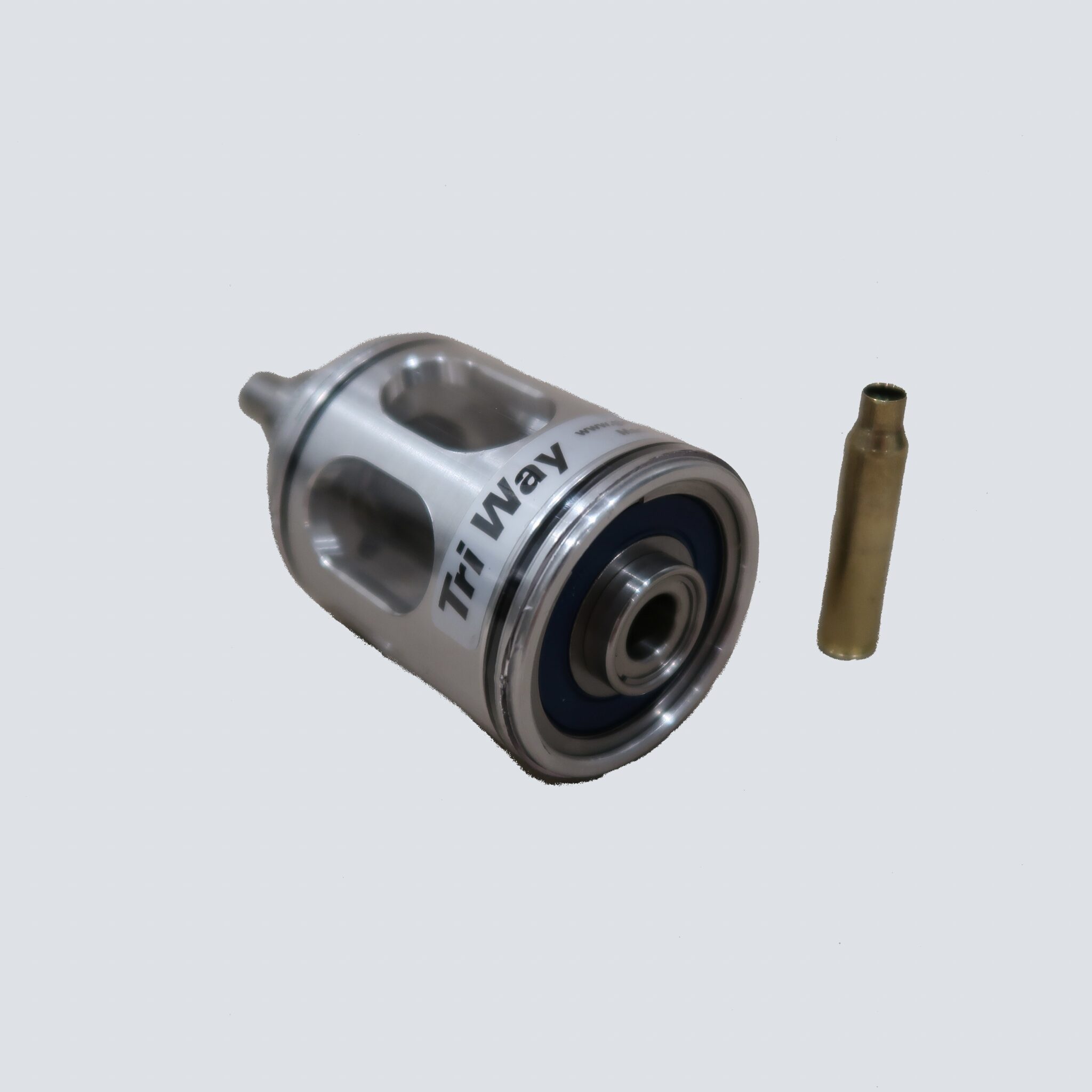
Giraud sells the workflow in two tiers (giraudtool.com, 2026-09-17). The Tri-Way Trimmer at $120.00 changes the most for the least: a three-function head that trims, chamfers the inside and deburrs the outside in one pass, driven by whatever is already on the bench — Giraud’s own copy says a cordless drill or an old surplus motor. It is 6061-T6 aluminium and 303 stainless on a sealed ball bearing, and the carbide blade is adjustable, so finished length and amount of chamfer are set by the user. Tooling is sold by cartridge family, and the listed families include .223, .308, .30-06, .300 Blackout, 7.62×39 and .300 Winchester Magnum — every bottleneck chambering on this dive’s list.
The Giraud Power Case Trimmer at $575.00 (220-volt versions to $715.00) is a dedicated machine: a one-eighth horsepower 120-volt fan-cooled enclosed motor, supplied with one case holder, one cutter head, a Lexan chip guard and wrenches, listed as covering more than 220 cartridges. Recurring cost should be budgeted before ordering — case holders $45.00, cutting heads $55.00, carbide blades $35.00. One caveat must be carried: the Tri-Way and Power Trimmer pages fetched for this dive do not state what the tool indexes from. Retailers describe the power trimmer as indexing off the case shoulder, which is plausible and widely repeated, but it is vendor-described rather than manufacturer-confirmed and is written here as such.
Henderson Precision sits at the top, and the designation has moved: the URL search engines still index as the Gen 3 trimmer now serves the Gen 4 Ultimax at $889.00 (hendersonprecision.com, 2026-09-17). It is a single-speed 115-volt DC motor at 1,800 rpm, supplied with one collet in the caliber of choice, spares, base plate, wrenches and a shaving-catch assembly, with length set by a micrometer stop.
The most useful thing Henderson publishes is a correction to expectations. In the company’s own words the machine “will repeat to within 0.002″ with same brand brass” after setup. That is a manufacturer’s number, and two thousandths is not a tenth — an $889 trimmer buys throughput and single-pass finish, not an order-of-magnitude gain in length consistency over a good lathe trimmer. Gen 3 spares are still listed at $60.00 for a cutting head and $16.00 for a collet. Retailer listings for the older Gen 3 show 115-volt at $1,349.99 against 240-volt at $779.99; that inversion looks like a retailer data error and no comparison here rests on it.
Little Crow Gunworks’ World’s Finest Trimmer (WFT2) is the value proposition in this tier: $69.95 for the housing plus $24.95 per chamber insert, the insert a slip fit in the bearing retained by an O-ring, so a caliber change is a swap and a depth reset. It chucks in a drill and indexes off the shoulder datum, and it does not chamfer or deburr. Reported throughput for .300 Blackout is about 500 cases an hour, roughly ten a minute — the most concrete rate figure located for any tool here, and a user report rather than a manufacturer claim.
13.4 Trimming Inside the Sizing Stroke
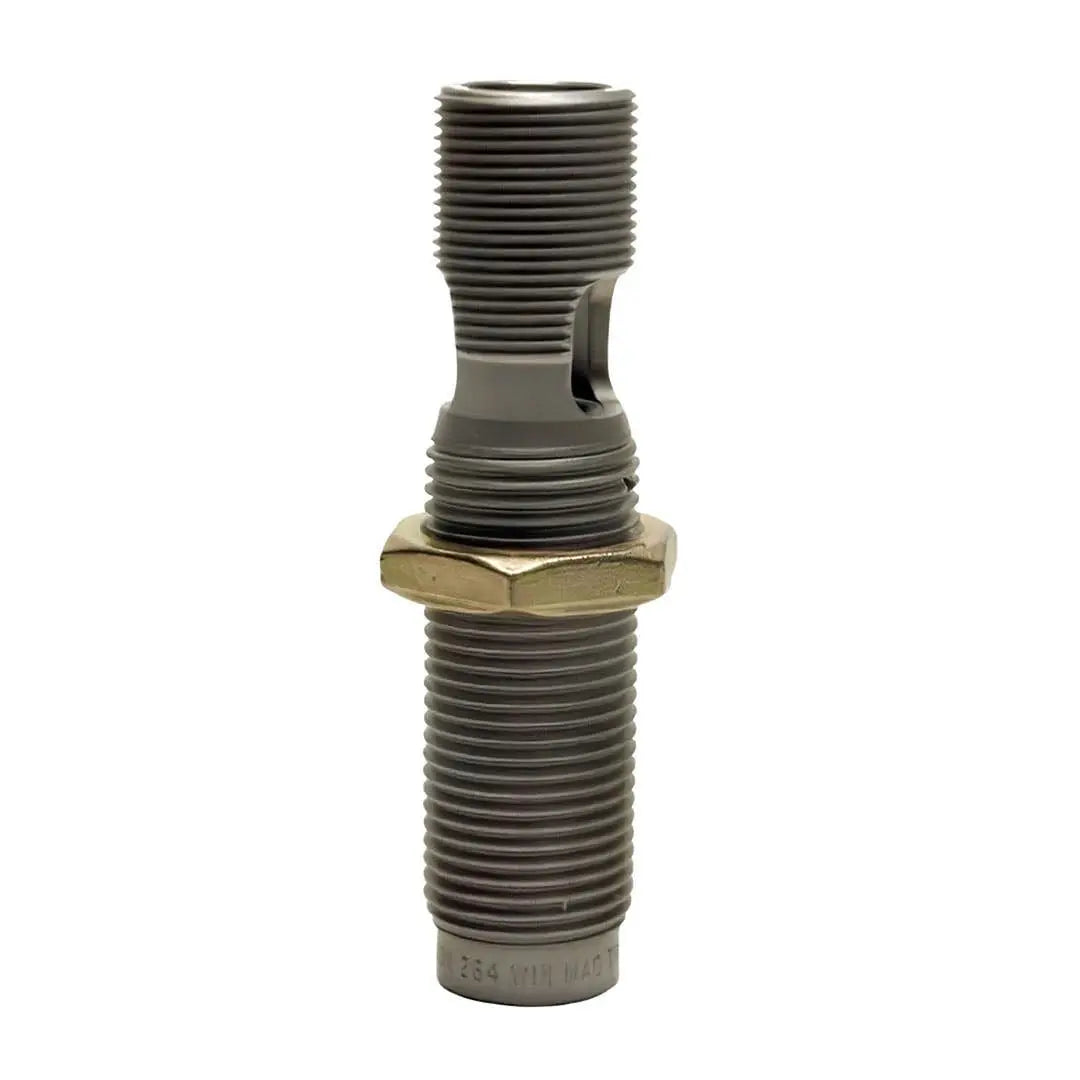
Dillon’s system is architecturally different. The trim die is a sizing die with a hole in the top: in Dillon’s own description it is used just like a standard sizing die, except that while the case is pushed in to size it, a quarter-horsepower motor driving a carbide cutter trims it to length. Sizing and trimming happen in one stroke, and the cut is referenced off the die-to-shoulder relationship rather than off the rim, a collet or a chamber-simulating holder.
Prices from dillonprecision.com on 2026-09-17: the RT1500 Rapid Case Trimmer at $440.00; steel size/trim dies from $79.95 and carbide from $265.00; a vacuum manifold and replacement carbide blades $29.95 each. Short trim die toolheads run from $74.95 for the RL550 to $275.00 for the RL1100 and Super 1050, and complete rifle case prep kits from $625.00 for the RL550 to $1,045.00 for the larger machines. The trim dies are compatible with both the current RT1500 and the older RT1200, which matters on the used market.
A documented progressive layout puts a universal decapping die in station one and the trim die in station four. The trimmer can also be run on a single-stage press, which is what makes it interesting for a two-machine bench: one head can serve the precision press for .30-06 and .308 and the progressive for 5.56.
Hornady has no true equivalent. The Cam Lock above is a bench lathe, and the Lock-N-Load Case Prep Trio at $139.99 (Brownells and MidwayUSA listings) is a powered chamfer, deburr and pocket station rather than a press-mounted trim die. A bench built around a Hornady progressive therefore trims off the press.
One adjacent product changes the question rather than answering it. RCBS’s X-die carries a mandrel intended to restrain the case from stretching during resizing, with the claim that after an initial trim to a set length no further trimming is needed. How completely it achieves that could not be verified in this pass, and the claim is recorded without endorsement. If it holds even partly it is attractive for bulk 5.56, which is exactly where trimming labour is hardest to justify.
13.5 Chamfer and Deburr — In the Same Pass, or Not
Trimming leaves a burr inside and outside the mouth. The outside burr interferes with chambering and will fail a case gauge; the inside burr shaves jacket material off a bullet on seating. Both must go, so the question for any trimmer is whether they go in the same handling of the case.
The single-pass tools are the Giraud heads, the Lee Quick Trim and the Frankford trim-and-prep centre. Everything else needs a second operation, and the tooling is cheap — Lyman’s deburring tool at $27.95 and its chamfer tools from $17.95, Forster’s 3-in-1 case mouth cutter at $84.00, L.E. Wilson’s burring tool at $40.95, Frankford’s Case Prep Essentials kit at $76.99. A VLD chamfer is a shallower, longer taper matched to the long boat-tails and secant ogives of very-low-drag bullets: a functional difference rather than a marketing tier.
The honest arithmetic: a second handling of every case costs several seconds each, which at five hundred cases is most of an hour. That, not length precision, is what the single-pass tools are actually selling.
13.6 Throughput, Honestly
No maker in this volume publishes a rate, and only one user-reported figure was located — the five hundred cases an hour above. That absence is worth stating rather than papering over with invented numbers. Structurally, the tiers separate by handling rather than by cutting speed. A lathe trimmer requires insert, lock, cut, unlock, remove, then a second handling for chamfer and deburr: six operations. A drill-driven single-pass head requires insert, push, withdraw — three, chamfer included. An on-press trim die requires none beyond the press stroke already being made for sizing, which is why it is the only architecture whose marginal cost per case is effectively zero. Cost per thousand is therefore dominated by labour, and purchase price is recovered in labour long before anything else.
13.7 Where Trimming Matters, and Where It Is Optional
Trimming matters for any crimped round, because crimp depth is referenced from the mouth and uneven length means uneven crimp and uneven bullet release; for any case at or near maximum length; for high-pressure bottleneck cases full-length sized every firing, because those grow every cycle; and always for formed brass, which starts life out of specification by definition.
It is optional or near-optional for neck-sized bolt-gun brass at moderate pressure, which grows slowly enough that measuring each cycle and trimming by exception suffices; for low-pressure straight-wall cases at mild loads, where reported .45-70 practice is an occasional trim rising to every one or two firings when the same brass is loaded heavily; and for cases that will be discarded after one or two firings, where trimming is labour spent on brass that will not live long enough to need it.
Table 1 — Where Trimming Matters, and Where It Is Optional
| Chambering | Maximum | Trim-to | Verdict |
|---|---|---|---|
| .30-06 (Garand) | 2.494 in | 2.484 in — secondary sources only | On a schedule. Full-length sizing is mandatory for feeding, so the case grows every cycle. Measure every batch. |
| .308 Winchester (bolt) | 2.015 in, min 1.995 in | 2.005 in, from Lyman’s 48th edition | By exception. Minimal bump at moderate pressure grows slowly; measure each cycle, trim what has reached trim-to. |
| .223 / 5.56 | 1.760 in | 1.750 in — the same figure for both | Every few firings, not every cycle. Sorting by measured length beats trimming blind; bulk range brass is usually retired before it needs trimming at all. |
| .300 AAC Blackout | 1.368 in | see below | Every cycle, and it is part of manufacture. |
| .450 Bushmaster | 1.700 in | 1.690 in | Occasionally, but uniformly. At 38,500 psi it grows slowly; length matters for the heavy crimp, not for growth. |
| 9 mm · .40 S&W · .45 ACP | .754 / .850 / .898 in | effectively never trimmed | No. Straight pistol cases do not stretch as bottleneck cases do; they are retired for mouth splits and base bulges. Published 9 mm gauge figures appear to span minimum to maximum rather than specify a trim point, and could not be confirmed. |
Two entries need expanding. The .300 Blackout case is the genuine outlier, and the only one here whose trim specification is two-sided. Every other cartridge guards against growing too long; in .300 Blackout, because cases are usually cut down from 5.56 brass, the live risk is finishing too short — outside minimum, with too little neck to grip a bullet consistently. Maximum case length is 1.368 inch; the commonly quoted minimum of 1.348 inch is a reading of the drawing convention by which case specifications are maxima and chamber specifications minima, plausible but not confirmed against the drawing itself, so it is printed as an inference rather than a specification. The documented forming workflows all cut long and trim back for this reason — a rough cut near 1.370 inch, or a jig set to 1.375 to 1.380, then a finish trim to 1.368 on a tool that deburrs in the same pass. Volume 16 covers forming in full; the trimming point is that here the trimmer is production equipment rather than maintenance equipment, and it needs to be single-pass.
The .450 Bushmaster entry inverts the usual reasoning. Its low working pressure argues for slow growth and long intervals between trims, but the cartridge needs a heavy crimp — heavy bullets, substantial recoil, a semi-auto slamming rounds up a feed ramp — and crimp uniformity is length uniformity. So the case needing the trimmer least often is also the one where a sloppy trim shows up soonest, as inconsistent bullet pull rather than as a pressure problem.
13.8 The Verdict for a Two-Machine Bench
For the precision side — .308, .30-06 for the Garand, and .450 Bushmaster in modest quantities — a good lathe trimmer is sufficient and the money is better spent elsewhere. The Forster at $126.00 and the RCBS Trim Pro-2 at $169.99 are both defensible; the RCBS power kit’s self-feeding cutter earns its premium mainly because it frees a hand.
For the bulk side — 5.56, and .300 Blackout if brass is being formed rather than bought — the Giraud Tri-Way at $120.00 driven by a drill already on the bench is the highest-value item in this volume, because it collapses three operations into one at hand-tool money. The WFT2 at $69.95 plus $24.95 an insert is the cheaper alternative and gives up the chamfer.
The dedicated machines earn their money only at volume: the Giraud Power Trimmer at $575.00 and the Henderson at $889.00 are bought for rate, and Henderson’s own two-thousandth figure is the honest limit on what else they buy. The Dillon trim die is the option worth thinking hardest about, because it adds no operation at all — at $440.00 plus $79.95 and up per caliber in steel, it is expensive for one cartridge and cheap for three, and it can serve both presses.
Where trimming genuinely does not matter is the pistol calibers, and saying so is as useful as any recommendation above. Volume 15 covers what actually ends those cases, which is not length.
Comments (0)