The Reloading Bench · Volume 14
Annealing — The Metallurgy, and Whether It Is Worth It
Why a temperature with no dwell time is not a specification, and why softening the head is a different class of error from softening the neck
Brass hardens when it is deformed, and a cartridge case is deformed on every cycle of its working life. That is the whole premise of annealing, and it is worth being precise about before any equipment is considered, because this is the one case-preparation subject where the popular instructions are not merely imprecise but structurally wrong. A great deal of published advice specifies a temperature and nothing else. A temperature alone does not describe an anneal, and the reason is metallurgical rather than pedantic.
14.1 Why Brass Work-Hardens
Cartridge brass is an alpha brass of roughly thirty percent zinc, giving it a single-phase face-centred-cubic structure. The best accessible primary-grade treatment located for this dive is a materials-education teaching module, Effect of Rolling and Annealing on Hardness of Brass, by Andrew Cantrell of the Department of Mechanical Engineering at the University of Washington, published through Edmonds Community College. Its samples are that same seventy-thirty copper-zinc alloy, so its numbers are usable directly.
Cold work — rolling in the module’s experiment, drawing and sizing in a case — elongates the grains and introduces defects within them called dislocations, which make it harder for atoms to slide over one another during further deformation. That is what raises strength and hardness, and it is not a defect: it is how brass is given the strength it needs, and it is why a new case is not in a virgin state but in a state its manufacturer chose. As Volume 2 noted, a case reached its finished shape through a sequence of draws, each of which hardened it and each followed by an anneal to make the next draw possible. Annealing at the bench therefore restores a condition rather than creating one.
Hardness has a ceiling. In the module’s samples it reached maximum at forty percent rolling while the microstructure continued to change with further rolling, because “there is always an associated hardness limit with any alloy resulting from its specific chemical composition.” A case does not get indefinitely harder; it hardens to the alloy’s limit and then gets less ductile until it cracks.
Annealing reverses this by nucleating new, strain-free grains which grow and consume the deformed material. A fifteen-minute anneal in the module partially recrystallized the sample, leaving new grains mixed with remnants of the old harder ones, while a full anneal returned hardness to the starting value with equiaxed grains and visible twinning. Two figures are worth carrying: the annealed baseline sheet measured HV 91, and a sample cold-worked sixty percent and then fully annealed returned to HV 91. From the same source, yield stress in Vickers terms is approximately HV divided by three.
One adjacent mechanism explains a failure that otherwise looks like ordinary work hardening. Ammonia causes stress-corrosion cracking in cartridge brass — season cracking, identified in 1921 after British cartridges stored in Indian stables cracked from ammonia acting on the residual tensile stress of cold-drawn cases. The industrial countermeasure is stress relief at roughly 250 to 300 degrees Celsius, which is precisely what annealing a case neck does. So a case cracking with very few firings on it, having sat in storage, is a season-cracking suspect rather than an over-worked one — and no ammonia-bearing cleaner belongs near brass destined for reloading.
14.2 The Correction That Matters Most
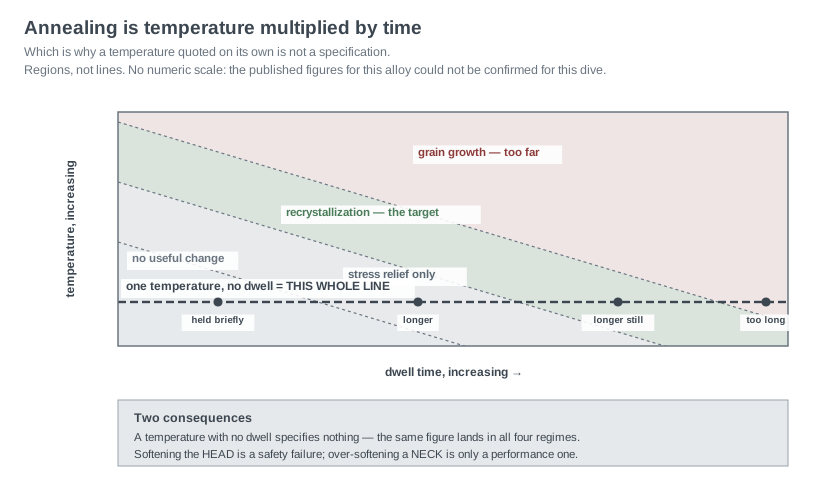
Recrystallization is a function of temperature and time, not of temperature alone.
A neck held at 300 degrees Celsius for fifteen minutes and a neck flashed to 750 degrees for half a second are different treatments with different outcomes, and neither is described by its peak temperature. This is not a subtlety at the margins — it is why torch annealers specify seconds, why induction annealers specify joules, and why every serious method is expressed as a dose rather than a setpoint. Any instruction to “anneal brass at X degrees” without a dwell time has said nothing. It is not a specification that has been simplified; it is not a specification.
Four regimes are worth distinguishing, with the caveat that every boundary moves with dwell time and with how much cold work the brass carries.
Table 1 — The Correction That Matters Most
| Regime | Approximate temperature | What happens |
|---|---|---|
| Drying | to about 90 °C / 200 °F | Nothing metallurgical |
| Stress relief | about 250–350 °C / 480–660 °F | Residual stress falls; hardness and strength essentially unchanged, the recrystallization temperature not having been exceeded — good for neck tension |
| Recrystallization | about 300 °C upward, depending on prior cold work and time | New strain-free grains nucleate; hardness falls |
| Full anneal, grain growth | around 500 °C for minutes, in the module’s experiment | Hardness returns to the soft baseline; grains coarsen |
| Damage | high temperature, long time | Excessive grain growth; a dead-soft neck that will not hold a bullet |
The module also records a rule of thumb — annealing is generally done above half the melting temperature — and gives brass a melting point near 900 degrees Celsius, which puts the classical full-anneal region where its own 500-degree experiments sat.
14.3 Cherry Red, Decomposed
The folk instruction to heat a neck until it glows cherry red bundles three separate errors, and they fail in different ways with different consequences.
Visible red is far past the target. Brass does not glow at stress-relief temperatures. By the time a neck glows visibly in a lit room it has been carried well past recrystallization and into grain growth. The result is a dead-soft neck with no consistent grip on the bullet — a performance failure, and a real one, since inconsistent neck tension is among the few variables that reliably shows up in velocity spread.
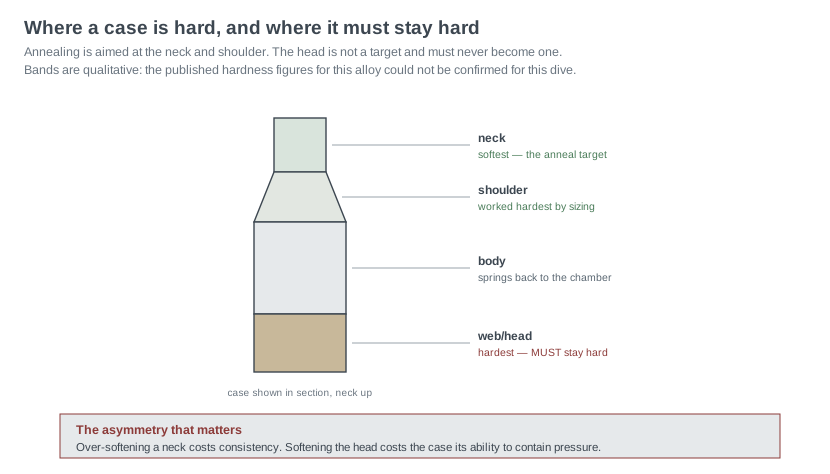
Heat travels, and a softened head is a safety failure. Documented torch practice uses a 450 °F temperature-indicating lacquer band on the case body for exactly one purpose: to show that heat has not travelled toward the head. The head is the pressure-bearing structure and is hard by design — the measurements below put heads at nearly twice neck hardness. A case whose head has been softened belongs in the scrap bucket, and no test at the bench will tell the loader it happened.
Judging by colour is judging in the dark. Perceived glow depends on ambient light, and the eye is a poor pyrometer — the same neck reads differently in a lit garage and at dusk. This is why every method in practical use is instrumented: temperature-indicating lacquer, a timed dwell against a stop, or induction with a measured energy dose. The instrumentation is not refinement; it is the only thing standing between a dose and a guess.
14.4 The Hardness Anchors, and the Asymmetry They Reveal
The most quoted cartridge-specific hardness figures come from AMP’s own published research, and they need a sourcing caveat rather than being printed as established fact. AMP’s website refused every automated retrieval attempted for this dive, returning 403 to each relevant page. The figures below were recovered through a search index rather than read off the page, and have not been re-read in a browser. Every AMP-specific number in this volume should be treated as unconfirmed.
With that stated: AMP reports that, measured on cross sections, virgin case necks from the two major brands it tested averaged about 100 HV, hardness halfway to the head averaged about 190 HV, and case heads ran 185 to 218 HV. AMP also notes that thin brass sections must be measured with micro-hardness Vickers or Knoop equipment, conventional Rockwell and Brinell instruments being unsuited to the section thickness — a credible methodological point, and a reason to be sceptical of hardness claims made with ordinary shop equipment. AMP is further reported to have found that at temperatures up to 350 degrees Celsius very little happened in the neck regions while case heads were softened in every region measured.
The neck figure has independent corroboration of a sort: the module’s fully annealed HV 91 sits close to AMP’s approximately 100 HV, from a separate source and method. The head figures have no such corroboration here.
What the anchors establish, whatever their precision, is an asymmetry that governs the whole subject. A case head is roughly twice as hard as a neck, deliberately. Over-softening a neck produces a case that will not hold a bullet consistently: a performance failure, detectable, recoverable by discarding the batch. Softening a head weakens the pressure-bearing structure: a safety failure, undetectable at the bench, and consequential. The two errors are not points on one scale. That is why every method below is judged first on how well it confines heat and only second on how precisely it delivers it.
14.5 Torch
The cheapest method: a torch, a case spinner or drill, and temperature-indicating lacquer. Documented practice uses 750 °F lacquer inside the neck as the target indicator and 450 °F on the body as the heat-did-not-reach-the-head check. A machine-fed torch account reports taking necks to approximately 800 °F for six seconds while holding the body below 425 °F.
Those numbers are useful precisely because they come as a temperature and a dwell. Quoted without the six seconds, the 800 °F figure would be the error this volume exists to correct — and an earlier research note for this dive recorded the temperature without the dwell, which is exactly how the mistake propagates.
The weakness is repeatability. Flame position, gas pressure, ambient temperature and case-to-case timing all vary, and the operator is the controller. A torch can deliver a correct dose; it cannot easily deliver the same dose four hundred times.
14.6 Salt Bath
A molten nitrate and nitrite bath held at a controlled temperature, into which the neck and shoulder are dipped for a few seconds. Elegant in principle, because the bath temperature is a ceiling the brass cannot pass.
A documented mixture is fifty percent potassium nitrate, forty-five percent sodium nitrite and five percent sodium nitrate, run near 500 degrees Celsius with an acceptable band of 450 to 530; component melting points are 334, 271 and 308 degrees. Reloading practice dips the neck and shoulder and withdraws after six to eight seconds, with four to five also reported. The process is described as not softening the material by more than 120 HV — a rarely quoted and genuinely useful bound.
The hazards are specific and severe and must not be written about casually. Moisture is the killer. Condensation or ice on an object becomes explosive on contact with molten salt if not thoroughly removed beforehand, and if moisture is introduced the rapid conversion to steam can splatter molten salt onto anyone nearby. The consequence for a bench that wet-tumbles is blunt: brass going into a salt bath must be bone dry, and “dry to the touch” is not the same claim. Work must be well ventilated and salts must not be mixed in a closed room. Gloves and eye protection are required, and the reason is worth repeating — molten salt at 500 degrees gives no sign of its temperature, no smoke and no roar. A further limit circulates attributed to AMP: above 550 degrees the salt can begin to decompose, releasing oxygen and creating a fire or explosion hazard. That claim reaches this dive through a forum quoting AMP rather than from AMP directly, and is recorded as unconfirmed — but it argues for running a bath well inside its band rather than at the top of it, and contamination falling out of dirty brass into a bath already near its limit is named as an additional risk.
Entry cost is reported around $200 for a working setup — a community figure, not a product price.
14.7 Induction
Induction heats the brass itself rather than a flame or a bath, which makes the dose controllable as electrical energy and confinement a matter of field geometry rather than of operator aim.
AMP (Annealing Made Perfect) is the reference machine. Dealer pricing checked 2026-09-17: the Mark II DB at $1,795.00, listed out of stock at Gunstop, with pilots separately at $19.95 to $19.99 each — the relevant ones covering the .300 Blackout, .223 Remington, .308 Winchester and .30-06 families. European pricing from Solid Solution Designs is €1,700.00 excluding VAT, pilots from €29.50. A figure of $1,275.00 circulates online; the page carrying it now returns a 404 and it is not printed here as a price, and the AMP MATE feeder’s price could not be confirmed. From a dealer reproducing AMP’s documentation, the machine uses a custom ferrite-core inductor with an air gap designed to focus magnetic fields, with no work coil and therefore nothing to burn out; universal input 85 to 265 volts; under 600 watts; roughly 200 cases continuously at 20 degrees Celsius before thermal protection intervenes.
AZTEC mode must be described carefully, because the pages describing it could not be read. In AMP’s dealer-reproduced words it “allows you to analyze your own brass and generate the correct setting yourself rather than sending it to us.” The workflow, as reported, runs increasing energy doses on sacrificial cases of the user’s own brass and derives a program code for that specific lot; AMP is reported to have made AZTEC standard in every Mark II, with the price adjusted accordingly. The algorithm behind it is not described in this volume, because the source describing it could not be retrieved, and inventing a mechanism would be worse than leaving the gap visible.
What AZTEC represents is the point this volume has been building toward. A machine that determines the correct dose empirically, per lot of brass, is an admission in hardware that temperature-and-time cannot simply be looked up — that the right dose depends on how much cold work this particular brass carries, which is a property of the lot and its history. That is the conclusion the metallurgy reaches, arrived at commercially.
The other machines occupy the space between a torch and an AMP, prices checked 2026-09-17:
Table 2 — The other machines occupy the space between a torch and an AMP, prices checked 2026-09-17
| Machine | Price | What it is |
|---|---|---|
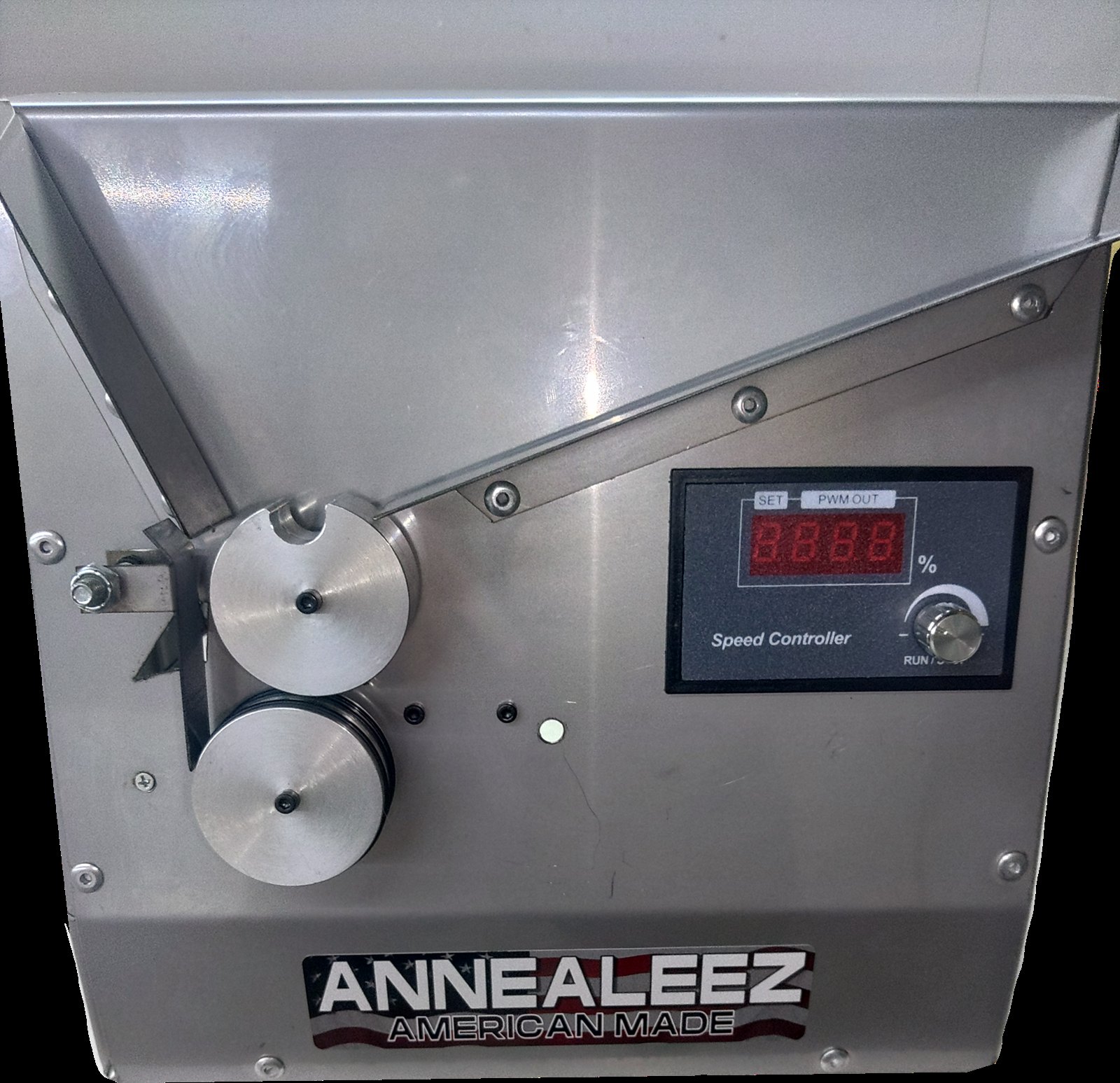
| Annealeez | $310.00 | Torch-based with a feed mechanism. The maker’s homepage publishes no throughput figure and no torch specification, so neither is quoted here. |
| Bench-Source | $525.00 | The maker calls it a precision case neck annealer, hand-assembled in the USA; annealer plates from $59.95. The dual-torch and indexing-shell-plate mechanism commonly attributed to it is not described on the maker’s page fetched for this dive, and is recorded as unverified. |
| Burstfire | $649.00 | Sold through Dillon; an induction machine at well under AMP money. |
14.8 One Claim Deliberately Left Unsourced
It is widely repeated that quenching annealed brass in water is unnecessary, because copper-zinc alloys do not harden on quenching — there being no martensitic transformation available in single-phase alpha brass. That is consistent with the metallurgy above and is probably correct, but no primary source stating it explicitly was verified for this dive, and it is therefore not asserted here. What can be said from the module is narrower and still useful: annealing’s effect comes from recrystallization and grain growth — from the soak — not from the cooling rate.
14.9 Is It Worth It — And the Question That Replaces That One
RCBS provides the manufacturer’s frame: annealing restores malleability and extends case life, and brass life is pressure-driven — “A rifle cartridge operating at max pressure of over 60,000 psi may only last 3-5 firings while something like a 45-70 Gov. may last a couple dozen.”
But “is annealing worth it” is the wrong question, and substituting the right one settles most arguments on the subject. Annealing addresses neck and shoulder work hardening — split necks, cracked shoulders, drifting neck tension. It does nothing for the other two ways a case dies: loose primer pockets and web or head stretching. Neither is a hardness problem and neither is reachable by heat applied to the neck.
So the question is never whether annealing works. It is: is neck hardening what is killing this brass? That is why the verdict below is organised by failure mode rather than by cartridge, and why two cartridges of nearly identical pressure land on opposite sides of it.
Table 3 — Is It Worth It — And the Question That Replaces That One
| Brass | Verdict | Reasoning |
|---|---|---|
| 5.56 / .223, bulk range pickup | Not worth it | Cheap, often unknown origin, usually retired on a loose pocket or failed inspection long before neck hardening dominates. Labour exceeds the value of the brass. |
| .223, quality brass in a bolt gun | Worth it | Around twenty firings reported on premium .223 at moderate loads; one account reports fifteen reloads annealing every third firing with pockets still holding. Practice, not tested fact. |
| .308 Winchester, bolt gun | Depends entirely on the load | Loaded hot, premium .308 is reported retired at four or five firings on loose primer pockets — and annealing does nothing for a pocket. At moderate pressure, twenty or more firings without cracked necks are reported, annealing every five. Same cartridge, opposite answer, decided by failure mode. |
| .30-06 for the Garand | Marginal | Full-length sizing is mandatory for feeding, so the case is worked hard every cycle — but the reported retirement criterion is the primer pocket, and ten loadings is the only figure located, from one account. Annealing addresses the wrong failure. |
| .300 Blackout formed from 5.56 | Worth it — arguably mandatory | Forming cold-works the neck severely, the neck being cut from what was case body. The most systematic forming account treats annealing as required and warns that skipping it risks inconsistent velocity, poor accuracy and short case life; head separations after one to three firings are reported on converted brass. The strongest case anywhere on this list. |
| .450 Bushmaster | Unresolved; the analogue is contested | No case-life figure for this cartridge was located at all. At 38,500 psi the nearest analogue is .45-70, where sources disagree: one holds that life ends in a split mouth, exactly what annealing addresses; the other that straight-sided cases do not get the work a bottleneck does and trimming matters more. Both practice-level, and no consensus is manufactured here. |
| 9 mm · .40 S&W · .45 ACP | Not in practice | One source argues hardening occurs faster in .40 S&W than in lower-pressure cartridges, making annealing more important for case life. A reasonable mechanical claim, but annealing pistol brass is uncommon, and these cases are consumables: inspected each cycle, culled freely. The .40 is retired on a base bulge, which annealing cannot touch. |
14.10 The Verdict
For a bench serving these chamberings the honest answer is narrow. Annealing earns its place unambiguously in exactly one place — formed .300 Blackout brass, where the forming operation is itself the severe cold work and the documented failures are neck and shoulder failures. It earns a conditional place in moderate-pressure .308 and quality .223 in a bolt gun, where necks are plausibly the limit. It earns nothing on bulk range 5.56, on pistol brass, or on any brass being retired for a loose primer pocket — and money spent on a machine to anneal those is money spent on the wrong failure.
That also sets the equipment answer. A bench annealing a few hundred formed cases in batches does not need a $1,795 induction machine; a torch with temperature-indicating lacquer and a timed dwell, or a feed-mechanism torch machine near $310, will deliver a controlled dose if the operator controls it. What the expensive machine buys is dose repeatability across hundreds of cases without an operator in the loop — worth real money to someone annealing every batch of precision brass, and worth nothing to someone annealing a hundred cases twice a year.
Volume 15 takes up what does end a case’s life in each of these chamberings, and how to retire brass at quantity without inspecting each piece as though it were the only one.
Comments (0)