The Reloading Bench · Volume 8
Choosing — The Verdict, Starting Out and Coming Back
What changed while you were away, the warranty boundary nobody mentions, and what this particular bench should be
Buying a press is two different problems wearing the same name. Someone who has never loaded a round needs a machine that teaches, fails safely, and costs little enough that a change of mind is not expensive. Someone who loaded for years, sold the equipment, and is coming back needs something else entirely: a map of what moved while they were gone, because the muscle memory is intact and the catalogue is not. This volume answers both, and then commits to a specific recommendation for the bench documented here.
Every price below carries the date it was read — 2026-09-17 — and the source it was read from. Component and equipment prices in this trade move fast enough that an undated figure is worse than no figure.
8.1 What Changed, for Someone Coming Back
The returning handloader’s problem is that the brands are all still there and the model numbers have quietly rotated underneath them.
Dillon’s XL650 became the XL750 in 2019, and it is a real revision rather than a badge change. The priming system changed from the rotary “telephone dial” arrangement to a linear one, the indexing was redesigned, and the frame gained roughly 15 percent in mass. Dillon’s own position on continuity is worth quoting precisely because it is easy to misread in both directions: “The XL650 cannot be updated into an XL750” — so there is no upgrade kit — but all caliber conversion kits, toolheads and most parts interchange freely, and the frame mounting holes are identical. A bench drilled for the older machine takes the new one.
The RL550B became the RL550C around 2017, a lighter revision concerning greasing and the frame. All 550B parts fit, which makes used-market parts and toolheads for the older machine entirely usable.
Dillon bought AmmoBot in late 2019 and formed Dillon Automation. That matters more than a corporate footnote, because it removed the one independent competitor to Mark 7 in press automation. The consequence for a buyer is in Volume 7.
RCBS was acquired by Hodgdon in 2024, so the benchmark single-stage press is now a Hodgdon product. The press itself is unchanged in any way that affects a purchase.
The Super 1050’s status is genuinely unresolved. It was announced as discontinued in 2019 and Dillon still lists it, prices it and services it. This dive does not claim to know which is true.
8.2 The Warranty Boundary
This is the single most useful thing a returning buyer can be told, and it is not prominent anywhere.
Dillon’s lifetime transferable “No-B.S.” warranty — the thing the brand’s reputation largely rests on, and the reason many people buy Dillon at all — covers hobby-level machines only. Per Dillon’s current published terms, the RL1100 carries a two-year warranty and the Super 1050 carries one year.
That inverts the intuition. Spending more money moves a buyer out of the warranty that motivated the brand choice. It does not make the commercial machines bad — they are built for volumes a private bench will not reach — but a buyer who is paying partly for the warranty should know exactly where it stops. For the bench recommended below, this is one of the two reasons the recommendation stays in the hobby tier.
8.3 What a Throughput Number Actually Means
Rated rates are a sprint with the consumables pre-loaded. Sustained output runs about 60 to 70 percent of the rated figure, a relationship supported by three independent instances in the research for this dive. The shortfall is not the machine; it is refilling primer tubes, topping up powder, refilling case feeders, and dealing with the occasional stoppage.
Two specifics are worth carrying:
The only independently measured rate located anywhere is American Rifleman’s 540 rounds per hour on the Frankford Arsenal X-10. Every other figure in circulation is a manufacturer claim. When comparing machines, that is the one number with a witness.
Lee’s “250+ rounds per hour” turret claim is a timed trial that explicitly excludes refilling primers and powder — which is to say it excludes the thing that makes real rates lower than rated ones.
Mark 7 publishes no manual rate for the Apex 10, and Lee publishes none for the Six Pack Pro. Those absences are stated here rather than filled with an estimate.
8.4 The Verdict for Someone Starting Out
Buy a single-stage press, and buy the ordinary one.
The RCBS Rock Chucker Supreme — $259.99 from RCBS, $239.99 from Scheels, both read 2026-09-17 — is the default recommendation for a reason that has nothing to do with it being the best press. It is the press that does one operation at a time, slowly, with the case visible and in hand at every step. A beginner needs to see a charged case before a bullet goes on top of it, and a single-stage enforces that. A progressive performs four operations on one stroke, which is exactly the property that makes it fast and exactly the property that lets a mistake reach a hundred rounds before anyone notices.
The alternatives are all defensible and none of them is a better first press: the Forster Co-Ax at $376.99 from Graf’s is a better press by most measures and a stranger one to learn on; the Lee Classic Cast at $260 and the Redding Big Boss II at $261.99 from Graf’s are close substitutes for the Rock Chucker; the Area 419 ZERO Gen 2 at $1,400 is a precision instrument bought for reasons a beginner does not yet have.
Do not start on a progressive, and be clear about why. The reason is not that progressives are dangerous in themselves. It is that the skill a progressive demands is the skill of noticing that something is wrong from an indirect signal — the feel of the handle, the sound of a primer seating, a powder level that looks slightly off — and that skill is built one case at a time on a single-stage.
8.5 The Verdict for This Bench
The bench documented here has a defined job: precision loading for .308 Winchester, .300 Blackout, .450 Bushmaster and .30-06 for an M1 Garand, plus bulk loading for 5.56, 9mm, .40 S&W and .45 ACP. That is two genuinely different workflows, and the recommendation is three machines because the third one is cheap and does work the other two cannot.
Table 1 — The Verdict for This Bench
| Machine | Price, read 2026-09-17 | Job |
|---|---|---|
| Redding T-7 turret | $391.99 | Precision rifle: .308, .300 BLK, .450, .30-06 |
| Dillon XL750 progressive | $850 + $370 case feeder | Bulk: 5.56, 9mm, .40, .45 ACP |
| RCBS Rock Chucker Supreme | $239.99 (Scheels) | Auxiliary: forming, bulge removal, odd jobs |
That is approximately $1,852 before dies and caliber conversions, and the conversions are not a rounding error — budget them separately from the machine.
Why the XL750 and not the RL550C. The RL550C is $675 and its caliber conversions are cheaper, $99.95 against the XL750’s $175. On price it wins. It loses on one thing that outweighs that: the XL750’s fifth station. A five-station toolhead lets a powder-check die live in the press permanently, on every caliber, forever. The RL550C’s four stations are all committed to operations that have to happen, so a powder check means giving one up or doing without. On a machine whose entire risk profile is “a charge error you did not see”, a permanent powder check is the best $175 on the bench. That is the argument, and it is a safety argument dressed as a feature comparison.
Why a turret and not a second single-stage for precision. A turret holds the die set in a head that rotates, so a caliber’s dies stay set up and in alignment between sessions. For four rifle cartridges loaded in small batches, that is the difference between a session that starts with loading and a session that starts with setting up dies.
Why the Rock Chucker is still on the bench. Two concrete jobs justify it. Case forming for .300 Blackout — Volume 16 — wants a strong single-stage and wants it not tied up. And removing the Glock bulge from .40 S&W brass requires a pass-through die (Redding GR-X, EGW, or the Lee Bulge Buster) on a separate press, because a conventional sizing die does not remove that bulge at all. That is a real operation with a real machine requirement, and it is the kind of thing that only shows up once the calibers are named.
8.6 Why Not the Others
Hornady Lock-N-Load AP, $649.99 from Sportsman’s. A capable press and cheaper than the XL750. The disqualifier is forward-looking: no Mark 7 Autodrive fits any Hornady press, and since Dillon bought AmmoBot, the automation path for a Hornady machine is effectively closed. For a buyer who may never automate, this is not a real objection. For one who might, it is decisive.
Frankford Arsenal X-10, $899.99 including the case feeder — the best-value progressive on paper, and the only one with an independently measured rate. Two problems. Its case feed stops at .308, so it cannot serve .30-06, which this bench needs. And Frankford’s own shellplate list shows no 9mm and no .40 S&W — a claim this dive could not confirm either way. If that resolves favourably the X-10 becomes a serious challenger; until it does, it cannot be recommended for a bench whose bulk calibers are 9mm and .40.
Mark 7 Apex 10, $2,699.99, and its case feed also stops at .308. Same exclusion, at three times the price.
Dillon RL1100 ($2,395) and Super 1050 ($2,500). Better machines than the XL750 in output and in features — in-line primer-pocket swaging in particular, which matters for military brass. They are not recommended here for the warranty reason above, and because the volumes that justify them are commercial volumes.
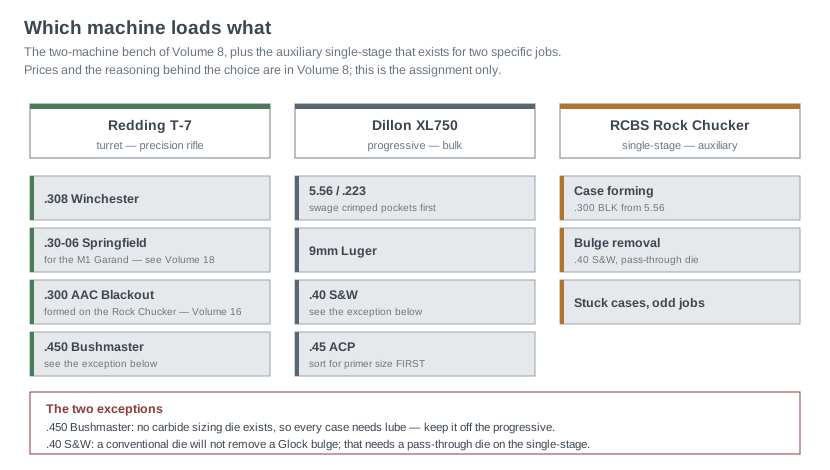
8.7 Which Machine Loads What
Table 2 — Which Machine Loads What
| Chambering | Machine | Note |
|---|---|---|
| .308 Winchester | T-7 | Precision work; shoulder bump per the Headspace dive |
| .30-06 (M1 Garand) | T-7 | Volume 18’s powder window is the constraint, not the press |
| .300 Blackout | T-7, forming on the Rock Chucker | Two load regimes; see Volumes 16 and 21 |
| .450 Bushmaster | T-7 | Keep it off the progressive — no carbide die exists, so every case needs lube |
| 5.56 / .223 | XL750 | The volume caliber; swage crimped pockets first |
| 9mm | XL750 | |
| .40 S&W | XL750, bulge pass on the Rock Chucker | A conventional die will not remove a Glock bulge |
| .45 ACP | XL750 | Sort for primer size before anything else |
The .45 ACP entry carries the trap that Volume 2 sets out and Volume 10 turns into a procedure: the cartridge exists in both large-primer and small-primer brass, eye-sorting is only about 80 percent effective, and a small-primer case reaching a press set up with a large decapping pin can stop the machine. On a progressive, that is a stoppage in the middle of a run.
8.8 Buying Order
The turret first, because the precision calibers are the ones with the smallest batch sizes and the most to gain, and because it is the machine on which the process is learned properly.
The Rock Chucker second, because it is inexpensive and unlocks case forming.
The XL750 last, and only once there is enough prepared brass and enough component supply to justify the rate. A progressive bought before the brass pipeline exists is a machine waiting on its own inputs.
8.9 What This Verdict Does Not Know
Three things are held open rather than resolved, and a reader should treat them as live.
The X-10 shellplate question. If Frankford Arsenal does list 9mm and .40 S&W shellplates, the value comparison shifts materially. This is checkable at the vendor in a minute and has not been checked here.
The Super 1050’s availability. Announced discontinued, still sold and serviced. A buyer contemplating one should ask Dillon directly.
Every price on this page is a single reading on a single day. The relationships between them are more durable than the numbers, and the reasoning above is built on the relationships — the fifth station, the case-feed ceiling, the warranty boundary — precisely so that it survives the numbers changing.
Comments (0)