The Reloading Bench · Volume 7
Presses III — Automation and the Robotized Bench
A motor removes the handle pull and nothing else — and a machine that can make a mistake three thousand times an hour needs sensing a hand-cranked press does not
Automation of a progressive press means one specific thing: a motor turns the crank. Everything else stays where it was. That sentence is the whole of this volume’s argument, and it is worth stating first because the marketing in this category invites a different reading — that a drive converts a reloading press into an ammunition factory, with the operator reduced to filling hoppers. It does not. It removes the handle pull, multiplies the rate at which every remaining decision is executed, and introduces failure modes that do not exist on a hand-operated machine, because a hand stops when something feels wrong.
Prices below were observed on 2026-09-17, each given with the source it was read from.
7.1 What a Drive Is, Mechanically
A drive is a motor, a reduction arrangement and a controller, mounted to a frame that bolts to or under the press and coupled to the press’s own crank. The engineering that distinguishes one from another is not in the motor. It is in the clutch, the torque sensing and the jam detection — the layer that decides when to stop.
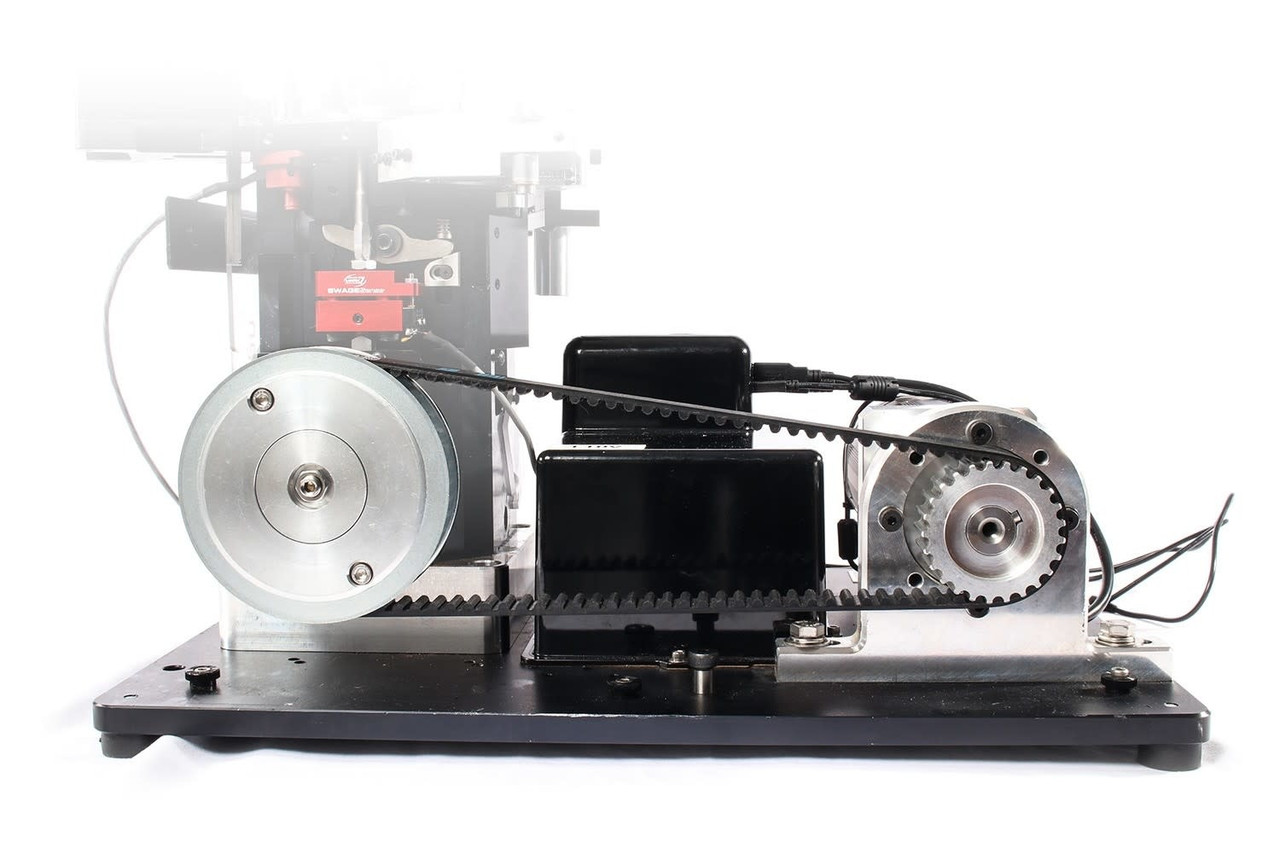
The Mark 7 Autodrive is a pre-assembled drive on an aluminium base plate, described by the manufacturer and its dealers as using patented digital sensor technology, a torque-sensing motor and jam-sense technology, with an adjustable digital clutch offering twenty levels with torque feedback, a ten-inch Android tablet running software the company calls upgradable for life, a maintenance-free timing belt drive, user-selectable speeds, a one-year full warranty and a twenty to thirty minute installation. Sensors are sold separately.
Dillon’s DA3000 takes the same functional approach with different choices: a fifty-level digital clutch with travel and work zones, electronic overload protection with automatic shut-off, a refined motion curve intended to reduce case wobble at speed, improved indexing, extended dwell of up to eight seconds, and adjustable cyclic rate and dwell. Its interface is a dot-matrix display rather than a tablet.
Two of those specifications reveal what the problem actually is. An adjustable clutch exists because the correct stopping force differs by cartridge, by die set and by operation. An adjustable dwell exists because a powder charge needs time to drop and a swage needs time under load, and a machine running fast enough to outrun either produces bad ammunition quietly.
7.2 Mark 7 Autodrive — and What It Fits
Mark 7, a Lyman brand since 2019, sells three Autodrive variants, and the fitment list is the most consequential thing about them. The Apex 10 and Evolution Autodrive fits Mark 7’s own two ten-station machines and is quoted at up to 3,500 rounds per hour. The 650/750 Pro Autodrive fits the Dillon XL650 and XL750 and is quoted at up to 1,800 in a dealer listing. The 1050/1100/CP2000 Autodrive fits the Dillon RL1050, Super 1050, RL1100 and CP2000 and is quoted at 3,500.
No Mark 7 Autodrive fits any Hornady press. Nothing was found for Hornady, Lee, RCBS or Frankford Arsenal either. That is not a small omission for a buyer weighing the Lock-N-Load AP of Volume 6 against its competitors: the Hornady machine has no automation path at all, first-party or third-party, and Hornady’s own “Ammo Plant” is a case-feeder and bullet-feeder package rather than a drive. A machine that can never be automated is a different purchase from one that can, and the distinction is invisible on a specification sheet.
Autodrive pricing is a spread rather than a number, and the spread includes the manufacturer disagreeing with itself. Graf & Sons lists the 650/750 Pro Autodrive in 110 volt form at $2,499.95; Bobcat Armament lists the Apex 10 and Evolution unit at $2,399.95; Mark 7’s own Autodrive comparison page says $2,349 worldwide; and Mark 7’s automated-press comparison page says $2,399. All four were seen 2026-09-17. So a drive is roughly $2,350 to $2,500 depending on model and dealer, and Mark 7’s two marketing pages disagree with each other by $50. Several other dealers list the units at prices that could not be read.
The reference all-in figure Mark 7 publishes is the Apex 10 Automated Bundle at $5,499.95: press, drive, eleven-inch case feeder, mechanical powder measure, ten-station toolhead, shuttle disk priming, hold-down die, a bullet feeder and double guide rods. That is the honest scale of a fully automated hobby bench, and it excludes dies.
7.3 Dillon Automation, and the AmmoBot Acquisition
The most consequential event in this market over the last decade is a corporate one, and it is largely absent from buyer’s guides.
AmmoBot was the third-party pioneer of hobby press automation, with a review of an AmmoBot MK1 existing from February 2016. Dillon bought AmmoBot and its intellectual property, by forum accounts approximately two and a half years before April 2022 — so around late 2019 — after which no new AmmoBots were available while the market waited for Dillon’s own product. Dillon then formed a separate company, Dillon Automation, reportedly for export-control compliance reasons. Both the timing and that rationale come from forum discussions that could not be read directly and are recorded as forum-sourced; the compliance explanation in particular could not be confirmed. The outcome is verifiable: Dillon Automation exists and sells the DA3000, launched at the 2022 SHOT Show.
The net effect is what matters. Dillon removed the independent competitor to Mark 7 and replaced it with a first-party product that fits only Dillon’s own top machines. An owner of an XL750 who wants automation buys from Mark 7 or does not automate; an owner of anything from Hornady, Lee, RCBS or Frankford Arsenal does not automate at all.
7.4 The DA3000, and Two Numbers That Do Not Agree
The DA3000 is $1,995.00 for each of its two versions, confirmed on three separate Dillon pages on 2026-09-17. It fits the RL1100 and the CP2000 only — not the XL750, not the 550. Its included sensing is a Low Powder Sensor and a Low Primer Sensor; a cartridge catch funnel, additional primer and powder sensors and a spent primer catch are accessories. Its warranty is one year, and Dillon states that fitting it maintains the factory one-year warranty on the RL1100.
Two contradictions attach to it, and neither is resolved here.
On price, Dillon’s own current pages say $1,995. Ultimate Reloader’s December 2022 hands-on says $2,399, which appears to be the launch price. Mark 7’s competitive comparison pages claim $2,399 on one page and $1,999 on another — so a competitor’s marketing quotes the figure $400 high while its own two pages disagree with each other. Dillon’s current page is authoritative, and the discrepancy is worth naming precisely because Mark 7’s comparison argument is built partly on price.
On speed, Dillon contradicts itself. The DA3000’s own product pages state up to 3,000 rounds per hour, qualified by a note that optimal loading rates vary by cartridge. Dillon’s RL1100 page states up to 2,000 rounds per hour with the DA3000 fitted. Mark 7’s comparison asserts 2,000 for the Dillon combination against 3,500 for its own. The plausible reconciliation is that 3,000 is the drive’s mechanical cycle ceiling and 2,000 a realistic loaded-round rate, but that is inference and not a published statement. No single figure is adopted here; the conflict is the finding.
7.5 Reading the Vendor Comparison Critically
Mark 7 publishes a head-to-head comparison of its Apex 10 with Autodrive against Dillon’s RL1100 with DA3000. It is marketing from one party, but most of its factual claims are checkable, and checking them is the useful exercise.
Installation difficulty: corroborated. Mark 7 claims thirty minutes with no disassembly for its own drive against a few hours and complete press disassembly for Dillon’s. Ultimate Reloader’s independent DA3000 installation found the most complex part to be swapping the crankshaft, describing the process as manageable but multi-step. A crankshaft swap is meaningfully more invasive than bolting on a base plate, and it is also why one drive is portable and the other is bolted where it is.
Sensor coverage: corroborated. Dillon’s own DA3000 pages list only the low powder and low primer sensors as included, and Mark 7’s sensor catalogue is substantially longer.
Speed: disputed, as above — and Mark 7’s figure for the Dillon matches Dillon’s press page rather than Dillon’s drive page, so the competitor quotes the lower of two manufacturer numbers. Price: wrong as of 2026-09-17. Availability: unconfirmed — Mark 7 claims worldwide availability against United States only for Dillon, which is consistent with the export-compliance account of Dillon Automation’s formation but could not be independently verified.
The comparison’s sharpest and most defensible point concerns neither speed nor price. It is that Dillon’s two sensors detect component availability but not faults during loading. That is a real categorical difference rather than marketing, and the rest of this volume is about why it matters.
7.6 What Automation Does Not Remove
The clearest independent statement available is Ultimate Reloader’s DA3000 assessment, which found that with the drive fitted the press very infrequently has to be cranked by hand — and then that operators must still configure die heights, adjust indexing, set trimmer depth using case gauges, calibrate swaging pressure and install conversion kit components. The automation handles repetitive motion but does not eliminate the technical setup and adjustment work a caliber conversion requires.
Set out as a list, what a drive leaves untouched is most of the craft. Die setup and every dimensional decision — shoulder bump, seating depth, crimp; the drive executes a setting, it does not arrive at one. Powder measure calibration and charge verification, since the measure is the same measure throwing from the same bar, and a powder that meters badly meters badly faster. Caliber conversion labour, arguably increased, because the drive must be re-homed and the dwell re-tuned in addition to everything Volume 6 lists for a hand-cranked conversion. Component preparation — cleaning, sorting, lubricating, primer-pocket decisions — since nothing upstream of the press changes at all. Consumable replenishment, because primer tubes, powder hopper, case bowl and bullet feeder all still empty, and they empty faster. And inspection: nothing about automation inspects the finished round. That last item matters most, and it is the one the rated-throughput figures of Volume 6 quietly assume away.
7.7 The New Failure Modes
A hand-cranked press and an automated one do not fail in the same way. The sensor catalogues are the best available evidence of what the failure taxonomy actually is, because they show what the vendors thought worth detecting and paid engineers to detect.
Speed outruns attention. At two to three and a half thousand rounds an hour a fault produces scrap faster than a person notices it. A squib run that would be three rounds by hand is forty automated, and those forty are physically indistinguishable from good ones in a bin.
The operator is no longer a sensor. Hand-cranking transmits force feedback. A high primer, a stuck case, a missing case-mouth flare and a shellplate that has not fully indexed all feel different through the handle, and an experienced hand stops before it thinks. A torque-sensing motor substitutes for that, imperfectly, which is why Mark 7 sells torque sensing with a twenty-level clutch and Dillon fits electronic overload protection with automatic shut-off and a fifty-level clutch. The clutch is not a convenience feature; it is a prosthetic for the operator’s hand.
Jam energy. A motor will drive through what a hand would stop at — hence jam sensing on one machine and automatic shut-off on the other. A jam under power can bend a toolhead or shear a locator, and the damage happens in one stroke.
Primer-orientation and primer-feed faults, which hand priming rarely produces at volume. Mark 7 sells a primer orientation sensor specifically, which is a straightforward admission that primers arrive at the station wrong often enough to be worth instrumenting.
Component exhaustion mid-cycle, where running out of primers or powder while the machine keeps cycling produces unprimed or uncharged cases interleaved with good ones.
Loss of the natural inspection cadence. Hand loading forces a look at every case whether or not the operator intends to inspect. Automation removes the enforcement and leaves the intention.
7.8 Indicators Against Lock-Outs
The single most useful distinction in this subject is between a device that tells a human and a device that stops the machine, and it states as a rule: on an automated press, only the second category is worth anything.
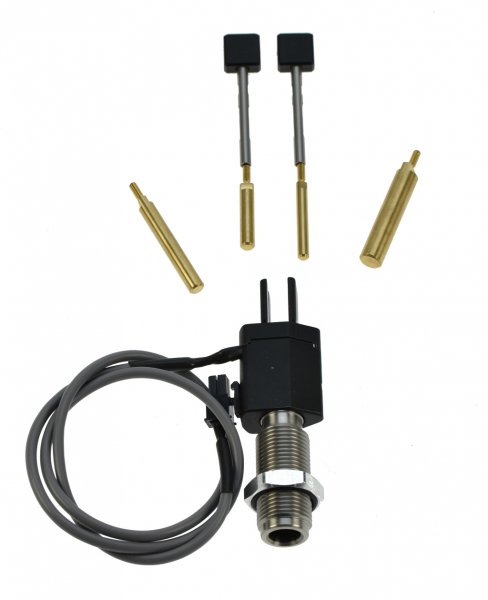
Mechanical powder checks predate automation and remain the baseline layer on any progressive. A powder-cop or powder-checker die indicates — it raises a rod, or positions an indicator ring against a reference, and requires someone to be watching at the top of every stroke. The RCBS lock-out die is the important exception in that group, because it locks the press on a bad charge rather than merely showing one. A magnetic powder check of the same indicating type is also sold. Mark 7 sells both categories for its own machines: a powder check alarm at $84.95 as an Apex 10 add-on, which signals, and a digital powder-check sensor which the company describes as able to automatically stop the machine when a grossly incorrect powder level is detected inside the case, using an infrared beam against over-charge and under-charge windows, shipped with probes for small pistol, small rifle, large pistol and large rifle.
The clearest illustration of the principle is a product that exists only to fix it. Dillon’s low primer alarm is audible, designed for a human at the handle. Mark 7 sells PrimerSense, described in its own words as adapting the Dillon low primer alarm to work with the Autodrive so that it will actually stop the press when primers run low. An alarm designed for a person becomes useless the moment the person leaves, and an entire accessory exists to translate one into the other. Nothing makes the argument better.
The rest of the catalogue follows the same logic — decap sensing, swage sensing, bullet sensing, primer orientation and a remote stop, plus a vibratory primer system at $595.95 automating primer supply as distinct from the press drive. Each corresponds to a specific way the machine can be wrong while continuing to run.
7.9 The .45 ACP Case, as an Illustration
Volume 6 establishes that .45 ACP’s mixed primer sizes are the biggest progressive-specific trap on this bench, that eye-sorting is only about 80 percent effective, and that a small-primer case in a large-primer run jams the press at the depriming station.
Automation makes that worse and then offers to fix it. One user of an eight-station machine with an advanced sensor setup reported a sensor at the primer-pocket checking station that detects a small primer, pauses the machine, has the case ejector kick it sideways into a bin, and resumes. That report is user-sourced and could not be confirmed, but it is the right shape to think with: automation solving a problem automation itself made more expensive. On a hand press the mismatched case is two seconds of annoyance; at 3,000 rounds an hour it is a stopped production run; with a sensor it is a case in a side bin and no interruption at all. Each step costs money and adds a component that can itself fail.
7.10 The Commercial Tier — Camdex and Ammo Load
Above the hobby drives sits the tier where reloading becomes manufacturing, and it appears here mainly to give the hobby figures a sense of scale.
Camdex, Inc. is in Troy, Michigan, which makes it a local company for this bench. It describes high-speed equipment for loading and reloading ammunition plus support equipment for sorting mixed range brass, and its product list runs a 2100 Series pistol and small rifle loader, case processors, a 2275 small rifle pull-and-put machine and a 2300 Series large rifle loading machine. Camdex specifications and prices are essentially unpublished — the company’s own site gives no station counts, cycle rates or prices, and a distributor listing is gated behind a wholesale login. From search snippets only, and therefore unconfirmed, the 2100 Series is described as having eleven stations in line and being speed-adjustable to 4,400 cycles per hour. A used-equipment listing showed a Camdex press at $89,000, and that figure is not printed here as a Camdex price — it is one listing of unknown configuration and condition. What can honestly be said is that used commercial Camdex equipment has been listed in the tens of thousands of dollars.
Ammo Load Worldwide is the other name in the tier, and every automated fetch of its site returned an access error, so everything here is snippet-sourced and unconfirmed. Its Mark X pistol machine is described as producing between 3,000 and 5,000 rounds per hour in normal use, with one used listing claiming an upgrade to 5,500. Its Mark LV rifle machine is described as having eleven stations with electronic sensors to ensure accurate loads for each cartridge, using fibre-optic technology to increase accuracy and reduce maintenance. The company’s own caveat is the most honest sentence in this entire subject and deserves quoting: the quality and quantity of ammunition produced is governed by the quality of the components, particularly the cases, the caliber, and the capabilities of the operator.
7.11 The Scale Ladder
Laid out in order, the rates and prices produce an apparent paradox. A turret runs 150 to 250 rounds an hour for under $300. A hand-cranked five-station progressive is rated 500 to 800 and sells for $850. A ten-station hand-cranked machine measured 540 and sells for $899.99. An automated eight-station Dillon claims 2,000 to 3,000 for $2,395 plus $1,995. An automated ten-station Mark 7 claims 3,500 for a $5,499.95 bundle. And commercial machines costing an order of magnitude more claim rates in the same band as that bundle.
The resolution is that peak rate is the wrong axis. What separates a $5,500 automated hobby bench from a machine costing tens of thousands is duty cycle, sensor coverage, unattended reliability and a service contract — the ability to run a shift, every day, with faults caught by instrumentation rather than by an operator’s attention, and with a vendor obligated to keep it running. Stated that way, the commercial tier stops looking absurd and starts looking like a different product with a similar top speed, which is what it is.
7.12 The Do-It-Yourself Scene, Honestly
There is a genuine hobbyist automation scene, and its centre of gravity is not where one would expect. It is concentrated on powder dispensing rather than on press drives — which makes sense, because a dispenser is a control problem with a scale in the loop, and a drive is a mechanical and safety problem with a primer stack in the loop.
The one concrete, named, citable open-source artefact in the space is OpenPowder, an Arduino-based project for precise powder dosing published on a public code repository. It uses a stepper motor for controlled dispensing, a high-precision load cell for real-time weight monitoring, an LCD interface, adaptive dosing modes and a calibration routine. It is a real piece of engineering with real source code, and it is the right thing to point a capable maker at.
Press-drive projects are discussed far more than they are finished. Forum threads over many years describe automating the press arm with a servo, brackets carrying NEMA 23 or NEMA 34 stepper motors on machines such as the Lee Loadmaster, Arduino control with production-metric readouts, and — on the machinists’ forums — the duty-cycle and torque realities the electronics forums tend to skip. A closed-loop servo project intended as a general-purpose actuator is what the drive builders reach for, because closed-loop position and torque control is exactly what the safety argument above requires. A three-dimensional-printed low primer sensor published on a model-sharing site is evidence that the community identified the same failure mode the vendors did, and answered it for the price of filament.
The honest assessment is that no mature open-source equivalent to a commercial autodrive could be located, and the reason is the reason the commercial products cost what they cost. The hard part is not turning the crank; a motor and a belt will turn a crank. The hard part is the clutch, the torque sensing and the jam detection, and that is where the vendors concentrate their engineering and their patents. A drive without torque sensing is a machine that will eventually break itself, and it sits directly above a stacked column of primers. That is not a reason nobody should build one — a bench with real machine-tool capability and closed-loop servo experience is exactly where such a thing could be built properly. It is a reason not to build the easy version, and a reason the do-it-yourself path should not be romanticised as a cheap substitute for a $2,400 drive when the $2,400 is mostly buying the part that stops the machine.
7.13 What This Leaves for the Bench
Nothing here is a recommendation, and for the two-machine bench this dive is written around the automation question is probably academic: the drives that exist fit machines above the tier that bench needs, and the one hand-cranked machine excluded from automation entirely is excluded for reasons Volume 6 records. Volume 8 makes the actual decisions, including whether an automation path is worth preserving as an option on a machine bought now.
What is worth carrying forward is not a product but a principle, and it applies to a hand-cranked press as much as to a motorised one. Every safety device on a loading press is either an indicator or a stop, and only the second kind works when nobody is watching. Automation simply makes the distinction expensive to get wrong. The powder-check die that locks the press, the sensor that halts the drive, and the habit of looking into every case before a bullet goes on top of it are three implementations of the same idea, and the last one is free.
Comments (0)