The Reloading Bench · Volume 16
Case Forming — Making Brass Nobody Sells
.300 Blackout from 5.56 as the worked example, and the chambering hazard that comes with it
Some cartridges cannot be fed from a shelf. Either nobody makes the brass, or the brass that exists is expensive and scarce while the case it could be made from is abundant and nearly free. Case forming is the operation that closes that gap: it takes a case designed for one cartridge and reshapes it into a case for another. It is the one part of handloading that is genuinely manufacturing rather than assembly, and it is also the part with the highest ratio of effort to reward — which is why the honest question is not how to do it but whether to.
The worked example throughout is .300 AAC Blackout formed from .223 Remington or 5.56 NATO brass, because it is the most common forming job in current practice, because the parent case is the most abundant centerfire rifle brass in existence, and because it carries a specific and catastrophic hazard that no other job on this dive’s list carries.
16.1 What Forming Actually Changes
A case has a head, a web, a body, a shoulder, a neck and a mouth. Forming can move some of those and not others.
What cannot practically be changed is the head: its diameter, its rim or extractor groove, the primer pocket, and the thickness of the web behind it. Those are set when the case is drawn, and they are the features that determine which bolt face the case fits.
What can be changed is everything forward of the web — length, body taper, shoulder position and angle, and neck diameter. Forming works by removing material, by moving material, or by both.
The .300 Blackout job is unusually simple by the standards of case forming, and that is exactly why it is popular. The .300 Blackout was designed around the .223/5.56 case head. Forming therefore requires no change to the head at all. The case is shortened substantially and the neck is opened up to take a bullet of roughly .308 inch instead of .224 inch. There is no body reforming, no shoulder relocation into virgin brass, and no head swaging. Compared with forming an obsolete cartridge from a modern parent case, it is a short job.
16.2 The Sequence
The order matters, and some of the steps are the ordinary case-preparation operations of Volume 12 appearing in a different position.
Sort the parent brass first. Forming amplifies every inconsistency in the input. Mixed headstamps mean mixed case-wall thickness and mixed neck thickness after forming, and military brass brings crimped primer pockets that must be swaged or reamed. That work is better done before forming than after.
Deprime. Standard practice, and doing it before any cutting keeps swarf out of the pocket.
Cut long. The case is shortened by cutting, not by trimming, because the amount being removed is far more than a trimmer is built to take. The cut is made deliberately long — longer than the finished length — so that the subsequent forming operation and the final trim both have material to work with.
Form. The shortened case is run through a die that establishes the new shoulder and neck. It is worth being precise about what the tooling does here, because the marketing is not: a form die reshapes the case, while an ordinary sizing die for the finished cartridge only sizes a case that has already been formed. The research for this dive flags specifically that at least one manufacturer’s .300 Blackout die set sizes already-formed brass rather than forming it from a parent case. Read the die maker’s own description of the operation before buying, not the cartridge name on the box.
Trim to final length. Now the trimmer is doing the job it is built for, taking a small and consistent amount. Volume 13 covers which trimmer suits this work; a tool that indexes from the case shoulder rather than the case head is the more consistent choice on freshly formed brass.
Chamfer and deburr. A formed and trimmed mouth is sharp and will damage a bullet on seating.
Anneal where it is warranted. The neck and shoulder of a formed case have been worked hard in a single operation. This is the case-forming job where annealing earns its keep most clearly, for the reasons Volume 14 sets out — and it is a useful illustration of that volume’s central point, that annealing addresses neck and shoulder work-hardening and does nothing at all for the head or the web.
Gauge every case. A case gauge, not a caliper reading alone. This is the step that catches the failures, and on formed brass the failure rate is not negligible.
16.3 The Length Figure, and Why This Dive Does Not Print One
There is a question here that two independent research passes for this dive answered differently, and the honest thing is to say so rather than to average them.
One pass returned a finished trim length of 1.368 inches as established practice. The other returned 1.348 inches, and here the disagreement is sharper than a difference of two numbers: the two passes do not even agree on what kind of quantity 1.348 inches is. One treats it as the cartridge’s minimum case length, derived from the drawing convention. The other reports it as a widely quoted trim-to dimension. Those are different claims, they carry different consequences for a case that has just been cut and formed, and both sources flagged their own figure as unverified.
This collection holds the relevant SAAMI standard, and it cannot settle the question: the copy held here carries chamber and test-barrel drawings rather than cartridge drawings, so the case-length specification is simply not in it. That limitation is stated in Volume 2 and in the Headspace dive, and this is a concrete instance of it mattering.
The practical consequence is straightforward and does not require the disagreement to be resolved. Take the finished length from the instructions supplied with the forming die being used, and confirm the result in a case gauge for the cartridge. Cutting long and trimming down means an error in the direction of “too long” is recoverable. Neither figure above is printed here as authoritative, and a reader who needs the specification should read the current standard directly.
16.4 Yield, and Whether It Is Worth Doing
The case against forming is stronger than its advocates usually admit, and it is not primarily about the labour.
It is about tooling cost. The cutting arrangement, the form die, a trimmer that will index formed brass consistently, and — if annealing is part of the process — an annealer, together represent a real outlay. Against that sits the saving on brass. Since the parent case is among the cheapest centerfire brass available and the finished brass is also commercially available, the break-even quantity is high. For a shooter forming a few hundred cases, buying the brass is very likely cheaper once tooling is counted honestly. For one forming many thousands, the arithmetic reverses.
There is a genuine gap in the published record here, and it is worth naming: no source located for this dive gives a yield or scrap rate for the .300 Blackout forming process. Every account describes the method; none reports what fraction of cases come out of it unusable. That figure is what the economic argument actually turns on, and it does not appear to exist publicly. It is measurable at a bench with a counter and a scrap box, and doing so would produce a number that is not currently in the public record.
16.5 The Hazard
Forming .300 Blackout from 5.56 brass creates, as a by-product, the most dangerous ammunition mix-up available to a handloader. It deserves to be stated plainly and understood mechanically rather than memorised as a warning.
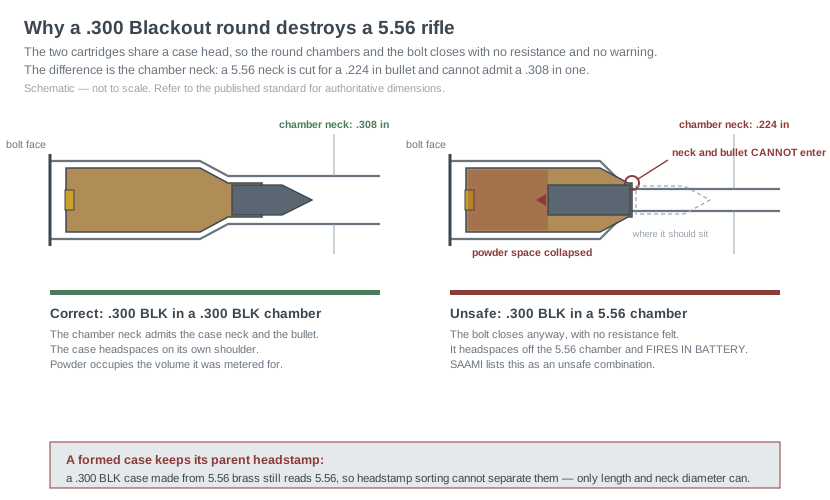
A .300 Blackout cartridge will chamber in a 5.56 rifle. SAAMI lists the combination among its unsafe arms and ammunition combinations. The two cartridges share a case head, a rim, an extractor groove and an overall envelope close enough that the round enters the chamber and the bolt closes.
The mechanism of the failure is the part that matters:
It chambers without resistance. There is no stiff bolt, no crunch, no tactile warning. The bolt closes the way it closes on a correct round.
The 5.56 throat drives the bullet back into its own case. A 5.56 chamber’s throat is cut for a .224-inch bullet. A .300 Blackout bullet is roughly .308 inch. As the bolt closes, the throat cannot admit the bullet, so the bullet is pushed rearward into the case that holds it.
Case volume collapses. The bullet being driven back reduces the space the powder charge occupies, sharply. The charge was metered for the original volume.
It headspaces off the 5.56 chamber and fires in battery. The rifle is not out of battery and does not behave as though anything is wrong. It fires.
The result is a pressure excursion in a bore too small for the projectile, with the action fully closed. A documented teardown following one such event records the upper receiver split into four pieces, the bolt carrier split lengthwise, the barrel extension cracked, the barrel nut fractured, and the case head separated. That is one account and should not be read as a universal outcome, but the direction is not in dispute.
16.6 Why Prevention Is Harder for a Handloader
The general advice for this hazard — keep the two calibers separated, label everything, colour-code magazines and the magazine wells they belong to — is sound and is not repeated here at length. But two points specific to handloading are not well stated in the general sources, and both follow directly from the forming process.
A .300 Blackout case formed from 5.56 brass carries the 5.56 headstamp. It was 5.56 brass; the head is the one part forming does not change. So the headstamp says 5.56 on a case that is now .300 Blackout. Headstamp sorting — the normal tool for keeping calibers apart — cannot separate them. Only case length and neck diameter can, which means the sort is a measurement rather than a glance.
Never process both calibers in the same bench session. This is stronger than the general “keep them separate” advice, and it follows from the first point: .300 Blackout is made from .223/5.56 cases, so both calibers are legitimately present at the same bench, in the same tumbler, in similar-looking containers, at the same stage of preparation. The point in the process where a formed case and an unformed parent case are hardest to tell apart is the point where both are clean, deprimed and waiting. Separating the two operations in time, and clearing the bench between them, removes the only interval in which the mistake is easy.
The corollary for storage is in Volume 4: a labelled container is the control, and a label that records the caliber, the date, the components and the load number is what makes a batch traceable at all.
16.7 Other Forming Work, Briefly
.300 Blackout is the common job but not the only one.
Obsolete and wildcat cartridges are often only available as formed brass, and the forming can be much more involved — body reshaping, shoulder relocation, neck turning to correct the wall thickness that reforming leaves uneven, and sometimes several progressive form dies used in sequence.
Fire-forming uses the chamber itself to finish the case, firing a load in a deliberately undersized case so that it expands to the chamber. The Headspace dive covers fire-forming and the reason a shooter’s own fired brass becomes the reference for that chamber, and that treatment is not duplicated here.
Neck-up and neck-down conversions between cartridges sharing a case head are the mildest form of the operation, and the .300 Blackout job is one of them.
16.8 The Verdict
Forming is worth it when the brass genuinely does not exist, or when the quantity is large enough that tooling amortises. For .300 Blackout specifically, and at the quantities a private bench consumes, buying formed brass is usually the better decision once the tooling is costed honestly — with the real exception being a shooter who already owns the trimmer and the annealer for other work, in which case the marginal cost of forming is only the form die and the cutting setup.
What is not optional, for anyone who forms .300 Blackout from 5.56 at all, is the segregation discipline. The hazard is not a consequence of forming badly. It is a consequence of the two cartridges sharing a case head, and it is present in every correctly formed case.
Comments (0)