The Reloading Bench · Volume 19
Weighing the Charge
Resolution, repeatability and accuracy are three different claims — and the effect being chased sits at or below the noise floor of the instruments used to detect it
Charge weight is the number handloaders spend the most money to control, and the equipment for controlling it spans two orders of magnitude in price. A powder measure and a beam scale cost about what a box of match bullets costs; a magnetic-force-restoration balance with an automated trickler costs more than most of the presses in Volumes 5 through 7. This volume covers what each class of instrument does, what environmental conditions do to each, and then the question the whole category exists to answer — how much charge-weight variation actually matters. The honest answer is not the one the market implies.
The chronograph appears here only as a measuring stick for that final argument. The instrument survey belongs to Volume 22 and load development method to Volume 21.
19.1 What a Grain Is
A grain is one seven-thousandth of an avoirdupois pound, which makes it 64.79891 milligrams exactly. A scale reading in 0.1 grain steps resolves about 6.5 milligrams; one reading to 0.001 gram resolves 0.0154 grain, roughly six times finer. A single kernel of a medium extruded rifle powder is on the order of 0.02 to 0.03 grain — quoted throughout the precision trade, varying by powder and lot, and not confirmed as a measured value by any source located for this dive.
Uncertain as it is, that figure sets the floor of the exercise: a balance resolving 0.0154 grain resolves something finer than one kernel of the powder being weighed, so the instrument has left the regime where its own resolution limits anything.
One further piece of arithmetic changes which cartridges are demanding. The same absolute error is a different relative error depending on charge size. A tenth of a grain on a 25-grain charge is 0.4 percent; on a 75-grain charge, 0.13 percent. Small-capacity cartridges and pistol charges are therefore more demanding of a scale than magnum rifle charges — the reverse of the intuition that big charges need big precision.
19.2 Resolution, Repeatability, Accuracy
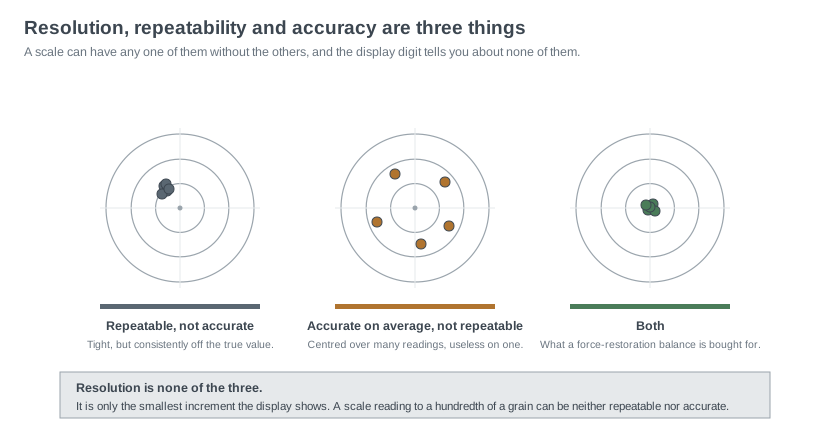
Three properties are routinely collapsed into one another by marketing copy, and separating them is the most useful thing this volume can do.
Table 1 — Resolution, Repeatability, Accuracy
| Property | The question it answers | How it fails |
|---|---|---|
| Resolution | What is the smallest increment the display can show? | A display can show 0.02 grain while being wrong by 0.3 grain |
| Repeatability | Put the same pan back on — does it read the same? | Drift, creep, temperature, radio frequency interference |
| Accuracy | Does the reading match the true mass? | Calibration error, non-linearity across the range |
Every consumer dispenser here advertises plus or minus 0.1 grain. That is a dispensing-tolerance claim rather than a scale-accuracy claim, it does not say which property it describes, and it is not independently audited.
The cleanest worked example is the most precise instrument in the volume. The A&D FX-120i resolves 0.001 gram, about 0.0154 grain, and repeats to the same figure — but its linearity is specified at plus or minus 0.002 gram, about 0.031 grain. Its trueness across the range is twice its resolution. For handloading that is irrelevant, because every charge is weighed at essentially the same point on the range against the same tare, so repeatability governs. But it demonstrates that the three numbers are different numbers, and that the largest is the one the marketing does not lead with.
The same lesson appears more intuitively in a second domain. In a documented head-to-head of three chronographs recording simultaneously, an acoustic unit produced the lowest standard deviation of the three while reading more than 80 fps slow even after velocity-decay adjustment — the most repeatable instrument in the test and the least accurate. A standard deviation will never reveal a systematic error, on a chronograph or a scale, which is why a check weight matters more than a tight-looking string of readings.
19.3 Volumetric Measures
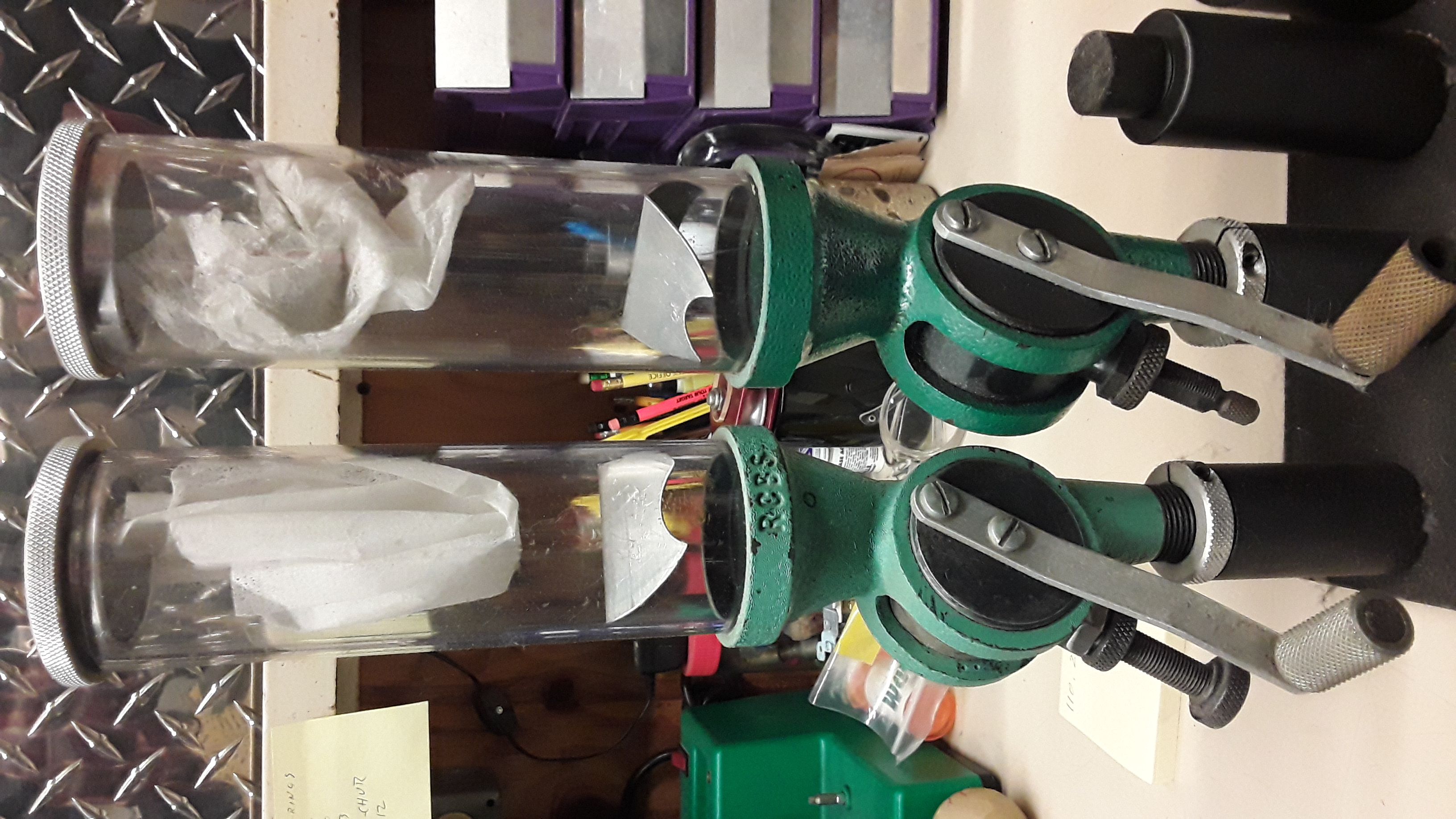
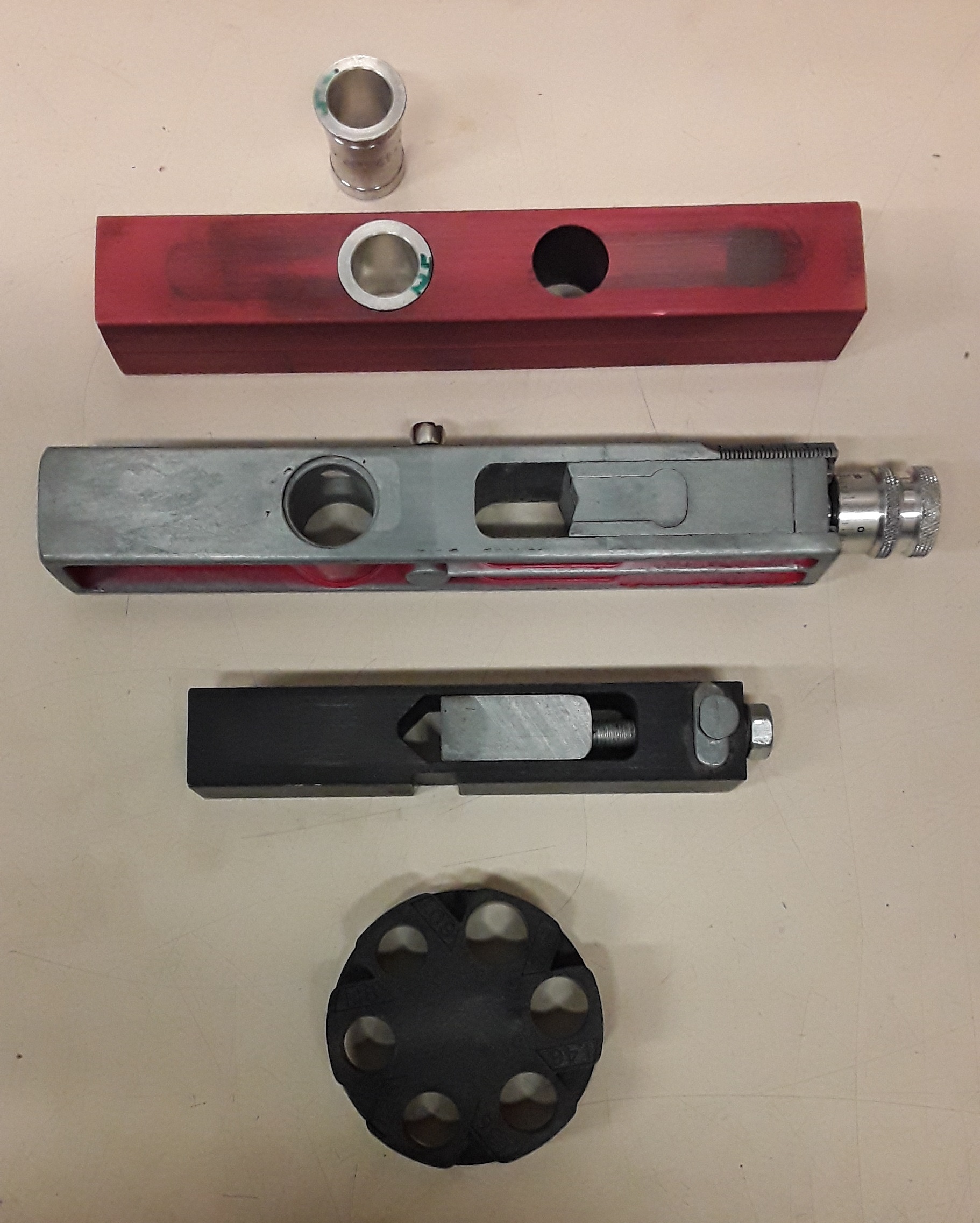
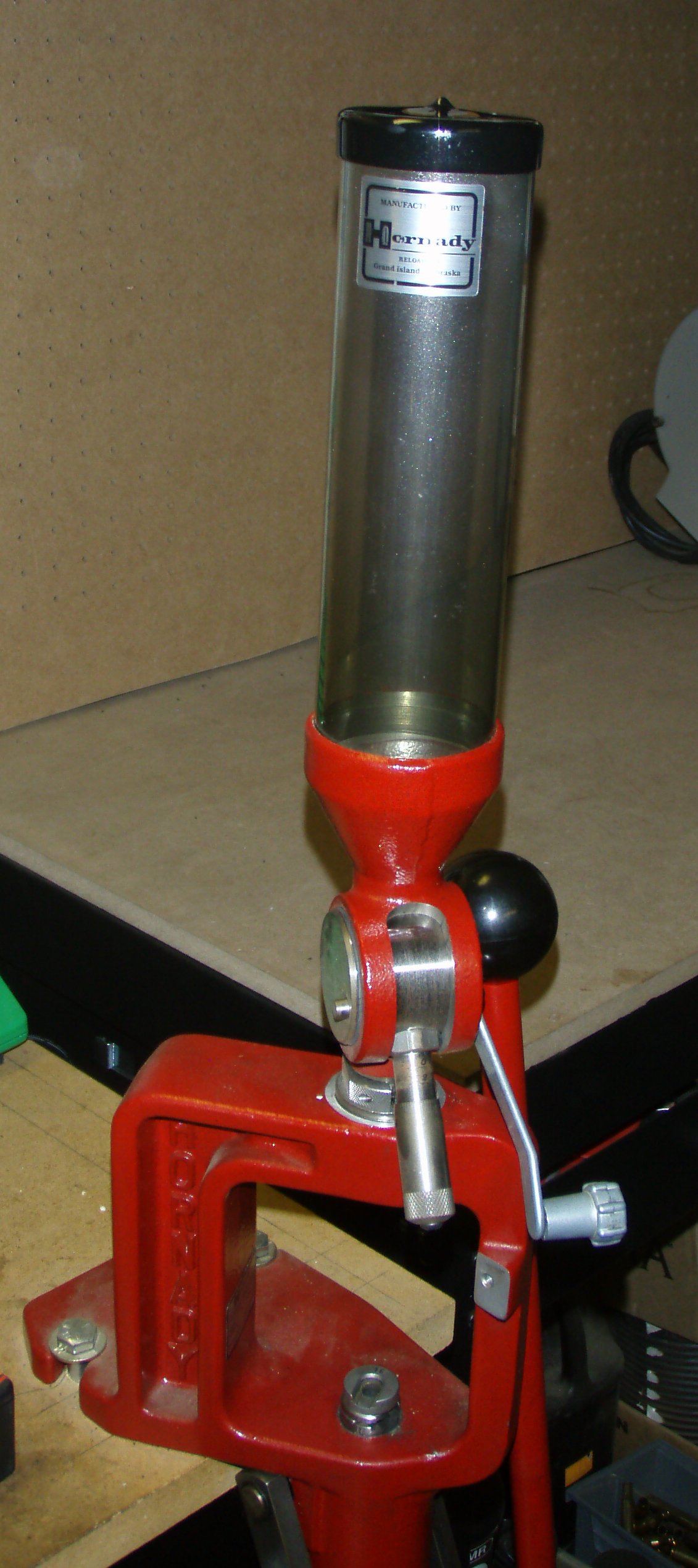
A volumetric measure fills a fixed-volume cavity and dumps it. Volume 18 covers why the mass out is less repeatable than the volume in: packing varies with kernel shape, long extruded kernels bridge the drum throat and are sheared by the drum edge, spheres flow consistently. Measured throw standard deviations run 0.1 to 0.2 grain for spherical powders against 0.2 or more for extruded, from a documented comparison covering the Redding BR-30, the RCBS Uniflow and a Harrell’s measure.
That comparison is the useful part of the record; individual product reputations are thinner than their confidence suggests. The RCBS Uniflow is the baseline drum measure, with practitioners reporting unit-to-unit variation between examples, most visible on long extruded powders — anecdote rather than measurement. The Redding BR-30 uses a drum optimised for the benchrest charge range, one user reporting worst-case deviation of 0.2 grain and an average just over 0.05. Harrell’s Precision click-adjustable measures are widely treated as the benchrest standard; a figure of about $265 was seen for a BR Premium on a single listing on 2026-09-17, which is not a retail price and could not be confirmed as one. No dealer cart price was captured for any of the three.
Dillon’s measures are a genuine gap in this record. The sliding-bar design integral to Dillon’s progressives is judged in practice by pistol-charge consistency rather than benchrest standard deviation, and no usable consistency data for it was located. That absence is stated rather than filled, and it matters for the bench of Volume 8, whose bulk calibers are all metered by that mechanism.
Technique matters as much as the tool, which is where the cheap end recovers ground. A consistent handle stroke, consistent dwell top and bottom, tapping or not tapping but doing whichever consistently, and keeping the hopper reasonably full and level all measurably reduce throw variation. Static in the hopper is controlled with graphite or an anti-static dryer sheet.
19.4 Beam Scales, and Why a Good One Is Still Competitive
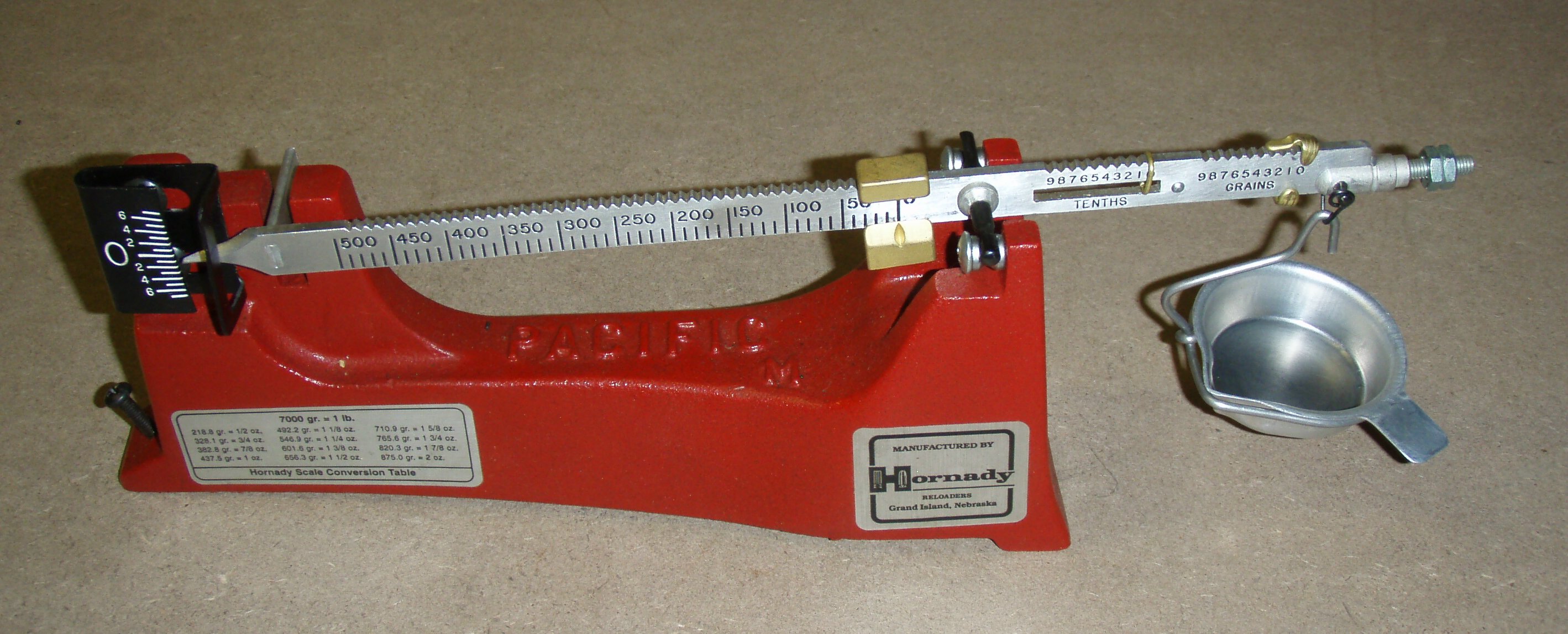
A beam balance is a mass comparator. It has no electronics to drift and is unaffected by radio frequency interference, fluorescent ballast fields and load-cell temperature coefficients — three of the four failure modes that plague inexpensive digital scales. That is not nostalgia; it follows from the measuring principle. Its weaknesses are different in kind: resolution typically limited to 0.1 grain graduations, speed, reading parallax, pivot wear, and sensitivity to an unlevel bench and to air currents across the pan.
The practitioner consensus, stated fairly, is that beam scales are about as accurate as cheap digital scales, and that the sensible choice is either to spend real money on digital or stay with a beam. The two commonly referenced examples are the RCBS 10-10, with 0.1 grain graduations, and the Redding No. 2.
There is also a tuning trade. Polishing and re-knifing the pivots and re-balancing produces scales practitioners describe as accurate to the kernel — a claim that is not independently measured and reads as enthusiasm rather than specification. The best-known service tunes customer-supplied RCBS 10-10 and Redding No. 2 scales at about $90, or supplies a tuned scale for $265 shipped, with turnaround reported as up to two years and many other RCBS models declined as untunable. Those figures were read on 2026-09-17 from forum and vendor reports rather than a storefront.
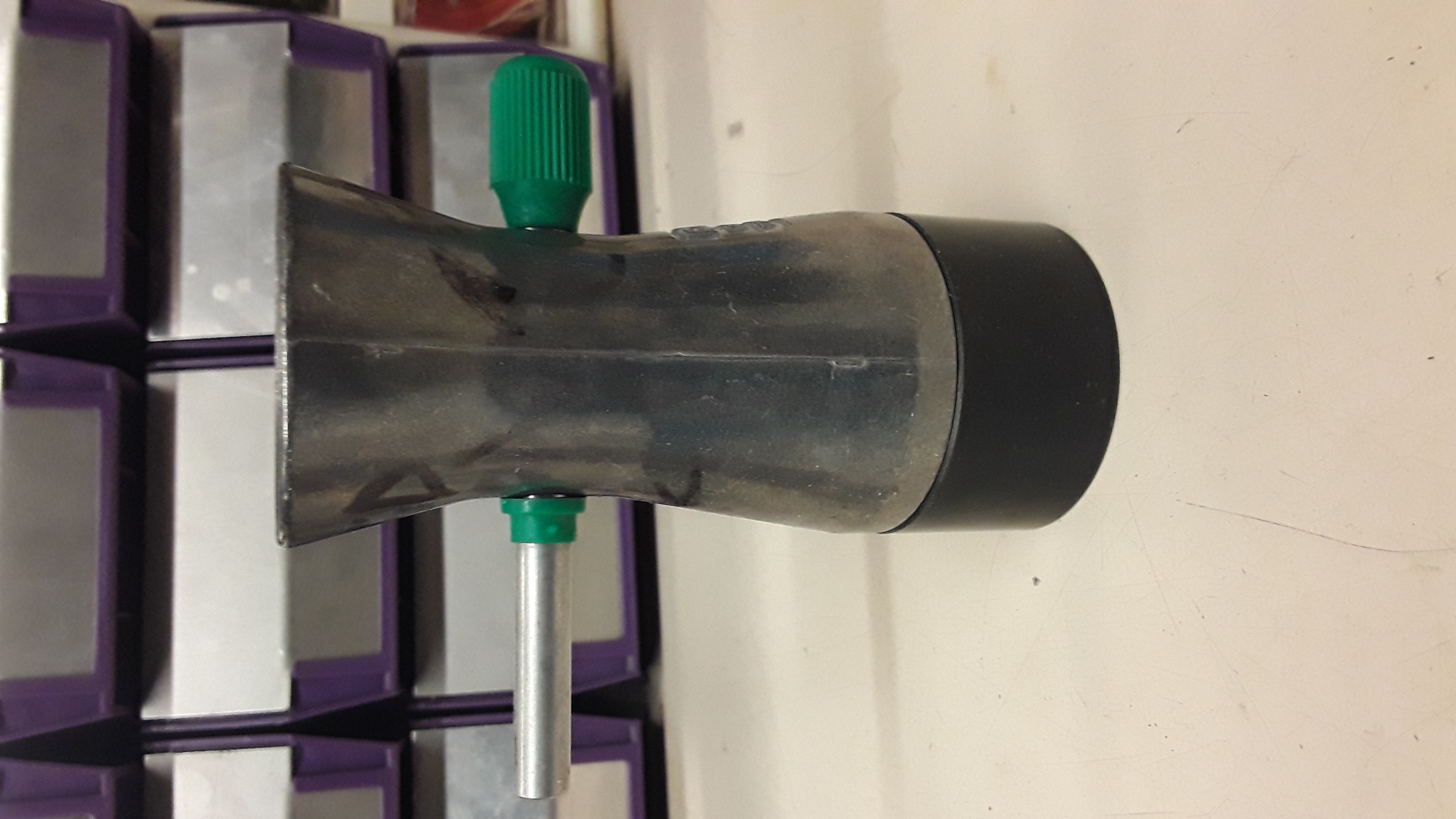
Tricklers pair with any balance: throw slightly under, then trickle to the line. A manual Redding trickler is the common start, with a short stem the usual complaint. A Dandy two-speed electric trickler — a vibrating tube with adjustable drop tube, handling stick, ball and flake, adapting to any beam scale — was reported at about $168 delivered on 2026-09-17 from forum and vendor reports, not confirmed against the vendor’s own cart. Area 419’s trickler accessories, trays and powder cups run $65 to $75 from the manufacturer’s catalogue on the same date.
19.5 Digital Strain-Gauge Scales, and How They Fail
A strain-gauge load cell converts mechanical deflection into a resistance change, and a high-gain amplifier turns that into a reading. Every failure mode follows from that sentence. The resistance varies with temperature, with load position on the pan, and with creep under sustained load, and the amplifier is susceptible to radio frequency interference and electromagnetic fields.
The reported culprits are consistent and mechanistically plausible. Fluorescent lighting is the classic, and the detail matters: the tubes are not the problem, the ballasts are — digital ballasts or LED fixtures fix it. Cell phones and handheld radios near the scale are the second. Temperature and pan-position sensitivity persist even in compensated units, which is why practitioners run fifteen to thirty minutes of warm-up and re-check zero and a check weight every ten to twenty charges.
Static is the interesting case, because it is partly folklore. It is repeatedly nominated as a cause of digital drift, yet at least one careful observer reports drift entirely absent with heavy static present. Static is better understood as a powder-handling problem — kernels clinging to a pan, sticking in a drop tube — than a scale problem. It is real, and not usually doing what it is blamed for.
19.6 The Consumer Dispensers
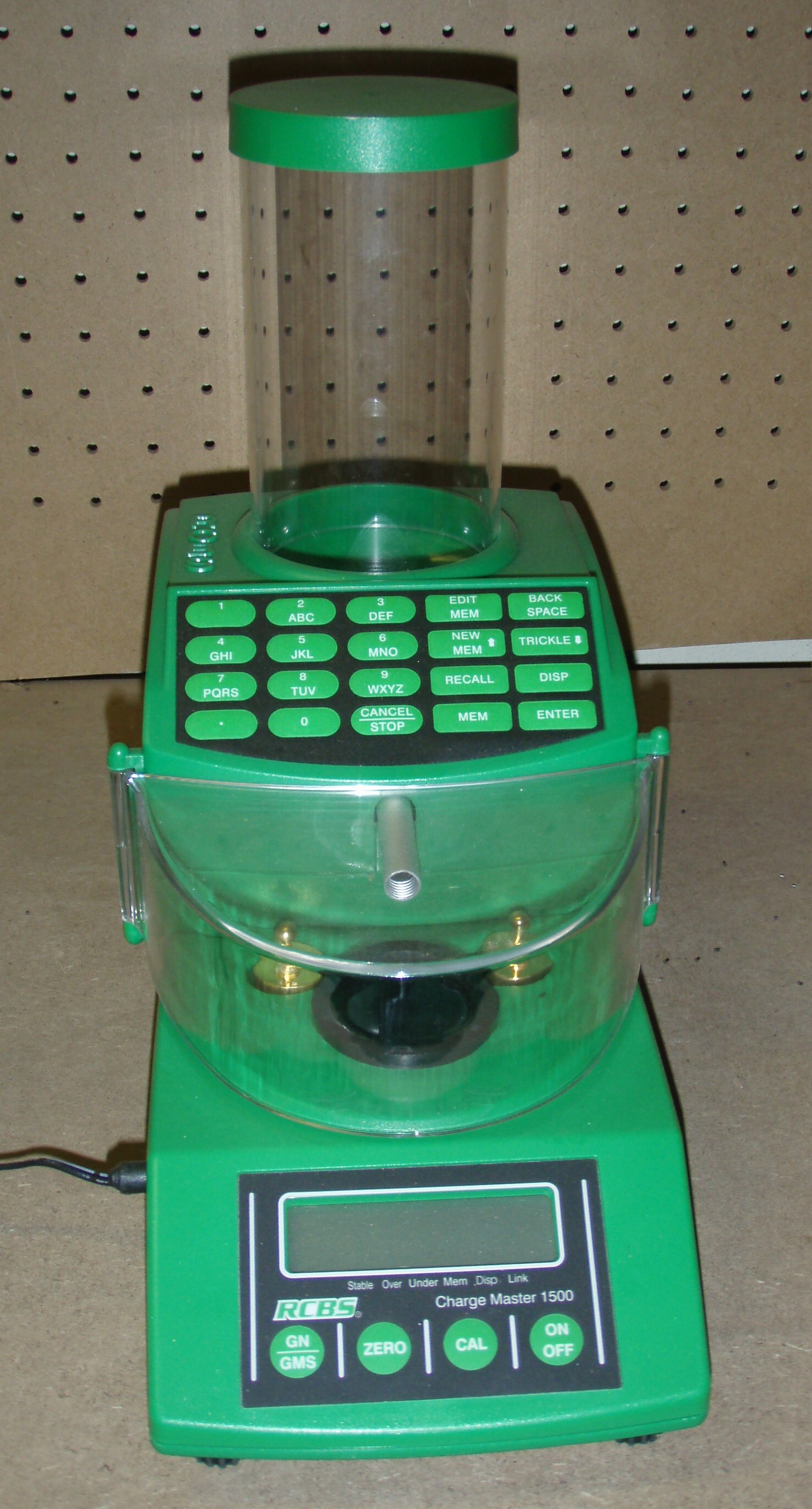
Four combined dispenser-and-scale units cover most of this market. All are load-cell instruments and all claim plus or minus 0.1 grain.
Table 2 — The Consumer Dispensers
| Unit | Claimed specification | Price, read 2026-09-17 |
|---|---|---|
| RCBS ChargeMaster Supreme | ±0.1 gr across 0–400 gr; 1,500 gr load-cell capacity; up to 2 gr per second; 50 memories; Bluetooth; powder-learn process; hopper-drain alarm; bubble level | $439.99 at RCBS’s own store; secondary sources list $429.99 |
| RCBS ChargeMaster Lite | ±0.1 gr; cut-down model, no Bluetooth or learn process | No price captured |
| Hornady Auto Charge Pro | Precise to within 0.1 gr; backlit touchscreen; customisable trickle speeds; four stored loads; bubble level | No price on Hornady’s own page. Secondary sources give MSRP $444.99 and street $339.99–$359.99, none confirmed |
| Frankford Arsenal Intellidropper 2.0 | ±0.1 gr up to 250 gr; one-pound hopper with drain valve; stepper motor; auto, manual and trickle modes; Bluetooth; colour touchscreen | $331.99 on Frankford’s own site |
The Intellidropper has what the others lack, published independent testing: a bench test found it held plus or minus 0.1 grain for all charges tested, meeting specification. Against that sits a body of user reports that light charges of some powders are much worse — holding well with one fast pistol powder while varying beyond specification under about six grains of another. That is not a contradiction but the relative-error arithmetic reappearing: the same absolute tolerance is a larger fraction of a six-grain charge, so a dispenser specified absolutely looks worse the smaller the charge.
19.7 Magnetic Force Restoration
This is a genuinely different measuring principle rather than a better version of the last one. A magnetic force restoration balance holds the pan at a null position and measures the current required to hold it there. No strain-gauge deflection sits in the measurement path, which is why repeatability and linearity are specified an order of magnitude tighter. The instrument the market has standardised on is the A&D FX-120i.
Table 3 — Magnetic Force Restoration
| Specification | Value | In grains |
|---|---|---|
| Capacity | 122 g | about 1,882 gr |
| Readability | 0.001 g | about 0.0154 gr |
| Repeatability, as standard deviation | 0.001 g | about 0.0154 gr |
| Linearity | ±0.002 g | about ±0.031 gr |
| Response time | about 1 second, programmable | — |
| Calibration | External; the FZ-120i is the internal-calibration sibling at the same repeatability and linearity | — |
Two cautions attach. One specialist dealer lists the FX-120i as discontinued, and a search summary indicated A&D launching a replacement series for the FX line as of January 2026 — a claim that could not be confirmed on any A&D page and is not asserted here, so current availability should be checked before buying. On price, one United States reloading dealer listed it at $580 with free shipping on 2026-09-17; it is also stocked by Brownells and through laboratory-supply channels carrying the identical instrument.
The AutoTrickler V4 is the automation built around it, at $490 on 2026-09-17 with the scale sold separately, a stated lead time of one to two weeks and a two-year warranty to the original purchaser, with most catalogue items showing sold out at retrieval. It is compatible only with A&D FX or FZ balances from 120i to 500i, and the vendor states other balances are not recommended. The mechanism explains the speed: a deep-spiral-grooved tube pours bulk powder at up to about 50 grains per second, ramping down to within one to two grains of target, after which a second small tube completes the charge to within a kernel using calibrated flow rates, with a green light signalling target and firmware exposing a deliberate speed-against-precision trade.
The AutoThrow could not be priced or specified. The only AutoThrow line item located in the vendor’s catalogue was a $10 timing belt; the complete unit was not priced or described on any page reached. It is named here without figures rather than described from inference.
This class’s environmental profile inverts the load-cell one, which is the practical point. An MFR balance is immune to strain-gauge drift modes and more sensitive to air currents — hence the draft shield — to bench vibration, hence the silicone isolation pads, and to not being level. Drafts from ventilation registers and open garage doors are the most commonly reported cause of a wandering reading. Buying the most precise instrument in the volume and setting it under a ceiling register is a common and self-defeating combination.
19.8 Prometheus, the Mechanical Outlier
The Prometheus Gen II is a mechanical measure with an integral balance beam rather than an electronic scale, outside every category above. Its manufacturer claims it is capable of nearly one thousandth of a grain accuracy when set up per instructions, works with most stick, flake and ball powders, and that because of its mechanical balance beam it is immune to electrical interference. The immunity claim follows from the principle and is credible on the same grounds as the beam section. The precision claim should be flagged rather than repeated: one thousandth of a grain is finer than the readability of the FX-120i, which would make this the most precise instrument here by a wide margin. It is a manufacturer claim and has not been independently verified.
No current price is printed, because none exists publicly — the manufacturer’s pricing page carries only an instruction to call. A published review put the first-generation unit at about $1,200 and a 2012 forum post claimed over three thousand for the Gen II; neither is current and neither is quoted as a price.
19.9 What Each Instrument Is Actually Vulnerable To
The failure modes are more useful for choosing than the specifications are.
Table 4 — What Each Instrument Is Actually Vulnerable To
| Factor | Beam | Load-cell digital | Force restoration | Volumetric measure | Prometheus |
|---|---|---|---|---|---|
| Draft or air current | Moderate | Moderate | High — needs a shield | None | Moderate |
| Radio frequency, radios, phones | None | High | Low | None | None |
| Fluorescent ballast fields | None | High | Low | None | None |
| Temperature change | Low | High | Low, specified | Low | Low |
| Static | Powder handling only | Powder handling; disputed as a drift cause | Powder handling | High — kernels cling | Powder handling |
| Bench not level | High | Moderate | High | Low | High |
| Vibration | High | Moderate | High | None | High |
Two patterns are worth reading off. The electronic and mechanical columns have almost disjoint vulnerabilities, which is why buying either a good beam or a genuinely good digital instrument is sound advice and the middle of the market is the weak part. And the most precise instruments are the most environmentally fragile — a level, draft-free, vibration-isolated bench is not an accessory to a force-restoration balance, it is part of it.
19.10 How Much Does Charge-Weight Variation Actually Matter?
This is what all the above equipment exists to answer, and it deserves a plain answer.
A tenth of a grain is worth single-digit feet per second in a normal-capacity rifle cartridge. The best-documented sensitivity figure located gives roughly 34 fps per grain in a .300 Weatherby Magnum, making 0.1 grain worth about 3.4 fps. A pistol figure near 13 fps per 0.1 grain circulates for one fast powder and could not be verified; it is plausible on the relative-error arithmetic, since pistol charges are small, but is not carried as a general figure. A pooled analysis of twenty-two data sets in .223 and .22-250 with a fast powder found a velocity standard deviation of 13.3 fps, which is the shot-to-shot noise a load carries anyway.
Two good chronographs agree with each other only to within 7 to 10 fps. That comes from the best head-to-head located — a Doppler radar unit and a barrel-mounted electromagnetic unit recording the same 75 rounds simultaneously — and is about 0.3 percent, consistent with both makers’ claims. Two independent technologies agreeing that closely is the strongest available evidence that either is accurate. The consumer claim of plus or minus 0.1 percent works out to about 2.8 fps at 2,800 fps, and real-world agreement between good units is several times that.
Put the two together and the conclusion is unavoidable. The velocity effect of a tenth of a grain of powder is at or below the noise floor of the instruments used to measure it. A shooter cannot detect, with the equipment a private bench owns, the difference between a charge thrown to 0.1 grain and one trickled to a kernel — not because the difference is zero, but because the measuring instrument’s own uncertainty is the same size or larger. Any velocity flat spot narrower than about 10 fps sits inside the chronograph’s error, a point Volume 21 develops into a criticism of a whole family of load-development methods.
One widely circulated claim that 0.1 grain produced a 46 fps difference in average muzzle velocity reads as a small-sample artefact rather than a finding: it is roughly an order of magnitude larger than the measured sensitivity figures, and exactly the shape of result an underpowered test produces.
So what is a good scale for? Two things, and neither is the last hundredth of a grain.
Eliminating the gross error. A double charge, a squib, a charge two grains off target — the errors that destroy rifles and injure shooters, and also the errors any competent scale catches trivially. The safety argument for good weighing equipment is overwhelming, and it is an argument about magnitude rather than precision. A permanent powder-check die on a progressive, discussed in Volume 8, does the same job by another route.
Velocity standard deviation, because it converts directly into vertical dispersion at distance and is the one number a ballistic solver consumes. That is the honest reason to care about charge consistency, and it is a long-range argument rather than a hundred-yard-group one. Volume 22 covers how to measure it and how many rounds that honestly takes.
What a good scale is not for is chasing a difference that cannot be observed. The equipment here is worth owning; the belief that its finest increments are measurable at the target is not supported by the measurements available.
19.11 Matching the Tool to the Job
Three combinations cover nearly everything a private bench does, and the powder’s shape decides which applies.
Spherical powder, pistol or bulk rifle volume. A good volumetric measure with consistent technique is a complete solution — throw standard deviation is already 0.1 to 0.2 grain and no weighing step will improve the finished round detectably. This is the progressive press’s native case.
Extruded powder, precision rifle, modest volume. Throw under and trickle up, against either a good beam or a force-restoration balance. The measure alone cannot hold the charge, for the bridging reason in Volume 18; the trickler does the real work and the balance only reports.
Extruded powder, precision rifle, enough volume that time matters. The only case that genuinely justifies an automated dispenser, and the justification is throughput rather than precision. A load-cell dispenser at three to four hundred dollars and a force-restoration setup above a thousand differ far more in speed and environmental fussiness than in anything that reaches the target.
Every price here is a single reading on 2026-09-17, and several could not be confirmed from a manufacturer’s own storefront at all — those are marked where they appear. The relationships between instruments, and the failure modes in the table above, are considerably more durable than the numbers.
Comments (0)