The Reloading Bench · Volume 6
Presses II — Progressives
Stations, indexing, priming and case feed — and why a rated throughput figure is a sprint with the consumables pre-loaded
Progressive presses perform the same operations as the machines in Volume 5, but several at once, on different cases, on the same pull of the handle. A case enters at one station, advances one position per stroke, and leaves as a finished cartridge; once the machine is full, every stroke produces a round. Everything difficult about a progressive follows from that. The operator can no longer watch one operation happen to one case, several things are being done simultaneously in places that are partly obscured, and a fault repeats at the machine’s rate rather than being noticed at the operator’s.
Prices below were observed on 2026-09-17, each given with the source it was read from.
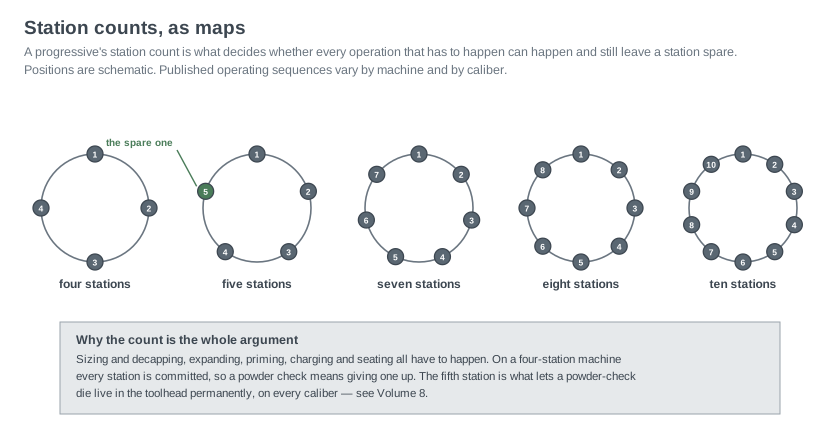
6.1 Stations, Indexing, and What They Cost
A station is a hole in a toolhead, and the sequence a machine can perform is limited by how many holes it has, minus whatever the architecture spends on something other than a die.
A four-station pistol sequence is size and deprime, expand and charge, seat, crimp. That fills every hole, so a powder-check die and a crimp die compete for the same position. A five-station machine holds a powder-check die permanently and still crimps; the Dillon XL750’s published layout is sizing and depriming, priming with powder charge, powder check, bullet seating, crimp. An eight-station machine adds a case inserter and a swager, as the Dillon RL1100 does: case inserter, sizing and depriming, swager, priming, powder charge and expansion, powder check or bullet feed, seating, crimping. A ten-station machine splits operations that elsewhere share a station; the Frankford Arsenal X-10 as reviewed runs case insertion, sizing and depriming, a second depriming station, swaging, priming, case mouth expansion, powder charge, powder check, seating, crimp.
That last layout shows what extra stations actually buy, and it is not speed. Separating the powder charge from the powder check, and giving depriming two attempts, are inspection and safety measures. Station count buys sequence, and sequence is mostly spent on checking.
Automatic indexing advances the shellplate as part of the stroke; manual indexing requires the operator to advance it by hand. Dillon’s RL550C is the significant manual-index machine still in production, and nearly everything else here auto-indexes. The difference is a safety trade with a direction. Because a manually indexed shellplate is advanced by a separate act, an interrupted rhythm can put one case under the powder drop twice — Ultimate Reloader names this explicitly, finding that manual indexing increases double-charge risk for inexperienced users. An auto-index machine makes that error much harder, because the plate cannot fail to move if the handle completed its stroke. Against that, manual indexing lets the operator stop mid-sequence, pull a case, weigh its charge and resume without disturbing the rest of the plate, which is why the 550 remains the favoured machine for rifle work and small batches.
6.2 Rated Throughput Is a Sprint
Every rated rounds-per-hour figure here is a manufacturer’s figure, and the evidence says such figures describe a practised sprint with the consumables already loaded. Sustained output including primer-tube refills, powder top-ups, case-bowl refills and inspection runs roughly 60 to 70 percent of rated — a ratio inferred from three independent instances rather than measured once, and to be read with that provenance.
The cleanest illustration is the smallest. Lee claims 250 or more rounds per hour for the Classic Turret of Volume 5; the timed trial behind it reached 249 and explicitly excludes renewing primers, cases and powder. The number is not dishonest, it simply measures something other than an evening at the bench.
The second comes from the Hornady Lock-N-Load AP, rated at up to 500. User reports span the range: one loader reached 500 and confirmed the claim, but achieved it once; others report 400 to 500 on pistol; and the most careful report gives about 350 in a good cadence but typically 200 to 250 with no bad rounds and random inspections to double check tolerances. That phrase is the key to the whole question. The difference between 500 an hour and 225 an hour is not the machine. It is whether the operator is inspecting.
The only independently measured rate located anywhere in the research for this dive is American Rifleman’s 540 rounds per hour on the Frankford Arsenal X-10, taken at a deliberately cautious initial pace by a named publication reporting a first-hand figure. Everything else in the category is an “up to.” That measurement is the anchor for what a ten-station hand-cranked progressive does; the same reviewer’s estimate of 700, or 1,000 with a bullet feeder, is an estimate and not a second measurement.
Three absences are as informative as the figures. Mark 7 publishes no manual rate for the Apex 10 — every number it quotes is with the Autodrive fitted, which rather gives away what the machine is designed for. Lee publishes no rate for the Six Pack Pro. Frankford Arsenal publishes none for the X-10. None of those gaps is filled with an estimate here. And exactly one manufacturer publishes a conservative number: RCBS rates the seven-station Pro Chucker 7 at approximately 600 per hour, below Dillon’s five-station claim and barely above Hornady’s.
6.3 Priming Is the Real Dividing Line
Priming architecture separates these machines more sharply than station count, because it decides whether a station is consumed, how much work a primer-size change is, and how production stops.
Machines with a dedicated priming station — the Dillon line, the X-10 — spend a hole on it. Machines priming at the bottom of the stroke do not, and Lee makes exactly that argument for the Six Pack Pro: automatic priming at bottom of stroke, so all six stations remain available for operations.
Primer-size change is the second axis. The Hornady AP documents a three-step change — seater punch, primer shuttle, primer feed tube — the most clearly specified procedure in the category. The Dillon XL750 uses a linear system feeding primers on demand, ships with both large and small systems in the box, and per Dillon requires the removal of only two nuts to detach and change sizes. The Mark 7 Apex 10’s Shuttle Disk Stacked Priming System is small or large, so a size change is a parts change. Lee claims changeover in seconds including primer size with no adjustments on the Six Pack Pro — a strong claim that could not be independently confirmed, and one that would beat both Dillon and Hornady if it holds.
Priming systems also bite back. Lee’s own users report the low primer trough binding as the supply runs down, and the X-10 answers the same problem with an inspection window confirming primers are in queue plus a low primer alarm at twelve remaining. A tube or trough that empties mid-plate produces unprimed cases that then take a powder charge.
6.4 Powder Measures and Case Feed
A progressive’s powder measure is actuated by the machine rather than the hand, which removes an inconsistency and introduces a dependency. The X-10 uses a case-actuated measure with a positive reset mechanism described as minimising squib risk — triggered by a case being present rather than by the stroke alone. The Pro Chucker 7 uses a large-capacity quick-change measure with a drain tube that empties it without removal from the press, which sounds trivial until a caliber change requires an empty hopper. Hornady’s measure takes quick-change metering inserts, and Dillon supplies large and small powder bars with the RL550C, so moving between pistol and rifle charge weights means changing the bar.
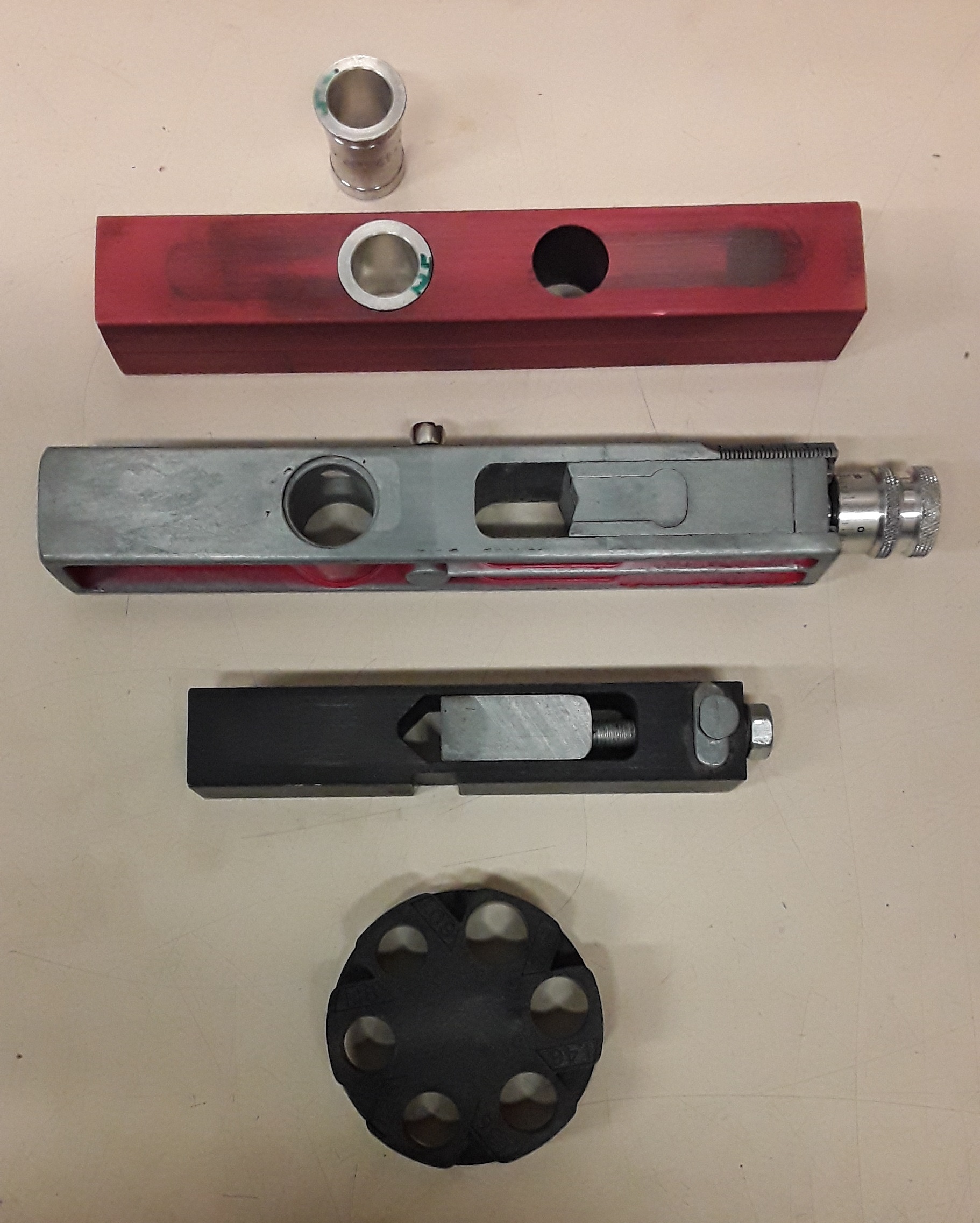
Case feeding is mechanically asymmetric. Pistol cases are short, straight or nearly so, and roughly as wide as they are tall, so they orient easily in a collator and drop under their own weight. Rifle cases are long, bottlenecked and tapered; they are slow to orient and they change both the feed tube geometry and the shellplate entry. The product lines show it: Dillon stocks case feeder assemblies in caliber-class variants, sells a separate magnum rifle casefeed kit that some large rifle cartridges require, and prices case feeding across a wide range of configurations — a range reported from a snippet whose page could not be read, so the exact configuration breakdown could not be confirmed. Lee’s case feed magazine is described as working with most handgun cases and all AR rifle cases, which is careful wording for the 5.56 class rather than for a full-length rifle cartridge.
6.5 The Length Ceiling That Excludes Machines
The published length ceilings exclude machines outright. The X-10 is specified for cartridges from 9mm to .308 in length. The Mark 7 Apex 10 is specified .380 up to .308. The Hornady Lock-N-Load AP is described in independent review as versatile up to .30-06 overall length. The Dillon XL750 spans .17 Hornet through the common belted magnums in rifle.
This bench has to load .30-06 for an M1 Garand. Against their own published limits the X-10 and the Apex 10 are therefore simply out for that job, and the Hornady AP and the XL750 are not. That is a hard, checkable constraint that appears nowhere in a rounds-per-hour comparison.
Two related points. A case feeder is close to mandatory for pistol volume and closer to optional for rifle, because rifle batches are smaller and the cases are handled individually anyway. And .450 Bushmaster should stay off the progressive entirely: no carbide sizing die exists for it, so every case must be lubricated, and lubricant plus a case collator plus a powder drop is a contamination path rather than a workflow.
6.6 What a Caliber Conversion Involves, and Costs
Dillon’s marketing language is that a machine adapts from one caliber to another in minutes. The RL550 conversion kit page is the only one in the industry that states plainly what is in the box: a shellplate, a powder funnel and locator buttons. That is the whole kit. A search summary of the XL750 kits adds casefeed adapter parts for case-fed machines. Dies are separate in every case, and Dillon’s own ordering flow says so — choose the conversion kit, then add the die set, then add the quick change kit and accessories.
What the operation involves is longer than the marketing: swap the shellplate and torque its bolt correctly, change the locator buttons, change the powder funnel, change the casefeed plate and adapter if the case diameter class changes, swap the toolhead, change the powder bar if moving between pistol and rifle charge weights, and change the priming system if the primer size changes. Whether the dies stay set depends entirely on owning a second toolhead. A quick-change toolhead is the difference between a five-minute change and a forty-five-minute one and is a separate purchase, so the honest way to price a multi-caliber machine is one toolhead per caliber. Caliber-specific extras compound it: some XL750 cartridges require an oversize powder die, some a magnum rifle casefeed kit, and some both. The advertised conversion price is a floor, not a cost.
The published costs, all seen 2026-09-17: RL550 kits at $99.95 from Dillon; XL750 pistol and rifle kits at $175.00 each from Dillon, with individual kits seen as low as $150.00; Square Deal B kits at $195.00 at Titan Reloading, with a deluxe quick-change-with-stand version at $250.00; X-10 shellplates at $89.99 and an X-10 toolhead at $123.99 from Frankford Arsenal; and Six Pack Pro shellplates at about $25 each, user-reported because Lee’s own shellplate page could not be reached and therefore could not be confirmed. The RL1100 and Super 1050 share a conversion parts catalogue. Whether the $195.00 Square Deal B kit includes dies could not be confirmed, and it matters, because a hardware-only kit and a kit containing a carbide die set at the same price are very different propositions.
6.7 The Warranty Boundary
Dillon’s lifetime “No-B.S.” warranty is real, is stated verbatim on the XL750 page — if it breaks, Dillon will repair or replace it, with no receipt, no warranty card and no hassle — and is transferable, Dillon’s general statement being that whether the owner is the first or the seventeenth, all its hobby-level machines carry a lifetime warranty. That transferability is what makes the used Dillon market rational.
The word doing the work is “hobby-level,” and it is the fact a returning buyer is least likely to expect. The lifetime warranty covers the Square Deal B, the RL550 and the XL750. It does not cover the commercial tier: per Dillon’s current pages, the RL1100 carries a two-year limited warranty against manufacturing defects and the Super 1050 a one-year limited warranty plus a thirty-day risk-free trial.
Sources conflict on the Super 1050’s terms — a forum summary describes lifetime coverage against defects plus one year against normal wear, against the one-year term on Dillon’s current page. The current manufacturer page is the better source, but the discrepancy suggests the terms changed at some point and no single warranty history for that machine can be stated with confidence. Separately, Dillon publishes a factory overhaul for the Super 1050, RL1100 and CP2000 at $295 including return shipping in the lower 48 states, in which the machine is disassembled, run through the solvent tank, inspected and rebuilt by the technicians who build them new. On a machine with a one- or two-year warranty, a published overhaul price is arguably the more useful number.
6.8 The Dillon Machines
The BL550 at $450.00 deliberately has no powder measure: it lacks the automatic powder measure and priming systems of the RL550C and substitutes a funnel for manually pouring weighed charges, its published sequence being deprime and resize, pour the weighed charge, seat, crimp. That makes it a turret press with a Dillon toolhead rather than a progressive in any useful sense, and Dillon publishes no rate for it — correctly, since the rate is set by the scale.
The RL550C is $675.00: four stations, manual index, rated up to 500 per hour, supplied with the powder measure and both powder bars, one priming system with large and small parts, pickup tubes, a low primer alarm, a four-station toolhead, a powder die and a cartridge bin. Independent assessment rates it on quality, simplicity, versatility, precision and economy, against the manual index, the four-station limit and the double-charge exposure described above. Forum reports put real output around 300 to 350 per hour.
The Square Deal B is $795.00 from Dillon and $729.00 at Titan Reloading, uniform across the eight caliber variants Titan stocks: four stations, auto-index, rated approximately 400 to 500 per hour, handgun only from .32 S&W Long through .45 Colt in eighteen caliber options, shipped pre-configured and factory-adjusted for one caliber with dies included. Its genuine merit is a pistol-optimised shorter stroke, making it feel faster per pull than its station count suggests. Its defining limitation is proprietary dies — any die already owned is worthless on it — and it takes no case feeder.
The XL750 is $850.00: five stations, auto-index, over thirty-five calibers, both priming systems included, priming automatic on the downstroke, with the case feeder a $370.00 variable-speed option. Dillon’s throughput language is unusually candid — with practice, most reloaders comfortably produce 500 to 800 rounds per hour — while its collections page says up to 800. No first-hand XL750 rate could be verified in this research; the two most promising discussion threads were unreadable, so the 400 to 500 figure usually repeated for it is indirect. Independent assessment names two weaknesses: cost, and a conflict between a bullet feeder and the powder measure, for which a third-party fix exists. Its fifth station is the machine’s central argument: a powder-check die lives there permanently without giving up the crimp, which on a four-station machine is impossible, and charge errors are the failure mode that destroys guns and hands.
The RL1100, from $2,395.00, and the Super 1050, from $2,500.00, are the eight-station commercial-tier machines, both auto-indexing and both rated approximately 1,000 to 1,200 per hour. Both include a variable-speed electric case feeder and plate as standard rather than as an option, a die set in the selected caliber, a conversion kit, automatic powder measure and priming, a low primer alarm and a roller handle, and both carry a built-in primer pocket swager, which on the RL1100 has a user-replaceable tip. The RL1100 arrived in 2019, is built of cast iron and steel, and is reported to run into millions of rounds. Note the price inversion: the Super 1050 costs more than the RL1100 while quoting the same rate, and the explanation is in the frame and the warranty rather than the speed.
The Super 1050’s status is unresolved and is presented that way. A 2019 announcement reported it would no longer be produced, with the RL1100 as its replacement. Yet as of 2026-09-17 Dillon still lists it, prices it, lists it separately in its own navigation, shares its conversion parts with the RL1100, includes it in the overhaul programme, and says nothing on the RL1100 page about superseding anything. It should not be described as discontinued, and whether current availability is new production or remaining stock could not be confirmed — the single best question to put to Dillon directly. One difference between the two is counterintuitive and consequential here: the Super 1050 is described as having a lengthened frame and crank assembly giving increased functional stroke for longer cartridges including .30-06, 6.5 Creedmoor and .308, which would mean the older machine has the longer usable stroke for .30-06-length brass. That comes from forum and dealer summaries rather than from Dillon and could not be confirmed. The RL1100’s own improvements are described as a roller bearing drive, a heavier frame, improved shellplate indexing, the upgraded swager and a spring-loaded priming station locator.
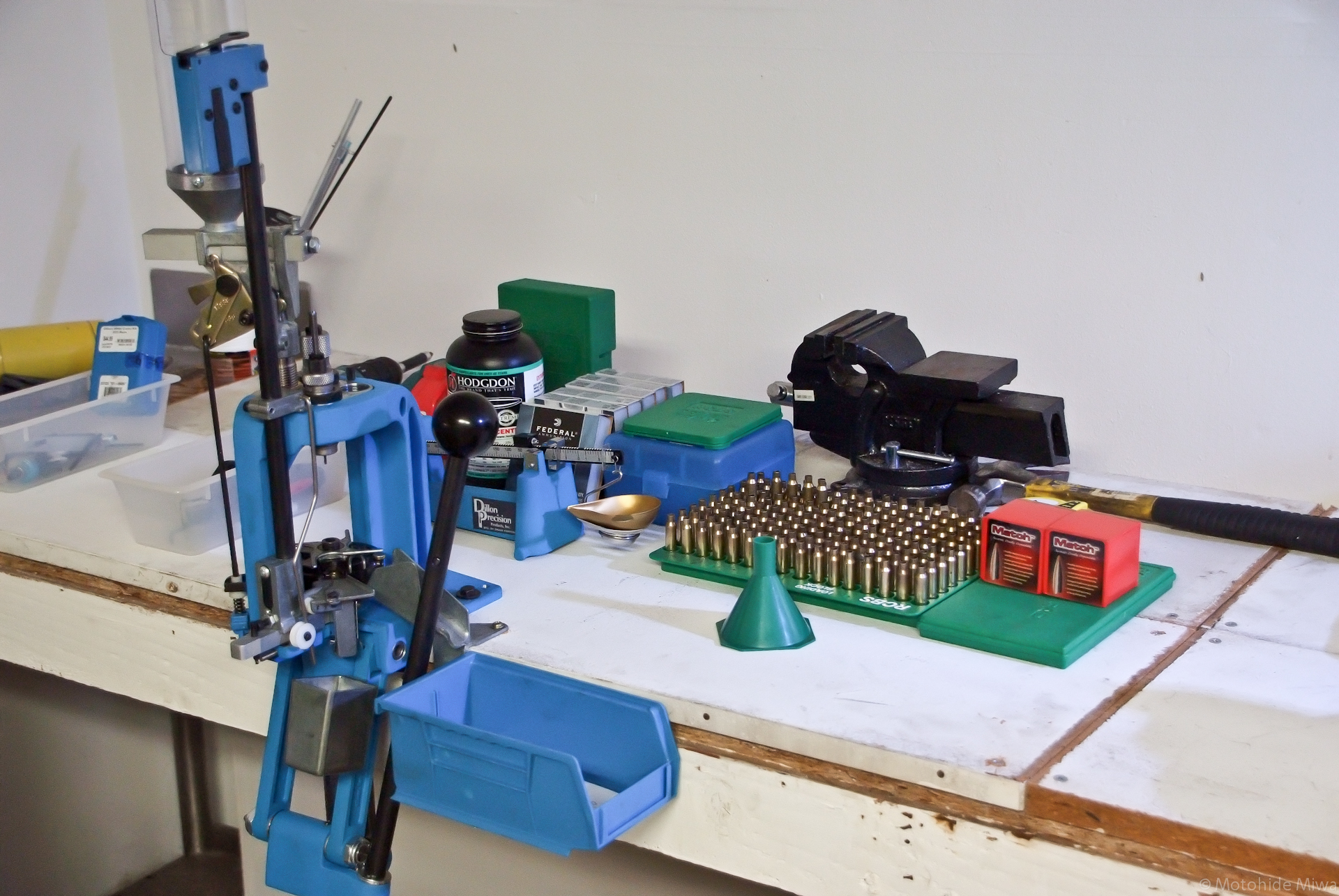
6.9 Hornady Lock-N-Load AP
Hornady publishes no price. The one verified retail figure is $649.99 at Sportsman’s Warehouse, out of stock online on 2026-09-17; other listings could not be read, so those prices could not be confirmed, nor could the price of the case feeder or the pistol bullet feeder.
Five stations, with EZject described by Hornady as giving fully reliable ejection of every cartridge without adjustment, the Lock-N-Load Quick Change Bushing System with six locking lugs allowing caliber changes in under five minutes, the quick-change powder measure, an optional case feeder, and the three-step primer size change. A typical pistol setup is size and deprime, prime below with the expander above, powder charge, seat, crimp. Independent assessment rates it on value and features and names three weaknesses: the case feeder produces noise and has feed reliability issues, certain components are susceptible to corrosion, and the cartridge bin bracket lacks durability.
The bushing is the cross-machine argument: it is the same standard as the Lock-N-Load Classic single stage of Volume 5, so a die transfers between them with its adjustment intact. Against that sits one hard constraint developed in Volume 7 — no Mark 7 Autodrive fits any Hornady press, and Hornady’s own “Ammo Plant” is a case-feeder and bullet-feeder package rather than a drive. The Lock-N-Load AP has no automation path, first-party or third-party.
6.10 RCBS Pro Chucker 7, and the Missing 5
The Pro Chucker 7 is $939.99 and in stock at RCBS on 2026-09-17, described by RCBS as the first seven-station auto-indexing press on the market and rated at approximately 600 rounds per hour, with a safety-shielded priming system taking standard pick-up tubes and spent primers dropping out of the bottom. The 600 figure is worth flagging rather than smoothing over: seven auto-indexing stations rated below a five-station competitor is either unusual conservatism or a genuinely slower stroke geometry, and which could not be established.
The Pro Chucker 5 appears to be out of production. RCBS’s own progressive category page lists only one complete progressive press while the company continues to sell a Pro Chucker 5 to 7 conversion kit at $349.99 and does not show the 5 as a standalone product. A snippet asserted outright discontinuation, but the page it came from returned a bot-challenge screen and that claim could not be confirmed. The defensible statement is what the store supports: as of 2026-09-17 RCBS offers no Pro Chucker 5 while still offering the conversion kit, so the machine should be treated as out of production but supported. Hodgdon’s 2024 acquisition of RCBS, noted in Volume 5, is an obvious candidate explanation for a line contraction and is raised as a hypothesis rather than a finding. Independently, the 5 shares the 7’s frame, includes a powder measure derived from the older Pro-2000, and changes calibers quickly; its noted weaknesses are the absence of an automatic case feeder and a price above budget alternatives.
6.11 Lee Six Pack Pro and Pro 4000
The Six Pack Pro is $400.00 for the press and $560.00 for complete kits with dies: six stations taking any brand of die including in-line bullet feed and powder check dies; automatic priming at bottom of stroke, which Lee describes as safe with any brand or size of primer; an automatic case inserter working with any case, with a port for hand feeding; and the Lee case feed magazine. Two of those claims are genuinely strong and neither could be independently confirmed — that bottom-of-stroke priming frees all six stations, and that a primer size change needs no adjustments. Lee publishes no rated rate.
User experience is specific in both directions. The priming system is described as the first Lee progressive priming system that is not finicky, with only a handful of lost primers over extended use. Against it: the press will seize when powder is dropped on an unprimed case, requiring regular cleaning and compressed air; the setup learning curve for die alignment and indexing is significant; the collator occasionally misfeeds; and the low primer trough binds as the supply runs down. Users report loading 9mm, .308 and .30-06 on it effectively, which is a user report rather than a published specification.
The Pro 4000, also sold as the Auto Breech Lock Pro, is $220.00 for the press and $365.00 for kits: four stations with the Breech Lock quick-change feature in all four positions, kits including a three-die carbide set, shellplate, a five-tube case feed magazine, a Deluxe Auto-Drum powder measure, automatic primer feed with through-ram primer disposal and a roller handle. It auto-indexes with a manual override, and the override is the useful detail here: the index can be worked by hand to load .30-06. Its throughput figure needs careful labelling — a user review hosted on Lee’s own product page says it is very easy to load three to four hundred rounds an hour of handgun and small rifle ammunition, which is neither an independent measurement nor a formal specification. A 2026 revision to its automatic primer feed, said to be safe with all brands and sizes of primers, comes from a search summary and could not be confirmed against Lee directly.
6.12 Frankford Arsenal X-10
The X-10 is $899.99 including the case feeder, direct from Frankford Arsenal on 2026-09-17, and its price history is the strongest single fact about it: American Rifleman’s review put it at approximately $1,200 at launch, describing that as nearly half the cost of comparable ten-station presses that previously fetched more than $2,200.
The specification is unusually complete for the money: ten stations; case feeder included; in-line primer pocket swaging for both small and large primers; dual depriming stations to prevent primer drawback; the case-actuated powder measure with positive reset; a gear-driven rotating shellplate; steel construction with an array of ball bearings; an integrated LED light in the toolhead; and spring-loaded case locator buttons. Priming is on the downstroke with the inspection window and the twelve-primer alarm. American Rifleman’s chief complaint is that the powder measure has no quick-detach and requires the removal of three screws; independent assessment adds complexity and setup time. It is a press-only ecosystem — Frankford Arsenal does not make full die sets, so dies come from another maker.
One question about it could not be resolved, and it is the most decision-relevant gap in this research: Frankford Arsenal’s own shellplate list shows no 9mm and no .40 S&W shellplate for the X-10. Four are listed — .223, .38 Special with .357 Magnum, .45 ACP with .308, and .45 Long Colt. Whether the two missing pistol cartridges are catalogued elsewhere, or whether coverage is genuinely that limited, could not be confirmed. If they exist, the X-10 is a ten-station machine with a case feeder and in-line swaging at a price below a five-station competitor similarly equipped. If they do not, the machine cannot load two of the four cartridges this bench’s bulk press exists to serve, and no price advantage survives that. The question is answerable with one telephone call and should be answered before any money moves.
6.13 Mark 7 Evolution and Apex 10
Lyman acquired Mark 7 Reloading in May 2019 and Mark 7 is now a Lyman brand; Mark 7 had introduced its Autodrive systems in 2015. The Evolution was the ten-station manual press and was superseded by the Apex 10 from April 2021, the Apex 10’s improvements being parts for both primer sizes included, an improved case feed with an all-metal bowl and variable speed, tighter tolerances on the main assembly, and a cast-iron toolhead including both guide rods as standard. The Evolution remains relevant because Mark 7 still sells a shared Apex 10 and Evolution drive, so an Evolution owner has an upgrade path.
The Apex 10 is $2,699.99 from Mark 7 on 2026-09-17, with estimated shipping six weeks from order, and there is an automated bundle at $5,499.95; a third-party figure of $2,994.95 appeared undated in a snippet and could not be confirmed. Specifications are ten stations, .380 up to .308, manual operation, the shuttle disk priming system in small or large, about 60 pounds and a two-year manufacturer’s warranty. The standard package includes an 11 inch variable-speed case feeder with case-sensor activation, a mechanical powder measure, a ten-station CNC machined toolhead, an ambidextrous handle, a hold-down die and double guide rod support. Dies and bullet feeder are separate, and the published add-ons are substantial: a vibratory primer system at $595.95, die packs from $269.95 to $399.95 depending on caliber, a decapping die at $56.50 and a powder check alarm at $84.95. As noted above, Mark 7 publishes no hand-cranked rate for it.
6.14 Three Cartridges That Change the Answer
.45 ACP is the biggest progressive-specific trap on this bench, and it has nothing to do with press capability. For roughly its first century the cartridge existed only with large pistol primer pockets; small-primer cases now circulate widely, with Federal NT, Blazer and Speer named as small-primer makers in the sibling caliber research. Mixed in a bucket the two are indistinguishable from the side.
On a single stage a mismatched case is a two-second annoyance. On a progressive it stops production, and at the wrong station: a small-primer case jams a press fitted with a large decapping pin, so the failure occurs at sizing and depriming, before priming, and can bend the pin. Sorting is therefore mandatory rather than optional for progressive loading of this cartridge, and sorting by eye is only about 80 percent effective — the recommended method is to decap only, then gauge, with a drill shank or a normalising tool doing the job without damaging the case. One point worth stating to stop the reader over-worrying: there is no difference in load data between the two, so the sort is a mechanical problem and not a ballistic one, and buying new or known-headstamp brass sidesteps it entirely. The consequence for machine selection is real, because the trap raises the value of in-line primer-pocket work — which favours the X-10 with its in-line swaging for both primer sizes and dual depriming, and the eight-station Dillons with their built-in swagers. Volume 7 returns to the same problem from the automation side.
.450 Bushmaster stays off the progressive, for the reason already given.
.40 S&W’s reputation is misattributed, and the fix is a die rather than a press. It shares 9mm’s 35,000 psi maximum average pressure; what differs is the larger head area, giving more total thrust at the same pressure, and less case support in common pistols, which produces bulging near the base. A conventional sizing die does not remove that bulge. The remedies are pass-through dies, which push the case fully through and therefore cannot live in a progressive toolhead alongside the normal sequence — so de-bulging is a separate operation on a separate press. Volume 9 covers the dies; the point here is that one of this bench’s four bulk cartridges has a preparation step the progressive cannot perform.
6.15 Where the Choosing Happens
One market observation belongs in this volume and its conclusion does not. Station count does not track price: the X-10 offers ten stations with a case feeder included for $899.99, while the XL750 offers five and charges $370.00 for case feeding, landing near $1,220 similarly equipped. What the more expensive machine sells at that premium is the transferable lifetime warranty, the parts network, resale value and decades of institutional knowledge — none of which appear on a specification sheet, and all of which are worth something. Pricing those honestly, weighing them against the unresolved shellplate question, and deciding what this bench should buy is Volume 8, which also covers what changed in Dillon’s line over the last decade and a half for a buyer returning to the market. Volume 7 takes up what happens when the handle is replaced by a motor.
Comments (0)