The Reloading Bench · Volume 2
The Cartridge as a Manufactured Object
Four components, one of which survives firing — and why that one decides everything else
Every centerfire cartridge is an assembly of four manufactured parts, and exactly one of them comes back out of the rifle in a condition worth keeping. That asymmetry is the entire basis of the craft. Handloading is not really the manufacture of ammunition from raw materials — it is the repeated refurbishment of one component, the case, with three consumables fitted to it each time. Understanding what the case is, what firing does to it, and how many times it will tolerate that, explains most of the equipment decisions in the volumes that follow.
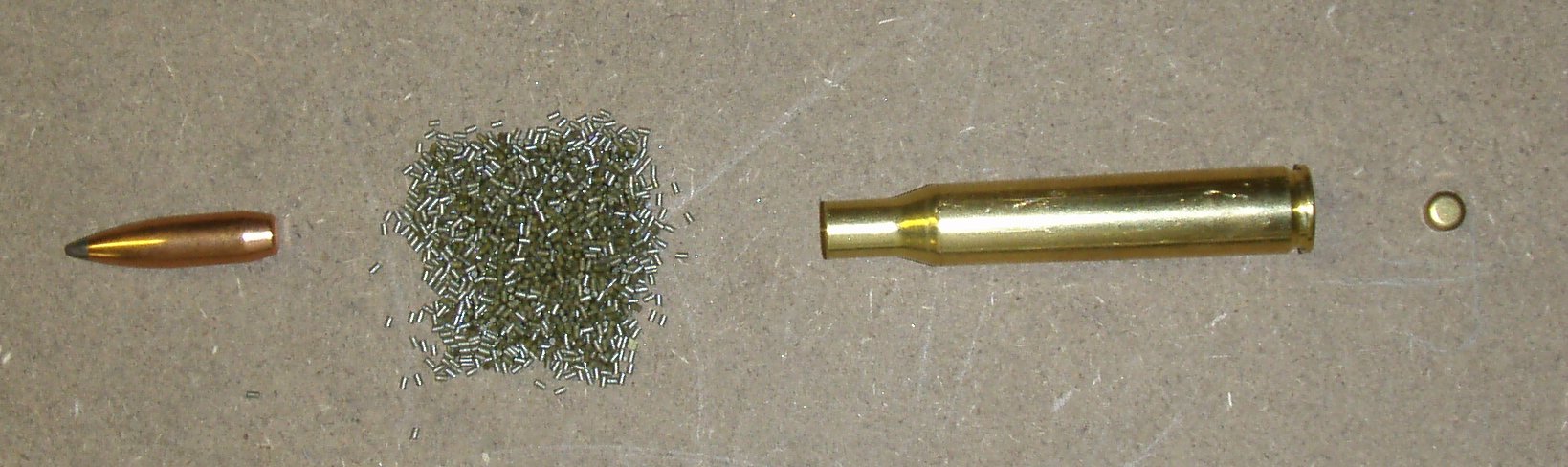
2.1 Four Components, One Survivor
The case is a drawn brass vessel. It positions the other three parts relative to the chamber, seals the breech against escaping gas, and is the only part that is recovered, inspected, reconditioned and used again.
The primer is a small cup of soft metal holding a pressure-sensitive explosive compound and, in the common pattern, its own anvil. It is destroyed on firing and replaced every time.
The propellant is consumed. What is recovered from a fired case is soot, not powder.
The bullet leaves the barrel. Handloading buys it, casts it or swages it, but never recovers it.
So of the four, three are simply purchased, measured and assembled. The fourth is a durable good with a service life, a wear-out mechanism and a retirement criterion. Almost every difficult judgement in handloading is a judgement about brass.
2.2 The Case Is a Pressure Vessel That Is Deliberately Loose
A cartridge case has to do two things that pull against each other. It must drop into a dirty, cold chamber without force, which means it must be smaller than the chamber in every dimension. And it must seal that same chamber against propellant gas at pressures measured in tens of thousands of pounds per square inch.
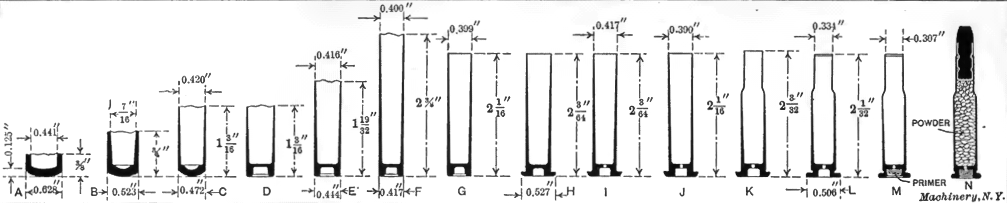
One thing that plate makes plain is easy to forget at the bench: a case has already been worked many times before it is fired even once. It began as a flat disc and reached its finished shape through a sequence of draws, each of which hardened the brass and each of which was followed by an anneal to make the next one possible. A piece of new brass is not in a virgin state — it is in a state the manufacturer chose. This is why the annealing question in Volume 14 is a question about restoring a condition rather than creating one, and why the number of firings a case tolerates is a property of how it was made as much as of how it is loaded.
It resolves this by deforming. On firing, the case expands outward until the brass is pressed hard against the chamber wall, and that contact is what stops gas travelling backwards past the case head. The seal is made by dead-soft brass being pushed into a shape it did not previously have. This is called obturation, and it works remarkably well — which is why a technology from the 1860s is still in universal use.
The consequence for the handloader is that a fired case is not the case that was chambered. It is a case that has been blown out to the dimensions of one particular chamber, and then sprung back slightly. Every operation in case preparation exists because of this: sizing returns it toward specification, trimming corrects the length it gained, and annealing addresses the hardness it acquired while being stretched.
Each of those cycles work-hardens the brass a little more. Brass has no fatigue limit in the useful sense; it gets harder and less ductile with each deformation until it cracks. A case therefore has a finite number of firings in it, and that number depends on the chamber, the pressure, how much the case is worked during sizing, and whether it is annealed. Volume 15 treats case life and retirement directly, and the diagnostic vocabulary for reading what a fired case is telling you belongs to the Headspace dive, which covers it thoroughly and is not duplicated here.
2.3 The Regions of a Case, and What Each One Does
A case is usually described from the closed end forward.
The head is the thick base. It carries the headstamp, contains the primer pocket, and takes the full rearward thrust of firing. It is the strongest part and the part whose failure is most serious.
The web is the solid brass between the primer pocket and the inside of the case. It is the thickest metal in the case, and the region immediately ahead of it is where the case is thinning as it stretches — which is why incipient separation is looked for there and nowhere else.
The body is the main wall. It expands to the chamber and springs back.
The shoulder is the angled transition on a bottleneck case. On the majority of modern rifle cartridges it is also the surface the cartridge headspaces on, which makes its position the single most important dimension the handloader controls. Setting a die to move that shoulder a measured amount — a shoulder bump — is the central skill of rifle case sizing, and the Headspace dive’s treatment of how much to bump and what moves the setting is the canonical one for this collection.
The neck grips the bullet. The force needed to pull the bullet out of the neck is the neck tension, and it matters more than most published advice suggests.
The mouth is the open end. It is what a crimp closes, and it is what trimming shortens.
2.4 Case Families, and Which One Each Chambering Belongs To
Cases are grouped by how they locate themselves in the chamber and by whether the body tapers to a narrower neck.
A rimmed case hangs on a flange at the head and locates on the rim’s thickness. A rimless case has an extractor groove but no protruding flange, and locates on its shoulder or on its mouth. A belted case locates on a raised band just ahead of the extractor groove. A rebated case has a rim smaller in diameter than its body.
Crossed with that is the body shape: a bottleneck case necks down to a smaller bullet diameter, while a straight-wall case does not.
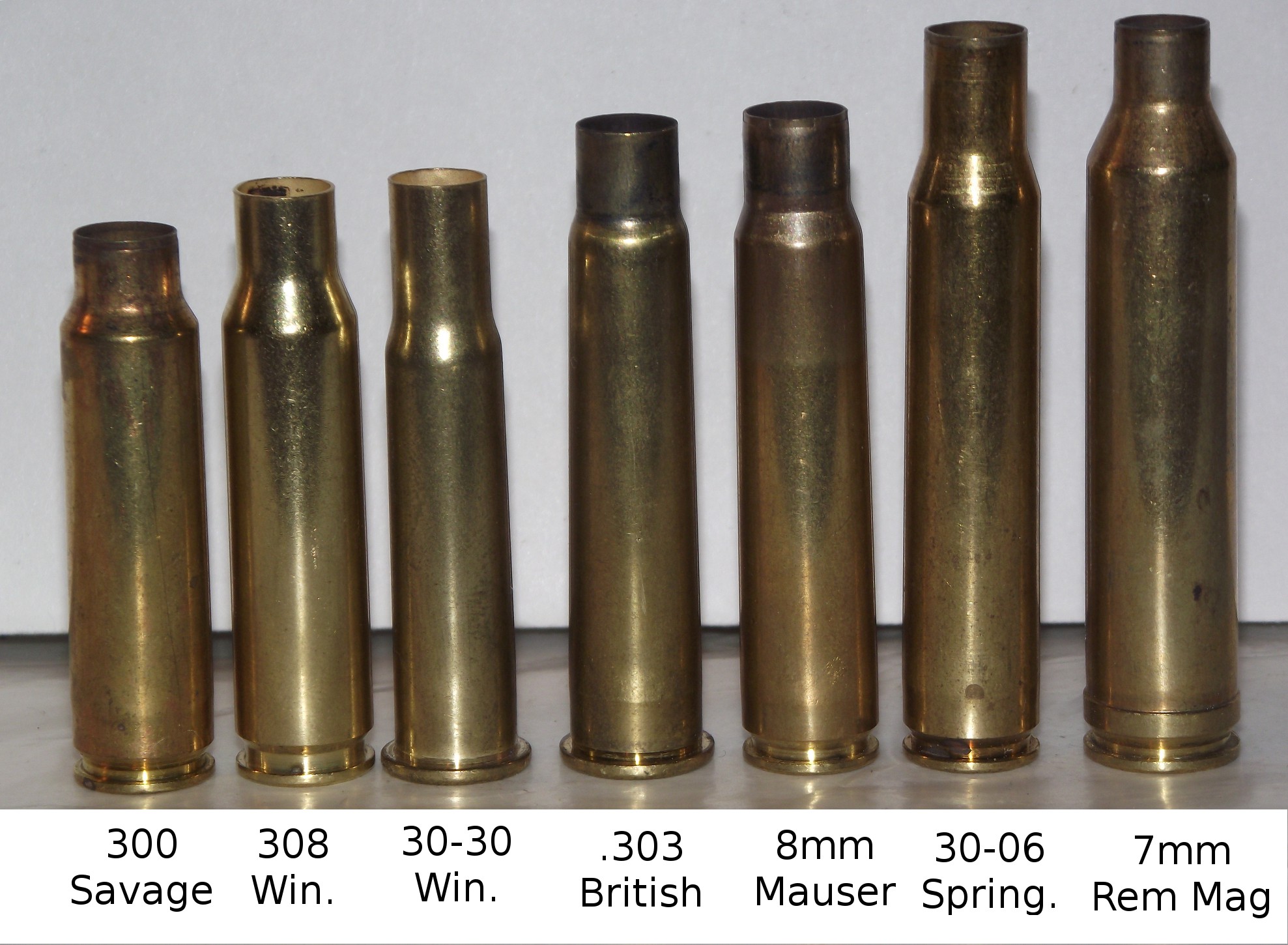
Of the chamberings this dive is written around, the .30-06 Springfield, .308 Winchester, .223 Remington and .300 AAC Blackout are rimless bottleneck cases, and the 9mm Luger, .40 S&W and .45 ACP are rimless cases without a bottleneck. The .450 Bushmaster is the interesting one: it is usually described as straight-wall, and for the purpose of hunting regulations it is treated as such, but the body carries a slight taper. That taper has a direct bench consequence covered in Volume 9 — there is no carbide sizing die for it, so unlike the pistol calibers every case has to be lubricated. A straight-wall shape does not guarantee a straight-wall workflow.
One relationship among these matters more than the others: the .300 AAC Blackout case is made from .223 Remington or 5.56 brass, shortened and opened up to take a larger bullet on the same case head. That is what makes case forming a practical proposition for this cartridge, and it is also the root of the most dangerous confusion in this dive, which Volume 16 addresses directly.
2.5 Boxer and Berdan — the Distinction That Decides Reloadability
Two priming systems are in common circulation, and the difference between them is not a detail of chemistry but a question of which component owns the anvil.
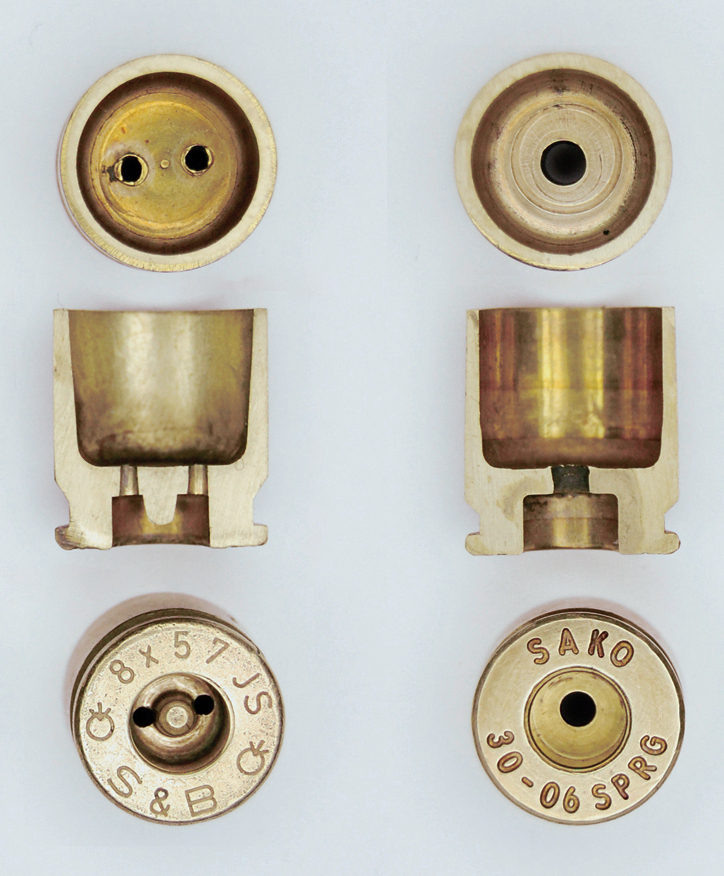
In a Boxer case, the anvil is part of the primer assembly. The case head has a single flash hole in the centre of the primer pocket. When the spent primer is pushed out, an ordinary decapping pin passes straight down that hole.
In a Berdan case, the anvil is formed into the case itself, as a raised feature in the floor of the primer pocket. Because that feature occupies the centre, the flash holes are moved off to the sides — there are typically two of them. There is no central hole for a decapping pin to pass through.
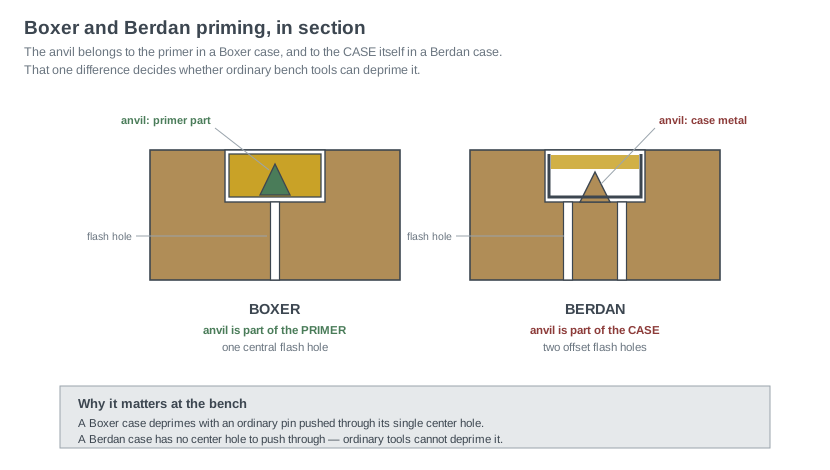
The practical outcome is blunt: a Berdan case cannot be deprimed with ordinary reloading tools. Specialised tools exist, Berdan primers are hard to source in most markets, and the pockets are not always a standard size. For nearly all purposes a Berdan case encountered in a bucket of range brass is scrap. Since Berdan priming is common in military and surplus ammunition of European and former-Soviet origin, this is a sorting criterion rather than a curiosity, and it is one of the rejection rules in Volume 10.
2.6 Primer Size Is Not a Detail
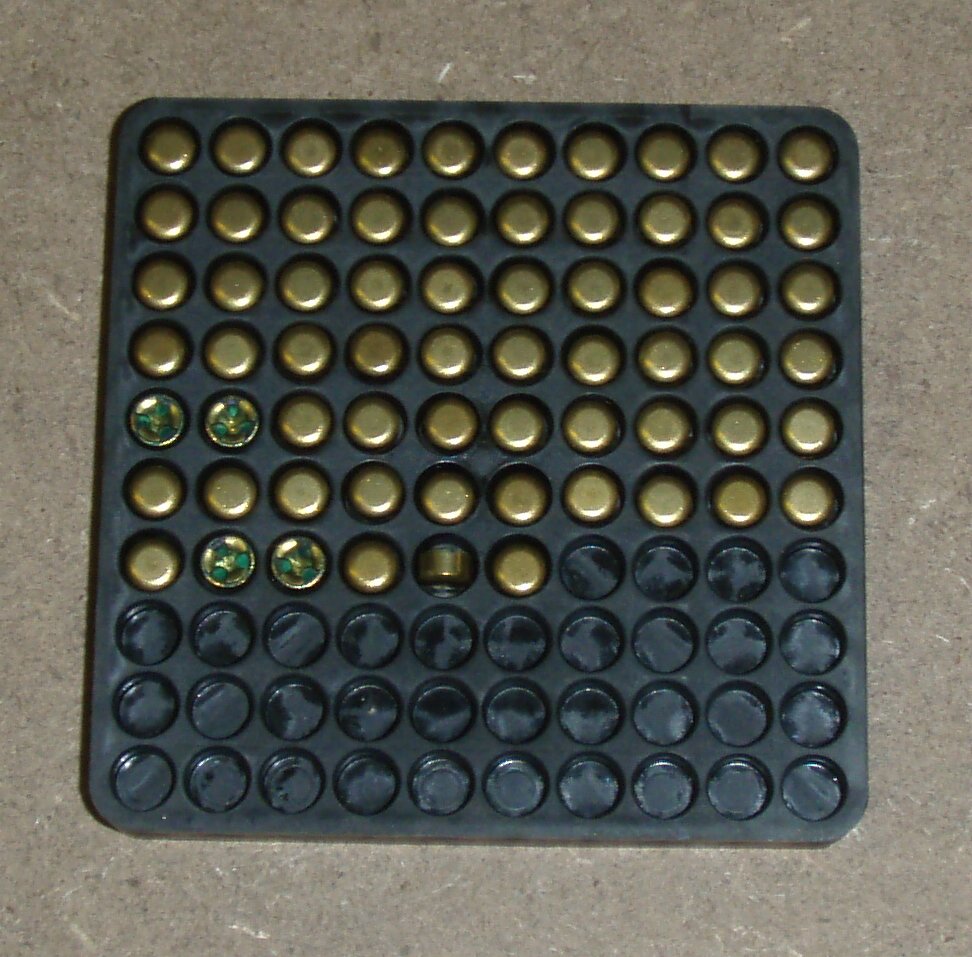
Primers come in a small number of standard sizes — broadly, small and large, in rifle and pistol variants — and the size a case takes is a property of that case, not a preference. Two instances on this dive’s own list of chamberings are worth knowing before any components are ordered, because both cause avoidable trouble.
The first is that .450 Bushmaster uses a small rifle primer, which surprises people who reason from its large bullet diameter to a large primer.
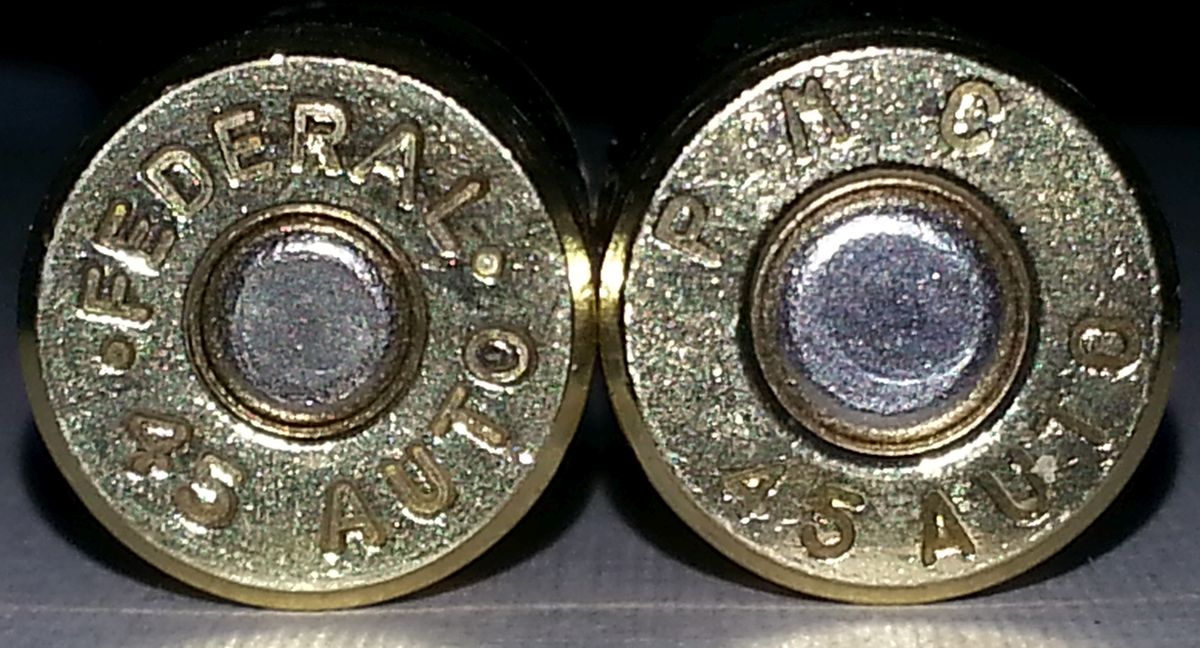
The second is more disruptive. .45 ACP exists in both large-primer and small-primer brass. The large primer is the traditional pattern; a number of makers have produced small-primer .45 ACP cases. Mixed in a bucket, the two look identical from the side. On a press set up with a large decapping pin, a small-primer case does not simply fail to deprime — it can stop the machine. For a chambering that is destined for the bulk progressive, that makes headstamp and primer-pocket sorting a mandatory step rather than a refinement, and it is the one caliber on this list where that is true.
2.7 Propellant Is a Shape as Much as a Chemistry
Smokeless propellant is treated in full in Volume 18, but one property belongs here because it is a property of the object rather than of the load: the physical form of the granule determines how well it meters.
Extruded stick powders, spherical or ball powders, and flake powders behave differently when a fixed volume of them is dropped through a measure. A powder that meters badly will not throw consistent charges from a volumetric measure however good the measure is, and that single fact is why the charge-weighing equipment in Volume 19 exists in the price range it does. The choice of propellant and the choice of weighing method are not independent decisions.
2.8 The Bullet, and What a Bullet Weight Does Not Tell You
Bullets divide by construction — cast lead, plated, jacketed, and monolithic — and each interacts differently with the neck that grips it, the crimp that may close on it, and the bore it engraves into.
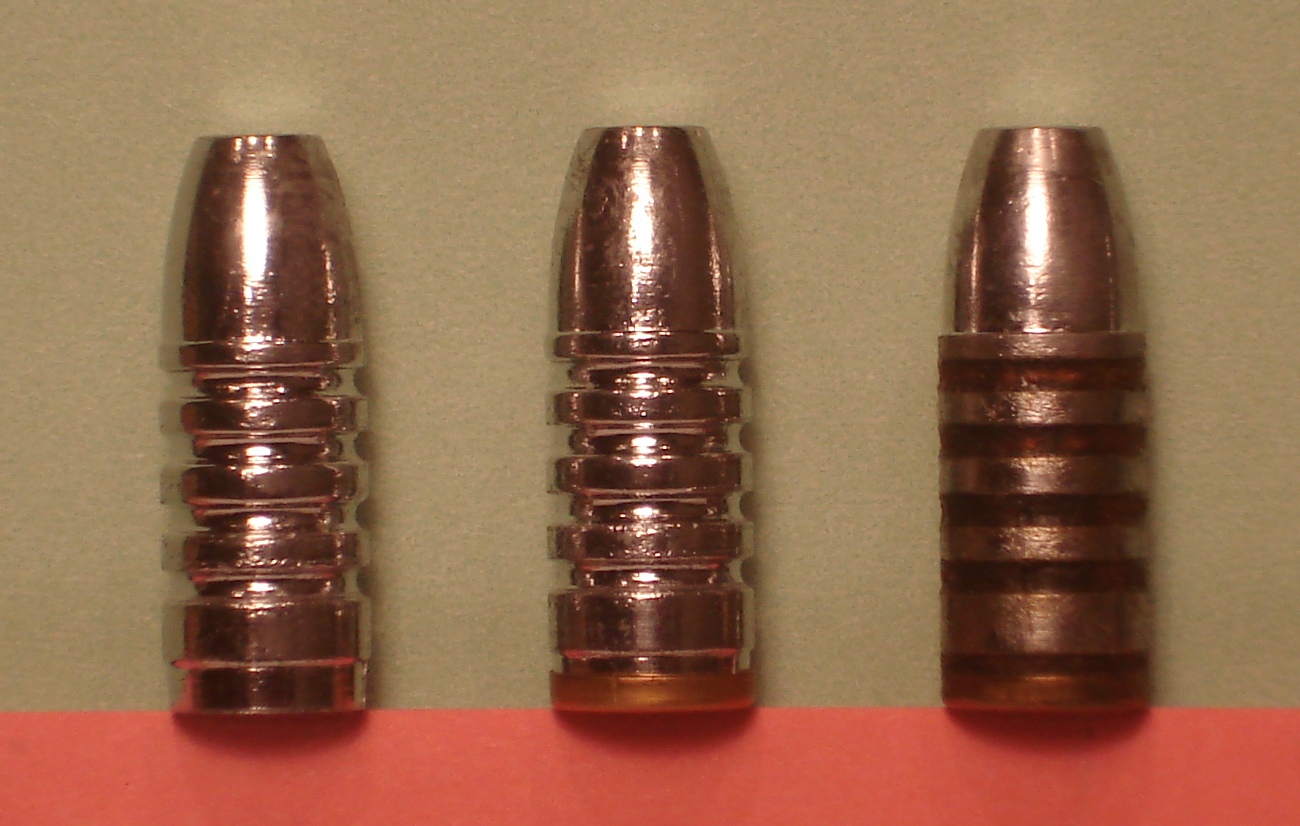
Two properties of a bullet are commonly conflated, and separating them prevents a persistent error. Bullet weight is what the box advertises and what load data is indexed by. Bullet length, together with its shape, is what determines whether a given barrel twist will stabilise it. These correlate loosely, and reasoning about stability from weight alone gives the wrong answer often enough to matter — the AR-15 5.56 dive in this collection works through a case where holding weight constant and varying only length changes the stability factor by a factor of four, and where a heavier bullet of equal length is the more stable of the two. Volume 20 returns to this when seating depth is considered, because depth is measured to the ogive rather than to the tip for the same underlying reason: the tip is the least consistent feature of a bullet and the least relevant to how it sits in the throat.
2.9 What the Standard Actually Specifies
The dimensions and pressures in this dive trace, where possible, to the published industry standard rather than to secondary summaries. For centerfire rifle cartridges that is ANSI/SAAMI Z299.4-2015, which is held in this collection’s reference library, and for the pistol calibers the corresponding pistol and revolver standard.
Two things about how that document is constructed are worth stating, because both are routinely misread.
First, the pressure limit is a statistical construct, not a never-exceed ceiling for an individual round. The standard defines a Maximum Average Pressure as a recommended maximum level for commercial loading, and builds around it an allowance for sample variation expressed as a standard deviation, with the acceptance criteria framed in terms of a high probability that the average of a sample does not exceed the limit. Treating the published figure as a hard wall that one round either crosses or does not is a misunderstanding of the quantity being specified.
Second, a pressure figure is only comparable to another pressure figure measured the same way. Copper-crusher values in CUP and piezoelectric transducer values in psi are different measurements of different things, and there is no valid conversion between them. Where sources appear to disagree violently about the pressure of a cartridge, the usual explanation is that one of them is quoting a figure in the other system, or a figure taken at a different transducer position. The per-caliber volumes give both systems separately where both are published, and never convert between them.
One limitation of the copy held here should be stated plainly rather than papered over: it carries chamber and test-barrel drawings rather than cartridge drawings. Headspace dimensions and chamber geometry can therefore be read from the primary source, while case length and trim-to figures cannot, and are secondary-sourced wherever they appear. The per-caliber volumes flag this individually.
2.10 Where This Goes Next
The rest of the dive follows the object through its cycle. Volumes 5 through 8 are about the machine that does the work and which one to buy. Volume 9 covers the dies that act on the case. Volumes 10 to 15 follow a piece of brass from the ground at a range through cleaning, preparation, trimming, annealing and eventual retirement. Volume 16 covers making cases that nobody sells, with .300 Blackout from 5.56 as the worked example. Volumes 17 to 20 cover the three consumables and the act of assembly. Volumes 21 to 23 are about finding out whether any of it worked, and feeding that answer back into the next batch.
Comments (0)