The Reloading Bench · Volume 1
Overview — Why Handload, and What This Dive Decides
Two machines, eight chamberings, and the corrections that make this worth reading
Handloading is the practice of rebuilding a fired cartridge case into a new cartridge. That is a narrow description of an activity that people take up for at least four distinct reasons, and the reasons matter because they lead to different equipment and different habits. This dive is written to be read straight through by someone setting a bench up, and to be returned to a volume at a time by someone who has one.
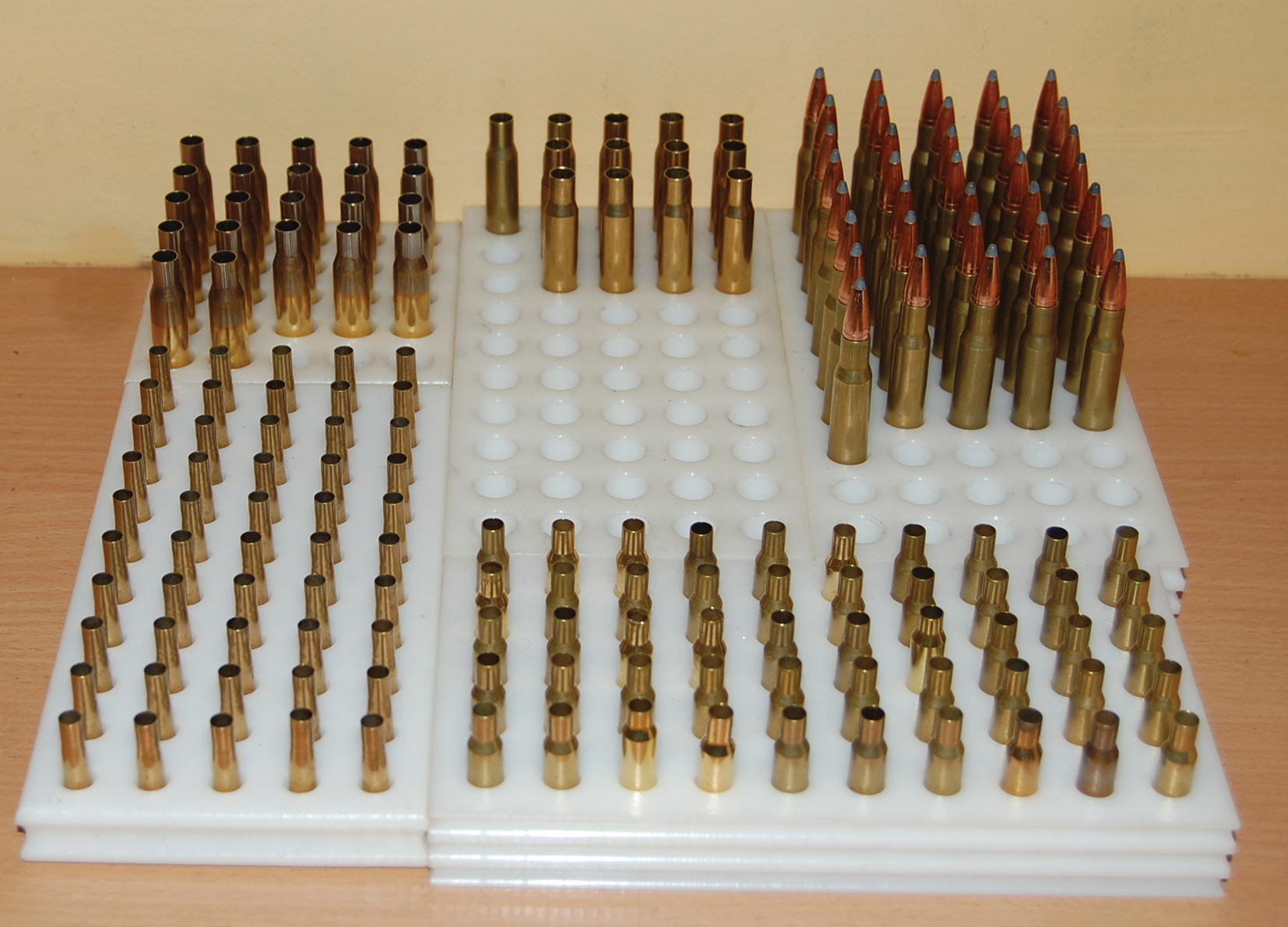
1.1 Four Reasons, and Only Three of Them Hold Up
Cost. Real, and usually overstated. Component prices move, the saving per round is genuine, and the saving is almost always reinvested in shooting more rather than banked. A bench that pays for itself does so over thousands of rounds, not hundreds — Volume 8 costs the equipment honestly rather than optimistically.
Availability. The strongest argument, and the least discussed. A handloader with components is insulated from the ammunition shortages that recur every few years, and can feed a chambering whose factory supply is thin — which on this bench includes .450 Bushmaster, where published data is scarce and factory choice is narrow.
Precision. Real, and the reason most precision rifle shooters load. The cause is not magic: a handload can be tailored to one chamber, one throat and one barrel, which no factory load can be. Volumes 20 through 22 cover how much of that advantage is actually measurable, and are more sceptical than most treatments.
Cartridges nobody loads well. Subsonic .300 Blackout is the clearest case on this bench. The load a suppressed subsonic rifle wants is a specific and unusual combination, and the factory options are few. Volume 16 goes further, to cartridges whose brass nobody sells at all.
1.2 What This Dive Is Written Against
This is a bench being built, not a bench being admired. The reader it is written for reloaded years ago, sold the equipment, and is returning to a market whose model numbers have rotated underneath familiar brand names — so Volume 8 spends as much effort on what changed as on what to buy.
The work is defined by eight chamberings across two workflows:
Table 1 — The work is defined by eight chamberings across two workflows
| Workflow | Chamberings | Machine |
|---|---|---|
| Precision rifle | .308 Winchester · .30-06 Springfield · .300 AAC Blackout · .450 Bushmaster | A turret |
| Bulk | 5.56/.223 · 9mm Luger · .40 S&W · .45 ACP | A progressive |
Plus an auxiliary single-stage that exists for two specific jobs — case forming, and removing a bulge that no conventional die will touch.
The .30-06 is the specialised item. It is loaded for an M1 Garand, which is gas-operated and sensitive to port pressure in a way no bolt gun is: the wrong powder class can damage the operating rod, there is a bullet-weight window, and the en-bloc clip constrains cartridge length. The M1 Garand dive in this collection is the canonical treatment of gas-port-pressure-sensitive ammunition; this dive covers the bench side of loading for it.
1.3 The Arc
The dive runs in five movements.
What the object is (Volume 2). The cartridge as a manufactured thing: four components, one of which survives firing, and why that asymmetry determines everything else.
The bench and what stands on it (Volumes 3 to 9). The bench as tooling rather than furniture; component storage; the press landscape from single-stage to automated; the verdict; and the dies that actually establish every dimension on a finished round.
The brass (Volumes 10 to 16). One piece of brass followed from the ground at a range through sorting, cleaning, preparation, trimming, annealing and retirement — then forming cases that nobody sells.
The consumables and the assembly (Volumes 17 to 20). Primers, powder, weighing the charge, and seating a bullet.
Finding out whether it worked (Volumes 21 to 24). Load development and its honest critique, the instruments, the record that closes the loop, and a laminate-ready summary.
1.4 Where to Start, Depending on the Question
Table 2 — Where to Start, Depending on the Question
| If the question is | Go to |
|---|---|
| Which press should be bought | Volume 8 — and Volumes 5 to 7 for the machines themselves |
| How should powder and primers be stored | Volume 4 |
| Is this brass worth keeping | Volume 10, then Volume 15 |
| Wet or dry tumbling | Volume 11 |
| Does trimming matter, and with what | Volume 13 |
| Is annealing worth it | Volume 14 |
| How is .300 Blackout brass made from 5.56 | Volume 16 |
| Which scale, and does 0.1 grain matter | Volume 19 |
| How should a load be worked up | Volume 21 |
| Why group size keeps changing between sessions | Volume 22 |
| What should be written down | Volume 23 |
1.5 What Belongs to Other Dives
Four sibling dives in this collection own adjacent ground, and this one refers to them rather than re-deriving them. The division is deliberate: duplicated technical material drifts apart over time, and then a reader cannot tell which version is current.
The Headspace dive owns headspace, the datum, shoulder bump and how much to bump, trimming theory, and the entire diagnostic vocabulary for reading a fired case — the bright ring, the wire test, primer appearance, extraction feel. This dive covers the bench procedures and the equipment; that dive covers the measurement.
The Ballistics Overview owns internal, external and terminal ballistics as physics.
The .45-70 Government dive owns the argument about handloading pressure tiers that sit above a published maximum.
The M1 Garand dive owns gas-port-pressure-sensitive ammunition.
1.6 What This Dive Refuses To Do
Three rules shape the writing, and they are worth stating at the front so a reader knows what kind of document this is.
No charge weight is ever offered in this dive’s own voice. Where a published table is reproduced anywhere in this collection it is attributed to its publisher by name and closed with an instruction to work up from the starting load in the current published source. A number without a named source, or a number phrased as this dive’s recommendation, would be a safety defect rather than a helpful addition.
Nothing is stated more confidently than its source supports. Where a figure could not be confirmed, the prose says so. Where two sources disagree, both are given and the disagreement is named rather than averaged away. There are more such admissions in this dive than is conventional, and they are the parts most worth trusting.
Folklore is named as folklore. This subject carries an unusual quantity of confidently repeated advice that does not survive checking, and pointing at it is treated as content rather than as digression.
1.7 The Corrections This Dive Turns On
If the dive has a product beyond organisation, it is this list. Each of these is developed properly in its own volume.
A .300 Blackout round chambers in a 5.56 rifle and fires in battery with no warning — and a .300 Blackout case formed from 5.56 brass still carries the 5.56 headstamp, so headstamp sorting cannot separate them. Only length and neck diameter can. (Volume 16.)
Smokeless powder does not detonate. Confined, it bursts its container. So powder wants a cabinet that vents while primers — the one component that genuinely mass-detonates — want one that is rugged. The two requirements point in opposite directions, and a gun safe is the specific common error. (Volume 4.)
A velocity flat spot narrower than about ten feet per second is inside the noise floor of the instrument used to find it, because two good chronographs agree only to 7 to 10 fps while a tenth of a grain of powder is worth single digits. The node-hunting methods are not fraudulent; they are below the resolution of the measurement. (Volumes 21 and 22.)
Case-head expansion is not a pressure gauge. Instrumented work has found identical case-head expansion from peak pressures differing by a factor of two. A pressure sign is a stop signal, never a green light. (Volumes 15 and 21.)
There is no carbide sizing die for .450 Bushmaster, so despite its straight-walled shape it is a rifle-loading process in which every case must be lubricated. (Volumes 9 and 8.)
.45 ACP exists in both large-primer and small-primer brass, eye-sorting is only about 80 percent effective, and a small-primer case can stop a press set up with a large decapping pin. (Volumes 2 and 10.)
Dillon’s lifetime warranty covers hobby-tier machines only — the commercial presses carry one and two-year terms. Spending more moves a buyer out of the warranty that motivated the brand choice. (Volume 8.)
A rated throughput figure is a sprint with the consumables pre-loaded. Sustained output runs 60 to 70 percent of rated, and the only independently measured rate located anywhere is 540 rounds per hour on one machine. (Volumes 6 and 8.)
Shiny brass is cosmetic. The three functional requirements are grit removal to protect dies, a surface readable enough to inspect, and full primer seating. (Volume 11.)
“Anneal at 800 degrees” is not a specification, because recrystallization is temperature multiplied by time. A temperature quoted without its dwell says nothing — and an early research note for this dive made exactly that mistake, which is how it propagates. (Volume 14.)
A brass change alone, at an unchanged charge, has stuck a case and sheared a bolt handle off a rifle — for handloaders with seventeen years of experience. Any component change restarts the work-up, and that is not a formality. (Volume 21.)
1.8 A Note on What Is Still Owed
Several questions in this subject appear to have no published answer, and two of them are answerable at an ordinary bench with a counter and a notebook: the yield and scrap rate of forming .300 Blackout cases from 5.56 brass, which the economic argument in Volume 16 turns on and which no located source reports; and chronograph strings from barrels shorter than the standard’s test barrel, since every published velocity is a test-barrel figure. Volume 23 makes the case that the record-keeping which makes a bench better at its own work is the same record-keeping that lets it contribute something back.
Comments (0)