The Reloading Bench · Volume 17
Primers and Priming
Four parts in a cup a few thousandths thick, the crush nobody measures, and the one component on the bench that propagates
Ignition gets the least attention of the four components and has the least margin. A primer is the smallest part of the cartridge and the cheapest by a wide margin, yet it is the only one whose failure produces both of the two opposite outcomes a handloader cares about: a round that does not fire at all, and a round that fires before the action is ready for it. It is also, of the three things stored on a loading bench, the one with a genuine mass-detonation hazard.
Boxer and Berdan priming, and the reason a Berdan case in a bucket of range brass is scrap, are set out in Volume 2 and not re-derived here. Nor are the two size traps introduced there — that .450 Bushmaster takes a small rifle primer, and that .45 ACP exists in both large-primer and small-primer brass — though both are referred to where they bear on tooling.
17.1 Four Parts in a Cup
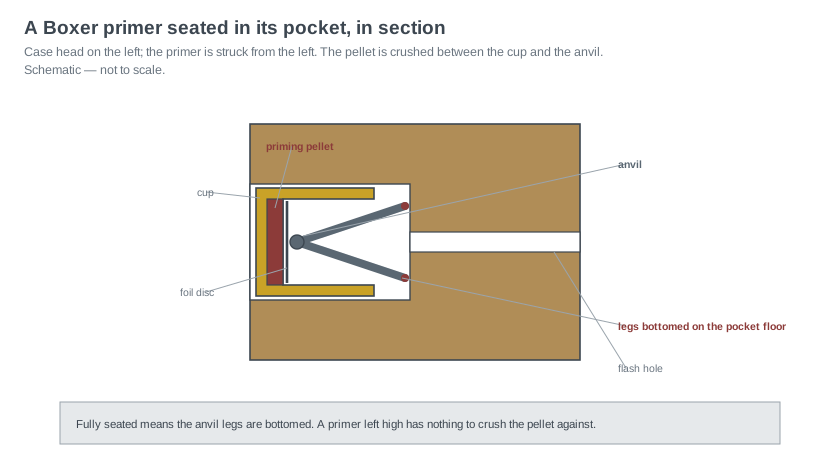
A modern Boxer primer is four parts, and each fails differently.
The cup is drawn brass, sometimes nickel-plated. Its thickness and hardness set two things at once: how much firing-pin energy is needed to initiate the primer, and how much chamber pressure it will take before the metal flows. Those pull in opposite directions, and nearly every difference between primer products is a choice about where to sit between them.
The priming compound is a pressed pellet based on lead styphnate, lacquered in place. The anvil is the hard surface the compound is crushed against; in a Boxer primer it belongs to the primer, in a Berdan case to the pocket. The foil or sealant is a disc and lacquer over the pellet, protecting it from moisture and from breaking up in transit.
Function is a pinch rather than a blow. The firing pin dents the cup, trapping compound between cup and anvil legs, and friction and impact initiate it. What leaves the flash hole is the part worth precision. SAAMI’s description is that primers “are designed to explode and produce the heat, gas and hot particles necessary to ignite the propellant powders in sporting ammunition when the firing pin of a firearm strikes them properly.”
“Hot particles” carries real weight. Ignition is not purely thermal — incandescent solids jetting down the case do much of the work of lighting the powder column. That is why brisance, the shattering quality of the initiation, is distinct from simply making a bigger flame, and why the magnum question below is harder than it looks.
Priming chemistry leaves one legacy still in circulation. Fulminate of mercury corroded bores and embrittled brass, so mercury-primed cases are not reloadable; potassium chlorate improved ignition and worsened corrosion, leaving a hygroscopic residue that draws moisture and rusts bores from the inside. Non-corrosive lead styphnate arrived commercially from roughly the 1950s, so corrosive-primed surplus exists and the bore that fires it wants prompt water-based cleaning. Lead-free priming exists in indoor-range and some law-enforcement ammunition, but no handloading-canister lead-free primer line could be confirmed for this dive. One hazard belongs here rather than a footnote: SAAMI publishes guidance on the take-home lead hazard, and handling primers is a named exposure pathway alongside tumbling brass, so hand-washing is a control rather than a formality.
17.2 Two Diameters Do Nearly All the Work
Primer sizing is simpler than the product range suggests.
Table 1 — Two Diameters Do Nearly All the Work
| Size | Cup diameter |
|---|---|
| Small rifle and small pistol | 0.175 inch |
| Large rifle and large pistol | 0.210 inch |
| .50 BMG | 0.315 inch |
The trap is in the first two rows: small rifle and small pistol primers are dimensionally interchangeable and functionally are not. The same holds for the large pair. Rifle cups are thicker and harder, for higher chamber pressure and heavier strikes. The best-attributed figure is that a large rifle cup runs about 0.008 inch thicker than a large pistol cup.
Absolute thicknesses are harder to pin down, because manufacturers do not publish them. The circulating numbers are practitioner measurements — roughly 0.017 inch for a small pistol cup, 0.020 for a large pistol, 0.025 for a magnum small rifle. One widely cited figure for a standard small rifle cup appears in its source as 0.0019 inch, thinner than household foil and plainly a transcription error; it is not reproduced here, and no substitute could be confirmed.
The substitution rule follows. A pistol primer in a rifle cartridge risks cup failure and gas leakage into the action; a rifle primer in a pistol risks light strikes and misfires in a low-energy hammer system. Neither is a preference.
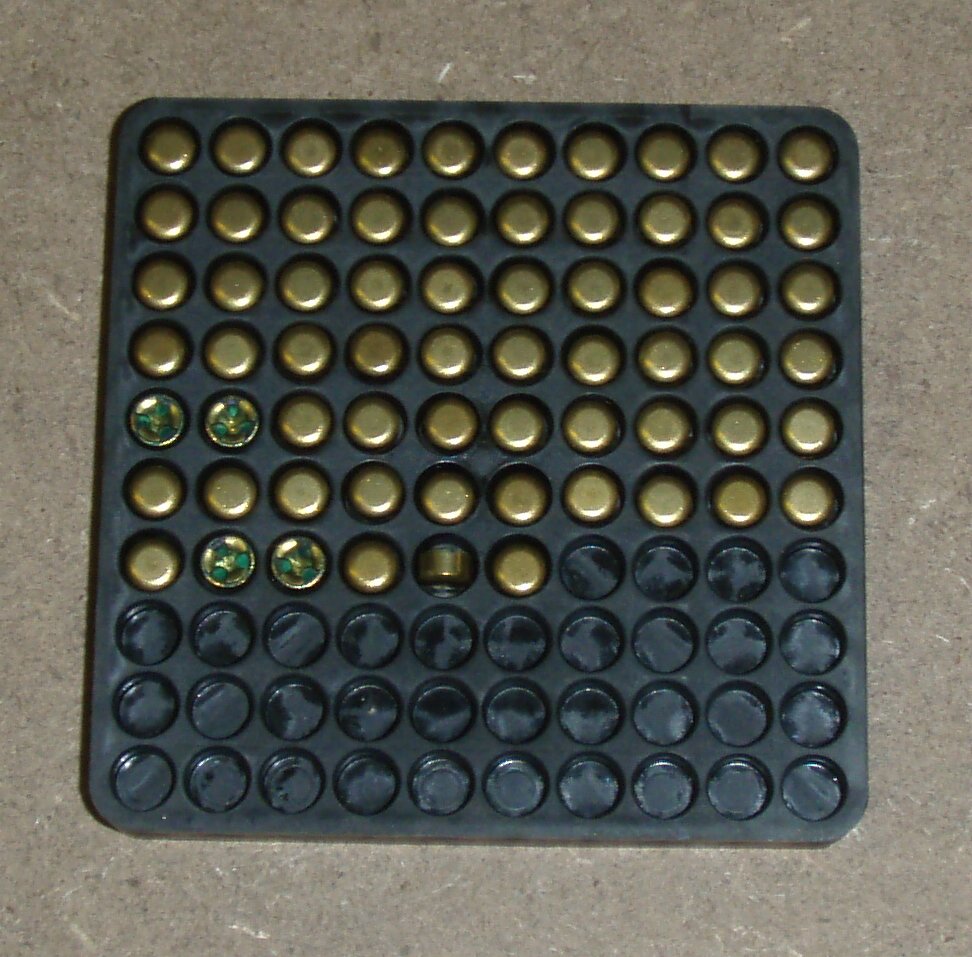
Hardness also varies within the rifle category, which is why a separate class exists. A semi-automatic with a free-floating firing pin can have the pin tap the primer as the bolt closes, and a primer sensitive enough or seated high enough can fire out of sequence. Harder military cups exist for that — CCI #34 in large rifle for .30-06, CCI #41 in small rifle for 5.56 — and are conventional where slam-fire is the concern. Conventional, not required: the M1 Garand dive is the canonical treatment, and it records that published M1 data does not always specify one and that Handloader’s own M1 testing used an ordinary Federal 210. The sources genuinely differ, so the position here is modest — a hard cup is normal practice for a floating-pin semi-automatic rather than a demonstrated requirement, and the more important control is a primer seated fully below the case head every time.
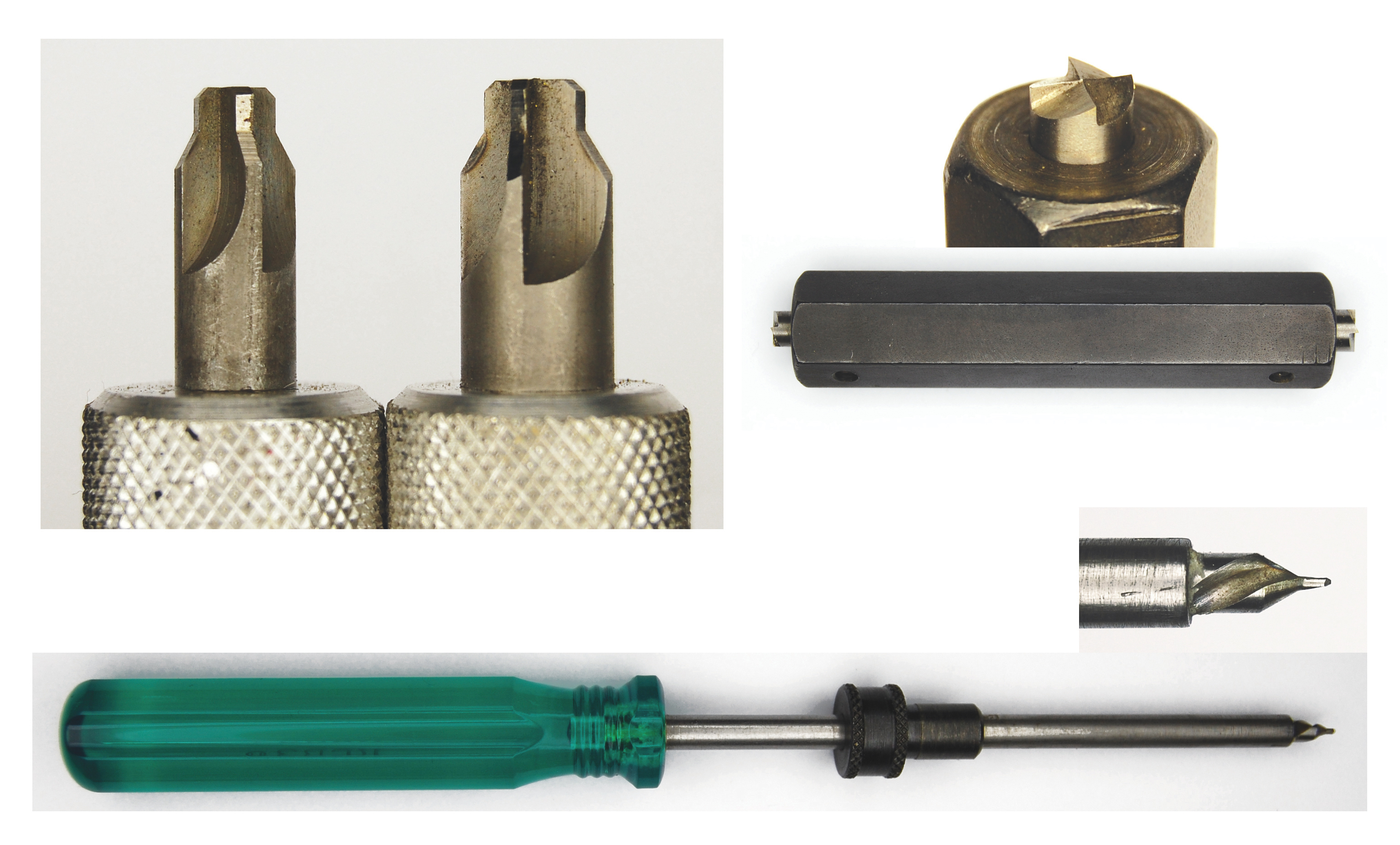
Military brass brings one adjacent complication. Lake City and similar cases have crimped primer pockets, removed once by swaging or reaming and never returning. The tooling belongs to Volume 12; that reaming removes pocket metal and can shorten the life of the feature which usually retires a rifle case belongs to Volume 15.
17.3 Seating Depth and Crush
This governs more than it receives attention for, and it is where the evidence splits.
The mechanism is not in dispute. A primer is seated until the anvil legs bottom on the pocket floor and then pushed slightly further, pre-loading the anvil against the compound. That pre-load is the crush. Too little, and the first of the firing pin’s energy is spent seating the anvil rather than pinching compound — variable ignition delay, elevated velocity spread, occasional misfires. Too much, and the pellet can be damaged or the compound desensitised. A high primer standing above the case head is the extreme of the first error, and the configuration implicated in slam fires.
The commonly cited target is about 0.002 inch of crush, putting the primer roughly 0.004 to 0.005 inch below the case head in common brass. That is repeated consistently across the practitioner literature but could not be traced to any primer manufacturer’s own published specification for this dive, and is not printed here as one.
The confound matters more than the tool. Pocket depth varies between brass makers and between lots of one maker. Seating to a fixed depth below the head therefore gives inconsistent crush when pockets vary, and seating to a fixed crush requires knowing each pocket’s depth. That is why pocket uniforming tools exist, and why users of measuring seaters report inconsistent results from inconsistent pockets however precise the seater. A tool repeating to a thousandth is repeating to a datum that moves.
Two bodies of evidence then diverge. Testing reported with the Primal Rights seater puts each 0.002 inch of seating depth at roughly one and a half to two inches of point-of-impact shift, with 0.004 and 0.006 inch crush overlapping and holding 2.7 inches of vertical spread in a 6BRA. That reads strongly until the sample is read: six shots, with no stated distance, control or repetition. Volume 21 sets out why six shots cannot separate a 2.7-inch spread from ordinary dispersion — confidently repeated, and not supported by the measurement it rests on. Against it, the Hornady ballistics laboratory, with pressure-instrumented equipment and sample sizes a private bench does not shoot, concluded that bullet and powder changes significantly affect accuracy while primer and bullet jump have minimal effect. That was captured from the episode’s published description and secondary summaries rather than the episode itself, so it is reported as the laboratory’s position without attributing a number to a named individual.
The resolution both camps can carry: the mechanism is real, and nobody disputes that grossly under-seated primers cause misfires and erratic ignition. What is unsupported is the fine-tuning claim, that two thousandths of crush is detectable for an ordinary rifle and shooter. So seat primers consistently and fully, and do not treat crush as a tuning knob — not a compromise, but the part of each position that survives.
17.4 Priming Tools
Every well-regarded tool here is praised for the same property, and it is not precision. It is feel — transmitting the moment the anvil bottoms clearly enough that the hand knows the primer is home.
Table 2 — Priming Tools
| Tool | Character | Price, read 2026-09-17 |
|---|---|---|
| Lyman E-Zee Universal | Budget universal hand primer | $69 |
| Frankford Arsenal Perfect Seat | Hand tool with seating-depth adjustment; about a dozen shellholders | $119 |
| RCBS hand priming tool | Shellholder-based hand squeeze | about $120 |
| Lee Auto Bench Prime | Bench-mounted lever, Lee shellholder system | $125 |
| RCBS Universal hand primer | No shellholders — the jaws grip the case rim | $136 |
| Primal Rights CPS | Bench tool, adjustable in 0.001 inch increments, claimed repeatable to a thousandth above twenty cases a minute | $695 |
Two named products could not be priced: the 21st Century hand primer, click-adjustable for depth on Lee Auto-Prime-pattern shellholders, and the Primal Rights PrimeWhere, which measures actual seated depth rather than inferring it. Both were located as products and neither price was captured from a vendor cart, so they are named without figures. The CPS launched at $600 in 2017, a useful anchor for that end of the market. Most hand-tool prices above come from a retail summary rather than each manufacturer’s cart, and all are one reading on one day.
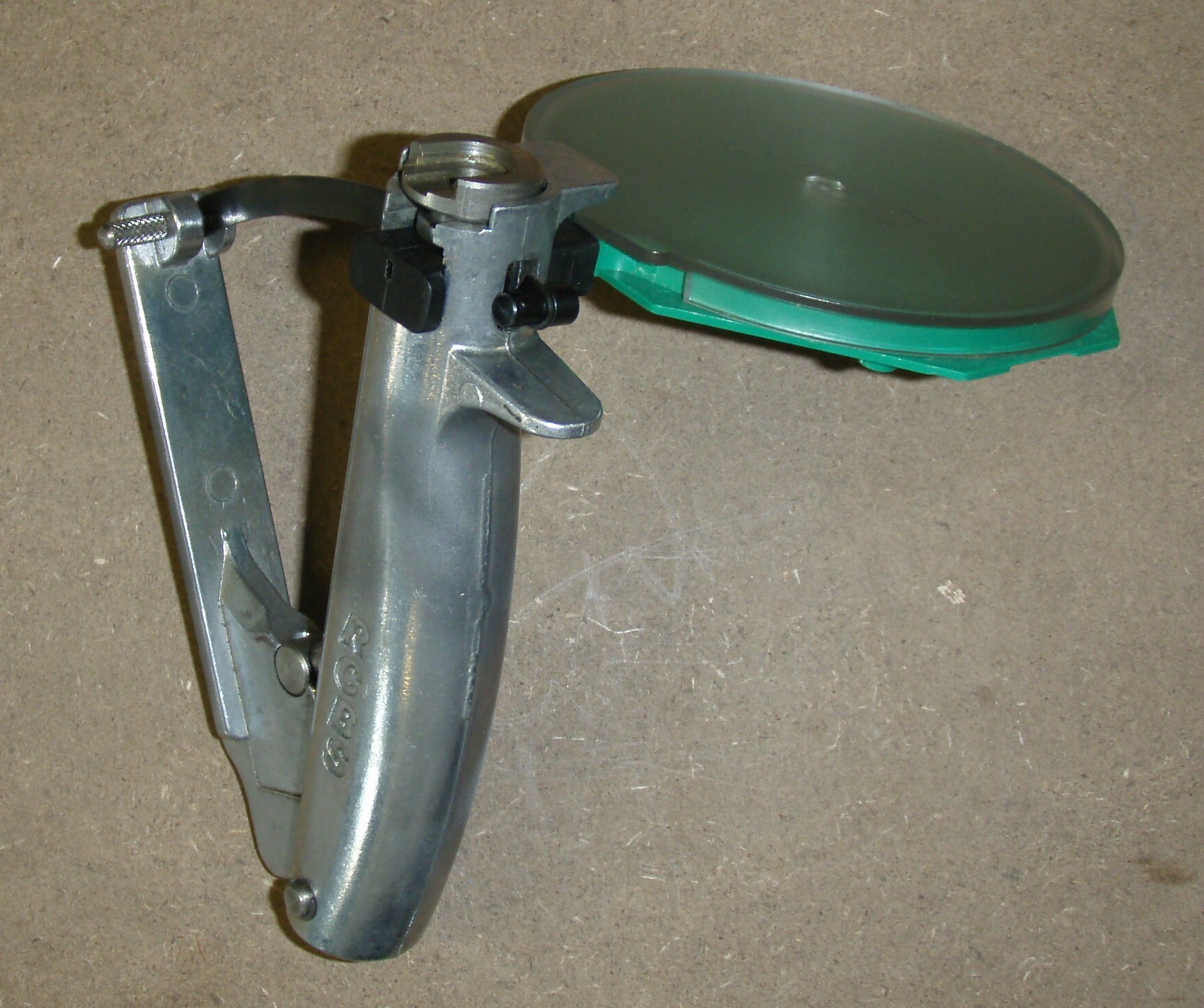
On-press priming deserves a fair hearing, since it is what most rounds are primed with. Most single-stage presses and all progressives will prime, and it removes a handling step entirely. The cost is the property the dedicated tools sell: mechanical advantage swamps the tactile signal of the anvil bottoming, so there is far less feel. And on a progressive the supply is a tube or disc of primers in bulk contact, which is what the next section is about. The trade is real in both directions rather than a verdict.
17.5 Primer Safety
This is the sharpest hazard on a loading bench, and the source states it plainly enough that paraphrase weakens it. The following are from SAAMI’s primers document of 8 November 2022.
Primers are explosives and behave like it. “Primers may explode if mishandled. Explosions may be caused by friction and by percussion, such as hammering, pounding, dropping or bullet impact. Heating by fire, static electricity, sparks, hot tobacco ashes, or other unspecified abuses may also cause primers to explode.”
In bulk they propagate. “If primers are loose or in bulk, having contact one with another, one primer exploding can, and usually will, cause a violent, sympathetic explosion of all primers so situated. In other words, one primer exploding for any reason under these circumstances will normally cause all the primers to explode in one violent blast.”
That is the most important sentence in the volume, and its force comes from the comparison. SAAMI’s ammunition document states that if one cartridge ignites and bursts “it will not usually cause surrounding cartridges to ignite” — loaded ammunition does not propagate. And smokeless powder, as Volume 18 sets out, does not detonate like high explosives; its hazard is that confinement raises pressure, pressure raises the burning rate, and the container fails as a pressure vessel with effects similar to an explosion. Three components, three mechanisms. Of the three, bulk loose primers in contact are the one that genuinely mass-detonates. The storage consequences, which run opposite to powder’s, belong to Volume 4.
Primer dust is the mechanism behind feed-tube events. “Primers may ‘dust.’ Small particles of priming compound may separate from the primers in the form of dust, especially when they are subjected to shaking or jolting. Accumulation of this dust in primer feed tubes, loading machines, and loading areas is extremely hazardous as it might cause explosions or fires.” A progressive shakes and jolts primers by design, so tube and tray discipline is the control for a known accumulation rather than fussiness.
The handling rules follow, mostly a sentence each. Never force a primer — avoid rough handling and “undue force where a primer is involved, since the primer may fire.” A primer that will not seat has a cause: a crimped, undersized or fouled pocket, debris, or the wrong size in the wrong case, found with the handle released rather than with more pressure on it. Do not deprime live primers, since “the depriming (a.k.a. ‘decapping’) of shells or cases containing live primers is to be avoided.” Clear malfunctions with extreme caution. Ground the equipment and manage static on the person — “loading equipment should be electrically grounded.”
Clean by damp wiping. The area is kept “scrupulously clean and free of primer dust and powder accumulations,” cleaned “by wiping with a damp cloth or sponge which should be thoroughly rinsed after each use.” Note what that excludes: brushing generates friction and static, and a household vacuum is an ignition source with a bag full of fuel. Spent debris is itself a hazard, as fired cups and anvils “are a hazard during loading operation as contact with them may cause primers to fire”, and spills are picked up at once because primers “may explode when stepped upon.”
One tray at a time. “An absolute minimum of primers should be maintained at the loading operation. Only one packing tray at a time should be removed from the primer storage container.” Leftovers return to the original packaging at the end of the session.
Contamination kills primers quietly. “Primers exposed to water or any organic solvent, such as paint thinner, gasoline, kerosene, oil, or grease, may deteriorate, resulting in misfires or poor ignition.” Oil and grease are on that list, making an oily press a reliability problem rather than only a housekeeping one. Containers stay dry and below 150 degrees Fahrenheit. And safety glasses, always: “safety glasses must be worn when performing any and all handloading operations.”
One point explains why that discipline must be absolute. Powder announces deterioration by smell, as Volume 18 describes. A degraded primer looks entirely normal. No source consulted gives a shelf-life figure for primers or a visual test for a bad one, and none is invented here — so there is no inspection step to fall back on, and the handling and storage rules carry the whole load.
17.6 What This Volume Does Not Settle
What makes a magnum primer magnum. Two mechanisms are offered and the hobby conflates them: more compound, giving a longer and larger-volume flame front, or a different compound giving higher brisance. The industry framing is that magnum primers deliver “a hotter and more voluminous fire”, intended for slow-burning powders, large case volumes and high-performance loads, and particularly beneficial in cold conditions. A repeated practitioner claim goes further — that brisance is inherent to what the compound is rather than how much there is, and that in some standard-and-magnum pairs the only real difference is cup thickness. That is plausible, internally consistent, and a forum assertion rather than a manufacturer disclosure. Manufacturers publish neither compound masses nor compositions, so the mechanism is not publicly knowable and this volume does not pretend otherwise.
What is certain is the part affecting safety. A standard-to-magnum swap is a component change. It changes ignition and pressure, published data specifies a primer for a reason, and the swap means returning to the starting load and working up again. Magnum primers most defensibly earn their keep with the spherical powders of Volume 18, whose heavy deterrent coatings make them harder to ignite — the form that meters best being the fussiest about lighting. Cold sharpens that, and poor ignition with ball powders in the cold is the most consistently reported thing a magnum primer cures.
Whether primer choice is worth optimising at all. The laboratory position puts primer among the variables that matter least, while a large and sincere body of practitioner work treats it as a tuning variable. The two are closer than they look, for the reason Volume 21 develops: they are answers at different precision scales, measured with very different sample sizes. What survives either way is unglamorous and cheap. Buy the primer the published data specifies, seat it fully and consistently, keep pockets uniform and clean, and spend the attention saved on the coarse variables known to move.
Comments (0)