The SKS · Volume 5
The Secret Carbine — What the CIA Knew, and When
Secrecy around a rifle sounds faintly absurd. A rifle is a thing you hand to a conscript; ten thousand people see it a week. But the Soviet Union classified the SKS, and then classified the ammunition, and then went to lengths that read as comedy until you notice they very nearly worked.
This volume is built on two declassified CIA information reports. Both are held with this dive. They are the best kind of source: contemporaneous, specific, and wrong in ways that tell you more than being right would have.
5.1 The Two Documents
CIA-RDP80-00810A001000900006-5 — “New Type Soviet Submachine Gun and Carbine.” Country: USSR (Leningrad Oblast). Distributed 29 April 1953. Five pages. Classified SECRET / SECURITY INFORMATION. Marked, in a box on the cover, “This is UNEVALUATED Information.” Released 2009-03-05.
CIA-RDP82-00046R000500020007-7 — “New Soviet 7.62 mm Semi-Automatic Carbine SKS, Submachine Gun, and 7.62 mm Pistol.” Country: USSR/Austria (Soviet Zone). Distributed 14 April 1955, inner report dated 28 March. Thirteen pages. Classified CONFIDENTIAL. Declassified in part 2013-09-27.
Two years apart. The difference between them is the whole story.
5.2 April 1953 — A Rifle Somebody Remembered
The 1953 report comes out of the Krasnoselskiy Guards, Order of Aleksandr Nevskiy Rifle Regiment, in Leningrad Oblast. It has the texture of a debriefing: three companies of older soldiers were clearing minefields in Leningrad and Novgorod oblasts, and only signalmen, drivers and cooks were still living in the barracks.
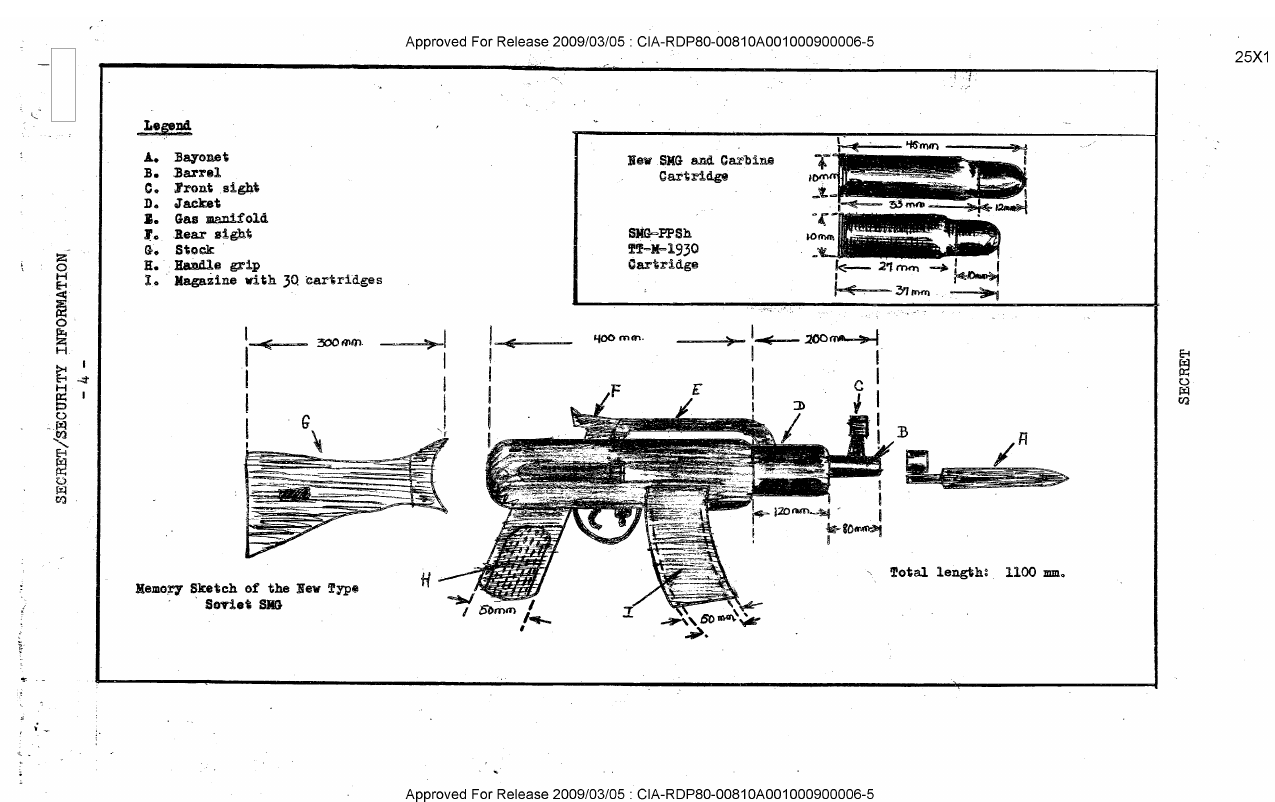
Then the substance. The regiment’s soldiers “were equipped with new type submachine guns and carbines.” Its new recruits, organised into three companies at the start of basic training, “were issued old type PPSh submachine guns and the old type of carbine.”
Read that twice. The trained soldiers had the new weapons; the recruits had the old ones. That is not a supply constraint. It is a security policy, and the next paragraph confirms it.
5.2.1 The description
The report’s paragraph on the carbine is short. Here is what it got right:
“The new Soviet carbine was of the same length as the old M-44, but somewhat heavier… It was provided with a non-removable knife-type bayonet. When not in use, the bayonet was switched back to lie in a special groove in the bottom of the stock. Like the new submachine gun, this carbine was provided with a gas manifold for the recoil of the bolt and the ejection of cartridge. The bolt was completely covered from the sides and top, except for a slit on the right side for the bolt’s handle. The clip held 10 rounds of the universal new submachine gun – carbine ammunition.”
Every clause of that is accurate. The folding bayonet, the groove in the stock, the gas system above the barrel, the enclosed receiver with a slot on the right for the bolt handle, the ten-round capacity, and — most importantly — the fact that the carbine and the submachine gun shared a cartridge. That last point is the strategically significant one, and the source delivered it.
5.2.2 And here is what it got wrong
Two sentences, in the same paragraph:
“This carbine could be fired automatically or could fire single shots.”
The SKS has no automatic capability of any kind. There is no selector, no sear arrangement for it, and no version that had one.
“The clip was placed into the magazine from the bottom part of the stock.”
Exactly backwards. The SKS is charged from a stripper clip through the top of the open action, over the bolt. Nothing is inserted from below; the magazine hinges downward to unload, which may be what the source saw and mis-remembered.
Those two errors are not incidental. They are the two most consequential facts about an infantry rifle — how it fires and how it feeds — and Western intelligence had both of them wrong in April 1953, four years after adoption.
5.2.3 The sketches
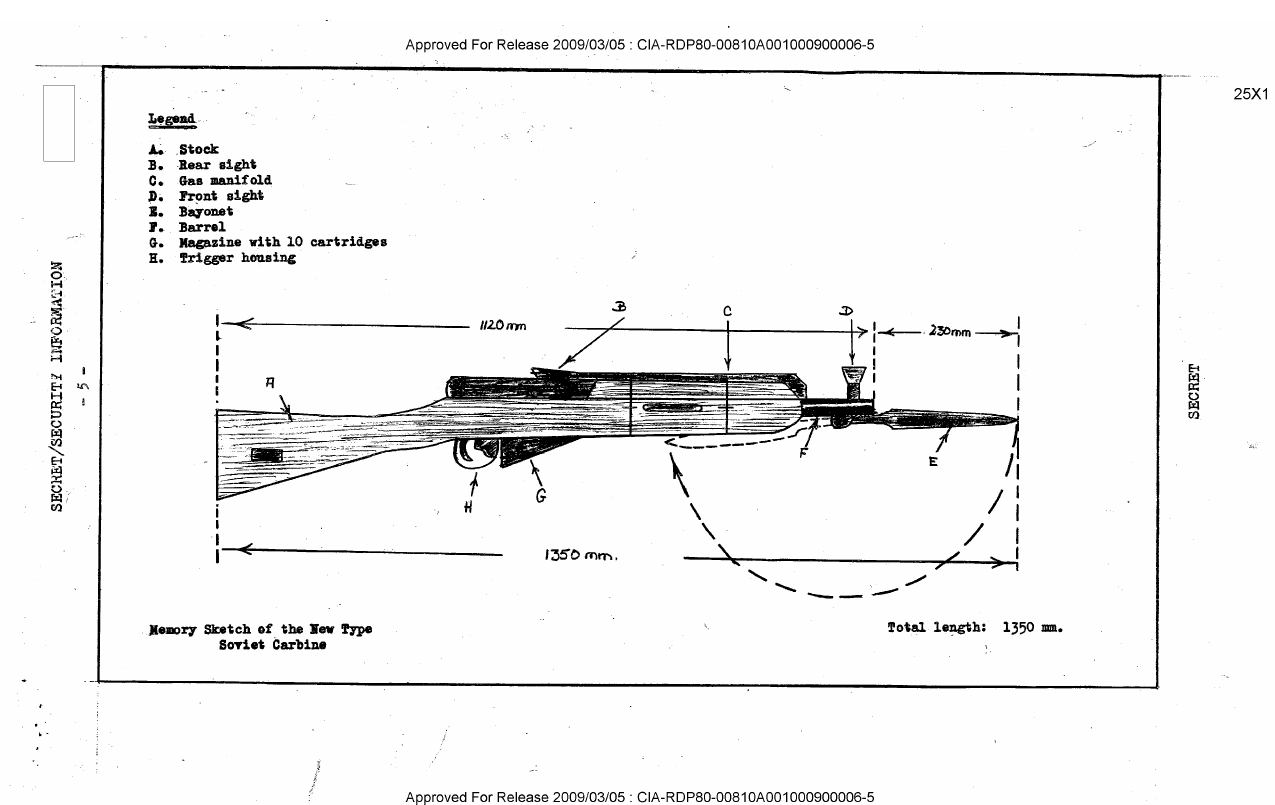
Because no one could photograph or measure it, the report closes with two hand-drawn “memory sketches.” The carbine sketch carries a legend — A stock, B rear sight, C gas manifold, D front sight, E bayonet, F barrel, G magazine with 10 cartridges, H trigger housing — and dimensions: 1,120 mm for the rifle, 230 mm for the bayonet, and a total of 1,350 mm with a dashed arc showing the bayonet swinging forward.
The true figures are about 1,020 mm folded and 1,260 mm extended. He was long by roughly 100 mm on both, which for a man drawing from memory a weapon he was not allowed near is a remarkably good result. The proportions, the bayonet arc, the gas tube, the magazine, the trigger housing: all correct.
5.3 The Security Regime, in the Soviets’ Own Practice
Paragraph 5 of the 1953 report is the clearest statement of policy in either document:
“Until they had taken the military oath at the end of the basic training period, new recruits in Svobodnoye were not allowed by their superiors to come close to these new submachine guns or carbines… these new weapons were considered military secrets and were issued only to some troops of the Leningrad and Far Eastern military districts. Even in these military districts, in order to preserve the required degree of secrecy, they were issued only to troops stationed in military settlements away from inhabited localities.”
Three concentric rings. Only two military districts of the whole USSR. Within those districts, only units posted away from towns. Within those units, only men who had already sworn the oath.
5.4 March 1955 — Somebody Who Actually Had One
The 1955 report is a different animal, and the reason is that its source was issued the rifle rather than glimpsing one.
In March 1954, enough of the new carbines arrived at a Soviet garrison in occupied Austria to replace 156 M1944 Mosin-Nagant carbines held by the privates of the 735th Separate Radio Communication Battalion. About twenty-four of the new submachine guns arrived at the same time for the squad and platoon sergeants.
Now the reporting gets very good. The title of the document itself names the rifle correctly — SKS — which the 1953 report could not do.
5.4.1 What a soldier’s-eye view produced
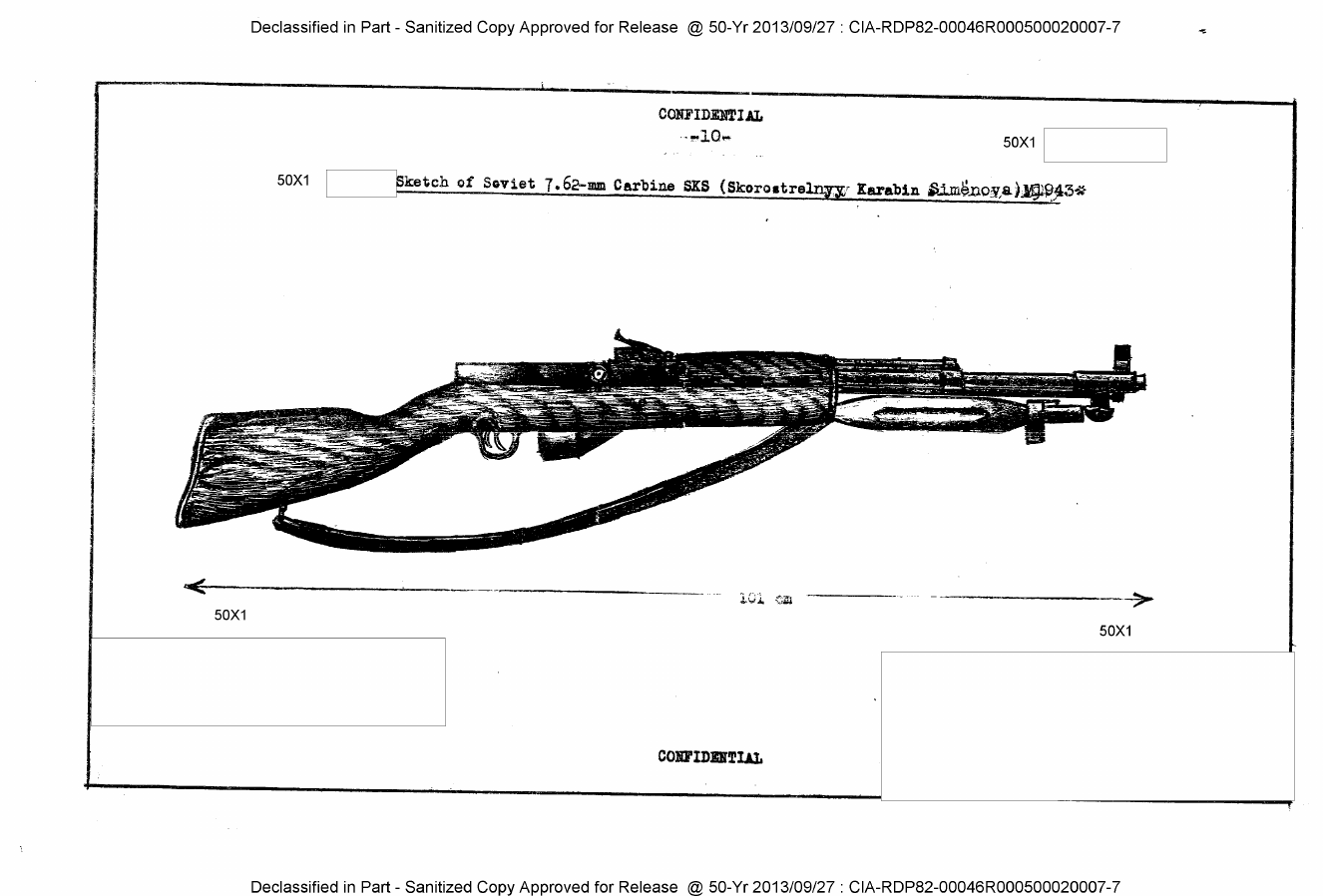
The report lists the rifle’s characteristics, marking with an asterisk those quoted from the manual. Most of it is right:
- Operation: “Gas, semi-automatic, magazine-fed, counter-recoil-spring loaded.” Correct — and note that the automatic-fire error of 1953 is gone.
- Diameter of gas port: “approximately 2.4 mm.” Correct and specific.
- Magazine: integral box, nine in the magazine and one in the chamber.
- Rifling: “four lands and grooves, uniform right hand twist, twist unknown.”
- Cooling: “air, assisted through three air vents on either side of the wooden upper hand guard.”
- Rear sight: “tangent curve — graduated from cyrillic П and then numbers 1 through 10. Each graduation represented 100 m… No windage adjustment.”
- Stock: “two pieces, wooden, unlaminated… Yellow or black wood. His unit had both colors of stocks.”
- Charging: “Ten-round straight-line clip (non-expendable).”
- Rate of fire: “35 to 40 rounds per minute… optimum practical rate.”
- Bayonet: “Two types: Permanent, folding, knife; and permanent, folding, four-edged prong-type.”
- Weapon replaced: 7.62 mm Mosin-Nagant Carbine M1944.
- Year of manufacture: 1953 stamped on the source’s rifle; others in the unit stamped 1951.
That bayonet line is worth stopping on. Two bayonet types, in one unit, in 1954, with different weights recorded for each — 3.950 kg with the knife, 3.800 kg with the prong. The collector literature has the earliest Soviet SKSs leaving Tula in 1949 with a four-lobed spike before switching to the blade. Here is an independent confirmation of that transition from a soldier who had both in his arms room and had no idea he was documenting anything.
5.4.2 And the one figure that is badly wrong
“Muzzle velocity: 500 meters per second.”
The SKS produces 735 m/s. The report is low by about a third — a bigger error than anything in the 1953 document, and it survived into a report that got the gas-port diameter right to a tenth of a millimetre.
That is the shape of human-source intelligence. The details a man handles every day — the sight, the stock, the clip, the bayonet on the rack next to his — come through clean. The number he was read once in a classroom does not.
5.5 The Details That Make the Secrecy Real
Anyone can classify a weapon. What the 1955 report captures is what classifying a weapon actually costs a unit, day to day.
5.5.1 The cover weapon at the gate
“The men were all repeatedly informed in classes and formations that the new carbine was a classified weapon and would not be taken out of the garrison area except under specific instructions.”
The rifle left the garrison once in the reporting period — for a manoeuvre in Hungary in the summer of 1954.
And then this:
“When [the source was] on guard duty and assigned to the post attending the main gate of the garrison, [he] drew one of six old PPSh SMG’s retained in the company for use when personnel were expected to be seen by Austrians.”
Six obsolete submachine guns, carried on the company’s strength, cleaned and accounted for, existing for no purpose except to be the weapon the sentry holds where foreigners can see him. The Soviet Army maintained a prop.
5.5.2 The hat full of brass
The single best detail in either document is in paragraph 7, and it is about the ammunition rather than the rifle:
“The rounds used by the carbine were also considered to be secret… the system of accountability for this ammunition was very strict. On the two occasions when [the unit did] carbine firing while on the firing range, each marksman was flanked by a second soldier whose function it was to retrieve all ejected brass with his garrison cap (pilotka). After a day on the range all the brass and unexpended rounds were carefully counted to insure that none was lost. The men were warned that if one round or brass cartridge was lost, the entire battalion might have to be called out to search for it.”
Consider what that implies. The Soviets had worked out that a single fired case tells an adversary the calibre, the case dimensions, the shoulder angle, the primer type, the headstamp and the factory — and from all of that, a great deal about the weapon that fired it. So they detailed a second man per shooter, on a range fifteen kilometres outside Baden, to catch the brass in his hat.
The rifle was a secret. The hole in the middle of it was also a secret.
5.5.3 The story that went around the barracks
“Shortly after the new carbines were issued to the men, [the] company first sergeant went on business to his old unit, an unidentified Soviet Army unit, about 200 km away and came back with a story that a sentry had been kidnapped and that the new carbine that the soldier had been armed with had been stolen… this act was performed by revengeful Austrians.”
Whether it happened is beside the point. It circulated, and a story like that is a security briefing that does not need an officer to deliver it.
5.6 The Thing That Undoes All of It
And then, in paragraph 8, the classroom instruction:
“Classroom instruction was conducted by the platoon sergeant or one of the squad leaders who generally read from the infantry manual on this weapon. The manual was titled ‘NSD (nastavleniye po strelkovomu delu) Karabin SKS (skorostrelnyy karabin Simonova) OBR 43 (model 1943) goda.’ It was dark brown in color, contained about 20 pages, and was about 12 x 8 cm in size.”
“The manual was available to all privates and was in a reading file in the company orderly room. It was not classified. Each time an NCO needed the manual for classroom instruction, he went to the orderly room and drew a copy for the instruction period.”
The rifle was a state secret. Its manual — with the operating principle, the sight graduations, the weights, the dimensions, the ammunition types and the disassembly sequence — was unclassified, sat in a reading file, and any private could pick it up.
That is where the whole apparatus falls over, and it is a completely ordinary institutional failure. The weapon was classified by one authority; the training publication was graded by another; nobody reconciled them. A hat full of brass on the range, and a twenty-page pamphlet in the orderly room that the enemy could have read at leisure.
The source’s assessment of the instruction itself is the best detail in either document. The lesson “consisted of reading the manual from cover to cover… after several such sessions most of the men would sit and sleep in the classroom.”
5.7 What the West Had by 1955, and What It Did With It
Paragraph 14 of the 1955 report is easy to skim past and it is significant. It says disassembly, assembly, loading and operation “coincided closely with other data received on this weapon,” and then lists seven specific points of difference — how the trigger assembly releases, that its forward portion hooks onto two lugs, that the magazine catch is attached to something other than the trigger assembly, that a pin and two hooks connect the barrel and receiver, that the pin is visible on the outside of the lower handguard, that the bayonet-catch lug is straight on its bearing surface, and that the bayonet is more pointed.
Those are the observations of an analyst comparing a source’s account against a technical description he already has. By early 1955 the West was no longer asking what the SKS was. It was reconciling variants.
The reporting sequence is worth putting against the AK’s, since the two documents cover both weapons:
Table 1 — The reporting sequence is worth putting against the AK's, since the two documents cover both weapons
| Date | What Western intelligence had |
|---|---|
| April 1953 | A memory sketch. Shape right; select-fire and feeding wrong. No model designation for either weapon |
| March–April 1955 | Correct designation “SKS,” correct operating principle, gas port to 0.1 mm, sight graduations, both bayonet types, manufacture years, and the unit’s own security procedures. Muzzle velocity out by a third |
| 1960–61 | First physical AK specimens in US hands; one photographed at Springfield Armory in October 1961, hand-labelled “submachine gun” |
| December 1962 | US Army Combat Developments Command concludes the AK-47 “is basically a submachine gun and inferior to the M14 and AR-15 in range, effectiveness, ammunition lethality, and other desired rifle characteristics” |
The SKS’s secrecy therefore lasted, in a meaningful sense, about six years — 1949 to 1955 — and what broke it was not a defector or a captured rifle but a conscript in Austria who had been made to sit through the same twenty-page pamphlet once a week until he could recite it.
5.8 The Postscript in the Same File
The 1955 report’s title mentions a third weapon: a “new Soviet 7.62 mm unidentified pistol.” The source describes it as carrying 25 rounds in a magazine, firing semi-automatically, being fired from the shoulder “using the wooden holster as a stock,” and being “similar to the German World War II ‘Mauser’ pistol.”
That is almost certainly the Stechkin APS, adopted in 1951, which has a wooden holster-stock and a twenty-round magazine in 9×18 Makarov. The Mauser comparison is exactly right in form and exactly wrong in origin — the hub’s own Mauser C96 dive covers why a wooden holster-stock reads as “Mauser” to anyone who has seen one.
And there is one more error, attributed to the officers themselves: “Unit officers stated that the ammunition would fit the new pistol.”
It would not. 7.62×39 has never been a pistol cartridge and never will be. Somewhere in a Soviet garrison in Austria in 1954, an officer told his men something confidently incorrect about a weapon he had not been briefed on, a private wrote it down, and it went into a CIA information report and then into a filing cabinet for fifty-eight years.
Comments (0)