The SKS · Volume 2
Simonov — Twenty Years of Getting to the SKS
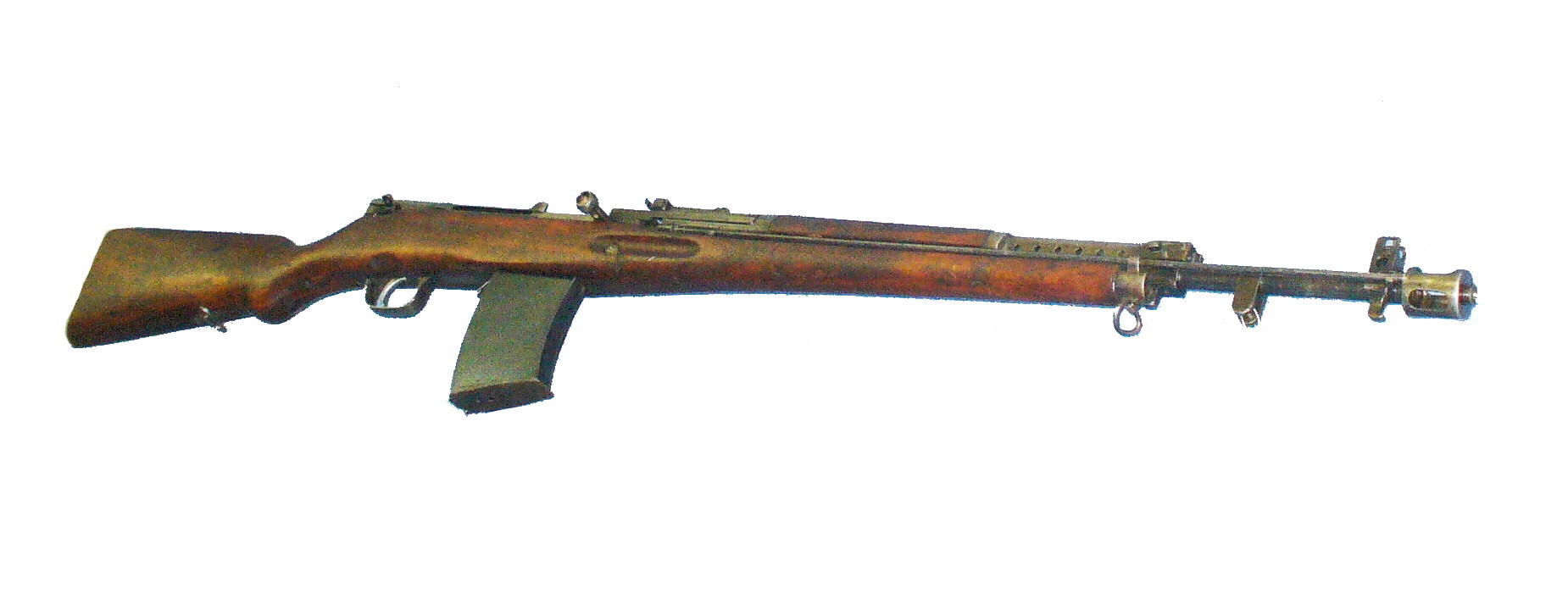
Sergei Gavrilovich Simonov is the designer everybody has heard of without knowing it. His anti-tank rifle is in every Eastern Front photograph; his carbine is in every Cold War parade; and he is remembered as the man who lost to Tokarev and then lost to Kalashnikov. That framing is wrong in an interesting way. The SKS is not a consolation prize — it is the fourth iteration of one continuous idea, and the idea took two decades to get right.
2.1 The AVS-36 and What It Taught Him
Simonov’s first adopted design was the AVS-36, accepted in 1936 as the Red Army’s first select-fire service rifle in 7.62×54R. It had a vertically-sliding locking block, a substantial muzzle brake, and a full-power cartridge on full automatic, which is a combination that flatters nobody.
It was in production for about two years before the Tokarev SVT-38 displaced it. The AVS was complicated where it should have been simple, it was sensitive to dirt, and firing it on automatic was closer to an event than a technique.
What Simonov did next is the interesting part. He did not refine the AVS-36. He replaced its locking system outright.
2.2 The SVS-38 — The Rifle That Lost and Won Anyway
In 1938 he submitted the SVS-38, whose bolt does not slide, rotate, or use a separate locking block. It tilts. The rear of the bolt drops into a shoulder machined in the receiver, and a cam surface on the bolt carrier lifts it back out. One motion, one surface, no separate part.
The SVS-38 was rejected after testing. But the tilting bolt is now the family trait:
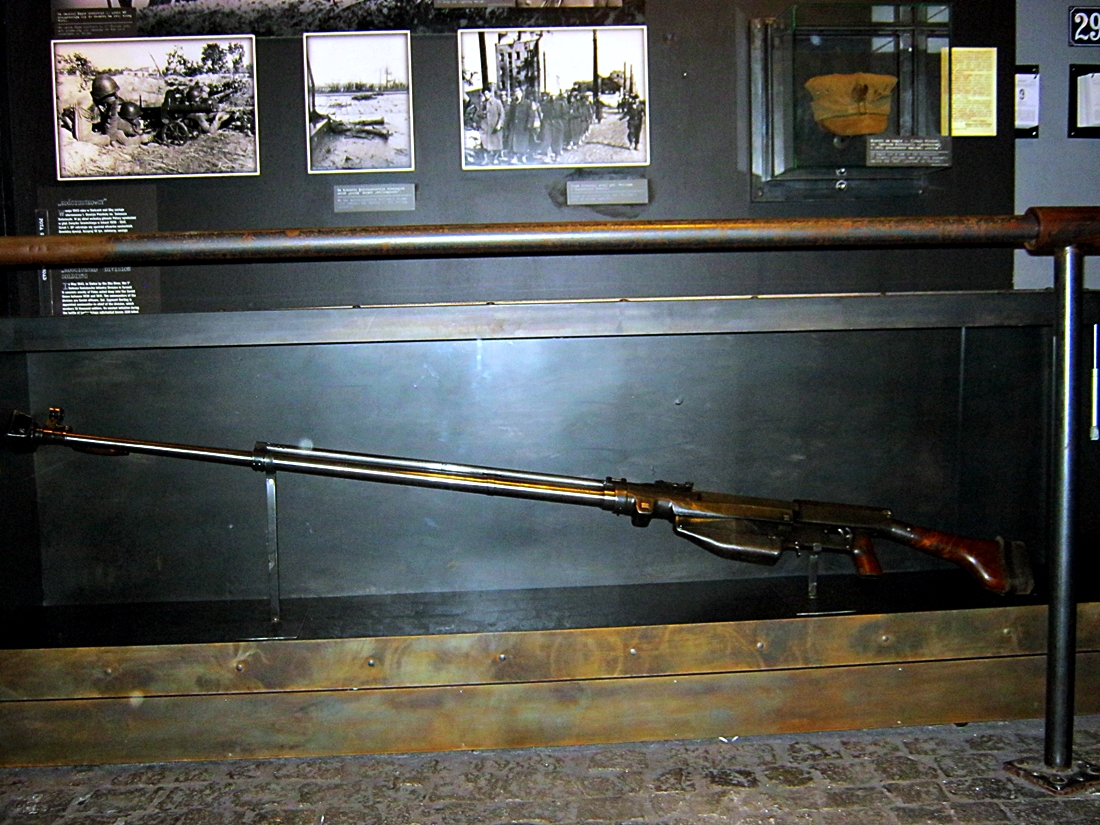
- It went into the PTRS-41 anti-tank rifle, scaled up to 14.5×114 mm, where it worked well enough that thousands were built and used.
- It went into his 1940–41 self-loading carbine, which is where this story really starts.
- It went into the SKS.
You will very often read that the SKS is “the PTRS-41 scaled down.” That is a reasonable description of the mechanism and a poor description of the chronology. The carbine came first as a design; the anti-tank rifle was the enlargement of it, done under wartime urgency. When the carbine came back after the war it was returning to its own size, not being shrunk from something else.
2.3 The 1940–41 Carbine, and the SKS-41
By 1940 Simonov was working on a self-loading carbine with a fixed magazine, derived directly from the SVS-38. Prototypes existed with five- and ten-round magazines, all charged from stripper clips, and the earliest of them were chambered in the cartridges the Soviet Union actually had: 7.62×54R, and reportedly 7.62×25 Tokarev in at least one experiment.
On 1 July 1941 the Artillery Committee evaluated it and designated it the SKS-41. The evaluation praised two things specifically: its light weight, and the fixed magazine.
That second point deserves a moment, because it reads oddly now. A fixed magazine is a limitation to modern eyes. In 1941 it was a feature, and a considered one:
- It cannot be lost, and a rifleman who loses his magazine has lost his rifle.
- It cannot be dropped in mud and then reinserted full of grit.
- It does not need a supply chain of its own, and it does not need a pouch designed around it.
- Stripper clips are cheap, light, and had been the Russian infantry’s loading method for forty years.
The German invasion of June 1941 ended the programme before it could go into production, and Simonov’s design work turned to the anti-tank rifle instead.
2.4 The 1944 Wartime Carbine in 7.62×54R
There is a second, easily-confused rifle in this lineage. In 1944 a trial batch of Simonov carbines chambered in the full-power 7.62×54R cartridge was issued for troop trials.
They were not liked. The reported complaints were heavy recoil, enormous muzzle blast, and insufficient reliability — which is exactly the AVS-36’s report card again, and for the same reason: it is a light self-loader firing a rimmed full-power rifle cartridge.
That rifle is a dead end. But it matters here because it is frequently confused with the intermediate-cartridge trial that ran alongside it, and the confusion is where the “SKS fought in the Second World War” story comes from. Vol 4 untangles it.
2.5 The Thing That Changed Everything
What made the design finally work was not a change to the rifle. It was a change to the cartridge.
In December 1943 the Soviet Union adopted an intermediate round, and every problem Simonov had been fighting since 1936 — recoil, blast, mass, complexity, reliability under automatic or rapid fire — got smaller in proportion. He did not need a locking block that could hold 55,000 psi behind a 150-grain bullet at 2,800 fps. He needed one that could hold an intermediate round, and he already had one that held 14.5 mm anti-tank.
The changes he made to fit the new cartridge were, in the sources’ phrasing, modest: the bore, the locking dimensions and the cycle dimensions were adjusted, some components were reduced in size, the muzzle brake was deleted, and the detachable bayonet became a folding one.
Deleting the muzzle brake is the whole story in one detail. The AVS-36 needed a brake. The SKS did not.
2.6 The Shape of a Career
Table 1 — 2.6 The Shape of a Career
| Year | Design | Cartridge | Outcome |
|---|---|---|---|
| 1936 | AVS-36 | 7.62×54R | Adopted; replaced by SVT-38 within two years |
| 1938 | SVS-38 | 7.62×54R | Rejected — but introduces the tilting bolt |
| 1940–41 | Self-loading carbine (SKS-41) | 7.62×54R and others | Approved for small-scale production; stopped by the invasion |
| 1941 | PTRS-41 | 14.5×114 | Adopted; the tilting bolt proved at scale |
| 1944 | Trial carbine | 7.62×54R | Troop trials; disliked — recoil, blast, reliability |
| 1944–45 | SKS-45 | 7.62×41 M43 | Trials; becomes the rifle |
| 1949 | SKS | 7.62×39 M43 | Adopted |
Read down that table and the SKS stops looking like a rifle that was designed and starts looking like one that was arrived at. Every element of it had already failed somewhere else in a form that was slightly too ambitious. The SKS is what is left when a designer has been beaten enough times to stop adding things.
2.7 A Note on the Name
The rifle is Samozaryadnyy Karabin sistemy Simonova — self-loading carbine, Simonov system. Note samozaryadnyy, self-loading.
The 1955 CIA report quoted in Vol 5 renders it skorostrelnyy karabin Simonova — rapid-firing carbine — because that is what the source heard in a classroom and wrote down. It is a small error and a revealing one: the Soviet conscript being read a manual cover to cover was not being taught the distinction, and the Western analyst had no way to check it. It sits next to a much larger error in the same family of documents, which is that in 1953 the Agency believed the thing could fire on full automatic.
Comments (0)