The SKS · Volume 12
Slam Fires and the Free-Floating Firing Pin
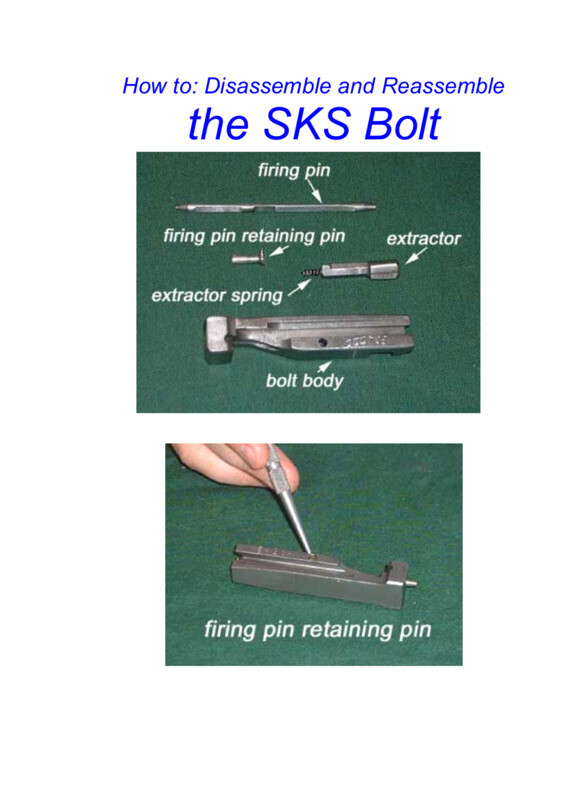
Slam fire is the one genuine safety issue the SKS has. It is real, it is well documented, it is entirely preventable, and it is also considerably over-dramatised on the internet. This volume tries to say exactly what it is, exactly what causes it, and exactly what to do — including being honest that the most commonly recommended fix is contested.
12.1 The Mechanism
The SKS firing pin floats. There is no spring behind it and nothing holds it rearward. It sits in a channel bored through the bolt, free to slide.
When the bolt carrier drives the bolt forward and the bolt stops against the barrel, the firing pin — which has mass and was moving — keeps going for a moment and taps the primer of the chambered round. Every free-floating firing pin design does this. The Garand does it, the AR-15 does it, the AK does it.
It is harmless provided two things are true:
- The pin is free to bounce back.
- The energy of that inertial tap is below what it takes to fire the primer.
The SKS was designed around hard-cupped military primers, and a clean pin in a clean channel bounces. The system has a margin and it works.
A slam fire happens when the pin cannot bounce. If the pin is held forward — stuck in its channel — the tip protrudes from the bolt face permanently. The round is then fired by the bolt closing on it, with no trigger involvement at all, and potentially before the bolt has fully locked.
That last clause is why this matters. A round fired out of battery in a tilting-bolt action has nothing behind it, and it can vent gas and brass rearward into the shooter’s face.
12.2 What Holds a Pin Forward
Cosmoline, overwhelmingly. Surplus SKSs were packed in heavy preservative — the 1955 CIA source watched them come out of wooden crates ten at a time “covered with heavy cosmolene” — and then they sat for anywhere from thirty to seventy years. Cosmoline that has aged in a blind hole is not grease any more. It is varnish.
A field strip does not reach the firing-pin channel. The bolt has to come apart (Vol 11 § 11.2). A rifle that has never had its bolt stripped since import has a firing-pin channel full of something, and you do not know what.
Fouling plus oil. The second cause is self-inflicted: people oil the firing-pin channel, because oiling things is what you do to guns. Oil in that channel collects carbon and unburnt powder and turns into a paste that does the same job cosmoline does, just more slowly.
Wrong pin orientation. The pin’s cross-section is triangular and it will enter the bolt three ways. Only one — notches up — is correct. Installed either of the other two ways, it binds.
Soft primers. This is a contributing factor rather than a cause. Commercial ammunition, and especially handloads assembled with standard small or large rifle primers, has softer primer cups than the military ammunition the rifle was designed for. A softer cup lowers the threshold, so a pin that is merely sluggish rather than fully stuck can become a problem. Slam fires are meaningfully less likely with hard military-spec primers.
12.3 The Fix
Clean the channel, and leave it dry.
That is the whole answer for the overwhelming majority of rifles. Vol 11 § 11.2 covers the method: boiling water or an aerosol solvent, repeated until what comes out is clear, then dried, then not oiled.
And then the test, which takes two seconds and should be done every single time the rifle is cleaned:
Shake the bolt. The firing pin must rattle, freely, in both directions.
If it does not rattle, the rifle is not safe to load. That is not a maybe.
12.4 The Sprung Firing Pin — And Why It Is Contested
Aftermarket spring-loaded firing pins are sold for the SKS. The best-known come from Murray’s Gunsmithing, a Texas shop that has been doing SKS work for a long time. The pin has a return spring behind it that positively retracts the tip after a strike.
There is a genuinely strong argument for them, and it is historical: the Soviets did it first. Original Soviet production from 1949 to about 1950 had a spring-loaded firing pin from the factory. The design was changed to free-floating around 1951.
Read that the right way round. The sprung pin was not an improvement somebody thought of later — it was the original, and it was deleted as a production simplification. Whatever else is true, the free-floating pin is the cheaper answer, not the better one.
The argument against fitting one is also real, and it is this: a spring behind the pin means the hammer’s energy now has to overcome that spring as well as fire the primer. On hard military surplus primers — exactly the ammunition most people feed these rifles — that can produce light strikes and failures to fire. You have traded an intermittent safety problem caused by poor maintenance for an intermittent reliability problem caused by the part itself.
There is a school of thought that says the whole slam-fire concern is overstated and an enhanced pin is a solution looking for a problem; there is another that says a five-dollar spring is cheap insurance on a seventy-year-old rifle of unknown history. Both are defensible.
The recommendation: clean the channel first, always, and shake the bolt every time. If after that you still want a sprung pin, fit it — but test it with the ammunition you actually shoot, twenty rounds at a time, and be alert for light strikes. Do not fit one instead of cleaning the channel, because a spring pushing against varnish is still a stuck pin.
12.5 What the Safety Does Not Do
The SKS safety is a trigger block. Vol 9 § 9.3 and Vol 11 § 11.3.
A slam fire does not involve the trigger. The safety therefore provides no protection against it whatsoever. A rifle with a stuck firing pin will slam fire with the safety on.
The only controls that matter here are muzzle discipline and a clean firing-pin channel.
12.6 Practical Rules
- Strip the bolt before the first firing of any SKS you have just acquired. Not the first cleaning — the first firing. You do not know what is in there.
- Shake the bolt at every cleaning. Rattle, or it does not get loaded.
- Leave the firing-pin channel dry. Oil the outside of the bolt; not the inside.
- Firing pin goes in notches up. Every time, no exceptions.
- Load with the muzzle in a safe direction and expect the rifle to fire as the bolt closes. This is just how you should chamber a round in any rifle, and on this one it has a specific reason.
- If it doubles, or fires as the bolt closes, stop. Do not finish the string, do not “see if it does it again.” Unload and strip the bolt.
- Hard military primers reduce the risk. They are not a substitute for a clean channel.
- A rifle with a mismatched bolt is a headspace question first and a slam-fire question second. The hub’s headspace dive covers how to answer the first one.
12.7 The Thing Nobody Says Out Loud
The reason slam fires became an SKS story rather than a general story is entirely about how these rifles reached American hands. Millions of them arrived between 1988 and 1998, packed in preservative, at prices that meant many buyers had never owned a centrefire rifle before and had no reason to suspect that a rifle needed to be taken apart further than the manual showed.
The design is not defective. It is a seventy-year-old military design that assumed an armourer, a weekly cleaning parade, and hard-primed ammunition — three things the 1955 CIA source describes in some detail, right down to the daily cleaning being compulsory for a week after firing.
Give it those three things and it is fine. Take a crated rifle straight to the range with a box of soft-primed commercial ammunition and it may not be.
Comments (0)