The SKS · Volume 3
The Cartridge — 7.62×41, Then 7.62×39
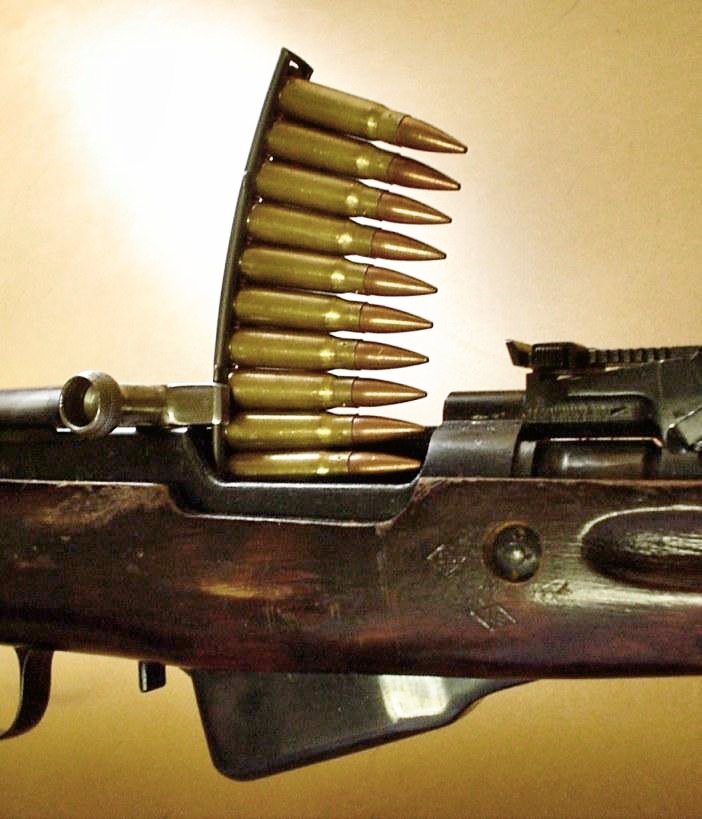
Everybody knows the SKS is chambered in 7.62×39. Rather fewer people know that the cartridge it was designed around had a 41 mm case, that the change to 39 mm happened after the rifle had already been through troop trials, and that the two rounds are different enough that the trial rifles of 1944 will not chamber the ammunition sold today.
That is not a footnote. It is the reason the adoption date is 1949 and not 1945.
3.1 Why an Intermediate Cartridge At All
The Soviet Army entered the war with 7.62×54R, a rimmed full-power rifle cartridge designed in 1891, and left it with the same round. Everything Simonov had built up to that point had been fighting it. So had Tokarev. A self-loading rifle in a full-power cartridge is heavy, it recoils hard, it needs a brake, it needs a strong lock and therefore a complicated one, and if you let it fire automatically the results are not useful past very short range.
The counter-example was in German hands: an intermediate round, shorter and less powerful than a rifle cartridge but far more capable than a pistol cartridge, in a rifle that could fire bursts a soldier could actually hold on target. The Soviet response was commissioned in 1943.
3.2 The M43, Version One — 7.62×41
Work went to NII-44, the Scientific Research Institute No. 44, under the People’s Commissariat of Armament. The two engineers whose names are attached to it are Nikolay M. Elizarov and Boris V. Semin.
The first variant passed range trials and was adopted for service in December 1943, with the GAU index 57-N-231 and the service designation M43.
That cartridge had:
- A case 41 mm long — hence the retrospective name 7.62×41.
- A bullet 22.8 mm long, with an all-lead core.
- No boat tail.
- A short, blunt ogive: maximum diameter reached only 13.01 mm from the tip, which is why period photographs of it look stubby against a modern round.
If you look closely at the 1953 CIA sketch reproduced in Vol 5, the source drew the new cartridge alongside a Tokarev pistol round and gave the new one an overall length of 46 mm with a 33 mm case — figures that do not match either version exactly, because he was drawing from memory. But he drew the shape right, and he noted the thing that mattered: “the top of the projectile was more pointed” than the pistol round, and it fed both the new carbine and the new submachine gun.
3.3 The Shortening, 1947–48
Between 1947 and 1948 the cartridge was reworked:
- The case was shortened from 41 mm to 39 mm.
- The bullet became slightly longer, and gained a boat tail.
- The core changed from lead to low-carbon steel wrapped in lead.
Three separate motives are visible in that list. The shorter case packages better in a curved magazine, which matters enormously for the AK and not at all for the SKS. The boat tail improves retained velocity downrange. And the steel core saves lead, which in 1947 was a serious consideration for a country planning to make this round by the billion.
3.4 The Consequence Nobody Mentions
Put the dates together:
Table 1 — Put the dates together
| Date | Rifle | Cartridge |
|---|---|---|
| May 1944 | SKS trial batch, about 50 built | 7.62×41 |
| 1946–47 | TOZ trials batch, 1,000+ | 7.62×41 |
| 1947–48 | — | case shortened to 7.62×39 |
| 1949 | SKS adopted | 7.62×39 |
The rifles that went to the front for trials in 1944, and the thousand-plus rifles built at Tula in 1946 and 1947 for extended field trials, were chambered for a cartridge that no longer exists in service. They are not simply early SKSs — they are early SKSs in a different chambering.
This also explains a gap that otherwise looks like bureaucratic sloth. The design was essentially finished in 1945. It was adopted in 1949. Four years is a long time for a rifle that works, and the answer is that for two of those years the ammunition was being redesigned underneath it, and there was no point standardising a rifle around a cartridge that was about to change.
3.5 What the Round Does
Fired from the SKS’s 521 mm (20.5 in) barrel, the service load leaves at 735 m/s, about 2,410 ft/s. That is a slightly higher figure than the same cartridge produces from an AK’s 415 mm barrel, and it is one of the two honest advantages the SKS retains over the rifle that replaced it. The other is the sight radius.
The Soviet manual, as reported by the source in the 1955 CIA document, claimed a maximum range of 2,000 m and stated that “at 1,500 m the bullet still had sufficient velocity to penetrate a human body.” Maximum effective range was given as 365 m, which the source equated with the “П” battle setting on the rear sight.
Two notes on that. First, the П setting — postoyannyy, “permanent” — is a 300 m battle zero, not 365; the source appears to have carried away a converted figure of 400 yards. Second, the same document records the manual’s muzzle velocity as 500 m/s, which is low by about a third and is simply wrong. Vol 5 deals with what that reveals about the intelligence picture.
3.6 The Rear Sight, Read Properly
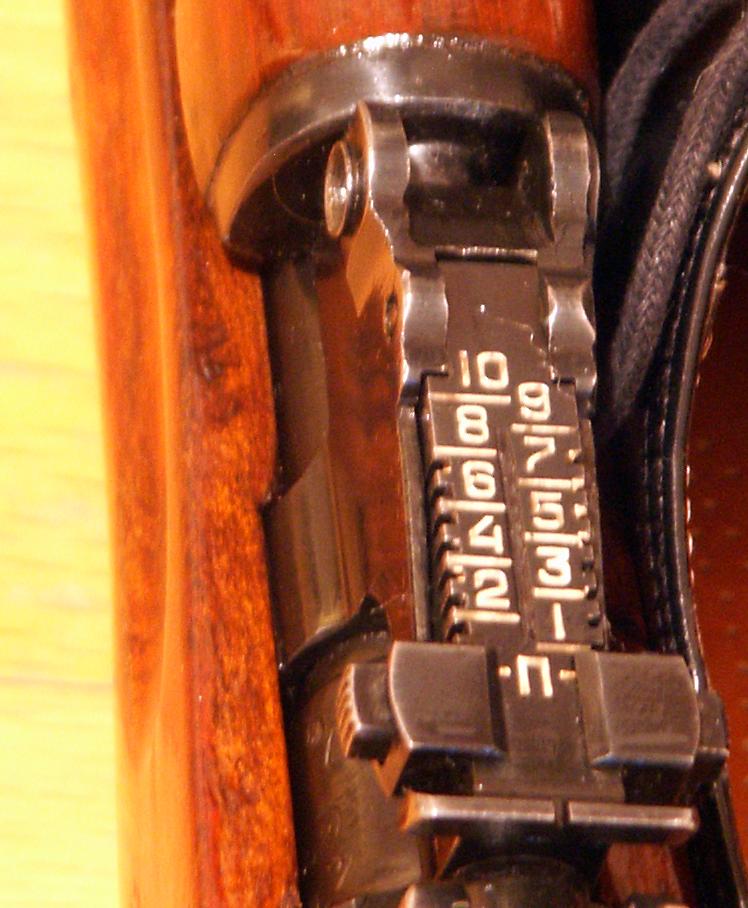
The sight ladder is graduated П, 1, 2, 3 … 10. Each numeral is that many hundred metres. “П” is the battle setting: put it there, hold centre mass, and inside about 300 m you do not think about elevation.
There is no windage adjustment on the rear sight at all. Windage is set at the front, by drifting the front sight post in its base — which is why the 1955 report describes the company armourer arriving with “a special vise-like tool” whenever a conscript’s rifle would not group where he was looking. That tool is a front sight pusher, and it is still the correct answer today. Vol 16 covers zeroing.
3.7 Ammunition Today, Briefly
Vol 16 goes into what to feed one. Two things belong here because they are cartridge facts rather than rifle facts:
Surplus military ammunition is frequently corrosive, because the primers use potassium chlorate. It shoots fine and it will rust a bore overnight if you do not clean with water or a water-based solvent afterwards. The chrome lining on most SKS barrels buys you time, not immunity, and the Yugoslav M59 and M59/66 barrels are not chrome-lined at all — which is exactly the combination that has ruined a lot of otherwise excellent rifles.
Steel-cased commercial ammunition is what this rifle was designed around and it works. The lacquered and polymer-coated cases people worry about are closer to the original specification than brass is.
Comments (0)