The SKS · Volume 15
Magazines, Triggers and the Rest of the Aftermarket
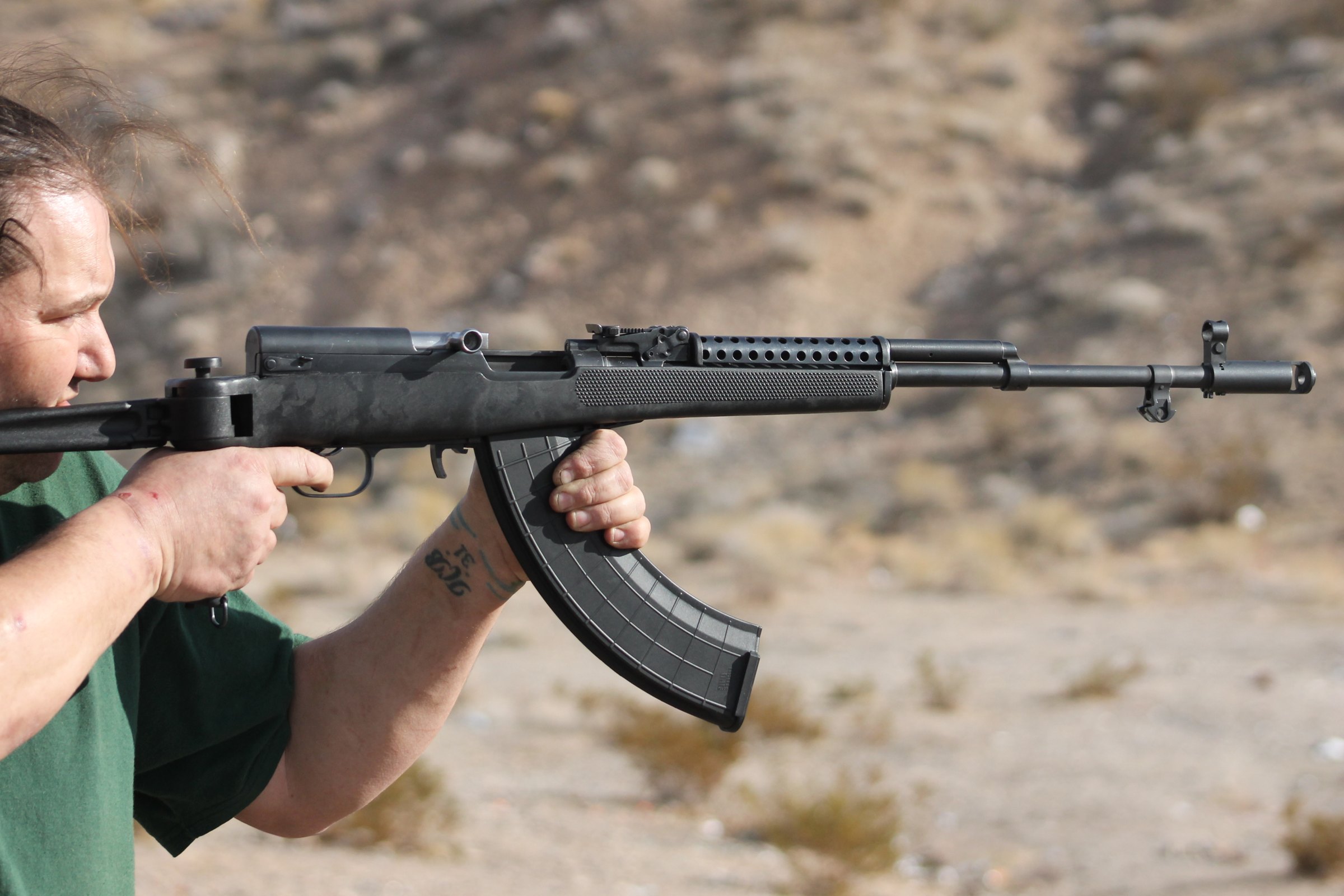
Beyond furniture and optics, the SKS aftermarket has three things worth discussing and a lot of things that are not. The three are detachable magazines, the trigger, and the small parts that actually improve reliability.
Detachable magazines get the most space here because they cause the most trouble.
15.1 The Detachable Magazine Problem
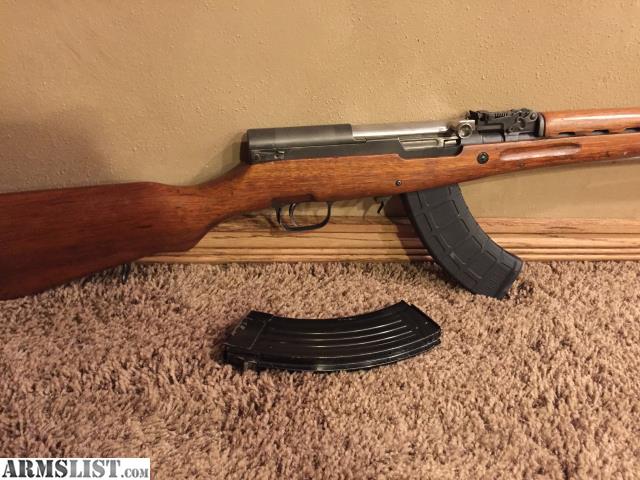
The SKS was designed around a fixed ten-round box charged from stripper clips. Vol 9 § 9.4. Everything about the feed geometry follows from that: the magazine is a fixed structural part of the rifle, its rear is captured by the trigger group, and its follower carries the stud that holds the bolt open.
An aftermarket detachable magazine has to reproduce all of that from a part that clips in and out. Most do it badly, and the failure modes are consistent:
Rock-in fitment. Most SKS detachable magazines rock in at the front and latch at the rear, AK-style, into a well that was never designed as one. The result is a magazine whose position varies from insertion to insertion, and feed geometry that varies with it.
Feed-lip stack. A tall magazine puts more spring pressure and more rounds bearing against the feed lips. The consensus among people who shoot these — and it is consistent enough to treat as a rule — is that a 20-round magazine feeds more reliably than a 30 or 35, for exactly that reason.
The bolt hold-open goes away. The stud is on the factory follower. An aftermarket magazine’s follower usually does not have it, so the rifle stops locking open on empty. Some people do not care. It is worth knowing you are giving it up.
The magazine catch. Converting usually means either replacing the trigger group with one that has a different catch arrangement, or living with the factory catch engaging something it was not shaped for.
15.1.1 What actually works
ProMag Archangel LVX, 35 rounds — around $52. A lever release, engineered specifically around the factory SKS magazine catch area rather than adapted from an AK pattern. The best-regarded of the current options.
ProMag 20-round — around $28. Lower capacity, and better behaved for it. US-made body, which matters for the parts count in Vol 17. May need hand-fitting.
Duckbill-style magazines — the old, cheap, ubiquitous ones. These are where the platform’s reputation for terrible magazines came from. Some individual examples work fine. Buying them by the brand is a lottery.
15.1.2 The factory answer
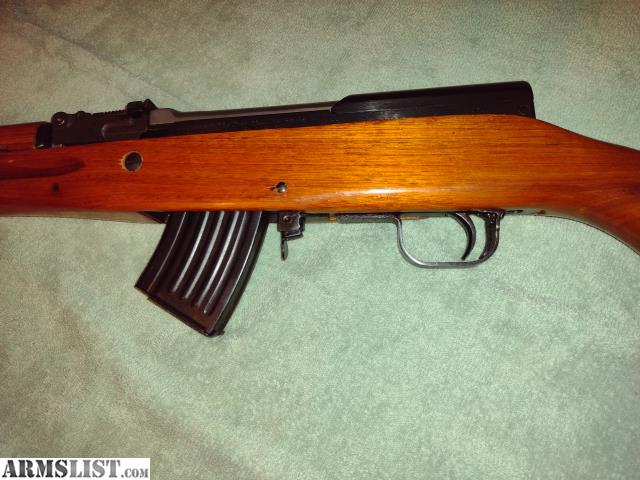
There is a rifle that feeds AK magazines properly, and China built it: the Type 56 Model D and the Model M, described in Vol 7 § 7.6. Those rifles have a magazine well and feed geometry designed for Kalashnikov magazines from the start.
If detachable magazines are what you want from an SKS, buying an SKS-D or SKS-M is a better answer than converting a standard rifle, and it is frequently cheaper once you have bought three brands of magazine trying to find one that runs.
15.1.3 And the legal note, which is not optional
Adding a detachable magazine to an imported SKS is the textbook trigger for the imported-parts count under federal law, and adding a pistol-grip stock at the same time — which most people do — makes it worse. This is not a footnote; it is the reason US-made magazine bodies, followers, floorplates, stocks and trigger groups are marketed the way they are. Vol 17 § 17.2.
15.2 The Trigger
The military SKS trigger is heavy, long, and gritty, and it is not a defect. It is a conscript rifle’s trigger, built to work with cold hands and gloves and to survive being dropped.
There are two legitimate routes to improving it.
Clean and de-burr. Free, and it does more than people expect. Strip the group (Vol 11 § 11.3), get seventy years of hardened grease out of it, and lightly stone the obvious burrs on the sear engagement surfaces — lightly, and only the burrs. Do not change the angles. Reassemble and function check, including the disconnector check in Vol 10 § 10.11.
Reduced-power springs. Murray’s sell a Wolff hammer and sear spring kit — around 27.5 lb, about $13. They also make flat-faced trigger components, which change the feel more than the weight by moving the finger’s contact point.
⚠ The caution is real and it is specific. A lighter hammer spring means less energy delivered to the primer. On hard military surplus primers — the ammunition most people feed these rifles — that produces light strikes and failures to fire. It is the same trade as the sprung firing pin in Vol 12 § 12.4, from the other direction.
If you fit reduced springs, test with the ammunition you actually shoot, and be prepared to put the factory springs back.
What not to do: do not attempt to reduce sear engagement to lighten the pull. The SKS’s sear and disconnector relationship is what enforces semi-automatic fire. Getting that wrong produces a rifle that doubles, which is both dangerous and — if a court decides it fires more than one round per trigger pull — a serious legal problem regardless of intent.
15.3 Small Parts That Are Worth Buying
Table 1 — 15.3 Small Parts That Are Worth Buying
| Part | Why | Roughly |
|---|---|---|
| Recoil spring | Seventy-year-old springs take a set. A weak-cycling rifle with a clean gas system usually wants one of these before anything else | Cheap |
| Extractor and spring | Failures to extract that survive a clean chamber | Cheap |
| Upper handguard | Almost every original is cracked | Cheap |
| Firing pin | Only for a chipped tip, or a deliberate move to a sprung pin — read Vol 12 first | Modest |
| Magazine follower | Restores the bolt hold-open after a conversion is reversed | Cheap |
| Gas piston | Mushroomed face only. Do not dress the original | Modest |
| Front sight tool | Because the rear sight has no windage, this is how you zero the rifle at all | Modest, and mandatory |
That last row is the one people skip and should not. You cannot zero an SKS for windage without a front sight pusher, unless you are prepared to drift a soft sight base with a punch.
15.4 Recoil, and the Slip-On Pad
The SKS does not recoil hard, but the military buttplate is a steel plate on a short stock and it is unpleasant over a long string.
A Pachmayr Decelerator slip-on pad, about $26, needs no gunsmithing and adds roughly an inch of length of pull — which on a stock that was cut short for a man in a greatcoat is usually an improvement rather than a cost. It goes on a wood stock; most synthetic stocks come with a pad already.
15.5 Muzzle Devices — Mostly Don’t
Most Chinese and Russian SKS barrels are not threaded. Fitting a muzzle device therefore means having the muzzle threaded, which means a lathe, a competent gunsmith, and a fresh crown.
Three reasons to think hard before doing it:
- There is very little to gain. A 7.62×39 carbine does not need a brake, and this one already weighs 8.5 pounds.
- A bad crown will cost you more accuracy than any brake will give you back.
- A threaded barrel is a feature that interacts with the imported-parts rule. Vol 17.
The Yugoslav rifles are the exception in a way that is not useful: their muzzle already carries a 22 mm grenade spigot, which is not a thread and not a brake.
If the goal is a suppressor, the hub’s suppressor dives are the place to start, and the short version is that 7.62×39 is a supersonic cartridge in a rifle with no gas adjustment, so the result is quieter but not quiet.
15.6 The Chest Rig, Which Is Genuinely Good
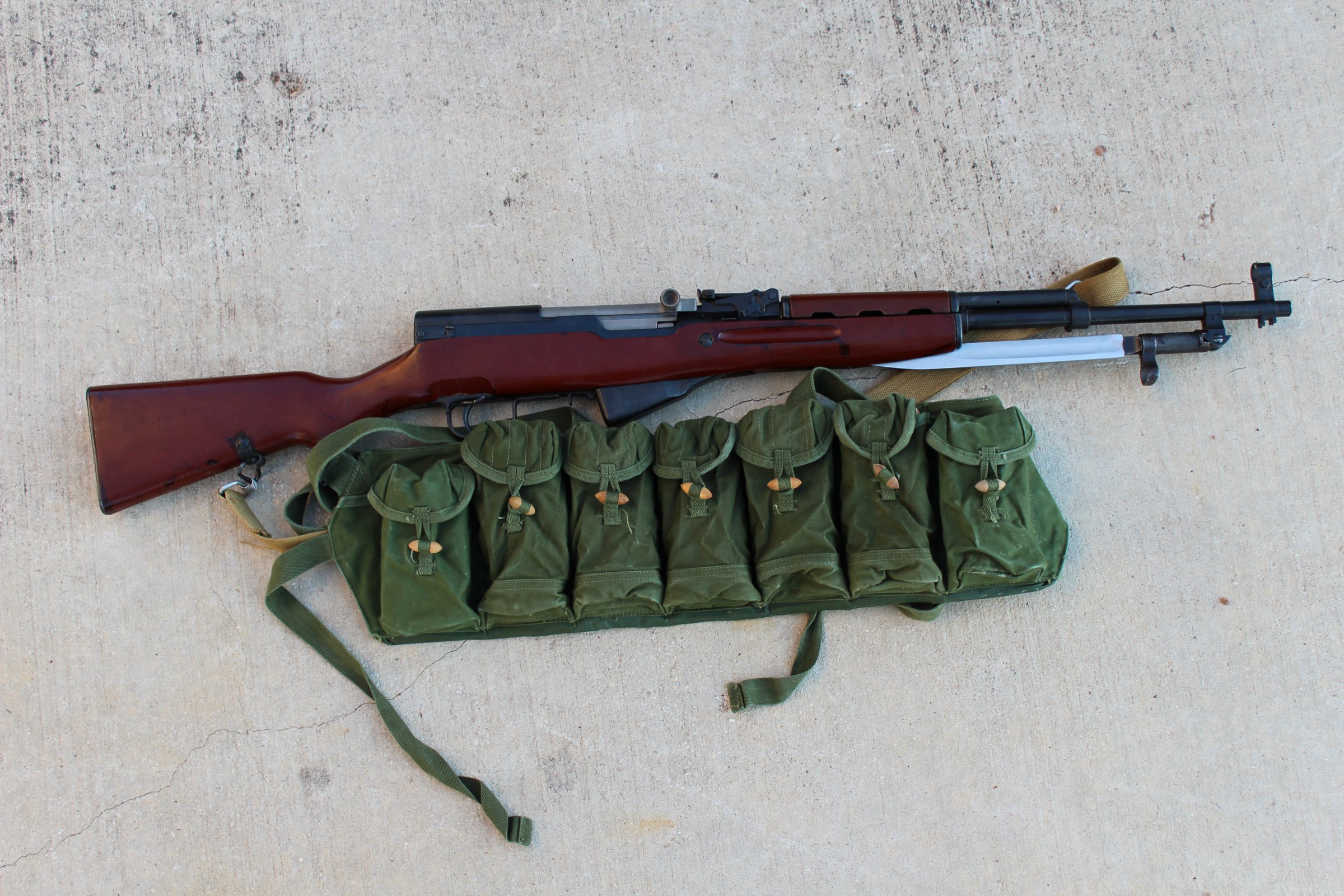
Worth a paragraph because it is cheap, still available, and better than most modern equivalents for this specific job.
The Chinese chest rig holds ten stripper clips across the front, with small pockets at the ends for a cleaning kit and an oil bottle. That is 100 rounds — exactly the basic combat load the 1955 CIA report records for the Soviet system, which carried three pouches of three clips each plus a loaded rifle.
For a rifle that loads from clips, a rig designed around clips is not nostalgia, it is the right tool. A modern magazine carrier does nothing for you here.
15.7 Modifications Not Worth Making
Cutting the barrel. Turns a $400 rifle into a $250 rifle and — below 16 inches — into a federal felony without paperwork. Genuine short Chinese variants exist; making your own is a bad trade in every dimension.
Welding on a side rail. Welding on a receiver, on a rifle whose value is largely in being original.
Removing the bayonet on a matching-numbers Russian rifle. Vol 13 § 13.8.
Anything that changes the disconnector. Vol 15 § 15.2.
A dust-cover scope mount. Vol 14 § 14.1. It is the cheapest thing in the catalogue and it is the reason people believe this rifle cannot be scoped.
Comments (0)