M1 Garand · Volume 6
Reading an M1 — Markings, Drawing Numbers and Dating
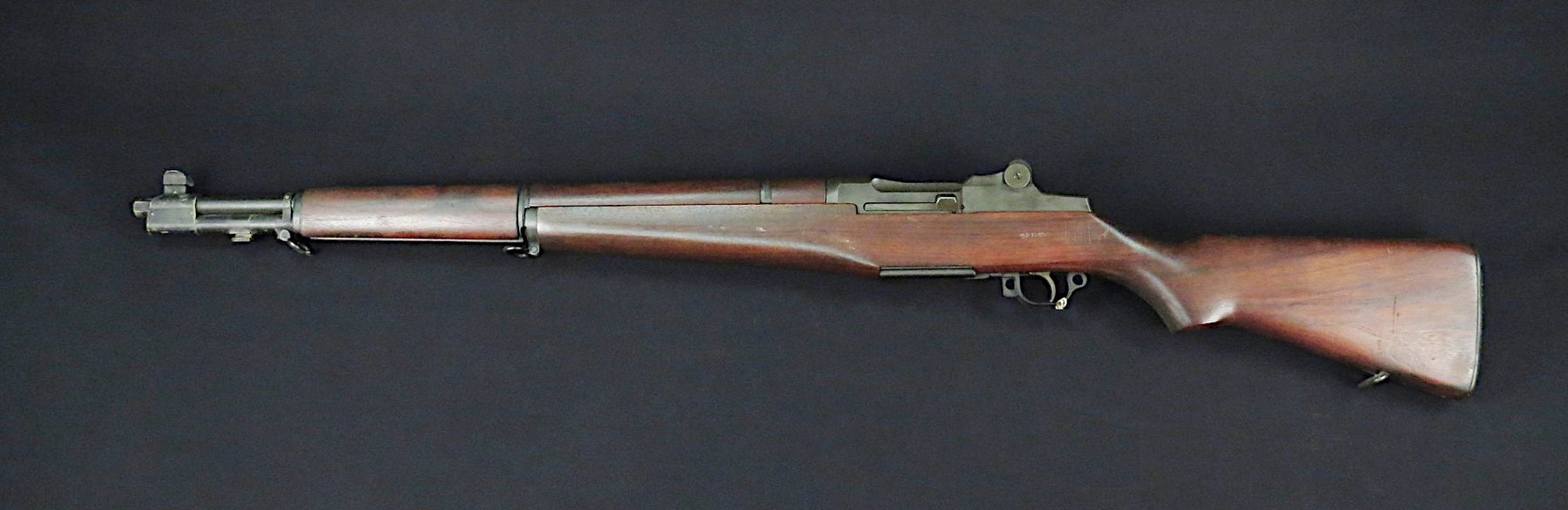
An M1 tells you a great deal about itself if you know where to look. The receiver says who made it and roughly when. Most of the major parts carry a drawing number — the number of the engineering drawing the part was made to — with a revision suffix and a maker’s code, and those revisions changed often enough during the war that they can date a part to a period of months. The stock carries inspectors’ stamps. Rebuilders left their own marks.
This volume is the method. It is the same method applied to Springfield 2450021 in Vol 7, and it is what you need before believing anything a seller tells you about an M1.
6.1 Start at the Heel
The receiver heel — the rear of the receiver, behind the rear sight — is stamped with the rifle’s designation, the maker’s name, and the serial number. It is the rifle’s identity.
- The maker’s name is the fact that matters. Springfield Armory, Winchester, International Harvester and Harrington & Richardson all stamped their names. A number alone does not identify a maker, because in places the makers’ numbers overlap (Vol 3).
- Look for anything after or under the number. An “A” suffix was the Army’s mark on one rifle of a discovered duplicate pair.
- Look at the crispness. Heavy pitting or a sandblasted look usually means an arsenal refinish at some point in the rifle’s life.
With the maker and number, Springfield Armory National Historic Site’s monthly table gives the month of manufacture. The Park Service will give you the year and sometimes the month for a Springfield serial, and nothing more; there are no individual history records for M1s.
6.2 The Receiver’s Right Leg
With the stock off, the right front leg of the receiver carries the receiver drawing number and revision, and the heat lot — a code identifying the batch of steel.
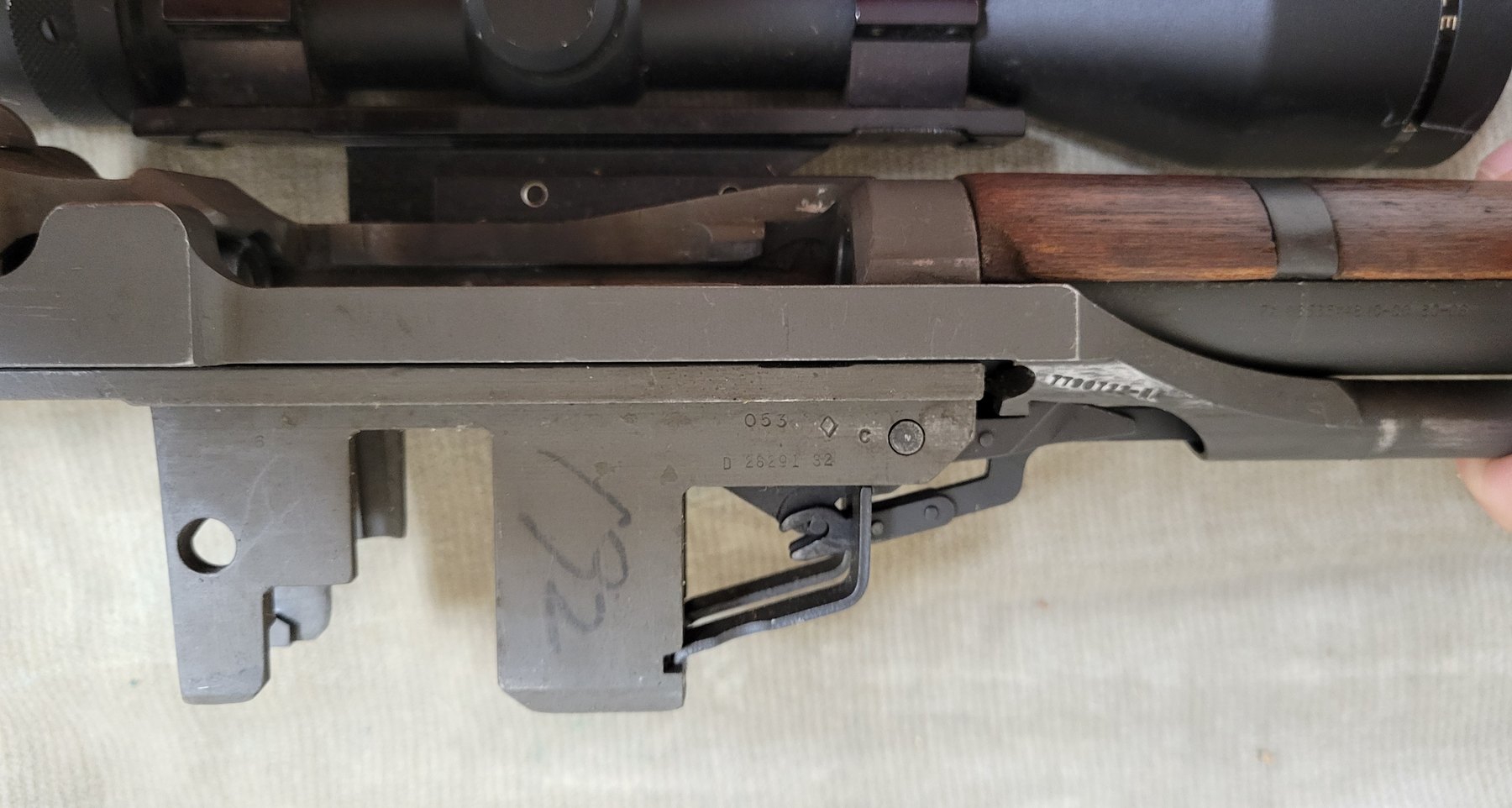
- The receiver drawing is D28291. Revisions climbed through the war; forum surveys associate -32 with Springfield serials in roughly the 2.3 to 2.85 million range, and -17 only with rifles up to about 1,500,000 (April 1943). Treat revision-to-date tables as collector research, not Ordnance records, and use them as a consistency check rather than proof.
- A diamond in the heat-lot marking is reported to mark 8620 steel, used for Springfield receivers after July 1942.
- Heat lots were how Springfield traced a part back to its steel. They mattered enough that a technical bulletin once ordered all bolts from one heat lot scrapped.
6.3 Drawing Numbers on the Major Parts
The drawing-number system changed after the war. Wartime drawings carry a letter prefix for the drawing size — B, C or D — followed by five digits. Post-war parts carry seven-digit numbers, typically beginning 65 or 77, for the same parts. That single change is often enough to tell a wartime part from a post-war replacement at a glance.
Table 1 — Drawing Numbers on the Major Parts
| Part | Wartime drawing | Post-war drawing | Where to look |
|---|---|---|---|
| Receiver | D28291-xx | — | right front leg |
| Bolt | D28287-xx SA | 6528287-SA (and other makers) | top of the bolt, visible in the receiver |
| Operating rod | D35382 (with revisions) | 7790722 (the final design, often stamped NM) | underside of the handle / tube |
| Trigger housing | D28290-xx-SA | — | side of the housing |
| Hammer | C46008-x SA | 5546008 | face of the hammer |
| Barrel | D35448 | 6535448 | under the rear handguard |
Two dated examples, from a specialist dealer’s listings in September 2026, show how precise the revisions can be — and how careful you have to be with them:
- D28290-12-SA trigger housing: March 1943–May 1944 by one listing, January 1943–August 1944 by another.
- C46008-7 SA hammer: May 1943–August 1944, with a serial range on the same page that does not agree with that start date.
Revision dating is a strong clue and a weak proof.
6.4 Barrels
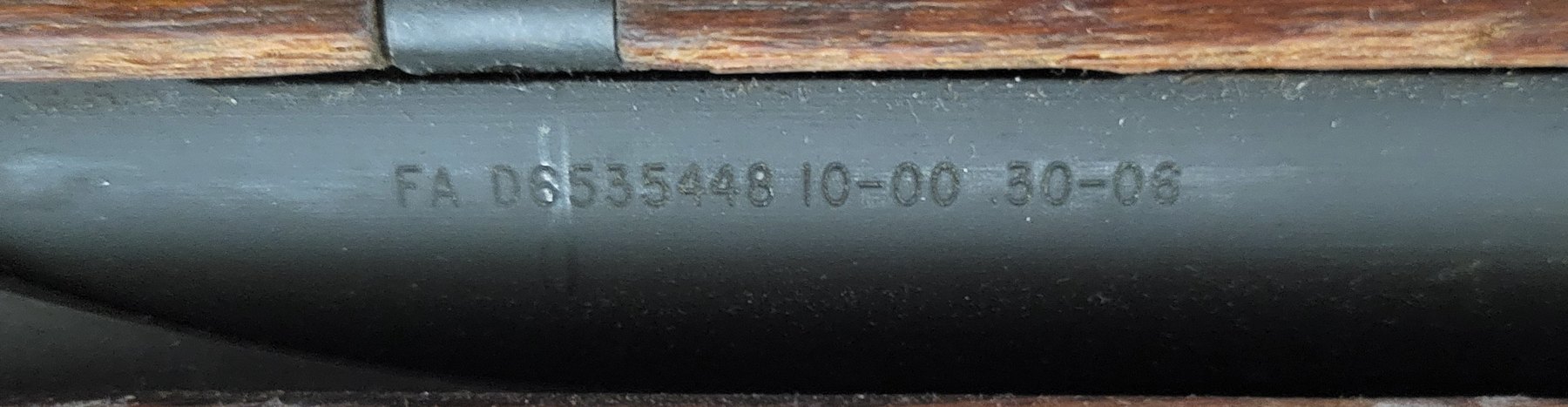
Government barrels are marked on the section under the rear handguard with the maker, the drawing number and a date. You have to remove or slide the handguard to read it, which is one reason sellers skip it.
A barrel is a consumable part, and replaced barrels are common:
- Arsenal replacement barrels made after the war carry later dates and makers.
- Commercial barrels carry commercial markings. The barrel on the rifle documented in Vol 7 reads FA D6535448 10-00 .30-06 — Fulton Armory, made by Criterion, October 2000. No government M1 barrel was ever marked “.30-06.”
6.5 The Stock
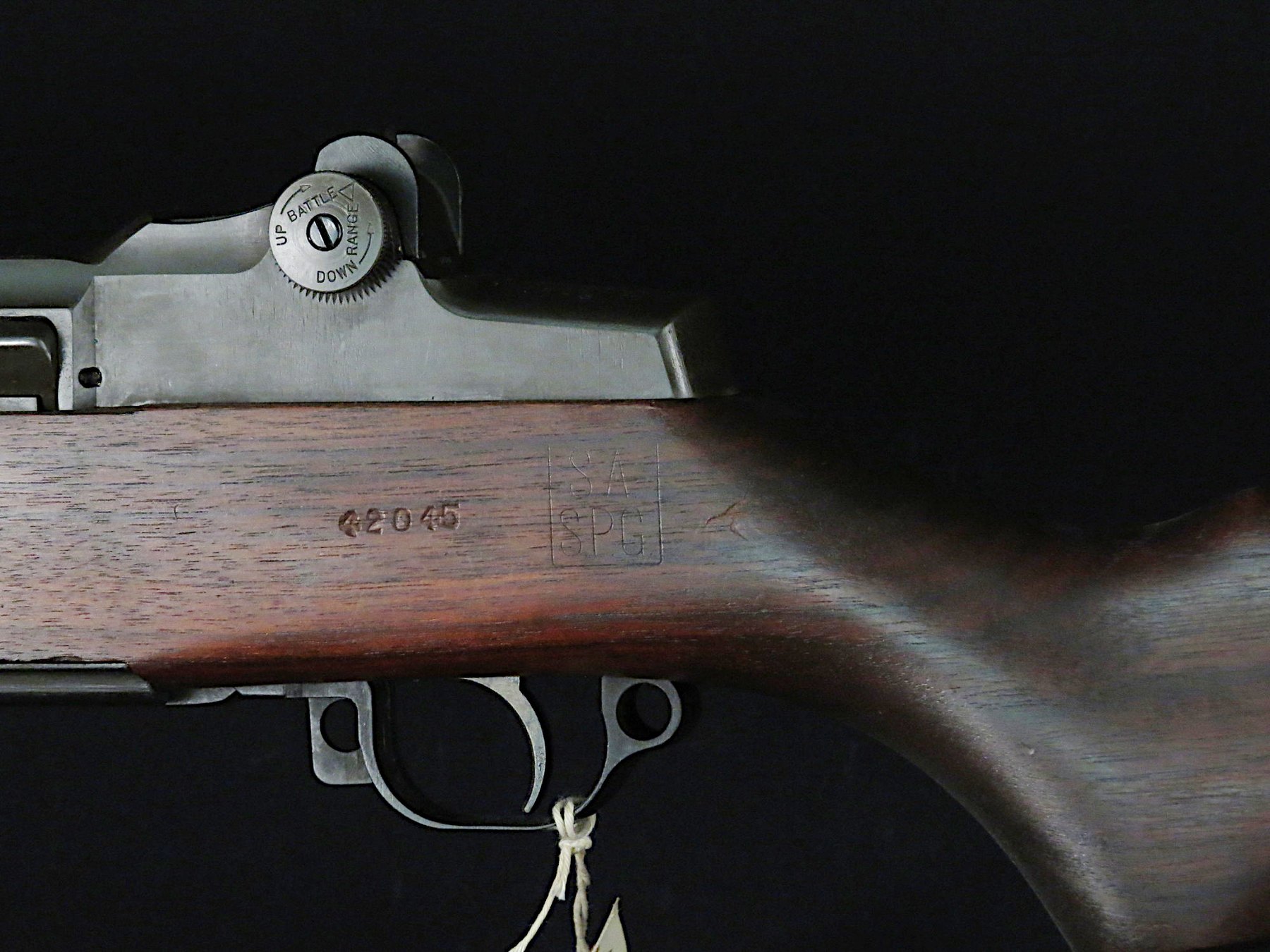
- Cartouches. Stocks were stamped on the left side behind the receiver by the accepting inspector: at Springfield, the inspector’s initials in a box with “SA.” Rebuild facilities added their own cartouches after the war. Vol 4 has the table — SA/SHM, SA/SPG, SA/JLG, RIA/FK, RIA/EB and the depot marks.
- Proof marks. A boxed “P” on the pistol grip is a proof mark; 1960s rebuilds usually carry one.
- No cartouche means the stock has been sanded or replaced. You cannot tell which from the wood alone.
6.6 Rebuild Marks on the Receiver
In the 1960s, depots marked rebuilt rifles with an electric-pen etch on the right receiver leg, usually with the month and year: LEAD (Letterkenny), TE (Tooele), SA (Springfield), RRA or RRAD (Red River). A rifle with one of these went through a full overhaul, and its parts will reflect that.
6.7 Import Marks
Rifles that came back to the United States from foreign military service through commercial importers carry an importer’s stamp, typically small and on the receiver or barrel. Their absence is generally a plus for value. Rifles returned through the Civilian Marksmanship Program from foreign aid, and rifles that never left U.S. service, do not carry them.
6.8 A Checklist
Look over an M1 in this order:
- Heel: maker, serial, any suffix, finish.
- Serial table: the month of manufacture, and for a Springfield or Winchester in an overlap band, the other maker’s month too.
- Receiver leg: drawing number revision and heat lot — consistent with the serial?
- Bolt: wartime D28287 or post-war 65-series?
- Operating rod: wartime, or a cut post-war rod; 7790722, NM stamp?
- Trigger housing and hammer: maker and revision.
- Barrel: slide the handguard — maker, drawing, date.
- Stock: cartouche, proof, sanding.
- Receiver walls: any holes (Vol 7, Vol 16).
- Import stamp.
Every line either agrees with the heel or it does not. Correct rifles are ones where they all agree.
6.9 A Naming Trap
Springfield Armory, Inc. — the commercial company in Geneseo, Illinois — is not the Springfield Armory that made M1s for the government, which closed in 1968. Its early history includes assembling rifles from government parts and later commercial receivers, and its name turns up in price guides alongside national-armory rifles. “SPRINGFIELD ARMORY” on the heel of a U.S. RIFLE CAL. .30 M1 with a wartime-format serial is the national armory.
Sources
- National Park Service, Springfield Armory National Historic Site, M1 serial-number ranges and “Firearm Serial Numbers.”
- Scott A. Duff, “What Is Heat Lot Number?” and “Seeing Double.”
- Bruce N. Canfield, “M1 Garand Rebuilds: History & Markings,” American Rifleman.
- Packrats Collectibles (ammogarand.com), part listings for trigger housings, hammers and bolts, checked September 2026.
- Fulton Armory, operating rod article and barrel listings.
- m1-garand-rifle.com, “How to Determine the Vintage and Origin of M1 Garand Components.”
- Military Surplus Collectors Forums (milsurps.com) and CMP Forums threads on receiver drawing revisions.
Comments (0)