M1 Garand · Volume 14
Bayonets — Which Fit, and How to Mount One
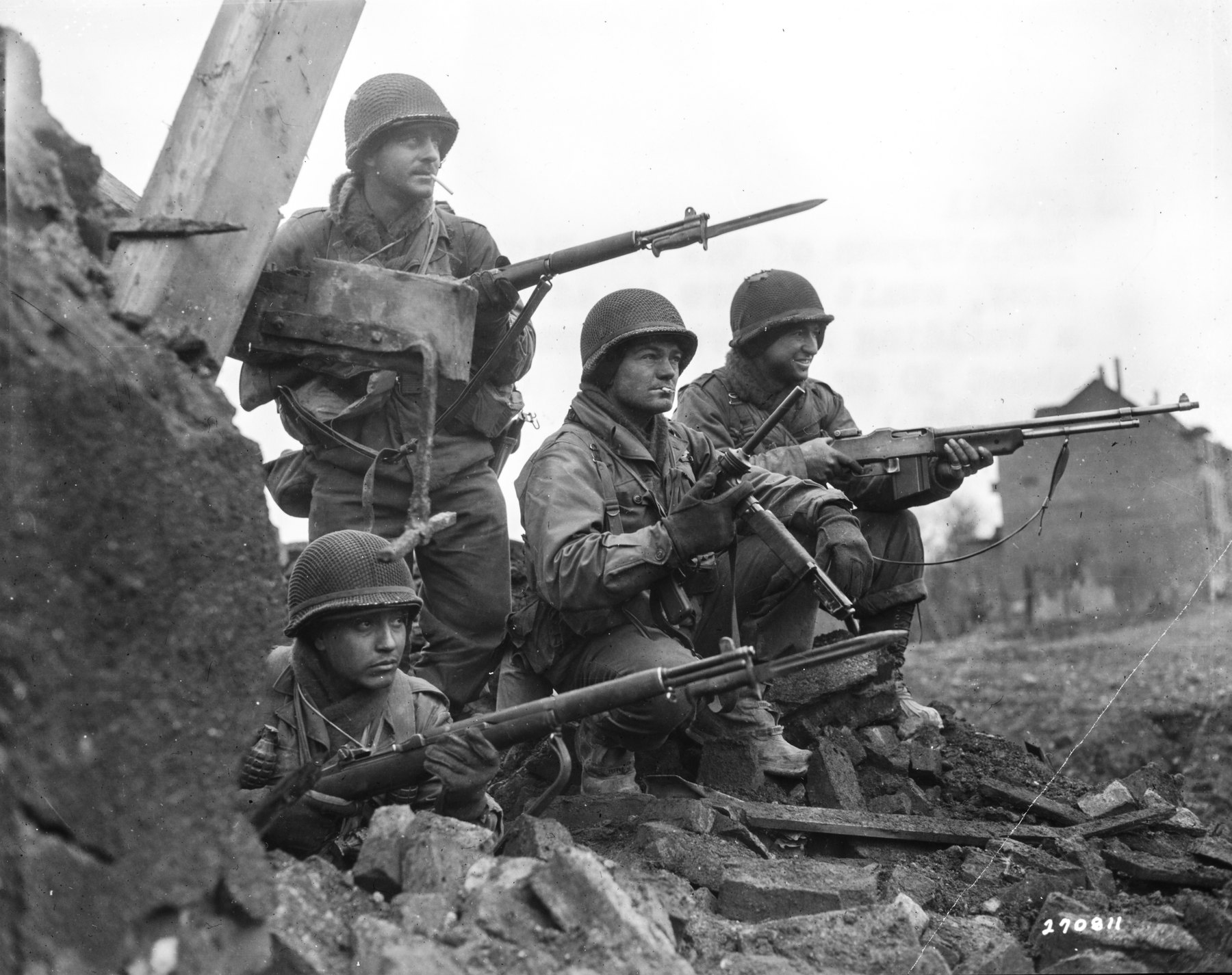
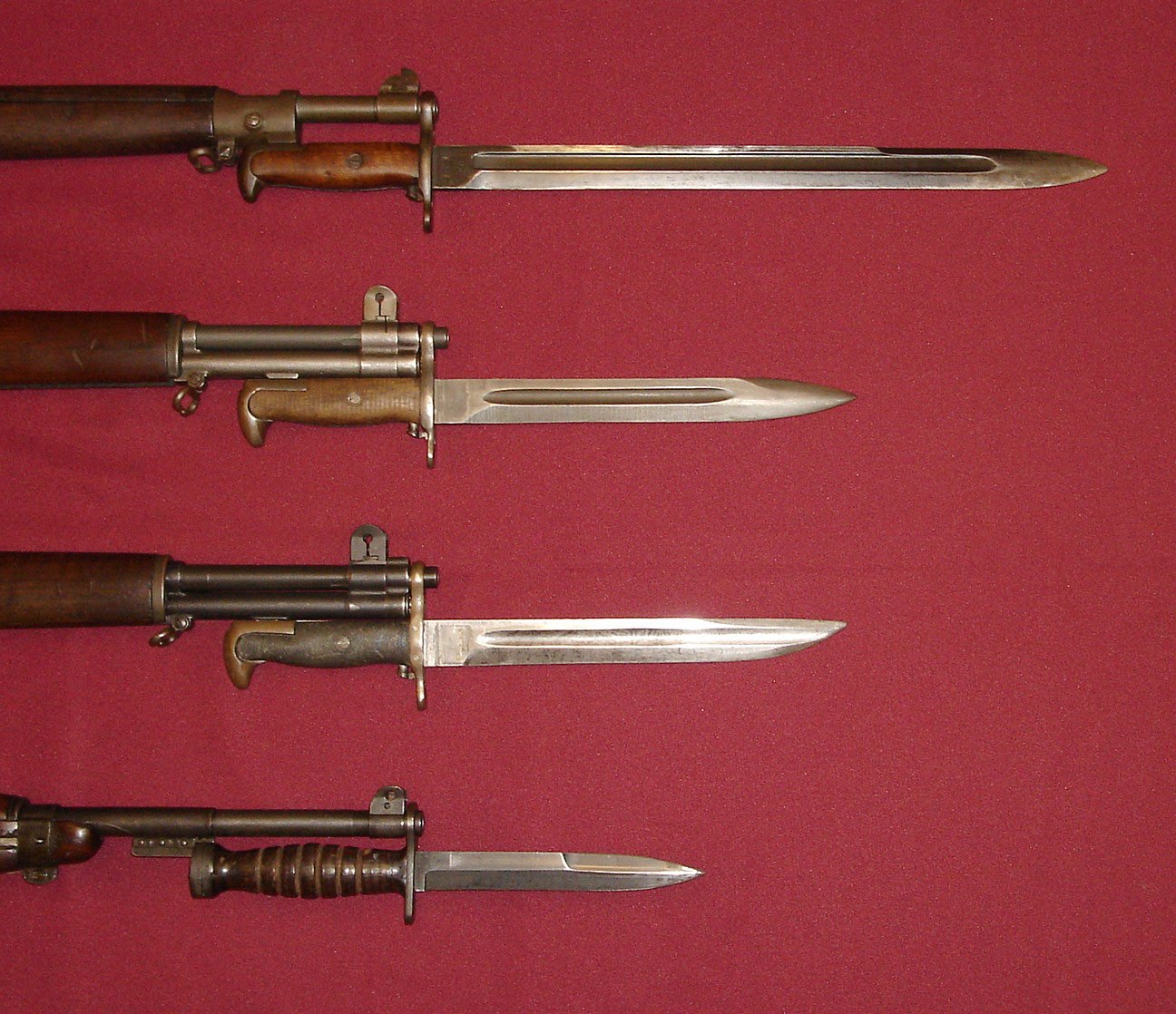
Four American bayonets fit the M1: the 16-inch M1905, the 10-inch M1, and the post-war M5 and M5A1. The wartime ones mount the same simple way — a ring over the muzzle and a slot onto a lug under the gas cylinder — and need nothing on the rifle except the gas cylinder it already has. This volume is which bayonet is right for which rifle, how to tell an original from a reproduction or a parts-assembled piece, and how to fit one.
For the rifle documented in Vol 7, a Springfield receiver from about January 1944, the period answer is either a 16-inch M1905 in an M3 scabbard, or a 10-inch M1 in an M7 scabbard. Both were in service that winter.
14.1 Where It Mounts
The M1’s bayonet lug is on the underside of the gas cylinder. There is no stud on the front band. The Army’s own manuals place it there: the 1951 field manual tells you to tap “on the bayonet stud” to loosen the gas cylinder, and the 1944 grenade manual describes the launcher latch clamping “in back of the bayonet lug… on the under side of the cylinder.”
That matters for two reasons. A bayonet bears on the gas cylinder, not the barrel. And any rifle with a correct government gas cylinder already has everything a wartime bayonet needs.
14.2 The M1905 — 16 Inches
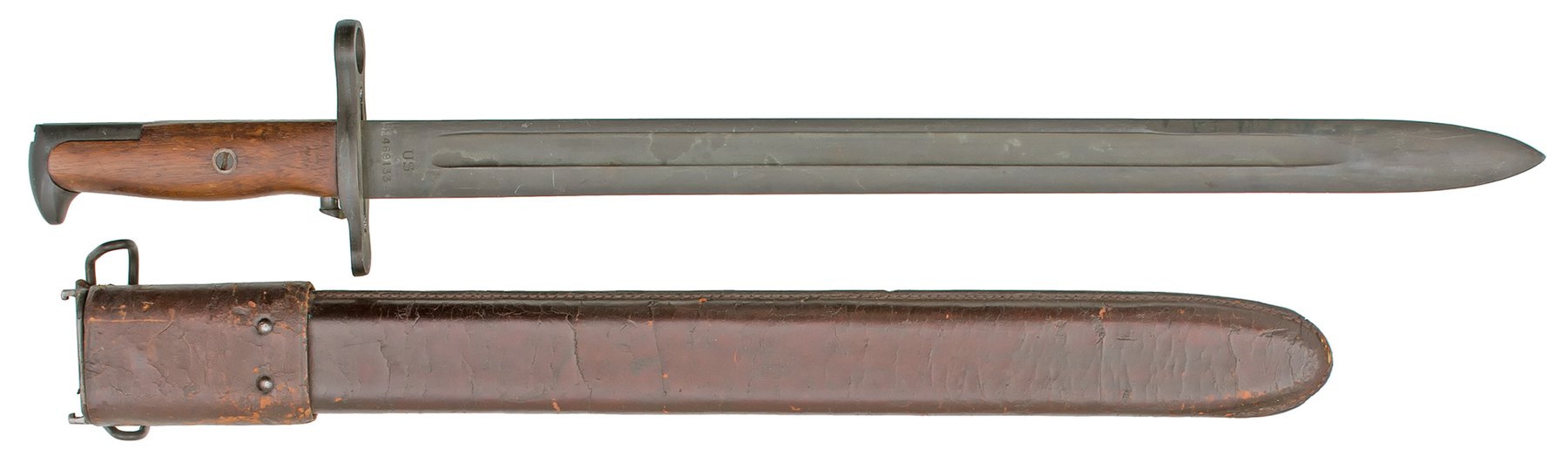
14.2.1 First production, 1906–1922
Designed for the M1903 Springfield, made by Springfield Armory (about 1,196,000) and Rock Island Arsenal (about 430,000). Walnut grips; blued handle and bright blade until 1918, then Parkerized. Early examples carry serial numbers. The Army’s 1933 mobilization plan counted 581,000 serviceable M1905s — enough to equip the first years of M1 production — and the 1941 field manual names “the bayonet, M1905, and bayonet scabbard, M1910” as the M1’s appendages. Many were refurbished during the Second World War, Parkerized and fitted with new grips.
14.2.2 Second production, April 1942 – May 1943
Six civilian contractors made 1,540,578 more between April 1942 and May 1943. Collectors call these “M1942” bayonets; the Army never did. The Garand Collectors Association Journal’s bayonet survey calls it “erroneously called the ‘M1942’.”
Table 1 — Second production, April 1942 – May 1943
| Mark | Maker | Estimated M1905 | Estimated new M1 |
|---|---|---|---|
| AFH | American Fork & Hoe, Geneva, Ohio | 400,000 | 1,015,000 |
| UFH | Union Fork & Hoe, Columbus, Ohio | 430,000 | 460,000 |
| UC | Utica Cutlery, Utica, New York | 200,000 | 880,000 |
| PAL | Pal Blade & Tool, Plattsburgh, New York | 210,000 | 340,000 |
| OL | Oneida Ltd, Oneida, New York | 150,000 | 250,000 |
| WT | Wilde Drop Forge & Tool, Kansas City, Missouri | about 60,000 | none |
The quantities are estimates from government acceptances and plant capacities, not exact records. Wilde Tool was dropped in February 1943, before M1 production, which makes WT bayonets scarce and expensive. Oneida’s were finely finished and are prized.
What they look like:
- Parkerized from the start, with black or sometimes brown plastic grips, and no serial numbers.
- The left ricasso reads maker over “U [flaming bomb] S” over the date — for example, “AFH / U [bomb] S / 1942.”
- During production the fuller changed from square to rounded by late 1942, the guard’s barrel hole was counterbored for easier fitting, and from February 1943 Utica supplied all the catches.
- Grips were Bakelite from two suppliers, or a cellulose plastic from a third that was discontinued in April 1943 because it was solvent-sensitive.
14.3 The M1 — 10 Inches
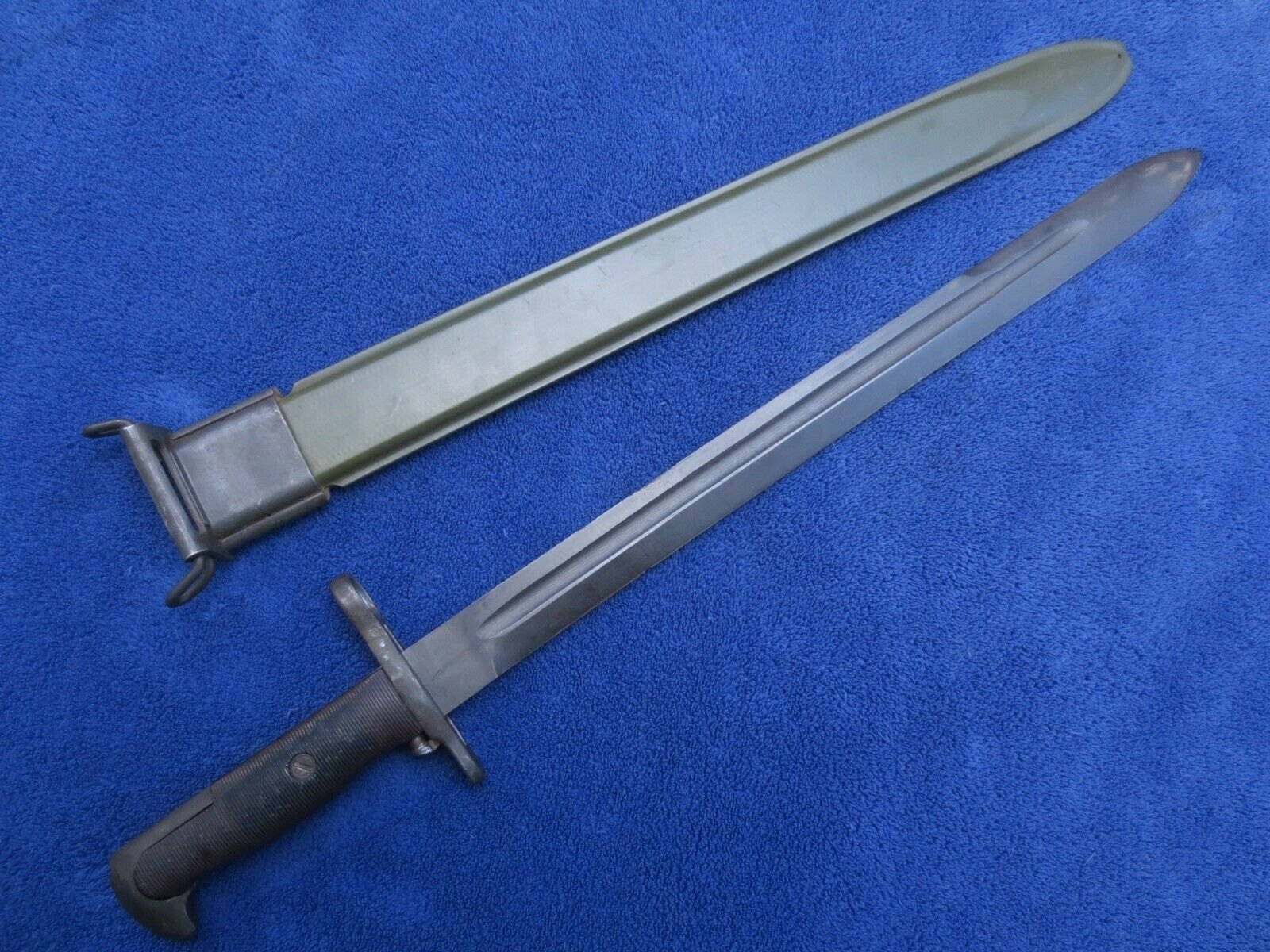
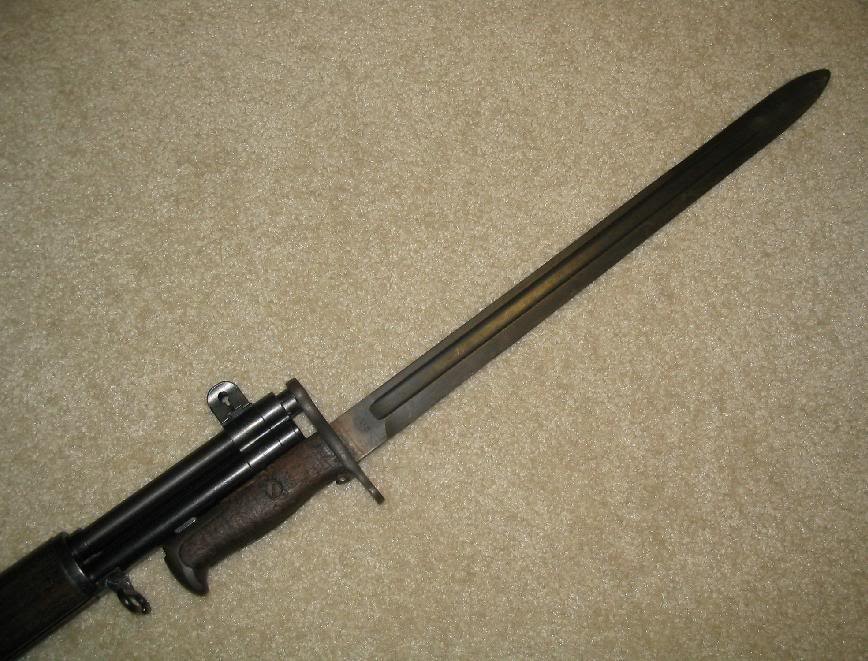
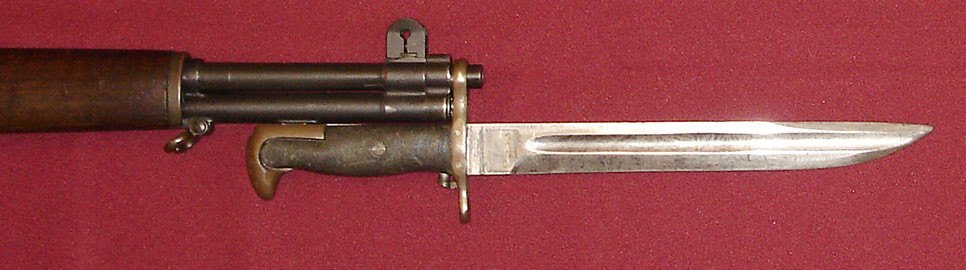
In 1943 the Army shortened the bayonet “to produce a more practical weapon and conserve steel.” The result, the Bayonet, M1, is an M1905 with a 10-inch blade. 2,948,649 new M1s were made from April 1943 to August 1945, by five of the six contractors — all but Wilde.
- The earliest M1s are dated 1943. “The vast majority… were not marked with the year.”
- Transitional M1s have irregular, sometimes hand-ground fullers near the point; collectors believe these were partly finished 16-inch blades re-forged to 10 inches.
- Many soldiers in the Pacific kept the 16-inch M1905 by preference, for reach.
14.3.1 Cut-down M1905s
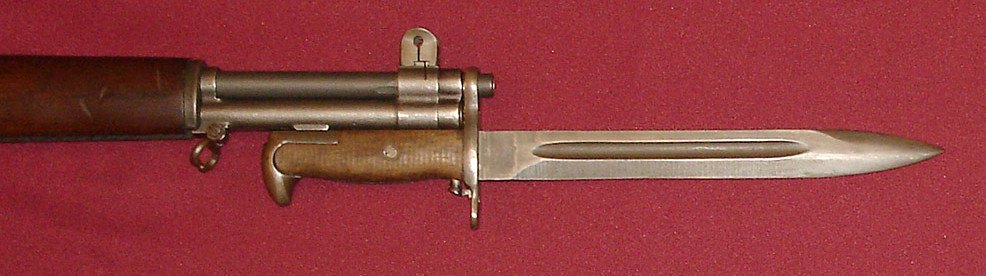
The Army also shortened the long bayonets it already had. 1,007,671 were converted during the war, by Springfield Armory and the five civilian makers, from any maker’s M1905 — including Springfield and Rock Island originals. Ordnance made no distinction: a converted bayonet was simply a Bayonet, M1. Collectors call them “M1905E1,” their test-phase designation.
- The converting firm usually marked the blade. An AFH 1942 blade shortened by Utica, for example, is marked “U.C. – MOD.” on the other ricasso.
- The fuller runs almost to the point, because it is the original 16-inch fuller. On a new-made M1, the fuller stops well short of the tip. That is the quickest way to tell them apart.
- Point shapes: a spear point was usual. A knife or “bowie” point appears on early square-fuller blades, where the deep fuller left too little steel for a spear point. Sources disagree on how common the bowie point was overall.
The cut-off six-inch points did not go to waste. A February 1944 advertisement quoted in the collectors’ survey says the maker turned them into hoes for victory gardens.
14.4 The M5 and M5A1 — Post-War
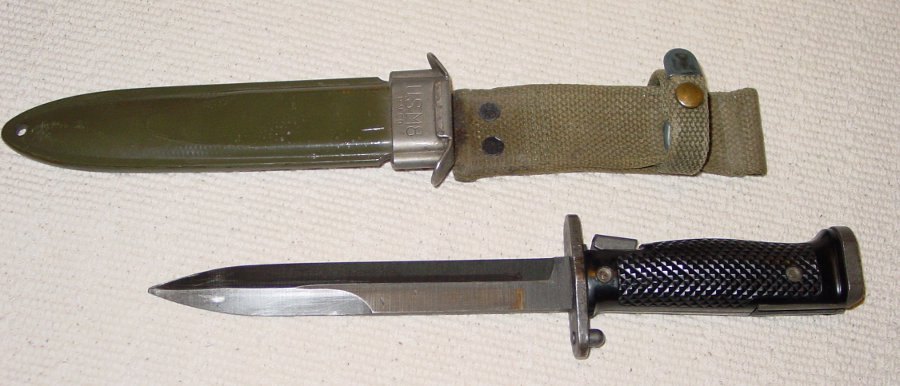
In Korea, the M1 bayonet was hard to fix and remove with gloves on. The M5, adopted near the end of the war (sources give 1953 or 1954), was a complete redesign: a trench-knife-style blade, like the M4 carbine bayonet, adapted to the Garand.
It mounts differently. There is no muzzle ring — the M5 is the only American bayonet without one. A stud on the crossguard fits into the gas cylinder lock screw, and locking grooves on the handle engage the bayonet lug. The M5A1 revised the catch for gloved hands; most are marked “M5-1.”
Two cautions for the M5:
- It may need the right lock screw. Fulton Armory lists its government poppet-valve gas cylinder lock screw as “required for M5A1 bayonet,” which implies the stud needs a screw with a center recess. That has not been confirmed in a manual. Test-fit before relying on it.
- Function-test with it fixed. The grenade launcher’s stud deliberately opens the valve in a valve-type lock screw. No source was found that says whether an M5’s stud touches a poppet valve. Fire a few rounds with the bayonet on and make sure the rifle cycles.
The M5 is not period for a wartime rifle.
14.5 Scabbards
Table 2 — Scabbards
| Scabbard | Construction | For | Made | Period for early 1944? |
|---|---|---|---|---|
| M1910 | Wood body, canvas cover, leather tip | M1905 | Pre-war | Yes, still in use |
| M1917 / M1905 modified | Leather | M1905 | First World War | Substitute; used early in the war |
| M3 | Resin-impregnated cotton duck, painted green; metal throat | M1905 (16-inch) | Beckwith Manufacturing and Detroit Gasket; 3,030,223, January 1942 – February 1943 | Yes — the most common |
| M7 | A shorter M3 | M1 (10-inch) | Beckwith only; 2,112,672, April 1943 – August 1945 | Yes |
| M7, converted | M3 shortened, throat reattached | M1 (10-inch) | 1,846,768 converted in the war | Yes |
| M8A1 | Resin body, steel throat, web hanger | M4 carbine bayonet; M5-series | 1944 onward | No — post-war for the Garand |
Tells:
- The throat is marked “U.S.,” the flaming bomb and the maker.
- An M7 marked Detroit Gasket is wrong unless it is a converted M3 — Detroit Gasket made no M7s.
- A converted M7 shows a different crimp where the body meets the throat.
- The M7 does not fit the M5, and the M8A1 is not correct on any wartime Garand bayonet.
- Watch for artificially aged reproduction leather M1905 scabbards.
14.6 Original, Reproduction, or Assembled
The bayonet is the most reproduced M1 accessory. The tells that hold up:
- Finish. Real 1942–43 M1905s and 1943–45 M1s are Parkerized. At least one widely sold reproduction “M-1942” is advertised with a blued blade, a 1942 date and a flaming bomb. A blued blade on a “1942” bayonet is a red flag.
- Markings. Maker, “U [bomb] S” and date on the ricasso of a 16-inch; mostly undated on a 10-inch; a converter’s mark on a conversion.
- Fuller. Square is early 1942; rounded from late 1942; running to the tip means a conversion.
- Fakes. Complete reproduction bayonets have been imported as fantasy items, and fake “OL”-stamped examples exist.
- Parts bayonets. Loose M1905 blades, grips and complete “bayonet project” kits are sold openly, so assembled bayonets exist. Check that the grip screw, catch, blade finish and wear all tell the same story.
14.6.1 Prices seen, September 2026
Table 3 — Prices seen, September 2026
| Item | Price | Seller |
|---|---|---|
| Reproduction 16-inch “M-1942” | $75 | International Military Antiques |
| Reproduction 10-inch M1 | $69.95 | International Military Antiques |
| Reproduction M3 / M7 / M1910 scabbard | $39.95 / $29.95 / $39.95 | International Military Antiques |
| Original AFH 1942, cut down by Utica, with M7 | $295 | International Military Antiques |
| Original unmarked M1 | $99.95 | SARCO |
| Original UFH 1943 M1 with M7 | $195 (sold; date of sale not shown) | Horse Soldier |
| Korean-army shortened M1 with Korean scabbard | $49.95 | SARCO |
14.7 How to Fix a Bayonet
14.7.1 M1905 or M1
- Clear the rifle.
- Hold the bayonet edge down — the same way it will sit on the rifle — with the catch toward you.
- Slide the ring in the guard over the muzzle and the slot in the pommel onto the bayonet lug under the gas cylinder.
- Push it home until the catch snaps over the lug. Pull on it to check.
- To remove, press the catch button and pull the bayonet forward.
The 1941 field manual says only that the guard “is constructed so as to fasten the bayonet securely to the rifle or its scabbard”; the bayonet drill itself is in the separate bayonet manual, FM 23-25.
14.7.2 If it will not go on
- Early straight-drilled guards can be tighter on some muzzles than the counterbored guards made from late 1942.
- Reproductions often need fitting. One dealer’s warning: “SOME MINOR FITTING MAY BE REQUIRED TO MOUNT ON AN ORIGINAL GARAND RIFLE.” Stone the bayonet — the catch or the pommel slot — never the rifle.
- On a commercial gas cylinder, check that the lug is present and correctly shaped before trusting it. No documented problem with commercial cylinders’ lugs was found, but a government cylinder is the safe assumption.
14.7.3 M5 or M5A1
Clear the rifle. Engage the crossguard stud in the gas cylinder lock screw, then press the handle up until its locking grooves latch onto the bayonet lug. Test-fit first on a rifle with a solid lock screw (above), and function-test.
14.8 Does It Change the Zero?
The Army thought so. The 1951 field manual: “You should be given the opportunity to zero your rifle with the bayonet and the grenade launcher attached, preferably at 300 yards.” The 1944 grenade manual explains the mechanism for the launcher — “‘barrel whip’ which is occasioned by the added weight of the launcher on the muzzle” — and a bayonet is weight on the muzzle too.
No published measurement was found of how far a 16-inch or 10-inch bayonet moves an M1’s point of impact. It would be an easy test: the same rifle, the same load, groups at 100 yards with no bayonet, with a 10-inch M1, and with a 16-inch M1905. It is an open test worth running.
As for the gas system: an M1905 or M1 bears only on the lug, which is part of the gas cylinder, and does not touch the lock screw. It cannot affect the valve.
14.9 Is a Bayonet Legal?
- Federal: there is no current federal restriction on a bayonet lug. The 1994–2004 federal assault weapons ban listed a bayonet mount as a feature, but only for rifles able to accept a detachable magazine; the en-bloc-fed M1 was outside the definition, and the law expired in 2004.
- California: a bayonet mount is not on California’s feature list.
- New York: a bayonet mount is on New York’s feature list, but the definition applies only to rifles with “an ability to accept a detachable magazine.” The M1 does not have one.
- Michigan: as of the most recent summary found (April 2024), Michigan has no laws regulating assault weapons. Check for changes.
This is not legal advice; Vol 17 has the broader legal picture.
Sources
- Mike Popernack, “M1 Garand Bayonets,” Garand Collectors Association Journal (Fall 2009), pp. 25–30.
- Gary Cunningham, Bayonet Points nos. 13, 23 and 35, usmilitaryknives.com.
- U.S. War Department, FM 23-5 (November 1941 and 1951 editions); FM 23-30, Hand and Rifle Grenades (1944).
- Fulton Armory, “The History of M1 Garand Bayonets,” and gas cylinder lock screw listing.
- SARCO, “Unpacking the Term M1 Bayonet,” and listings, checked September 14, 2026.
- International Military Antiques, College Hill Arsenal and Horse Soldier listings, checked September 14, 2026.
- 18 U.S.C. § 922 (2000 edition); California Penal Code § 30515; New York Penal Law § 265.00; Giffords Law Center, “Assault Weapons in Michigan” (updated April 15, 2024).
Comments (0)