M1 Garand · Volume 12
Ammunition — Why the Garand Is Particular
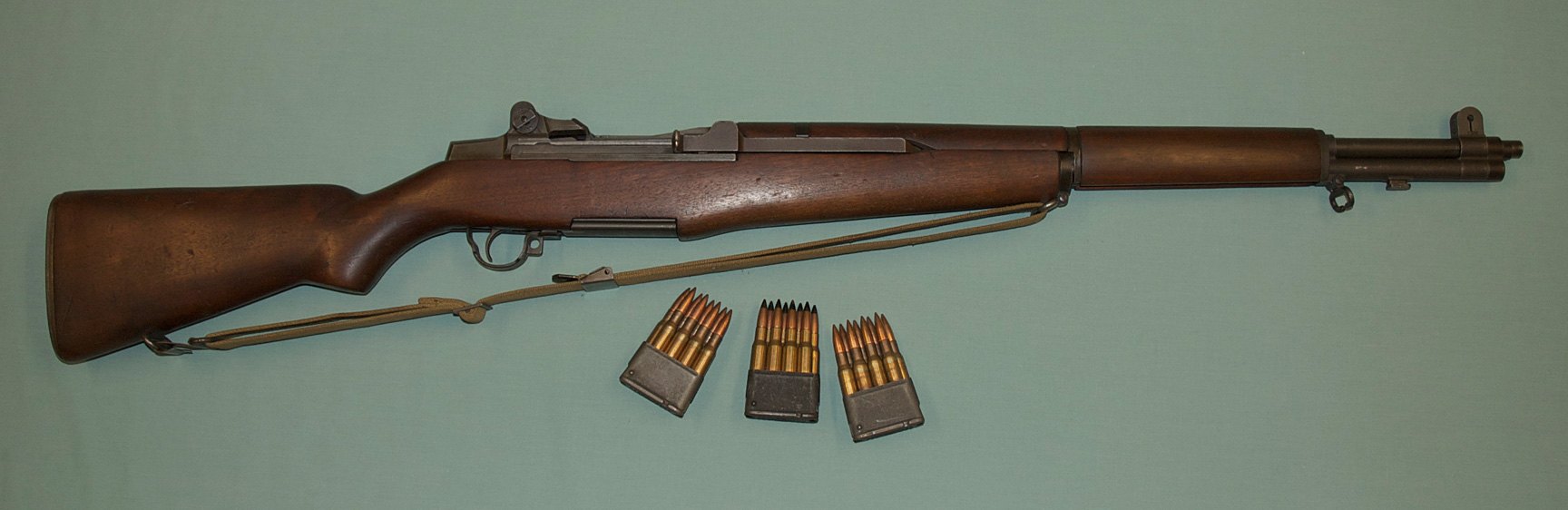
Most rifles do not care much what .30-06 you put in them, as long as it is within pressure. The M1 does. It can be damaged by ammunition that is perfectly safe in a bolt-action rifle — not because the chamber pressure is too high, but because of when the pressure arrives at the gas port. Understanding that one fact is most of what there is to know about feeding the rifle, and it is why this volume comes before the list of loads in Vol 13.
12.1 Where the Gas Comes From
The M1’s gas port is drilled into the underside of the barrel near the muzzle. The rifle does not tap gas until the bullet is almost out of the barrel, which means the pressure that works the action is not the pressure in the chamber — it is whatever pressure is left behind the bullet at that point.
That residual pressure depends heavily on how much powder is still burning. A fast-to-medium powder has largely finished by the time the bullet reaches the port; a slow powder is still generating gas. A heavy bullet moves more slowly and keeps the pressure up for longer. Both push harder on the operating rod.
Hornady’s chief ballistic scientist, Dave Emary, put it plainly when Hornady introduced its M1 load in 2008:
“Permanent damage can occur while shooting standard factory loaded 30-06 ammunition in the M1 Garand. Typical factory loads contain propellants that when fired, result in port pressures and gas volumes that are too high, causing violent stress to the rifle’s operating rod, bolt, and receiver.”
Sierra’s reloading manual says the same thing from the handloader’s side:
“Powders in the medium-burning range must be used when loading for a Garand. Due to its system of operation, the Garand can be damaged by improper powder selection, even if the loads themselves are perfectly safe.”
12.1.1 The timing
The gas event is short. One detailed analysis puts the peak gas-cylinder pressure at about 500 microseconds after the cylinder starts to fill, falling to near nothing by about 3 milliseconds — and during that whole pressure pulse, the operating rod moves only about three-eighths of an inch. Everything after that is momentum. Too much impulse in those three milliseconds, and the rod and bolt arrive at the back of the receiver far faster than the rifle was built for.
Garand Gear, who make gas plugs and have instrumented a Springfield M1’s gas cylinder, frame it in terms of impulse: their M2 Ball samples delivered 274–305 lbf·ms, and the rifle short-stroked below about 190 lbf·ms. They also make a point that runs against intuition: a slower bullet can produce a higher peak pressure in the gas cylinder. Keep in mind that Garand Gear sells the fix, but their numbers are the best public characterization of the rifle’s working window found for this dive.
12.1.2 What goes wrong
The part that takes the blow is the operating rod. Over-driven rods bend or warp, and a bent rod drags, which makes the problem worse. Garand Gear is careful to say ammunition is one of three causes: “The first is high pressure in the gas cylinder. The second is the binding of the operating rod. The third is caused by poor lubrication.” Vol 11 covers the other two.
Cracked receiver heels and damaged operating-rod catches are often blamed on commercial ammunition. They are the parts that absorb the impact, and it is reasonable to worry about them, but no primary source documenting the link was found, so it should not be stated as fact.
12.2 The Pressure Numbers, and a Trap in Them
Table 1 — The Pressure Numbers, and a Trap in Them
| Measure | Figure | Source |
|---|---|---|
| .30-06 maximum average pressure, transducer | 60,000 psi | SAAMI Z299.4-2015 |
| .30-06 maximum average pressure, copper crusher | 50,000 CUP | SAAMI Z299.4-2015 |
| Ball M2 chamber pressure, as specified | 50,000 psi | TM 43-0001-27 |
| CMP ceiling for M1 ammunition | 50,000 CUP, and bullets no heavier than 172–174 grains | Civilian Marksmanship Program |
PSI and CUP are different measurement systems with no fixed conversion. “50,000 psi” and “50,000 CUP” are not the same pressure, and a source that quotes one does not contradict a source that quotes the other. The Army’s manuals print psi; the CMP writes CUP; SAAMI gives both. Each is left in its own units here.
A widely repeated figure for M2 Ball port pressure — “not greater than 12,650 psi and not less than 9,150 psi” — is quoted from a specification whose title appears to belong to 7.62 mm NATO ball, measured at a point 15 inches from the bullet base. The M1’s port is almost 21 inches from it. The specification’s title could not be confirmed, so that range should not be printed as the Garand’s.
12.3 What the CMP Says
The Civilian Marksmanship Program — which has sold more surplus M1s than anyone — puts it on its M1 sales page:
“Do not use .30/06 ammunition in M1 Garands … that is loaded beyond 50,000 CUP and has a bullet weight more than 172–174gr.”
Its older commercial-ammunition page (2014) adds that some commercial .30-06 is represented by its makers as safe in semi-automatic rifles, that CMP sells commercial match ammunition it uses in its own events, and that adjustable gas-cylinder lock screws “are not legal for CMP John C. Garand Matches.”
That guidance is conservative, and it should be read as such. Hodgdon’s published M1 load data includes 180-grain bullets over IMR 4895 and Varget (Vol 13). The two positions are reconcilable: the real problem is factory 180-grain hunting ammunition, loaded with slow powders for bolt-action rifles — not a 180-grain bullet as such.
12.4 What the Rifle Was Built For
12.4.1 Caliber .30 Ball M1 (1920s–1930s)
The ammunition in service when Garand was designing was the M1 Ball — a boattail bullet of about 173–174 grains with a 9-degree taper, at about 2,640 ft/s. Sources disagree slightly on the weight and on when it was replaced. It carried too far: its maximum range made it unsafe on most American ranges, and it was superseded in the late 1930s, standardized as M2 by 1940.
12.4.2 Caliber .30 Ball M2
The rifle’s issue cartridge.
- Bullet: 152 grains, flat base (sources give 150 to 152).
- Propellant: IMR 4895, 50 grains nominal. Real rounds seldom reached the full nominal charge.
- Pressure: 50,000 psi as specified.
- Velocity: 2,740 ft/s measured 78 feet from the muzzle, which works out to about 2,800 ft/s at the muzzle. Both figures appear in print; they describe the same cartridge.
The M1’s rear sight is calibrated for M2 Ball.
During 1942–43 the St. Louis Ordnance Plant also made an “M2 Alternate” with a thinner, steel-clad jacket to save copper.
12.4.3 The rest of the family
Table 2 — The rest of the family
| Cartridge | Identification | Bullet | Pressure | Velocity (78 ft) |
|---|---|---|---|---|
| Armor Piercing M2 | Black tip | 165.7 gr | 54,000 psi | 2,715 ft/s |
| Match M72 | ”MATCH” headstamp; primer and bullet uncrimped | 173 gr | 50,000 psi | 2,640 ft/s |
| Tracer M1 | Red tip | — | 52,000 psi | 2,665 ft/s |
| Tracer M25 | Orange tip | — | 50,000 psi | 2,665 ft/s |
| Armor Piercing Incendiary M14 | — | — | 54,000 psi | — |
All figures from TM 43-0001-27 (1994). Tracer, armor-piercing and incendiary ammunition are banned from CMP matches.
12.5 Corrosive Primers
American military .30-06 used corrosive primers well into the 1950s. The primer residue is a salt that pulls moisture out of the air and rusts the bore, the chamber and — on a Garand — the gas cylinder, the gas cylinder lock screw and the operating rod piston, which is where the gas goes.
The rule of thumb in the Army’s own ammunition manual, TM 9-1305-200 (1961), is: if you do not know the lot number, assume anything with the year shown or earlier is corrosive. The first non-corrosive .30 Ball M2 lots, by maker:
Table 3 — The rule of thumb in the Army's own ammunition manual, TM 9-1305-200 (1961), is: if you do not know the lot number, assume anything with the year shown or earlier is corrosive. The first non-corrosive .30 Ball M2 lots, by maker
| Maker | First non-corrosive lot | Accepted | Treat as non-corrosive from |
|---|---|---|---|
| Frankford Arsenal (FA) | 4149 | October 1951 | FA 52 |
| Lake City (LC) | 13700 | June 1951 | LC 52 |
| Remington (RA) | 33853 | November 1951 | RA 52 |
| Western (WCC) | 6428 | June 1951 | WCC 52 |
| Winchester (WRA) | 23201 | August 1951 | WRA 52 |
| Twin Cities (TW) | 19632 | December 1950 | TW 51 |
| St. Louis (SL) | 9240 | May 1952 | SL 53 |
One of the standard secondary summaries gives the Twin Cities lot as 19362; one of the two figures is a transposition. A more conservative rule circulates among Garand shooters — nothing with a headstamp before 1953 — and it is consistent with the lot data.
What the manuals say to do about it. The 1940 field manual says to clean the chamber with a patch saturated “with cleaner, rifle bore, or with water, in order to dissolve any primer fouling,” and to hold the rifle upside down while cleaning so no water gets into the gas port. The 1951 edition offers hot soapy water as an alternative to bore cleaner; the 1965 edition demotes it to “only when bore cleaner is not available.” The principle holds either way: dissolve the salts with a water-based cleaner first, then oil — and do the gas cylinder, the lock screw and the piston area too. Vol 10 has the full cleaning sequence.
12.6 Gas Plugs
If you want to shoot ammunition the rifle was not designed for, there are two kinds of fix, and they work differently.
12.6.1 Adjustable (venting) plugs
A gas-cylinder lock screw with a threaded set screw through its center. The set screw controls how much gas is bled out to the atmosphere; the more it is opened, the less gas drives the piston.
Schuster makes the best known. In their own words it is “made specifically for use with heavier bullet weights and hotter reloads,” and it is “NOT LEGAL FOR ‘AS ISSUED’ GARAND MATCHES.” It was $50 and out of stock when checked in September 2026. The maker’s instructions:
- It starts open. “The setscrew comes at a factory set position, air will easily blow through it. The rifle WILL NOT FUNCTION at this position.”
- Close it in steps. “Turning the screw about ¼ turn at a time, tighten screw, and fire until the rifle functions reliably with your particular load.”
- Lock it. Install the hollow locking set screw against the first one if it loosens.
- Fine-tune for accuracy in eighth turns.
- One setting per load. “Your rifle is now set for that reload only! If you change to another load or to any factory loaded cartridge, you have to open up the set screw in the gas plug and start over.”
In one published test, a Winchester 180-grain Power-Point load needed the screw closed about one full turn from open to cycle, and a Remington 150-grain load about three-quarters of a turn — the heavier load needed less gas.
McCann Industries once made an adjustable system with interchangeable jets. No current listing was found, and it appears discontinued.
12.6.2 Ported (non-venting) plugs
Garand Gear’s Ported Gas Plug works on a different principle. It has “an open area in the base of the screw that increases the starting volume of the gas cylinder,” which lowers the peak pressure — they say by over 30 percent — without venting anything and without adjustment. In their testing it “limited peak pressures in all cases to levels below that of M2 Ball,” including 180-, 210- and 220-grain hunting loads. It was $42 and available in September 2026.
Whether a ported plug is legal in CMP as-issued matches is not addressed in any source found for this dive. The CMP’s statement bans adjustable screws, and the match rules require parts of “the exact same weight and dimensions” as government issue, which a hollowed plug arguably is not. Ask the match director before you shoot one in a Garand match.
12.7 Clips
The M1’s eight-round en-bloc clip is spring steel.
- New production: Aggressive Engineering (marked “AEC”) has made mil-spec Parkerized clips in very large numbers; the Packrats dealer’s current clip is coded “AG-7,” at $4.50 each in September 2026.
- Wartime clips by makers such as Winchester carry collector prices.
- New clips can be stiff. Garand Gear: “New clips that haven’t been used before sometimes can be difficult to insert, especially if the parkerizing is coarse on the guide rails.”
- Two- and five-round clips exist — the two-round for match rapid-fire strings, the five-round for hunting where capacity is limited — but the last new stock was made years ago and they are essentially discontinued. The CMP match rules do not require a two-round clip; they require “a clip and two rounds” (Vol 13).
No evidence was found for the common claim that blued wartime clips are too tight for modern rifles, so it is left out here.
12.8 A Word on 7.62 NATO Garands
The Navy converted M1s to 7.62 NATO in the 1960s (Vol 4), some with a chamber bushing that could come loose and eject with the fired case. When the CMP sold these rifles in 2024, it rated the bushed Mk 2 Mod 0 rifles “not safe to fire,” warned that the Mod 1 rifles were compatible exclusively with 7.62 NATO military ammunition, and said: “These rifles should not be assumed safe for use with commercial spec, .308 WIN ammunition.” None of that applies to a .30-06 rifle such as the one documented in Vol 7, but it matters if you ever see one for sale.
Sources
- Hornady press release, “New .30-06 M1 Garand Match Ammunition from Hornady,” June 2, 2008.
- Sierra Bullets, Reloading Manual, 6th ed., .30-06 Springfield introduction, p. 668.
- Garand Gear, “The M1 Garand and Commercial Ammunition,” and product page for the Ported Gas Plug.
- m1-garand-rifle.com, “Gas Pressure.”
- ANSI/SAAMI Z299.4-2015, centerfire rifle pressure and velocity standards.
- U.S. Army, TM 43-0001-27, Army Ammunition Data Sheets: Small Caliber Ammunition (1994).
- U.S. Army, TM 9-1305-200 (1961), Table III, as reproduced by armscollectors.com.
- U.S. Army, FM 23-5 (1940, 1951 and 1965 editions), cleaning instructions.
- Civilian Marksmanship Program, M1 Garand sales page (checked September 14, 2026); “Commercial Ammo” (2014); “The 7.62MM Garand — What Is It?”
- Schuster Manufacturing, “M1 Garand WWII Adjustable Gas Plug,” product page and instructions.
- Jordan Michaels, “Feed Your Garand What It Wants: Adjustable Gas Plug Install and Test,” GunsAmerica Digest (2019).
- Art Merrill, “Steel Pennies and Alternative Ammo,” Shooting Sports USA (2023).
- Packrats Collectibles (ammogarand.com), clips, checked September 2026.
- The Firearm Blog, “CMP Navy 7.62 NATO Garand Rifles Sale” (2024).
Comments (0)