M1 Garand · Volume 16
Collecting, Value and Restoration Choices
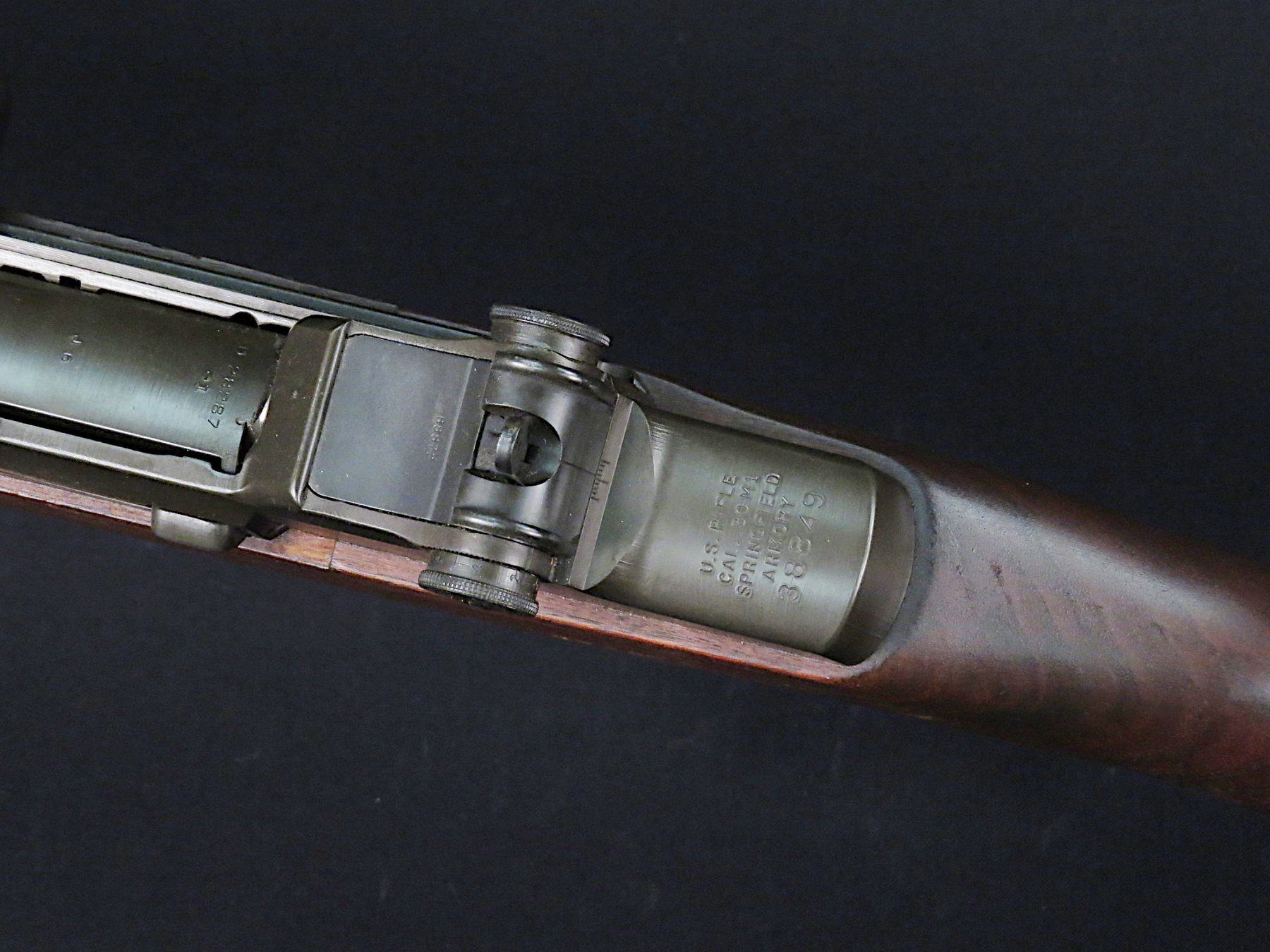
Almost every M1 has been rebuilt. Rifles that went through arsenal overhaul had their parts thrown into bins and reassembled onto whatever receiver came next, often more than once, over twenty years. So the question collectors ask is almost never “is this rifle original?” It is “how close is this rifle to what its receiver should have?” — and, separately, “has anything been done to it that cannot be undone?”
This volume is the general answer. Vol 7 applies it to Springfield 2450021.
16.1 The Vocabulary
Original means as it left the factory. It is the rarest claim and the hardest to prove, because nothing on an M1 records which parts were assembled together in 1944. A rifle can only really be called original with documentation or a very strong provenance.
Correct means every part is appropriate to the receiver’s date of manufacture — right maker, right drawing revision, right finish — whether or not those were the parts it left the factory with. The Civilian Marksmanship Program’s Correct Grade definition: “All correct parts for the date of manufacture with 80% or better overall original metal finish,” with walnut stocks bearing “appropriate inspector cartouche.”
Rebuild or arsenal rebuild means a rifle overhauled by an arsenal or depot between 1945 and the 1960s, usually identifiable by the stamps described in Vol 4 and Vol 6.
Mixmaster is collector slang for a rifle whose parts come from several makers and decades. One guide claims 99.999 percent of M1s are mixmasters; the number is rhetorical, but the point is fair.
Shooter means a rifle valued for how it functions — bore, throat and muzzle wear, tight fit — rather than for its parts. The CMP’s own Expert Grade is formally a shooter: a government receiver with “new commercial stock sets and barrels.”
Restored means parts were deliberately swapped to bring a rifle back to correct. That is an accepted practice — the CMP itself assembles and grades Correct Grade rifles by parts — but it must be described as restored, never as original.
16.2 The CMP Grades
The CMP’s grades are the closest thing the M1 market has to a common language. Its current definitions, with the gauge limits:
Table 1 — The CMP's grades are the closest thing the M1 market has to a common language. Its current definitions, with the gauge limits
| Grade | Condition | Throat erosion | Muzzle erosion | Status, September 14, 2026 |
|---|---|---|---|---|
| Rack | Fair | may gauge more than 5 | may gauge more than 3 | Sold out January 7, 2025 |
| Field | Fair to good | less than 6 | may gauge 3 or more | Sold out December 2, 2025 |
| Service | Good to very good | less than 5 | 3 or less | Sold out October 22, 2024 |
| Expert | New commercial barrel and stock | as Service | as Service | In stock, $1,150 |
| Correct | Very good to excellent | less than 4 | 2 or less | Auction only |
| Collector | Excellent; almost no wear, 95% or better original finish | under 3 | 2 or less | Auction only |
Some buyer’s guides print different thresholds for Service Grade; they appear to have mixed Service up with Correct. This volume uses the CMP’s own page. The throat and muzzle gauges themselves are covered in Vol 10.
16.3 Where the Money Is
The receiver anchors value, but correct parts realize it. A stripped receiver is the regulated “firearm” and carries the maker, number and date, so it defines provenance; but a collector premium only appears when date-correct parts surround it.
Price guides are not sales. Private-market figures for M1s come mostly from guide sites and dealer summaries, not from comparable sales, and realized auction prices could not be read while this was written. Every figure below is dated and should be read as a range of opinion.
Table 2 — Where the Money Is
| What | Figure | Source and date | Confidence |
|---|---|---|---|
| CMP Expert Grade (GI receiver, new barrel and stock) | $1,150 + $35 shipping | CMP, September 14, 2026 | High |
| CMP Custom Shop Special | $1,650 + $35 | CMP, September 14, 2026 | High |
| Last CMP prices, sold-out grades | Service ~$1,050, Field ~$850, Rack ~$730 | USA Gun Shop, September 1, 2026 | Medium |
| All used M1s, twelve-month average | $1,449 | USA Gun Shop, September 1, 2026 | Medium |
| Arsenal-rebuilt WWII Springfield | about $1,200 | Crate Club, undated | Low |
| Correct WWII Springfield | about $3,000 | Crate Club, undated | Low |
| Matching or collector grade, any maker | $2,500–5,000 and up | USA Gun Shop, September 1, 2026 | Medium |
| Winchester | $800–3,500, or $300–600 over a similar Springfield | three guides, disagreeing | Low to medium |
| International Harvester | somewhere above Springfield; three guides give non-overlapping ranges | — | Low |
| Import-marked rifles | 10–20 percent less | Crate Club, undated | Low |
A naming trap: aggregator sites that list “Springfield M1 Garand” prices mix in rifles from Springfield Armory, Inc., the commercial company in Illinois, which has no connection to the national armory. Any “new” price for a “Springfield M1” is a commercial rifle.
The surplus pipeline has closed. Three of the CMP’s four surplus grades have been sold out for a year or more, and the one remaining is a rebarreled rifle. That is a structural change in the M1 market, not a temporary shortage.
16.4 What Hurts Value, and How Much
16.4.1 Drilled and tapped receivers
This is the one that cannot be undone, and it is the largest single hit to a non-sniper M1’s collector value. Collector opinion ranges from “adding a scope to a non-sniper variant will drop the value in half” to “drilled and tapped M1 Garand receivers destroy any collector value” — both forum-level sources, but consistent with every auction description reviewed. American Rifleman’s advice for scoping a rack-grade M1 is a clamp-on mount specifically so it “can be returned to its original condition at any time.”
Plugging the holes does not fix it. Screw plugs are visible. Welding puts heat into a heat-treated receiver, and re-welded receivers are a recognized, discounted category of their own. No source was found that shows a plugged or welded receiver regaining value. Leave the holes and disclose them.
The only exception is a genuine M1C: a Griffin & Howe mount on a receiver drilled with three threaded holes and two taper-pin holes, correctly marked and documented. A civilian three-hole side mount is not that.
16.4.2 A commercial barrel
Negative for a collector, positive for a shooter. A new barrel from a good maker — Criterion, or Fulton Armory barrels made by Criterion — is exactly what makes a rifle shoot, and it is exactly what makes it no longer correct. Fulton Armory’s current GI-contour barrel is about $295, chambered short for a gunsmith to finish.
A commercial barrel also bears on curio-and-relic status (Vol 17).
16.4.3 Post-war parts in a wartime rifle
A 1950s bolt, a later operating rod or a later trigger group costs a wartime rifle its correctness. For shooting they are neutral or better: post-war operating rods carry a stress-relief cut that wartime rods lack, and Fulton Armory’s advice for a shooter with an uncut wartime rod is to “hang it on the wall or sell it to a collector and use a good cut rod.”
16.4.4 The stock
A correct stock carries the right cartouche for its date. A sanded stock, or one with no cartouche, is negative for a collector and neutral for a shooter if it fits tightly — and the tightness of the stock fit is one of the biggest influences on an M1’s accuracy.
16.4.5 Scopes, slings and accessories
A commercial scope on a non-sniper rifle is negative, mostly because it comes with holes. A reproduction sling or accessory is roughly neutral — only an original, correctly marked sling adds anything.
16.4.6 Import marks
Their absence helps. Rifles that came back from overseas service with an importer’s stamp typically sell for less than unmarked rifles in similar condition.
16.4.7 Serial-number curiosities
No documented premium was found for rifles in the Springfield–Winchester duplicate-serial bands, nor any auction description that priced one as such. It is a good story and a real one (Vol 3), worth recording but not worth charging for.
16.5 Restoring to Correct
Restoration can be worth doing, and it is an accepted part of M1 collecting, as long as it is disclosed. Two things to weigh before starting:
- The costs add up quickly. Individual wartime Springfield parts are inexpensive — a trigger housing around $43 and a hammer around $28 from a specialist dealer in September 2026 — but a date-correct barrel, bolt, operating rod and cartouched stock are another matter, and that set could not be priced reliably.
- A drilled receiver caps the result. A restored rifle on a drilled or plugged receiver is still a drilled receiver. The ceiling for a correct wartime Springfield — $2,500 to $5,000 and up in good condition — is not available to it.
The rule for describing any parts-swapped rifle is simple: “restored to correct” or “assembled correct,” never “original.”
16.6 Documenting a Rifle
- Springfield Armory National Historic Site will tell you the year, and sometimes the month, a Springfield serial was made. That is all. The Armory “did not keep records of where firearms went to after they were off the production line,” and there are no serial-number history letters for M1s.
- The Garand Collectors Association is the specialist club; its 1987 member survey is where the duplicate-serial blocks were identified. GCA membership also satisfies the CMP’s club requirement.
- James McCollum’s serial-number database took owner submissions for years. Its current status is uncertain.
- Scott Duff’s The M1 Garand: Serial Numbers & Data Sheets is the reference for recording a rifle part by part.
For a rifle with something unusual about it — a duplicate-band serial, a rare part, a documented history — record it this way:
- Photograph the receiver heel straight on, with the maker and number legible. The maker’s name, not the number, distinguishes a Springfield from a Winchester.
- Photograph the receiver drawing number and heat lot on the right leg.
- Record the presence or absence of any suffix on the serial.
- Photograph every part’s drawing number and write them down.
- Record throat and muzzle gauge readings.
- Note the serial-table evidence — the maker’s month, and for a duplicate-band rifle, the other maker’s month.
- Keep printouts of anything you submit to a database.
16.7 Insurance and Appraisal
Collectibles insurers typically do not require an appraisal for individual firearms below a scheduling threshold — one specialist insurer schedules only items or collections over $25,000 — but they do expect a record. A good photographic record of the markings, plus the maker, model, serial, purchase date and price, is effectively an appraisal package for a rifle in the M1’s price range. A formal written appraisal matters more for historically significant or documented rifles.
Sources
- Civilian Marksmanship Program, “M1 Garand” sales and grading page, checked September 14, 2026.
- USA Gun Shop, “Used M1 Garand” price data, updated September 1, 2026; Crate Club, “How Much Is an M1 Garand Worth?” (undated); We Buy Guns, “M1 Garand Valuation” (undated).
- Bruce N. Canfield, “M1 Garand Rebuilds: History & Markings” and “The M1C Garand Sniper Rifle,” American Rifleman.
- NRA Staff, “Scout Scope Mounts for M1 Garand Rifles,” American Rifleman (2011).
- Rock Island Auction Company lot descriptions (via Invaluable), 2025.
- Fulton Armory, operating rod article and barrel listings.
- Packrats Collectibles (ammogarand.com), part listings, checked September 2026.
- National Park Service, Springfield Armory NHS, “Firearm Serial Numbers.”
- Scott A. Duff, “Seeing Double” (2022) and The M1 Garand: Serial Numbers & Data Sheets.
- The Firearm Blog, “Individual M1 Garand Online Database” (2016).
- Collectibles Insurance Services, firearms coverage page.
Comments (0)