M1 Garand · Volume 3
The Wartime Rifle — Springfield and Winchester, 1937–1945
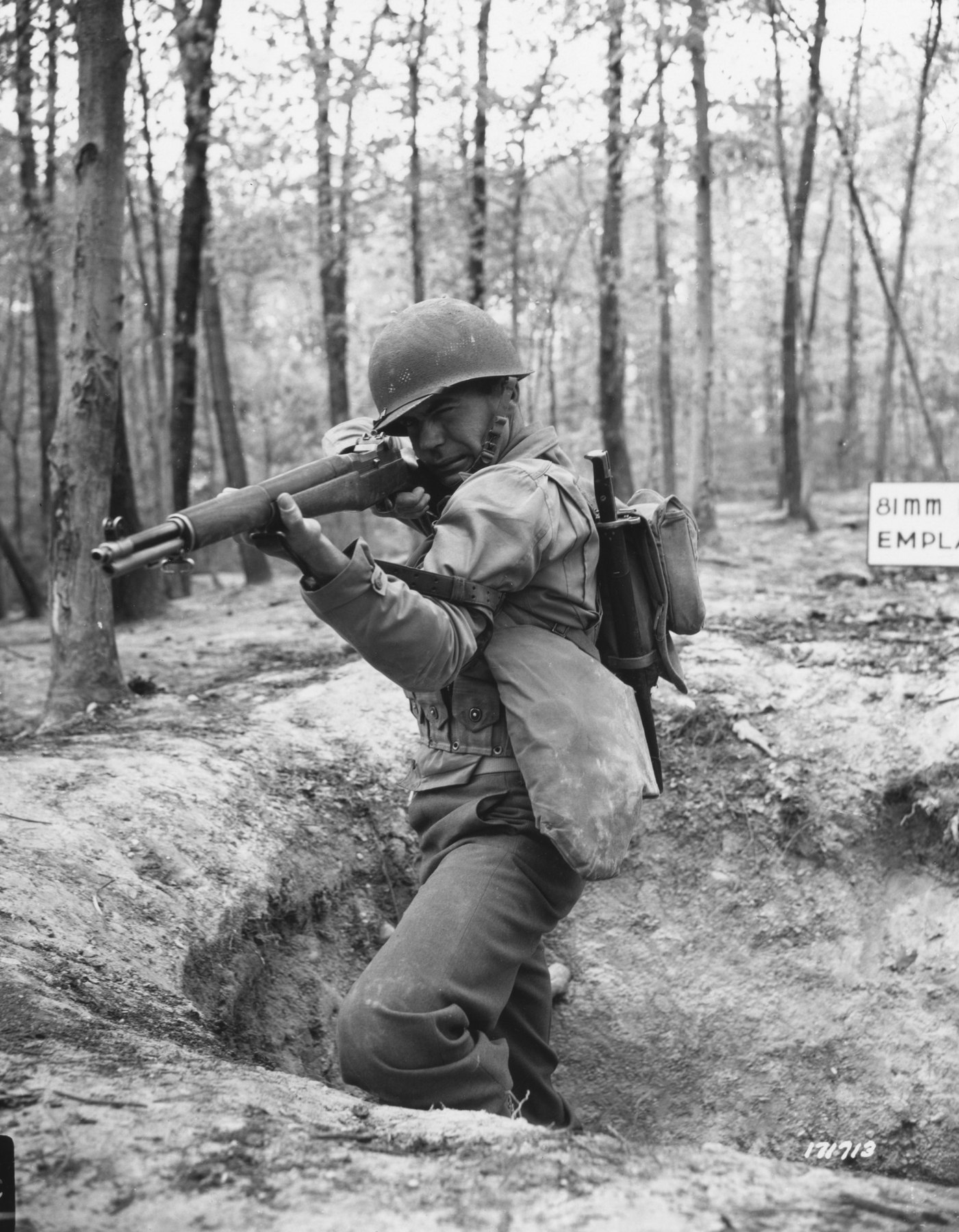
In September 1937 Springfield Armory was delivering ten M1 rifles a day. In January 1944 it built 122,001 of them in a single month. Between those two numbers sit a front end that had to be redesigned, a congressional hearing called while the British Army was being evacuated from Dunkirk, a second manufacturer brought in on an educational order, and a serial-number system that — as far as anyone has been able to reconstruct — let both factories stamp some of the same numbers.
That last point is where this dive’s example rifle comes in, and this volume is where the evidence for it lives. Vol 7 takes the rifle apart.
3.1 First Production and the Seventh-Round Stoppage
The first production M1 passed its proof and function firing on July 21, 1937. Deliveries began that September at ten rifles a day, and the Armory’s end-of-month serial numbers for the rest of the year show how slowly a new rifle comes up to rate: 120 by the end of August, 307 in September, 539 in October, 696 in November, 1,034 by the end of December.
The rate then climbed steadily, as Canfield records it:
Table 1 — The rate then climbed steadily, as Canfield records it
| Date | Daily rate |
|---|---|
| September 1937 | 10 |
| March 1, 1938 | 20 |
| July 1939 | 80 |
| September 1, 1939 | 100 |
| January 22, 1940 | 200 |
By November 1940 the end-of-month serials imply around 400 a day.
The first limited issue, in the fall of 1937, was just 48 rifles to five Army posts. Early problems included a “seventh-round stoppage” and actions that froze after water immersion; Canfield records that both were cured by re-calibrating tooling and changing to a graphite-based grease.
3.2 The Gas Trap
The rifles built from 1937 until 1940 did not have the gas system every M1 owner knows. They used a gas trap: a muzzle cap that caught gas at the muzzle and turned it back onto the piston. There was no port drilled in the barrel.
It did not hold up. Canfield lists the reasons:
- The screw that held the gas-cylinder plug could work loose.
- Carbon built up in the trap and was hard to clean — “It sometimes took a chisel to get out the accumulated carbon.”
- The bayonet attachment was weak.
- There was a risk of a bullet striking the gas cylinder and blowing it off the end of the barrel.
The replacement — a gas port drilled near the muzzle, with the gas cylinder and gas cylinder lock that are still on every M1 — was first tested in early 1939 and recommended for adoption on October 26, 1939. Winchester’s side of the change was approved on July 13, 1940, with $9,030 granted to cover it. When gas-port rifles actually began coming off Springfield’s line is given two ways by the same author: June 1940 in one article, late summer or early fall 1940 in another. The likeliest reconciliation is that parts deliveries started in June and assembled rifles followed later.
How many gas traps were made is also given more than one way. Canfield cites archival information for approximately 48,119; elsewhere he says “just over 50,000,” and original gas-trap serials as high as the 51,500 range have been reported by credible sources. The end-of-month table fits all of those — 46,221 at the end of June 1940, 51,970 at the end of July, 59,868 at the end of August.
Two cautions for anyone looking at an early rifle:
- A serial number does not identify a gas trap. Gas-port rifles assembled in mid-1941 exist in the 40,000 serial range, because receivers made earlier were used up later.
- Almost none survive unaltered. Canfield: “Virtually all of the early rifles were altered to later specifications just prior to and during World War II.” The unaltered ones are essentially those that were in museums or reference collections, or left the system by unofficial means. No count of survivors has been found.
Unaltered gas-trap rifles did fight — in the Philippines in 1941–42. In May 1942, General MacArthur said of them:
“The performance of this rifle under actual combat has been excellent. The weapon is operated without mechanical defects and has not developed stoppages from dust and dirt when used in fox holes. It has been used in almost constant action for as much as a week without cleaning or oiling.”
3.3 The Rifle on Trial, 1940
In 1940 the M1 very nearly lost its place, and not on the range.
On May 6, 1940, TIME ran “Wanted: a Rifle.” It reported that in the fourth year of testing the Army had discovered a defect serious enough to require a new barrel design, that 28,088 rifles with the “faulty barrel” were on hand as of February 16, and that 35,000 to 40,000 would be in service before corrected tooling arrived. It quoted a National Rifle Association test in which the rifle’s barrel “warped or buckled as it heated from our slow-fired shooting,” and a House subcommittee member, Rep. D. Lane Powers, saying Congress did not want to appropriate for more rifles “if what we hear and what we read and what we are told by some well-informed people is true.” The “barrel defect” was almost certainly the gas-trap front end, which was part of the barrel assembly — TIME’s framing, not a separate problem.
The challenger was Melvin Johnson’s rifle, a recoil-operated design. The two rifles were tested against each other at Fort Belvoir on May 9, 1940. On May 29 — the week the British Expeditionary Force was being taken off the beaches at Dunkirk — the Senate Military Affairs Committee held a hearing on S. 3983, a bill “to provide for the adoption of the Johnson semiautomatic rifle as a standard arm of the military and naval forces.” Johnson told the committee his rifle could be made faster than the Garand. Brigadier General Walter Delamater answered the question underneath the whole debate: “How long is it going to take us to get equipped; time is the most important factor.”
Congress let the matter drop by about July 1940; there was no case for adopting a second rifle when the first was in production.
The Marine Corps ran its own comparison in San Diego in November 1940 — the M1903 as a control, the M1, the Johnson, and a Winchester semi-automatic. Its finding: “In every instance except one, the M-1 proved superior to the M-1903 in musketry and combat exercises.” The Garand edged the Johnson; the Winchester came last. An earlier Marine test report, from May 1940, recorded 244,845 rounds fired with 131 stoppages.
Johnson found his customer elsewhere. The Netherlands Purchasing Commission placed an order in August 1940 for 10,200 rifles for the East Indies, and about 3,000 had been delivered when the Japanese took the islands in March 1942.
3.4 The Marines Were Not Resisters
It is often said the Marine Corps fought against giving up the Springfield. Andrew Stolinski’s archival review in American Rifleman shows the opposite:
- 1932 — the Navy asks for Marine trials of the experimental rifle; MacArthur refuses (Vol 2).
- 1936 — the Marines order 400 rifles.
- March 12, 1938 — “The first 100 M1 Garand rifles were received at the Philadelphia Depot.”
- September 1938 — 398 rifles go to the Depot, 2 to Quantico; the 6th Marines get 300.
- November 1940 — the San Diego comparison above.
- February 18, 1941 — “The Marine Corps formally adopted the rifle.” (Other sources give February 1.)
- February 1943 — enough M1s on hand to transfer surplus M1903s to the Navy.
What is true is that rifles were short in 1942. Most of the 1st Marine Division landed on Guadalcanal on August 7, 1942, with M1903s.
3.5 Winchester
Springfield was never going to be enough, and in the late 1930s the Army used a tool built for exactly this: the educational order, a small contract that paid a commercial firm to tool up and prove it could make a military item before a production contract depended on it.
- Contract W-ORD-343, dated April 4, 1939 (Canfield also gives March 1939), for 500 rifles plus one set of tools, fixtures and gauges for each part. Serials 100,001–100,500.
- A second contract for 65,000 rifles, awarded September 20, 1939 — while the educational order was still in work. Serials 100,501–165,500.
- First 100 educational-order rifles completed December 27, 1940; the educational order finished in March 1941.
- Production of the second contract began February 1941, shipments April 1941. Winchester had early trouble with operating rods made out of specification.
- Final contract February 1945; production cancelled June 1945.
Winchester’s wartime total is usually given as 513,880 — by Duff, and by Canfield in one article — though Canfield gives 520,492 “by June 1945” in another. Winchester also made en-bloc clips in very large numbers.
3.6 Springfield at War
Springfield’s own figures are the scale of the thing:
- Peak month: January 1944, 122,001 rifles — about 3,936 a day, or 164 an hour around the clock.
- Women made the rifle. At the wartime peak, the Park Service records 5,210 women working at the Armory, 45 percent of the workforce. (A second figure, 13,500 employees in 1943 with 43 percent women, circulates without a traceable source; the two do not agree.)
- Wartime production ended in October 1945, around serial 3,888,000. The last month-end figure in the table is 3,888,081.
- Springfield’s total from 1932 through 1945 is given by Duff as 3,526,922.
Together, Springfield and Winchester built something over four million M1s during the war. No authoritative wartime unit cost has been found. The widely repeated “$85” has no citation behind it, and the official Army Ordnance history that should hold the real figure was out of reach while this volume was written.
3.7 Serial Numbers — and Where They Collide
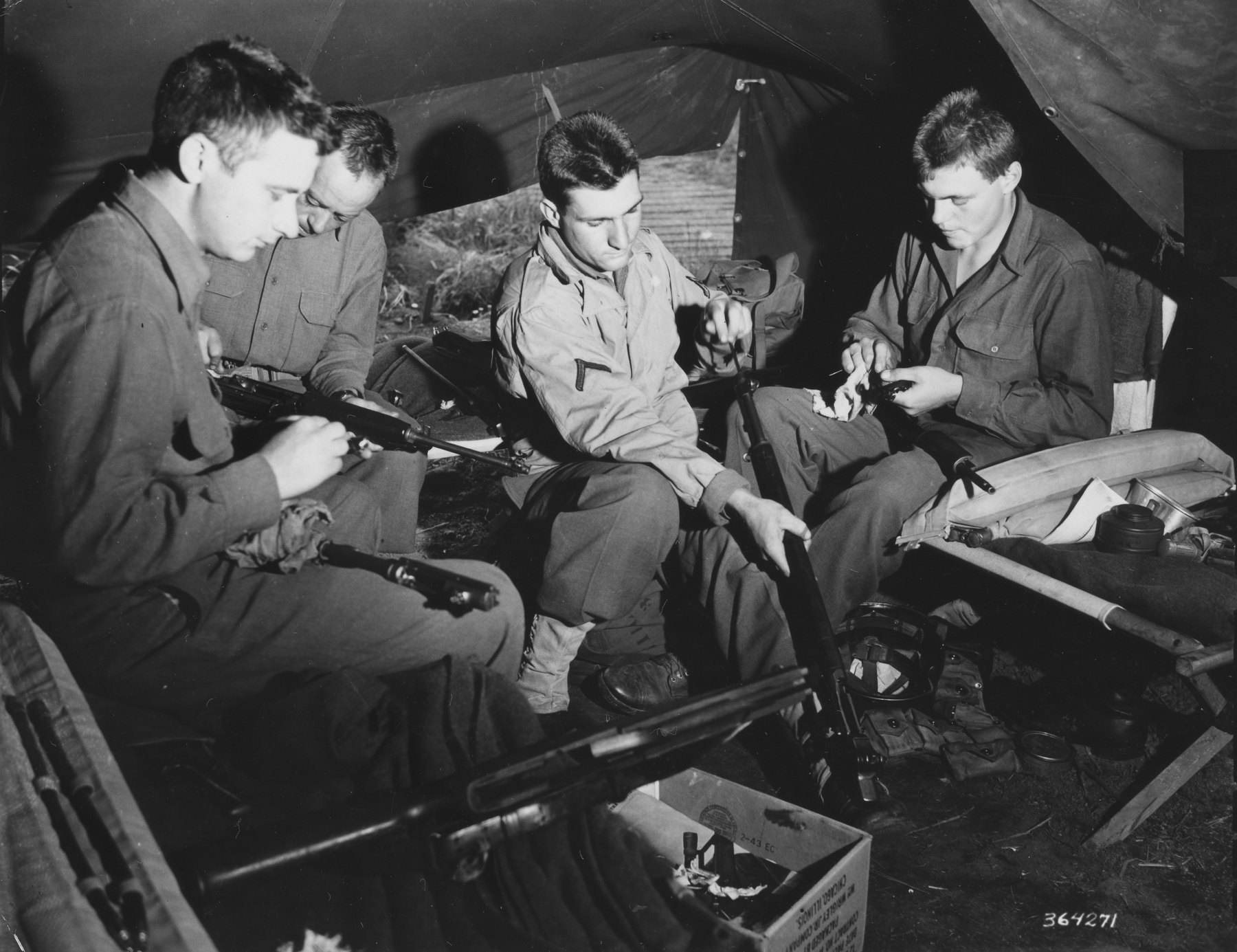
Every M1 carries its maker and serial number on the receiver heel. The Army assigned blocks of numbers to each manufacturer, and Springfield Armory National Historic Site publishes both the assigned blocks and, month by month, the last serial each maker reached. Both tables are credited to Scott Duff. This is the part of the rifle’s history that matters most to anyone holding a wartime Springfield or Winchester, because the two tables do not describe quite the same numbering — and in places the two makers’ numbers overlap.
3.7.1 The assigned blocks, 1936–1945
Table 2 — The assigned blocks, 1936–1945
| Serial range | Assigned to |
|---|---|
| 1 – 100,000 | Springfield |
| 100,001 – 165,500 | Winchester |
| 165,501 – 1,200,000 | Springfield |
| 1,200,001 – 1,357,473 | Winchester |
| 1,357,474 – 1,380,000 | ”Duplicate Numbers by W.R.A.” |
| 1,357,474 – 2,305,849 | Springfield |
| 2,305,850 – 2,655,849 | Winchester |
| 2,656,149 – 4,200,000 | Springfield |
The table itself flags the first overlap: Winchester numbered 1,357,474 through 1,380,000 inside Springfield’s range, and labels it as duplicates.
3.7.2 What each maker actually reached
The monthly table is where the second overlap shows. Around the turn of 1944 it reads:
Table 3 — The monthly table is where the second overlap shows. Around the turn of 1944 it reads
| End of month | Springfield | Winchester |
|---|---|---|
| August 1943 | 1,877,654 | 1,380,000, then 2,305,850 – 2,305,932 |
| December 1943 | 2,305,849 | 2,364,642 |
| January 1944 | 2,543,412 | 2,379,642 |
| February 1944 | 2,634,316 | 2,394,642 |
| May 1944 | 2,900,312 | 2,439,642 |
| June 1944 | 2,981,126 | 2,454,642 |
| December 1944 | 3,359,159 | 2,533,142 |
| January 1945 | 3,450,503 | 2,536,600, then to the 1.6 million range |
Three things fall out of that table:
- Winchester started its 2.3 million block in August 1943 and was still working through it at the end of 1944.
- Springfield’s month-end jumps from 2,305,849 to 2,543,412 between December 1943 and January 1944 — 237,563 numbers in the month Springfield built 122,001 rifles. Its December figure is the last number of its own block. Its January and February figures are inside Winchester’s assigned block.
- In January 1945 Winchester switched to the 1.6 million range. The Park Service note says the 2.5 million numbers “stopped in the area of 2,535,XXX,” that about 40,000 of these “WIN-13” rifles were made, and that serials between 1,602,XXX and 1,639,XXX have been observed. Those numbers were already on Springfield rifles made in May and June 1943.
3.7.3 The documented duplicates
This is not only an inference from arithmetic. Duplicate Springfield and Winchester rifles are documented:
- July 1960, American Rifleman. A short article with a photograph of a Springfield rifle and a Winchester rifle both serialed 2445470 — reported by Scott Duff, who has written the most careful account of the problem. The 1960 page itself was not examined for this dive.
- The 1987 Garand Collectors Association survey. Duff’s analysis of serial numbers contributed by members “revealed several blocks of assigned serial numbers that were duplicated.” It was published in his The M1 Garand: World War II, chapter 4. The web version of his article does not list the blocks.
- Duff-derived tables note duplication “particularly in the range of 2,305,800 to 2,533,400.”
- The “A” suffix. “The military procedure was to stamp one of the pair in this way when duplicate serial numbers were discovered.” Duff’s example pair is Springfield 1611010A and Winchester 1611010 — in the WIN-13 overlap, not the 2.4 million band. Only a pair that was discovered — typically because both rifles ended up on the same unit’s property books — would get the A.
3.7.4 What nobody has explained
No document has been found that explains why Springfield’s numbering jumped into Winchester’s block, or who ordered the A suffix and when. Neither the Park Service tables nor Duff’s published articles say. The leads are Duff’s book and the Office of the Chief of Ordnance records at the National Archives; neither was examined for this dive.
What the tables do support, as reasoning rather than record:
- If Springfield’s 122,001 January 1944 rifles were numbered consecutively up to 2,543,412, they ran from about 2,421,400 to 2,543,412, and Springfield skipped roughly 2,305,850 to 2,421,400.
- Winchester reached that same stretch between April 1944 and January 1945.
- So a Springfield rifle and a Winchester rifle could share a number anywhere from about 2,421,400 to about 2,536,600 — which is exactly where the 1960 pair, 2,445,470, sits. On Winchester’s table that number falls in June 1944; on Springfield’s it would be January 1944.
- Springfield’s February 1944 numbers, 2,543,413 to 2,634,316, are also inside Winchester’s assigned block but above anything Winchester actually reached, so by the same reasoning they should have no twins.
The rifle documented in Vol 7 is Springfield 2,450,021 — 4,551 numbers above the 1960 pair, with no A. Its Winchester twin, if one survives, would have been made in about June 1944. Vol 7 has the photographs.
3.8 Patton’s Letter
The most quoted sentence about the M1 is real, and it is a written one. On January 26, 1945, Lieutenant General George S. Patton Jr. wrote on Third Army letterhead to Major General Levin H. Campbell Jr., the Chief of Ordnance:
“In my opinion, the M-1 Rifle is the greatest battle implement ever devised.”
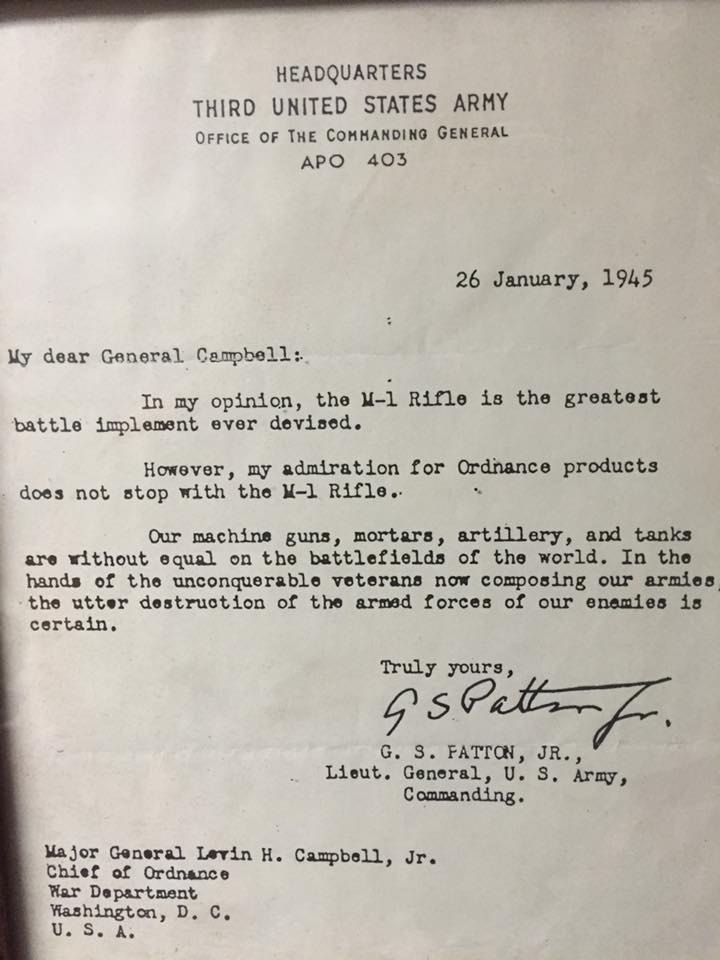
Two things are worth knowing about it. The first is that the sentence is the opening of a letter praising a whole list of Ordnance products — the machine guns, mortars, artillery and tanks are all in the next paragraph — so it is a general’s thank-you note to the Ordnance Department, not a considered ranking of weapons. The second is that the letter spells it “M-1.” The Wikimedia Commons file of this image is titled as a letter to Springfield Armory, which does not match the addressee on the page; the Commons title may be a mislabel, or there may be a second letter. A second Patton letter to Springfield (“I consider the M1 the greatest weapon ever made”) is reported by one source, but its date and text were not examined for this dive.
Patton said something similar earlier and less formally. His Letter of Instruction No. 2, April 3, 1944: “The M-1 rifle is the most deadly rifle in the world. If you cannot see the enemy, you can at least shoot at the place where he is apt to be.”
3.9 The Ping
The story goes that enemy soldiers listened for the clang of an empty en-bloc clip, knew the rifleman was empty, and rushed him.
Canfield’s verdict is flat: “there is no documented evidence that even one casualty was inflicted because of the sound, and the entire scenario is highly implausible.”
The best primary evidence is from Korea, not the Second World War. A 1952 Operations Research Office study, Use of Infantry Weapons and Equipment in Korea (ORO-T-18), asked riflemen about it:
Table 4 — The best primary evidence is from Korea, not the Second World War. A 1952 Operations Research Office study, Use of Infantry Weapons and Equipment in Korea (ORO-T-18), asked riflemen about it
| The noise of the ejected clip was… | Men |
|---|---|
| Helpful to the enemy | 85 |
| Helpful to know when to reload | 187 |
| Of no importance | 43 |
The report adds that “half the men had a nagging fear that some day the noise made in releasing the safety would reveal their positions to the enemy, yet only one-fourth objected to the distinctive noise the empty clip made.” The soldiers worried more about the safety than the ping.
So the ping was a real belief, held by a real minority of the men who carried the rifle, with no documented case of it getting anyone killed. That is not proof it never happened once, and it should not be written that way.
3.10 Britain’s Garands
Under Lend-Lease, 38,001 M1s went to Britain in 1941–42. They saw little wartime use — the Home Guard, airfield security, some commandos — and carried a two-inch red band painted around the stock with the caliber stenciled on it. In the mid-1950s they were sold off with British proof marks applied for export, bought by Sam Cummings’s Interarmco, and sold to Americans from February 1959 at $79.95, or $89.95 for “near-mint.”
Sources
- National Park Service, Springfield Armory National Historic Site: “U.S. Rifle M1 Garand Serial Number Ranges” (assigned blocks and monthly serials, credited to Scott A. Duff); “U.S. M1 Garand Rifle Production”; “Woman Ordnance Workers.”
- Scott A. Duff, “Seeing Double: Duplicate Serial Number – Springfield Armory and Winchester M1 Rifles” (2022) and “Who Made M1 Garands?” (2022); The M1 Garand: World War II (1993), ch. 4.
- Bruce N. Canfield, American Rifleman: “The First Garands”; “‘Gas-Trap’ Garand: The First M1 Rifle Design”; “‘Gas-Trap’ Rifles: The Unknown M1 Garand” (1994); “The Winchester Garand”; “Wartime Winchesters”; “The En Bloc Clip: Don’t Blame John Garand.”
- Andrew Stolinski, “Marines & The M1 Garand: The First 400,” American Rifleman.
- “Army & Navy: Wanted: a Rifle,” TIME, May 6, 1940.
- Library of Congress press photograph, Senate Military Affairs Committee and the Johnson rifle, May 29, 1940; Tom Laemlein, “M1 Garand vs. M1941 Johnson Rifle Debate,” The Armory Life.
- Allan D. Cors, “John C. Garand’s Rifles: His Very Own,” ASAC Bulletin 101 (MacArthur’s 1942 remarks).
- T. Logan Metesh, “Patton & the Garand,” The Armory Life (2020); The Firearm Blog, “Patton’s Garand Quotes” (2016).
- Operations Research Office, Johns Hopkins University, Use of Infantry Weapons and Equipment in Korea, ORO-T-18 (FEC), 1952, pp. 5, 18, 51, as transcribed by The BS Historian (2017).
- Scott A. Duff, “Garands in the King’s Service,” American Rifleman (2016).
- biggerhammer.net, M1 Garand serial-number tables (used with Duff’s permission).
Comments (0)