M1 Garand · Volume 4
Korea, the Post-War Makers, and the End of Service
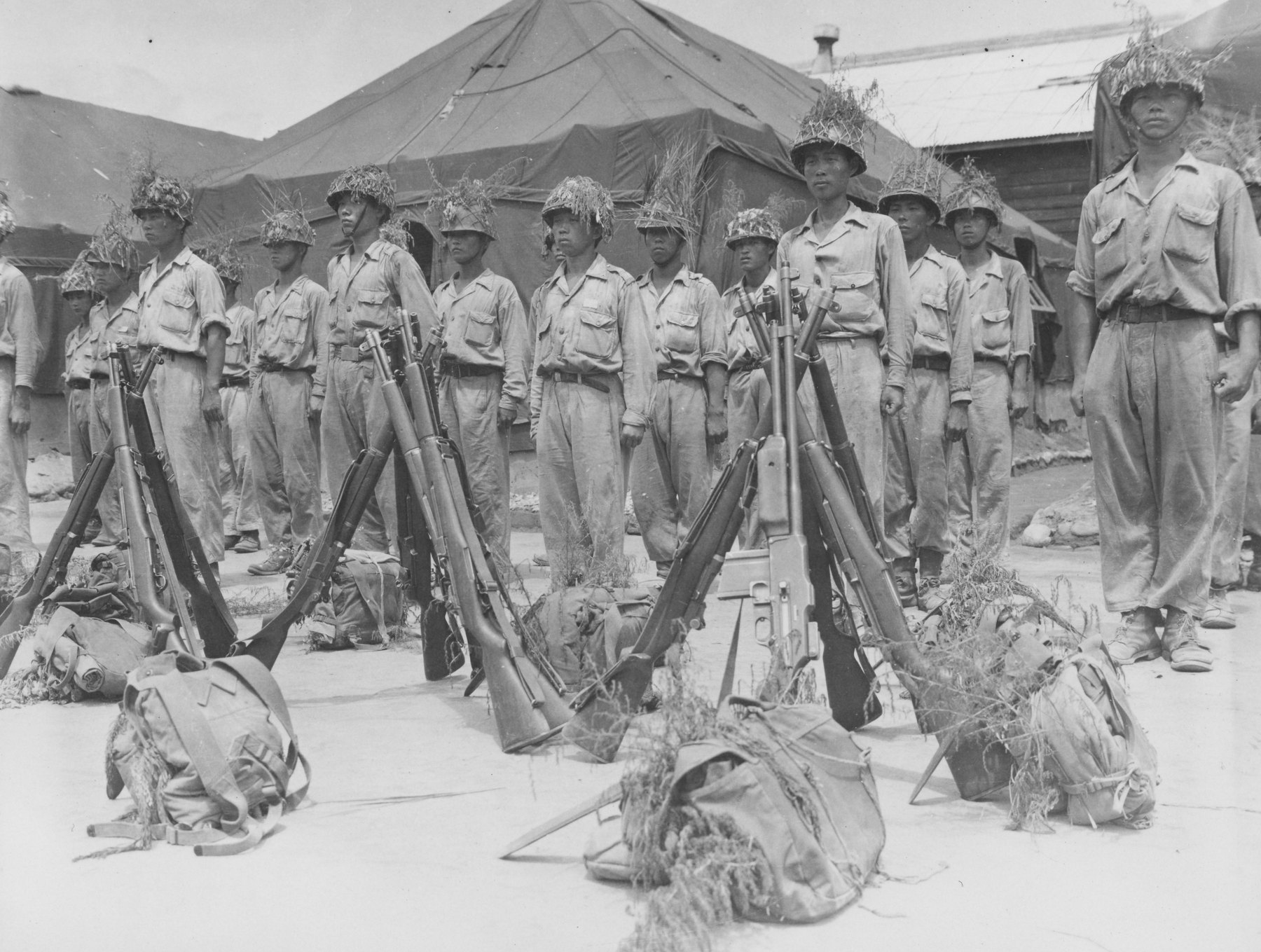
The Second World War ended with millions of M1s in inventory and most of them worn. What happened to those rifles over the next twenty years — rebuilt, re-issued, re-barreled, sent to allies, made again from scratch by three new manufacturers, accurized for Camp Perry, and finally sold to civilians — is the reason almost no M1 anyone owns today is in the configuration it left the factory in. Springfield 2450021, this dive’s example rifle, is one of them: a wartime receiver carrying a 1950s bolt, a late-1950s National Match operating rod, and a barrel made in 2000.
4.1 Rebuilt, Not Retired
From the end of the war into the 1960s, M1s went through arsenal overhaul programs at Springfield, Rock Island, and a long list of depots. A rifle was broken into major groups, inspected, had worn or superseded parts replaced, and was refinished. Parts went back into the bins, not back into the same rifle, which is how rebuilt M1s end up with parts from several makers and decades.
The scale of the parts program is the clue to how thoroughly the fleet was reworked. In fiscal years 1945 through 1948, Springfield alone made 563,310 barrels, 529,172 operating rods, 291,971 stocks, 787,307 front handguards and 893,736 rear handguards for replacement.
Typical changes made during overhaul:
- The T105E1 rear sight, adopted late in the war, fitted in place of earlier sights.
- Operating rods given a relief cut, a modification to address rods binding.
- Large trigger-housing pads milled down.
- Worn and superseded parts replaced as a matter of course.
4.1.1 How to read a rebuild
Rebuilds are identified mostly by the inspection stamps — cartouches — on the stock, and in the 1960s by etched codes on the receiver. Canfield’s list is the standard reference:
Table 1 — Rebuilds are identified mostly by the inspection stamps — cartouches — on the stock, and in the 1960s by etched codes on the receiver. Canfield's list is the standard reference
| Mark | Where | When | Whose |
|---|---|---|---|
| SA / SHM | Springfield | about Nov 1945 – Aug 1947 | Col. Stephen H. McGregor |
| SA / SPG | Springfield | to about 1950 | Stanley P. Gibbs, civilian inspector |
| SA / JLG | Springfield | from July 1950 | Col. James L. Guion; overhaul and new 1952–53 production |
| RIA / FK | Rock Island | 1941 – 1946 | Frank Krack |
| RIA / EB | Rock Island | 1947 – 1958 | Elmer Bjerke |
| AA, BA, HOD, SAA, OG, AN, MR, RA, RRA / RRAD | Augusta, Benicia, Hawaii, San Antonio, Ogden, Anniston, Mt. Rainier, Raritan, Red River | various | depot marks, usually with inspector initials |
| Electric-pen etch on the right receiver leg | Letterkenny (LEAD), Tooele (TE), Springfield (SA), Red River (RRA / RRAD) | 1960s | usually with month and year, and a boxed “P” proof on the grip |
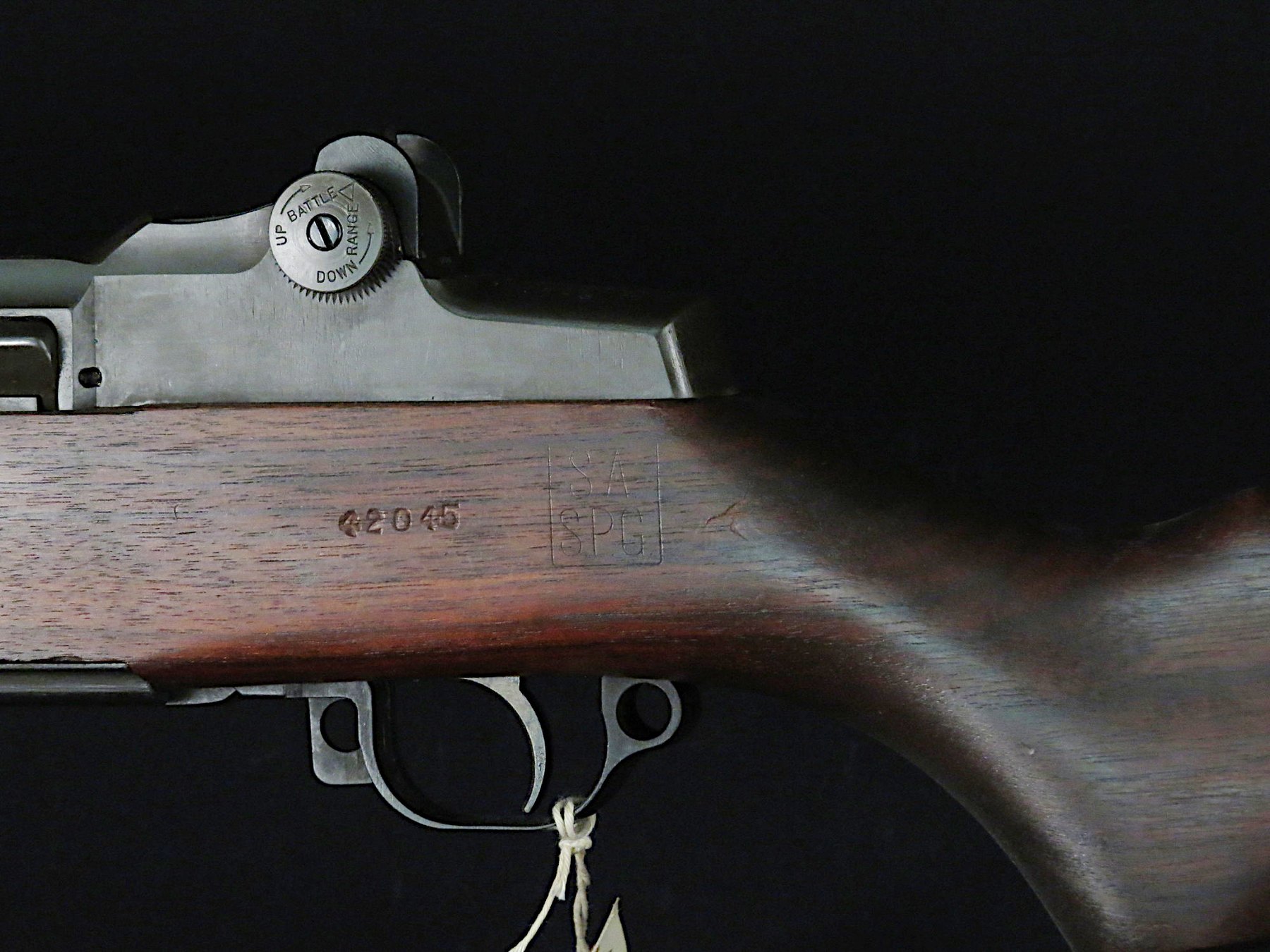
Some commonly repeated rebuild codes — “AMD” for Anniston, for example — did not appear in any source that could be verified, and they are left out rather than listed on trust.
4.2 Korea
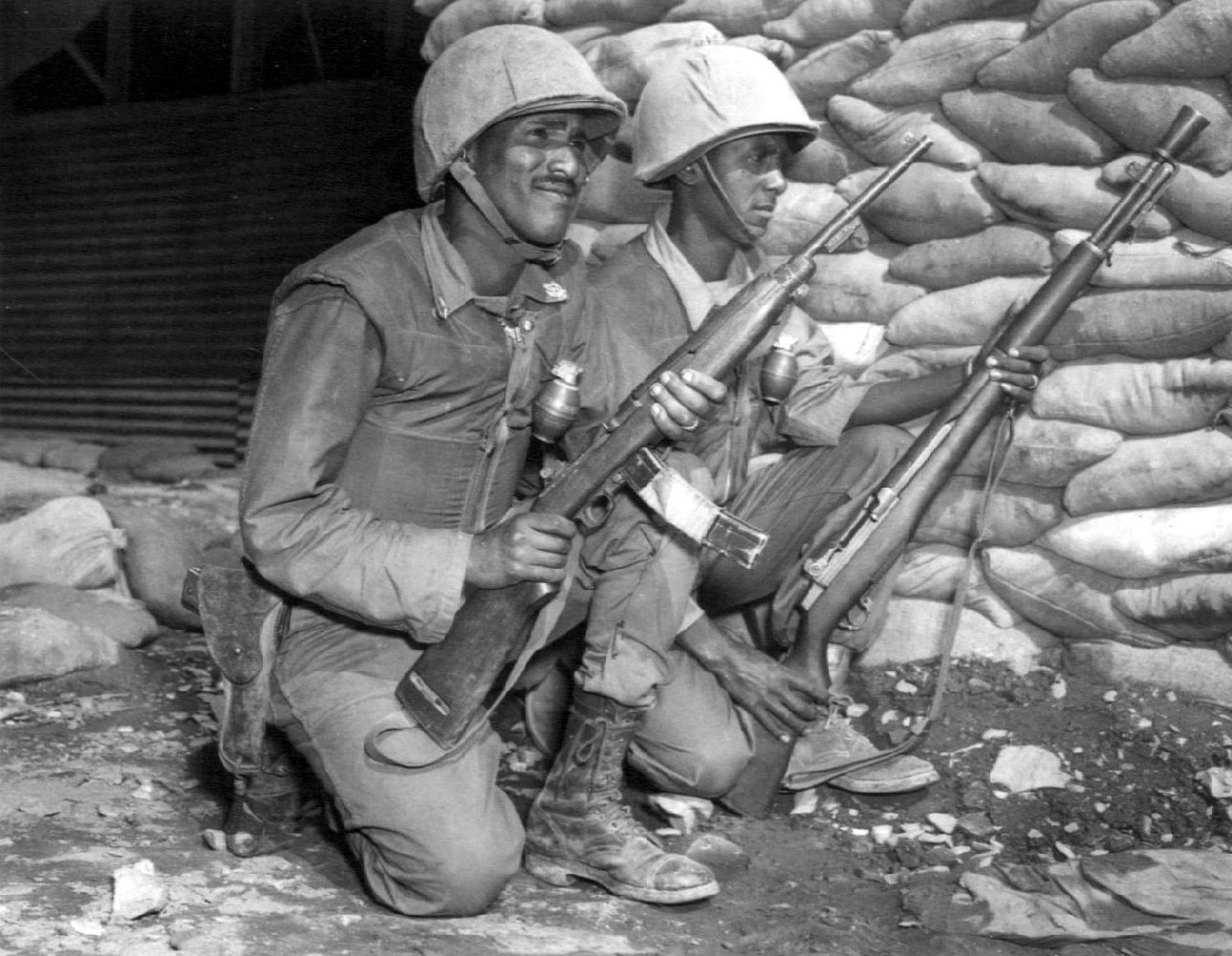
The rifles that went to Korea in 1950 were overwhelmingly the rifles that had come home from the Second World War. Frank Iannamico: “despite a production run during the 1950 to 1953 war era, most of the M1 rifles used during the war were refurbished weapons of World War II vintage.”
S. L. A. Marshall’s winter 1950–51 commentary for the Operations Research Office is often quoted as saying the rifle “has performed adequately in Korea and is regarded by troops with a liking amounting to affection.” That wording comes only from a search excerpt, not from the scan, and Marshall’s other conclusions from Korea — especially his ratio-of-fire claims — are contested by historians. The soldiers’ survey on the clip noise is in Vol 3.
4.3 New Rifles, 1952–1957
The Korean War restarted production, and for the first time since 1945 there were three American manufacturers.
4.3.1 Springfield Armory
New post-war M1s came off Springfield’s line from 1952. Serial blocks: 4,200,001–4,399,999 (1952–54); 5,000,000–5,000,500 (August 1952); 5,278,246–5,488,246 (1954–55); 5,793,848–6,099,905 (1955–57).
The total is given two ways: 661,747 including National Match variants (Canfield, the Park Service, and Cors), or 637,420 “service grade” (Duff). The difference is close to the number of new National Match rifles, which may be the reconciliation, but no source says so.
The last M1 came off the Springfield line at 10:43 a.m. on May 17, 1957, serial 6,084,405 — sixteen days after the Department of Defense announced the rifle that would replace it.
4.3.2 International Harvester
The farm-equipment maker won a contract on June 15, 1951, for 100,000 rifles, built in Evansville, Indiana. It struggled to get into production — mass production only by the second quarter of 1953 — and repeatedly had to obtain receivers from Springfield. American Rifleman’s account notes that “no fewer than 152 machining operations went into the creation of one receiver,” and that the acceptance test required “all eight shots inside of a 5-inch circle.” Production ended around the turn of 1956 at 337,623 rifles — a total every source agrees on. Serials 4,400,000–4,660,000 and 5,000,501–5,278,245.
4.3.3 Harrington & Richardson
Contracts on April 3, 1952 (100,000) and June 25, 1952 (31,000 more). Production ended May 1956 at 428,600. Serials 4,660,001–4,800,000 and 5,488,247–5,793,847, plus a 400-rifle overrun, 6,034,330–6,034,729, taken out of Springfield’s block. Some collectors rank H&R rifles among the best-made M1s.
4.3.4 The total
Adding Springfield’s wartime 3,526,922, Winchester’s 513,880, Springfield’s post-war 661,747, International Harvester’s 337,623 and H&R’s 428,600 gives 5,468,772 U.S.-made M1s — the figure Duff and Leroy Thompson both publish. Note that it only adds up using the 661,747 post-war figure, not the 637,420 Duff also lists. The frequent claim that “more than six million” were made is not supported by any maker-by-maker table found for this dive; it may come from reading the top serial numbers, which run past six million but contain large unused gaps.
4.4 Italy — Beretta and Breda
Beretta and Breda began making M1s around 1950, according to American Rifleman, “using the same tooling that Winchester had used to produce the rifle during World War II.” Other sources date licensed production to 1952. Their output went to Italy, Denmark and Indonesia, among others. The Italian total is unresolved — figures of about 100,000 and about 300,000 both circulate, and neither is well sourced.
Italy also converted M1s to 7.62 NATO, and in 1957 Beretta engineers Domenico Salza and Vittorio Valle began the BM59 — a select-fire M1 with a detachable 20-round magazine, adopted by Italy in 1962 and used by at least eight other countries.
4.5 Snipers — the M1C and M1D
Both sniper variants began as wartime prototypes: the M1E7, with a scope bracket on the left side of the receiver, and the M1E8, with a block mount.
4.5.1 M1C
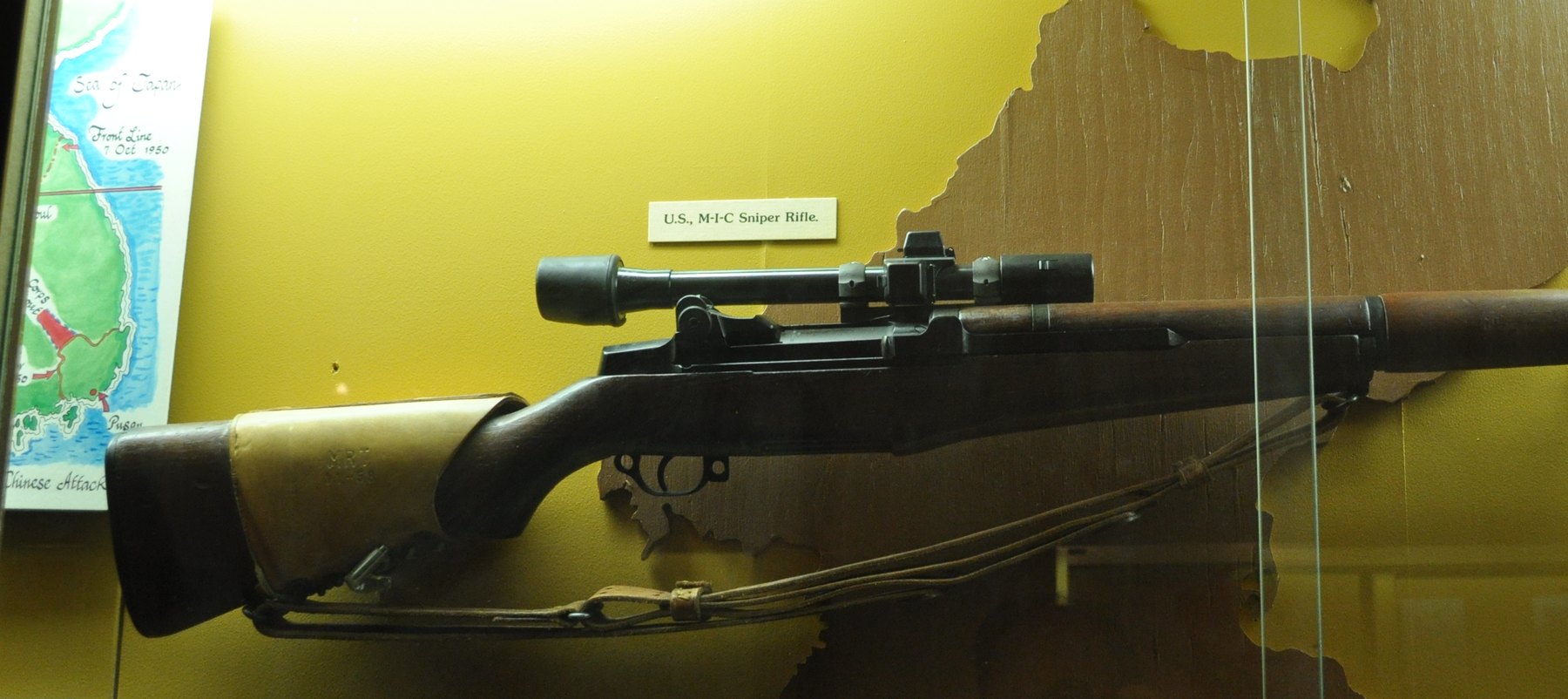
Standardized as “U.S. Rifle, Cal. .30, M1C, Snipers” — Canfield gives July 27, 1944; other sources say June 1944. Its mount was a Griffin & Howe design, and this is the detail that matters to anyone looking at a drilled M1:
“Five holes were drilled into the side of the M1C receiver for attachment of the mounting bracket. Three of the holes were threaded for screws and two were for taper pins.” — Canfield
Springfield 2450021, the rifle documented in Vol 7, has three threaded holes and no taper-pin holes in the left receiver wall, from a commercial Simmons side mount. That is not an M1C, and a collector will not mistake it for one. Vol 7 has the photographs.
M1C scopes were the M73 (a Lyman Alaskan), modified and redesignated M81 (crosshair) and M82 (tapered post), with an M2 flash hider and a leather cheek pad. Only 7,971 complete M1Cs were made during the war, and they reached service in the closing days of the Pacific war; another 4,796 were made in 1951–53. The M1C did most of its fighting in Korea — though Canfield doubts that any meaningful number of the 1951–53 rifles got there.
4.5.2 M1D
Adopted in September 1944 as “substitute standard.” Its mount was a block on a special barrel, designed by John Garand, taking the M84 (2.2×) scope and a leather cheek pad while leaving the iron sights usable. No M1Ds were made new: every one was converted from an existing M1, though Springfield made a large number of M1D barrels in 1951–53. The quantity is given as 21,380 (Canfield, 2014) or 14,325 ordered in December 1951 (a secondary source) — possibly a total and an order. The Park Service records M1D use in Korea and Vietnam, and on a limited basis by U.S. snipers as late as the 1991 Gulf War.
4.6 The Experimentals
- T26, the “Tanker Garand.” The name is a post-war collector invention. The Park Service: the shortened rifle was field-modified by a Sixth Army ordnance unit in the Philippines for paratroopers, sent to Springfield for testing in 1945, and is “erroneously referred to as the ‘Tanker Garand.’” About 150 were modified in the field; 15,000 were planned just before V-J Day.
- T20 — a select-fire M1 with a 20-round detachable magazine, developed by Garand in 1944–45. An order for 100,000 T20E2 rifles was placed in 1945 and cancelled with the end of the war.
- T35 — an M1 with a Sanford integral 10-round magazine, tested 1953–54.
4.7 National Match Rifles
In 1953 the Chief of Ordnance directed Springfield to select 800 M1s for the National Matches at Camp Perry, which Canfield calls the genesis of the true National Match Garand.
- Type 1 (1953 to about 1959) — carefully selected and tuned service rifles, “NM” on the barrel, no glass bedding. From 1953 through 1959, 16,032 new NM rifles were produced, though fewer than 4,000 were sold.
- Type 2 added features year by year:
Table 2 — - Type 2 added features year by year
| Year | Added |
|---|---|
| 1958 | NM gas cylinder; NM front sight optional |
| 1959 | Half-minute windage rear sight |
| 1960 | Glass bedding — the defining Type 2 feature |
| 1961 | NM operating rod; annual code on the barrel; serial on the floorplate |
| 1962 | Hooded aperture marked “NM/2” |
| 1963 | Aperture marked “NM/2A” |
The operating rod on Springfield 2450021 is a later 7790722-RA rod made by Remington and stamped NM on the handle — the final operating-rod design, gauged for National Match use. Vol 7 and Vol 16 cover what that means for a rifle like this one.
The M14 began replacing the M1 at the National Matches in 1964. The NM program moved to Rock Island around 1967, and sales of National Match M1s were suspended in 1973. Quantity figures for all National Match production disagree badly across sources — from 16,032 new through 1959 to over 21,000 new and 23,000 rebuilt through 1963 — partly because some rifles were rebuilt more than once.
4.8 The Navy’s 7.62 NATO Garands
When the services went to 7.62 NATO, the Navy kept M1s and converted them, because “it was deemed prudent to have commonality of ammunition with the M14.” The program began with $25,000 appropriated in 1959 at the Naval Ordnance Plant in York, Pennsylvania.
- Mk 2 Mod 0 — the original .30 barrel with a chamber bushing.
- Mk 2 Mod 1 — a new 7.62 barrel; the Navy contracted for 30,000, made 1965–66.
The bushings “tended to become loose and could be ejected,” and neither Loctite nor grooves cut in the chamber fully fixed it. Conversions were done by AMF (York) and H&R — roughly 17,000 and 15,000, three quarters of them Mod 0, though the published figures do not add up cleanly. The Navy’s accuracy program was sobering: of 1,869 rifles accurized, 84 met the Grade A standard.
4.9 The M14 and the End of Front-Line Service
On May 1, 1957, the Department of Defense announced that the T44 would be adopted over the T48 (the FN FAL) as the M14. M1 production ended sixteen days later. The first 50 M14s went to Ordnance in July 1959; the 101st Airborne had them in late 1961, and many units were partly or fully equipped by the Cuban Missile Crisis in October 1962.
When the M1 actually left front-line service depends on who is counting and which service: the Army began phasing it out as early as 1959, and Canfield has it in front-line use until at least the early 1960s. It remained in reserve, Guard and training service long after that.
4.10 The Rifle Abroad
After the war the M1 went to allies by the hundred thousand under Greek-Turkish Aid (1947) and the Mutual Defense Assistance Act (1949). Quantities vary wildly between sources, and they are given here as ranges of confidence, not as settled numbers:
Table 3 — After the war the M1 went to allies by the hundred thousand under Greek-Turkish Aid (1947) and the Mutual Defense Assistance Act (1949). Quantities vary wildly between sources, and they are given here as ranges of confidence, not as settled numbers
| Country | Figure | Source and confidence |
|---|---|---|
| Greece | 186,090 M1 and 1,880 M1C/M1D | Walter, Rifles of the World — medium |
| Turkey | 312,430 M1 (1953–70) | Walter — medium |
| Norway | 72,800 | Walter — medium |
| Denmark | 69,810; or 20,000 loaned plus 49,000 bought, plus 20,000 Italian-made | Walter; Forgotten Weapons — medium |
| Philippines | 34,300 M1 and 2,630 M1D delivered — but nearly 87,000 returned to the U.S. in 2018 | the delivered figure is low confidence; the return is from a GAO report |
| South Korea | 41,897 before 1949 and 471,839 during the war | low to medium |
| South Vietnam | 220,300 M1 and 520 M1C/M1D | low to medium |
| Italy | more than 100,000 by 1950, before domestic production | medium |
The Philippines row cannot be right as stated — a country cannot return two and a half times what it was sent — so one of those figures is wrong, or rifles went there by more than one route.
The M1 also turns up in ceremonial service in Guatemala, Japan, Greece and Taiwan (chrome-plated at the Martyrs’ Shrine in Taipei), and in the hands of irregulars in Iran, Liberia, the Philippines, Iraq, Lebanon and Yemen in recent decades.
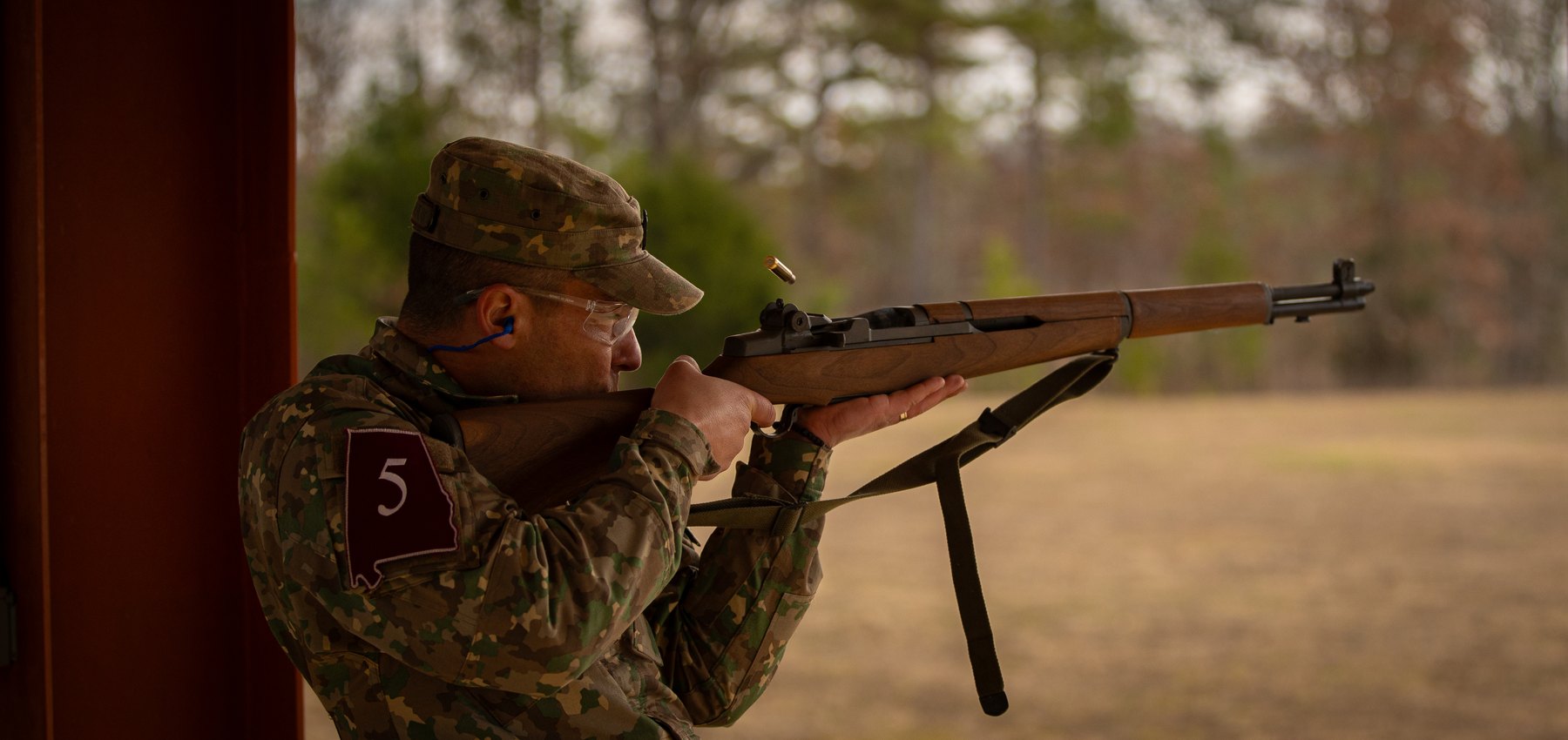
4.11 Coming Home — the DCM and the CMP
The civilian marksmanship program predates the M1 by thirty years. It traces to the War Department appropriations act of 1903, backed by Theodore Roosevelt.
- Civilian M1 sales through the Director of Civilian Marksmanship began in the mid-1950s (an October 1955 American Rifleman notice is reported, but was not examined for this dive), limited at first to NRA members enrolled with the DCM. National Match rifles were sold by mail from 1956 to 1973.
- 1979 — a federal judge struck down the NRA-membership requirement.
- 1996 — the National Defense Authorization Act moved the program out of the Army to a federally chartered nonprofit, the Corporation for the Promotion of Rifle Practice and Firearms Safety — the CMP — effective September 30, 1996.
- By September 30, 1998, 29,504 M1s had been transferred to the Corporation, 14,947 sold to individuals, and 230,590 remained stored at Anniston awaiting transfer. Prices were $400 to $750 by condition.
- Since 1996, the Army has transferred more than 700,000 surplus rifles and handguns to the CMP.
- In fiscal year 2018 the CMP received about 100,000 M1s recovered from foreign aid — more than 13,000 from Turkey and nearly 87,000 from the Philippines.
Importers tried to bring the rest home too. In 2010 the administration blocked the sale of 87,310 M1 Garands and 770,160 M1 carbines from South Korea to American importers, after approving it in 2009; Century Arms laid off 41 employees in 2014 and blamed the denial.
By 2026, the CMP’s surplus M1 pipeline has effectively closed. Vol 17 covers what is left to buy and how.
Sources
- Bruce N. Canfield, American Rifleman: “M1 Garand Rebuilds: History & Markings” (2003); “Post-World War II M1 Garand Rifles” (2006); “The M1C Garand Sniper Rifle”; “The National Match M1 Garand” (2011); “7.62 NATO U.S. Navy Garand Rifles” (2013); “The M14 Rifle: John Garand’s Final Legacy”; “Unexpected Longevity: Foreign Use of the M1 Garand.”
- Scott A. Duff, “Who Made M1 Garands?” (2022).
- National Park Service, Springfield Armory National Historic Site: serial-number ranges; “M1 Variations.”
- Frank Iannamico, “M1 Rifle of the Korean War,” Small Arms Review V10N1 (2006).
- S. L. A. Marshall, Commentary on Infantry Operations and Weapons Usage in Korea, Winter of 1950–51, ORO (DTIC AD0000342).
- Evan Brune, “Making the M1 Garand at International Harvester,” American Rifleman.
- Martin K. A. Morgan, “Evolution of the BM-59,” American Rifleman.
- Tom Laemlein, “The M1C and M1D Garand Sniper Rifles,” The Armory Life.
- John Walter, Rifles of the World, 3rd ed. (Krause, 2006), p. 147.
- U.S. General Accounting Office, GAO/NSIAD-99-41 (1999); U.S. Government Accountability Office, GAO-19-287 (2019); Congressional Research Service, Report 97-716 (1997).
- Art Merrill, “Last War for the Garand: Cold War Veterans Finally Come Home,” Shooting Sports USA (2018).
- Allan D. Cors, “John C. Garand’s Rifles: His Very Own,” ASAC Bulletin 101.
Comments (0)