M1 Garand · Volume 1
Overview — The Rifle That Went to War in the Army's Own Cartridge
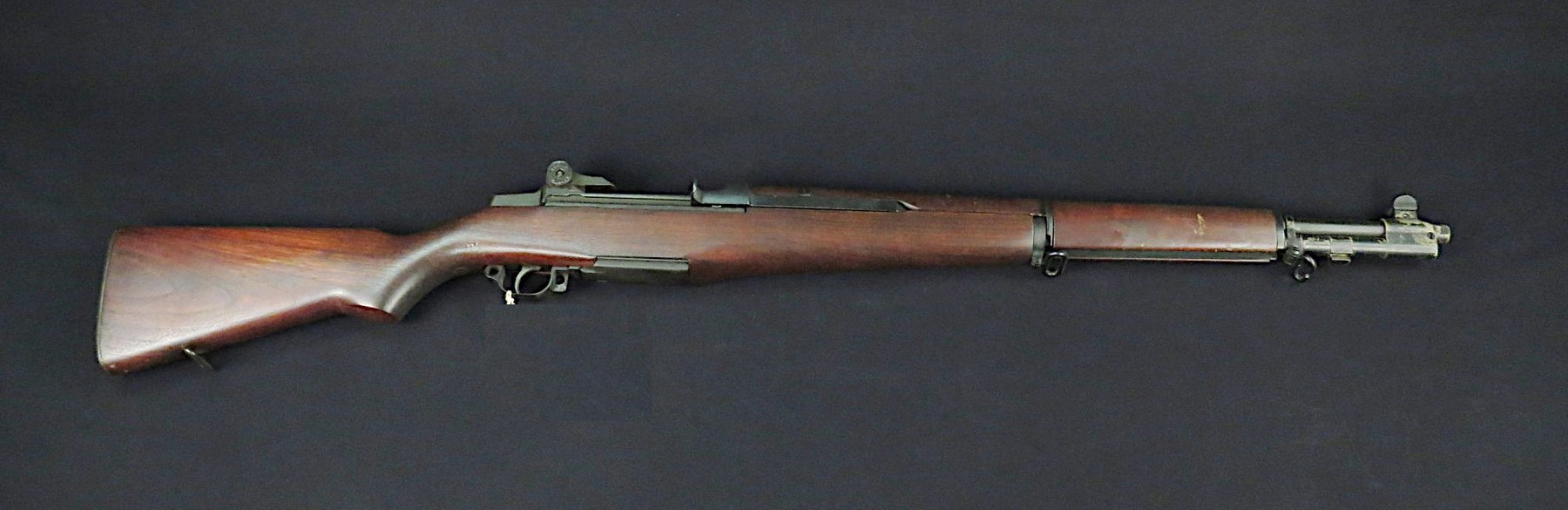
Every infantry rifle of the Second World War except one was a bolt action. The exception was the M1, and the United States was the only major army to go to war with a semi-automatic as its standard rifle. It was designed by a civil-service machinist who never received a royalty, it survived a congressional attempt to replace it in the same week as Dunkirk, and more than five million were built across two wars by five manufacturers.
The rifle this dive is built around was bought in September 2026, and it turned out to be more interesting than expected. Its receiver is a wartime Springfield stamped with a serial number from a block the Army had assigned to Winchester — in the band where the two factories are documented to have stamped the same numbers. Almost nothing else on it is original. That combination, a genuinely unusual receiver on an ordinary shooter, is why this dive exists, and Vol 7 takes that rifle apart.
The rest of the dive is the rifle itself: where it came from, how it works, how to take it apart and keep it running, what to feed it, how to fit a bayonet, and what the period kit looked like.
1.1 What It Is, in One Table
Table 1 — What It Is, in One Table
| Designation | U.S. Rifle, Caliber .30, M1 |
| Designer | John C. Garand, Springfield Armory |
| Standardized | January 9, 1936 (the “M1” name was first applied August 3, 1933) |
| Cartridge | .30-06 Springfield; Cal. .30 Ball M2 as issued |
| Operation | Gas-operated through a port near the muzzle; operating rod with integral piston; rotating bolt with two locking lugs |
| Feed | Eight-round en-bloc clip, inserted with the ammunition and ejected after the last shot |
| Barrel | 24 inches |
| Overall length | 43 inches |
| Weight | About 9.5 pounds without equipment; 11¾ pounds with sling, clip and equipment (1965 field manual) |
| Muzzle velocity | 2,750–2,800 ft/s (1969 technical manual) |
| Maximum effective range | 500 yards (1969 technical manual); 460 meters (1965 field manual) |
| Aimed rate of fire | 16–24 rounds per minute |
| Trigger pull | 5½ to 7½ pounds for service rifles (1965 field manual); earlier editions differ |
| U.S. production | About 5,468,772 rifles, 1937–1957 — Springfield, Winchester, International Harvester and Harrington & Richardson |
A note on that last row: the frequently repeated “more than six million” has no maker-by-maker table behind it. Vol 4 shows the arithmetic.
1.2 How It Works, in One Paragraph
When the rifle fires, the bullet passes a small port drilled into the underside of the barrel near the muzzle. Gas bleeds through it into the gas cylinder and drives the piston end of the operating rod rearward. A cam track inside a hump on the rod lifts the bolt’s operating lug, rotating the bolt out of lock. The rod and bolt travel back together, extracting and ejecting the case and cocking the hammer, and the compressed operating rod spring drives them forward again, stripping the next round from the clip and rotating the bolt back into lock. When the last round is fired, the follower rises, the operating rod catch holds the action open, and the clip ejector throws the empty clip out of the top of the receiver. Vol 5 takes that paragraph apart properly.
1.3 Why the Rifle Is the Way It Is
Three decisions that were not Garand’s shaped the rifle more than anything in its mechanism:
- The Army demanded clip feeding. An Ordnance specification of 1921 said the magazine “may be fed from clips” and that a detachable magazine was “not considered desirable.” Garand’s early prototypes used 20- and 30-round detachable boxes. The en-bloc clip was the Army’s requirement, not his preference.
- The Army overrode its own trials on caliber. A .276-caliber version of Garand’s rifle beat John Pedersen’s rifle in 1931 and was recommended for adoption. In 1932 General MacArthur disapproved the change of caliber, largely because of the enormous stock of .30-06 left over from the First World War. The rifle had to be redesigned around a bigger cartridge, and the clip dropped from ten rounds to eight.
- The gas port is near the muzzle. That placement is why the M1 is particular about ammunition: it taps gas late in the bullet’s travel, where pressure depends on how much powder is still burning. Modern commercial .30-06 loaded for bolt-action hunting rifles can batter the operating rod. Vols 12 and 13 are about living with that.
1.4 Things That Are Not True
A lot of what gets said about this rifle is wrong, and several of the volumes are built on correcting it:
- “The ping got GIs killed.” There is no documented case. A 1952 survey of Korean War riflemen found 187 who thought the sound of the ejected clip was a useful signal to reload, against 85 who thought it helped the enemy — and more of them worried about the noise of the safety. Vol 3.
- “Garand chose the eight-round clip.” The Army required clip feeding. Vol 2.
- “The .276 lost on merit.” It won the trials. Vol 2.
- “The Marines fought against the M1.” They ordered 400 in 1936 and adopted it in February 1941. Vol 3.
- “The Tanker Garand.” A post-war collector name. The shortened T26 was a field modification for paratroopers in the Philippines. Vol 4.
- “Serial number tells you if it’s a gas trap.” It does not; old receivers were used up after the change. Vol 3.
- “Varget is too slow for a Garand” and “never shoot a 180-grain bullet.” Both are contradicted by the powder maker’s own published M1 load data. What is true is that factory 180-grain hunting loads, built with slow powder for bolt guns, are a bad idea without a gas plug. Vol 13.
1.5 The Reading Order
Vols 2 through 4 are the history: Garand and the long road to 1936; wartime production at Springfield and Winchester, including the serial-number overlap and Patton’s letter; and Korea, the post-war makers, the snipers and National Match rifles, and the rifle’s long life abroad and in civilian hands.
Vol 5 is how it works, and Vol 6 is how to read one — maker marks, drawing numbers, heat lots and the stamps rebuilders left.
Vol 7 is this dive’s example rifle, Springfield 2450021, part by part, with a table of what is original, what is not, and what each difference does to its value.
Vols 8 through 11 are the shop half: field strip, detail strip, maintenance and gauging, and the common problems and how they are repaired.
Vols 12 and 13 are ammunition — why the rifle is particular, and the best loads for each job, including handloading.
Vols 14 and 15 are the bayonet and the period accessories: which bayonets fit and how to mount one, and the slings, belts, clips, grenade-launching gear and the buttstock cleaning kit.
Vol 16 is collecting and value, and Vol 17 is the law, buying from the Civilian Marksmanship Program, and a cheatsheet.
Sources
- U.S. Army, FM 23-5, U.S. Rifle, Caliber .30, M1 (1965), and TM 9-1005-222-12 (1969), specifications.
- Bruce N. Canfield, “The En Bloc Clip: Don’t Blame John Garand,” American Rifleman.
- Scott A. Duff, “Who Made M1 Garands?” (2022).
- Operations Research Office, Use of Infantry Weapons and Equipment in Korea, ORO-T-18 (1952).
- Hodgdon Powder Company, “M1 Garand Service Rifle Load Data.”
- National Park Service, Springfield Armory National Historic Site, “M1 Variations.”
Comments (0)