Daisy · Volume 7
The Red Ryder: Fred Harman and the Model-Number Tangle
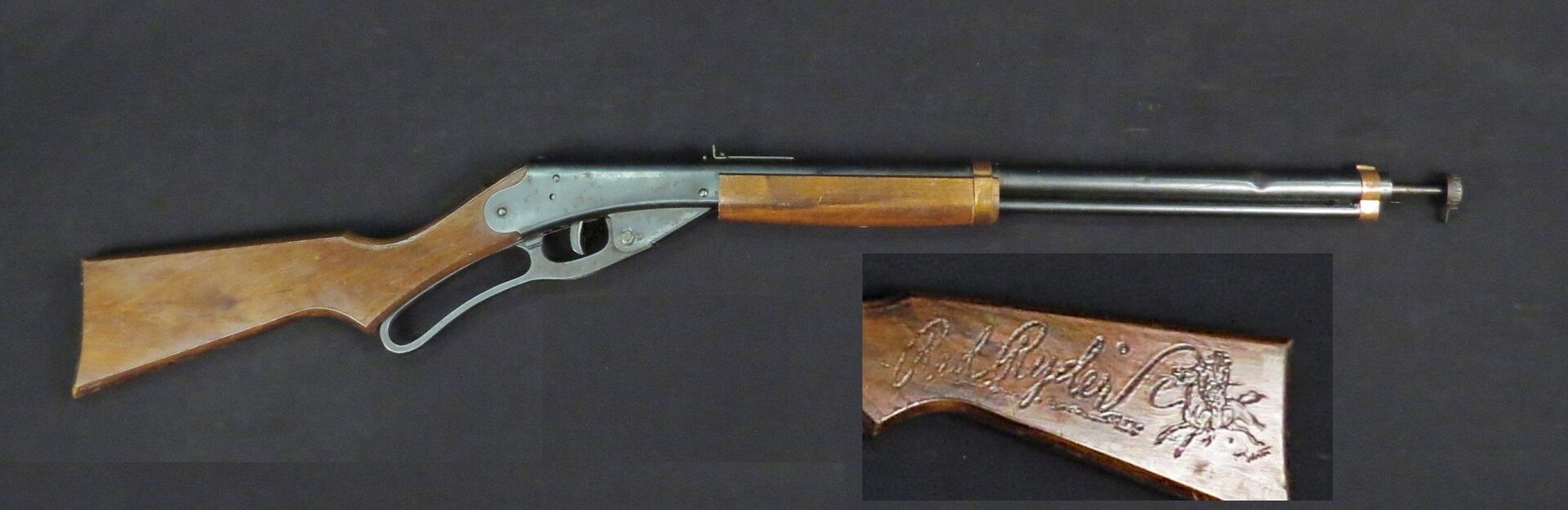
The Red Ryder is the most recognisable air rifle ever built, and its documentary record is a mess — not because the facts are missing, but because two separate confusions have been allowed to compound for eighty years. The first is a date: whether the gun is from 1938 or 1940. The second is a name: Daisy called one continuously-produced gun four different things, and one of those names is a number that looks like a year but is not. Both confusions are resolvable, and neither is a genuine historical dispute. They are bookkeeping problems that acquired the appearance of controversy through repetition.
7.1 Versus 1940: Both Are Right, About Different Things
The disagreement dissolves the moment one stops asking “when is the Red Ryder from” and starts asking three separate questions.
Table 1 — 1938 Versus 1940: Both Are Right, About Different Things
| Event | Date |
|---|---|
| Stephen Slesinger and Fred Harman approach Daisy with a Red Ryder pistol proposal; Daisy president Cass Hough counters with a rifle | 1938 |
| Licensing agreement signed with Stephen Slesinger, Inc. and Fred Harman | 6 October 1939 |
| First gun produced and shipped | April 1940 |
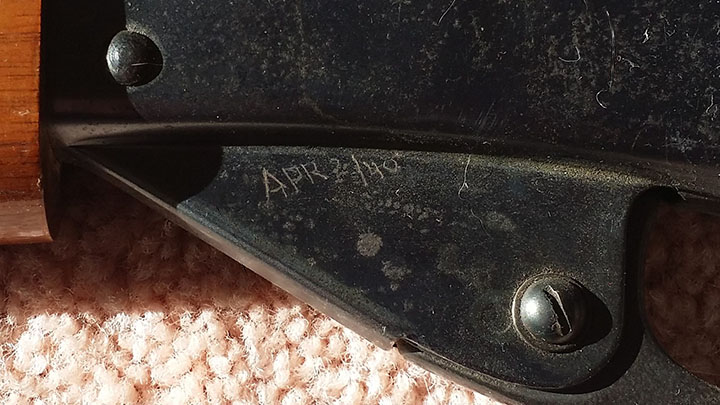
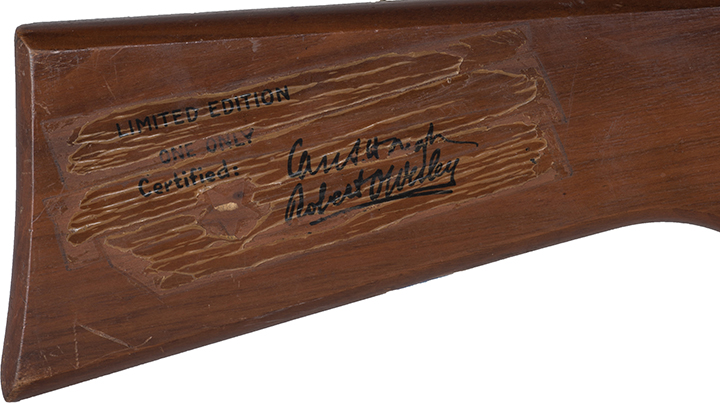
The 1938 date is the conversation — a meeting at which a comic-strip licensing agent and the strip’s artist pitched a branded product and Daisy’s president talked them into a different one.1 The October 1939 date is the contract, documented by the Daisy Museum in its account of receiving the first Red Ryder ever made.2 The April 1940 date is production, and it carries a piece of physical evidence that is about as good as this kind of thing gets: Fred Harman’s own presentation gun is scratched “APR2/40” on the frame.2 That gun also bears the signatures of Cass Hough and of Robert O. Wesley, Daisy’s advertising manager — the man who actually sketched the Red Ryder logo and pushed the rifle through — along with the inscription “LIMITED EDITION, ONE ONLY, Certified:” and a gold star. It resides at the Daisy Museum in Rogers, Arkansas.2
So: conceived 1938, contracted 1939, produced 1940.
The reason this keeps unravelling in print is that Daisy itself later turned the 1938 conversation date into the gun’s model number, and then built its anniversary programme around it. Daisy counts from 1938, not from 1940. That is why the 50th Anniversary gun is dated 1988 and required a special serial-numbering system, and why every anniversary edition since has followed the same convention: 1998 for the 60th, a Millennium edition in 2000, 2003 for the 65th, 2010 for the 70th, a 75th dated 2015 but released just before Christmas 2014, and 2018 for the 80th.3 Set those against an April 1940 first production and every single one lands two years early. The arithmetic is not wrong; it is simply counting a different event.
7.2 The Licensing Deal
Stephen Slesinger was the licensing agent who owned the Red Ryder trademark; Fred Harman was the Colorado rancher who drew the strip. The agreement they signed with Daisy in October 1939 has run continuously ever since, and is now held by Red Ryder Enterprises, Inc.4
Daisy’s own telling describes it as “probably the longest-lasting still-existent licensing agreement in American business history.” The superlative is Daisy’s marketing and is not independently verified here; the longevity itself is a matter of record. It is worth adding a specific negative finding: the research behind this series searched for evidence that the licence ever lapsed and was subsequently renewed, and found none. Sources uniformly describe it as continuous since 1939. Absent a primary document, no lapse should be asserted.
7.3 Four Names for One Gun
Daisy’s nomenclature for the Red Ryder changed four times across eighty-five years of continuous production. The sequence is the second great source of confusion, and it deserves a table of its own.
Table 2 — Four Names for One Gun
| Designation | Period | Note |
|---|---|---|
| No. 111 Model 40 | 1940 to about 1954 | The collector Red Ryder. “111” is Daisy’s model series and “40” the sub-model — neither is a year. Eight recognised variants in the current Blue Book of Airguns |
| No. 94 | about 1955 to 1962 | The Red Ryder name carried onto an entirely different model number |
| No. 1938 | from 1962 | The name becomes the number — the 1938 conversation date, promoted to a catalogue designation |
| 1938A, then 1938B | 1978, then 1979 | 1938B remains the current catalogue designation today |
The first row is where most writing goes wrong. A “No. 111 Model 40” looks irresistibly like a 1940 model year, and the coincidence that first production was April 1940 makes the misreading self-confirming. It is a series number and a sub-model number in Daisy’s internal scheme.5
The last row carries a caveat that ought to travel with it. The 94-to-1938 transition and the 1938A and 1938B introduction dates of 1978 and 1979 come from collector consensus — dealer and enthusiast sources such as alloutdoor and the DaisyTalk forum. No factory literature confirming 1978 and 1979 precisely was located.6 The dates are probably right and are given here as the best available, but they are not on the same evidentiary footing as the 6 October 1939 contract.
7.4 Wood to Plastic: Reading the Variants
Within the No. 111 Model 40 run, the Blue Book recognises eight variants, and the material transition through them is the practical dating tool.
Variant 1 (1940–1941) is the first gun: copper-plated forearm and barrel bands with the front band pinched into place, wood stock and wood forearm, the saddle ring with its leather thong, the Red Ryder brand burned into the left side of the stock, and a cast-iron lever.7 That cast-iron lever is a direct survival from Daisy’s cast-iron era, still present on the gun that would define the company’s next eighty years.
Variant 3 (1941–1942) moves to blued barrel bands and changes the logo from burned to silk-screened in black on red. The Blue Book describes it as the rarest of all Red Ryders — which makes sense, since the variant ran straight into the wall of American war production.8
Production halted for the Second World War and resumed afterward.
Variant 4 (1946) is the one collectors watch for: the last Red Ryder made with a wood forearm. Plastic forearms begin in 1947, which makes 1946 a hard material boundary rather than a gradual fade.9
Variant 6 (1950–1951) shows the mid-century configuration settling: wood stock, plastic forearm, stamped logo, black-painted cast-aluminium lever, fixed sights.10 The lever has now gone cast iron to cast aluminium, and the forearm wood to plastic, in a decade.
Variant 8 (December 1952 to mid-1953) completes the transition — plastic stock and plastic forearm, blued finish.11
The variant dates in this sequence carry medium confidence individually; the direction of travel — iron to aluminium, wood to plastic, burned to screened — is solid.
7.5 The Three Signatures
Strip away the variant minutiae and the Red Ryder is identifiable by three features that have survived every material change from 1940 to the current 1938B.
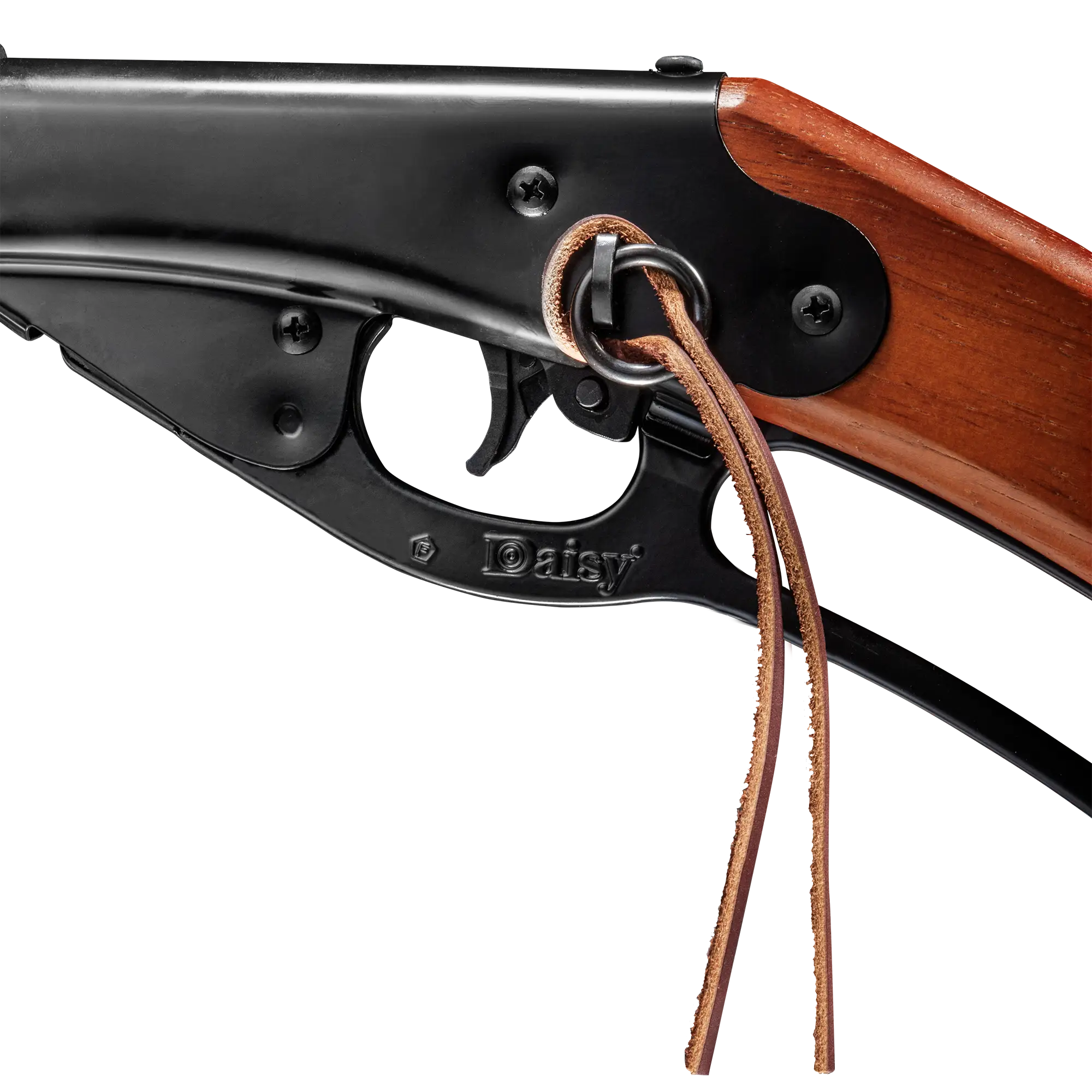
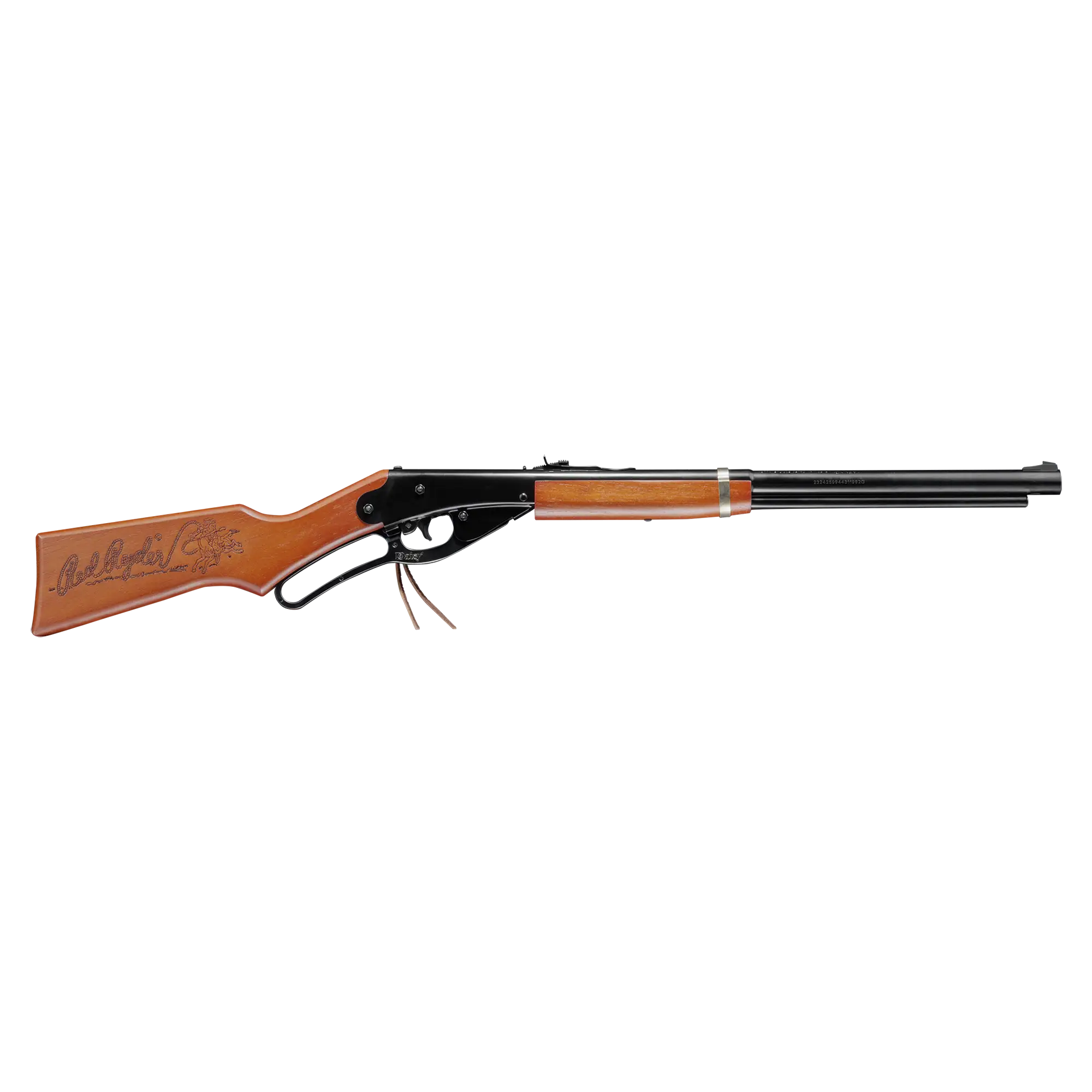
The lariat ring — properly a saddle ring, with a leather thong — mounted on the left side of the receiver. It is the visual signature, it is functionally decorative, and it is the single feature that says cowboy gun faster than anything else on the rifle.
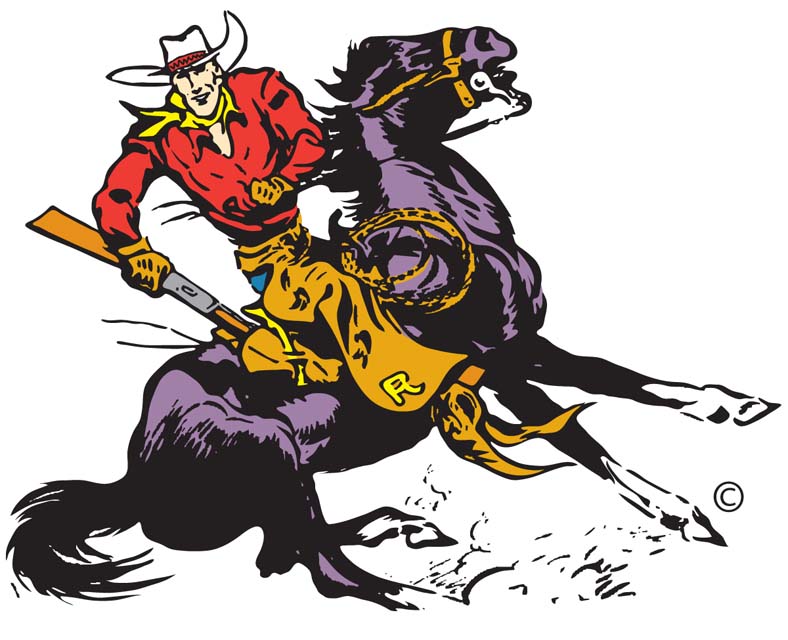
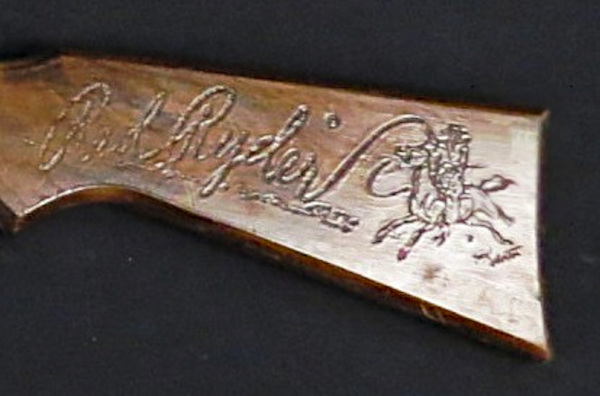
The Red Ryder logo on the stock, burned in on the earliest guns, silk-screened and later stamped thereafter.
The lever action, which is the Winchester silhouette in miniature and the reason the gun reads as a saddle carbine rather than as a toy.12
None of the three is an engineering feature. The powerplant underneath is the ordinary Daisy catapult-and-blast mechanism of Volume 5, shared with the Model 25 and the Buck. What Daisy sold, and has sold continuously for eighty-five years, is a costume for that mechanism — and it worked because the costume was licensed from a comic strip that a generation of American children read every morning.
7.6 The Gun as It Stands
The current Model 1938B is quoted by Daisy at a 650-shot gravity-feed reservoir and 350 fps, the latter being a rated maximum against a commonly measured figure nearer 270 fps as set out in Volume 5.13 Some youth-market variants quote a 400-shot capacity instead. It is still built in Rogers, Arkansas.
Volume 8 takes up the reason most people have heard of it at all — and the gun in that film is not, strictly, this one.
7.7 Bibliography
Footnotes
-
Daisy, Red Ryder product page. https://daisy.com/product/red-ryder/ ; AllOutdoor, “CR 103: Daisy Red Ryder Part II,” December 2024. https://www.alloutdoor.com/2024/12/18/cr-103-daisy-red-ryder-part-ii/ (confidence: high). ↩
-
Daisy Museum, “The Daisy Museum recently received the donation of the first Red Ryder ever made, and here’s the story.” https://daisy.com/the-daisy-museum-recently-received-the-donation-of-the-first-red-ryder-ever-made-and-heres-the-story/ ; corroborated at https://en.wikipedia.org/wiki/Daisy_Outdoor_Products (confidence: high). ↩ ↩2 ↩3
-
JG Airguns, “Daisy register, lot and serial numbers explained” — notes the special numbering system for the 1988 50th Anniversary guns. https://www.jgairguns.biz/daisy-register-lot-and-serial-numbers-explained-ezp-55.html ; anniversary editions at https://www.theoutdoorwire.com/story/12637923224hb7xfhva2j , https://airgunmaniac.com/daisy-red-ryder-1938-75th-anniversary-special-edition-review/ , https://daisy.com/product/80th-anniversary-red-ryder/ (confidence: medium). ↩
-
Red Ryder Enterprises, Inc. http://redryderent.com/ (confidence: medium on continuity; the “longest in American business history” superlative is Daisy’s own and is UNVERIFIED). No evidence of any lapse and renewal was found. ↩
-
Blue Book of Airguns, Daisy No. 111 Model 40 Red Ryder Variant 1. https://bluebookofgunvalues.com/products/daisy-no-111-model-40-red-ryder-variant-1 ; Baker Airguns, https://www.bakerairguns.com/product/daisy-111-40-red-ryder/ (confidence: high). ↩
-
AllOutdoor, “CR 104: Daisy Red Ryder BB Gun Part III,” January 2025. https://www.alloutdoor.com/2025/01/08/cr-104-daisy-red-ryder-bb-gun-part-iii/ ; current designation at https://daisy.com/product/red-ryder/ (confidence: medium — collector consensus; no factory literature located for the 1978/1979 dates). ↩
-
Blue Book of Airguns, Variant 1, as above (confidence: high). ↩
-
Blue Book of Airguns, Variant 3. https://bluebookofgunvalues.com/products/daisy-no-111-model-40-red-ryder-variant-3 (confidence: medium/high). ↩
-
Baker Airguns, https://www.bakerairguns.com/product/daisy-111-40-red-ryder/ (confidence: medium). ↩
-
Blue Book of Airguns, Variant 6. https://bluebookofgunvalues.com/products/daisy-no-111-model-40-red-ryder-variant-6 (confidence: medium). ↩
-
Blue Book of Airguns, Variant 8. https://bluebookofgunvalues.com/products/daisy-no-111-model-40-red-ryder-variant-8 (confidence: medium). ↩
-
Blue Book variant descriptions as above, consistent across all eight (confidence: high). ↩
-
Daisy, Red Ryder product page. https://daisy.com/product/red-ryder/ (confidence: medium on the 650-shot figure, which Daisy has quoted for decades). ↩
Comments (0)