Daisy · Volume 15
Caseless Ammunition, Volcanic to G11: Why It Keeps Failing
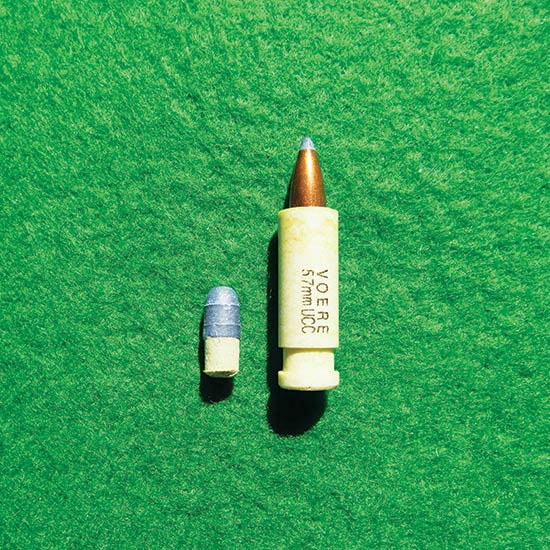
The Daisy V/L was not a novelty. It sits in a line of attempts, running from the 1840s to the 1990s, to build a cartridge without a cartridge case — to get the propellant, the projectile, and the means of ignition into a single object that leaves nothing behind but a hole in the target. Every one of these attempts was made by competent people. Every one failed commercially. Understanding why is the best way to understand what Daisy actually built, and it turns out that the V/L’s real distinction is not the one usually claimed for it.
15.1 The line
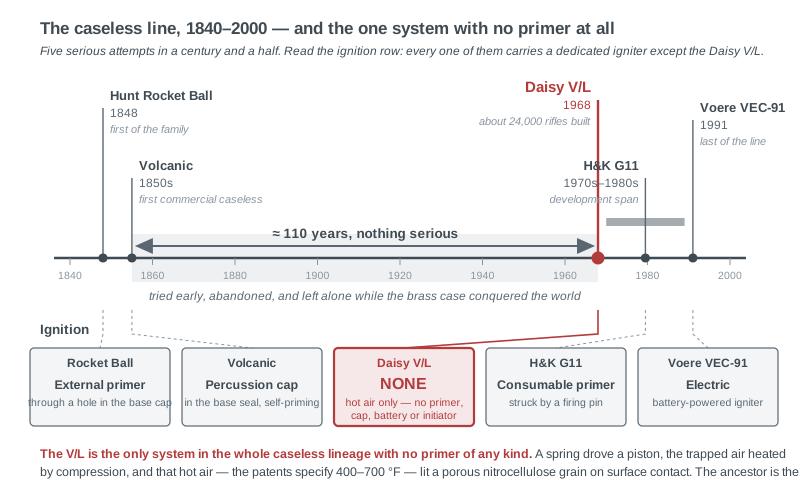
Walter Hunt’s Rocket Ball of 1848 is the first of the family that matters. It was a conical bullet in .31 and .41 calibre with a hollow base packed with powder, the base closed by a waterproof cap pierced with a hole so an external ignition source could reach the charge. The powder capacity was whatever the inside of a bullet could hold, which was not much, and the concept was hopelessly underpowered from the day it was drawn.1
The Volcanic of the 1850s was the Rocket Ball made self-priming: a percussion cap added to the base seal, so the round carried its own ignition instead of relying on an external one. It is the first commercially offered caseless cartridge in the ordinary sense of the phrase. It was also a commercial failure, though a spectacularly consequential one — the company that made it became, by two separate lines of descent, Winchester and Smith & Wesson.12
Then nothing, for well over a century. The gap between the Volcanic and the Daisy V/L is roughly one hundred and ten years, and it is one of the more striking facts about the whole subject: the caseless cartridge was tried early, abandoned, and left alone for four generations while the brass case conquered the world.3
The Daisy V/L arrived in 1968. Around 24,000 rifles were built before the project was abandoned, for reasons covered at length in the previous volume.
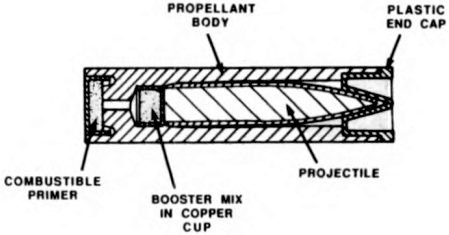
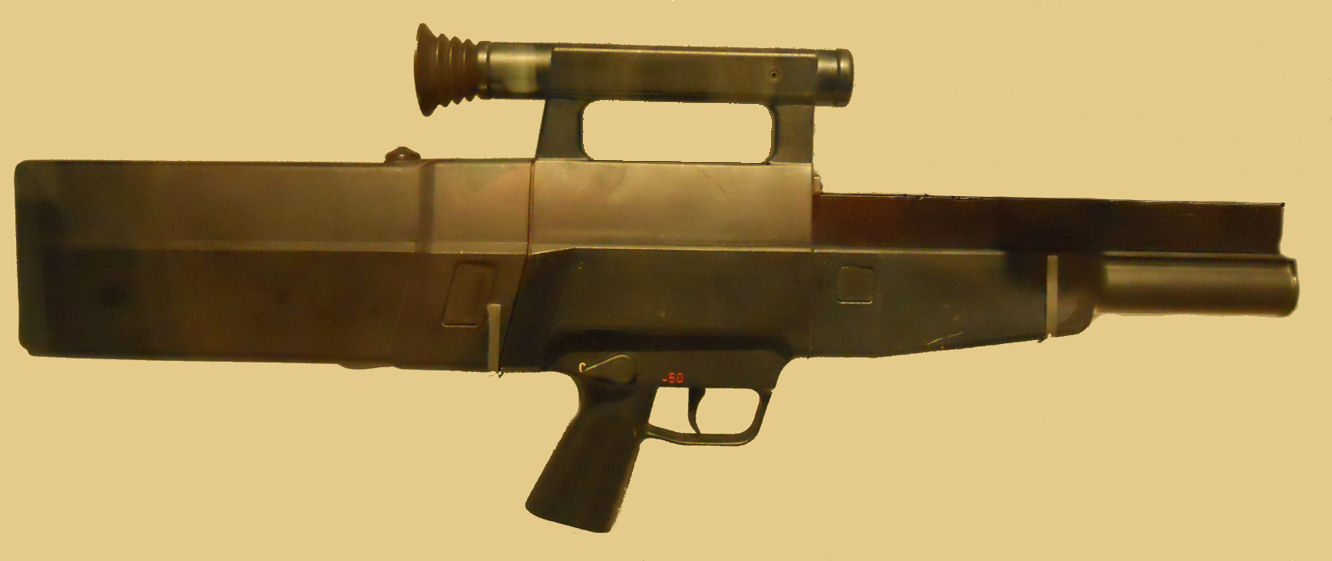
H&K’s G11, developed through the 1970s and 1980s, is the most serious caseless weapon ever built. Its round was a moulded block of propellant of square cross-section with the bullet embedded inside it, fired by a conventional firing pin striking a consumable primer. The rifle’s rotating breech and three-round burst at something near 2,000 rounds per minute were extraordinary engineering. It was shelved at the end of the Cold War, with the technical problems substantially but not completely solved.4
The Voere VEC-91 of 1991 was the last serious commercial attempt: a sporting rifle firing a cylindrical caseless round ignited electrically, by a battery-powered circuit rather than by mechanical impact. It was produced and sold. It never became mainstream.5
15.2 The comparison
Table 1 — The comparison
| System | Date | Ignition | Propellant form | Fate |
|---|---|---|---|---|
| Hunt Rocket Ball | 1848 | External primer through a hole in the base cap | Powder inside a hollow bullet base | Hopelessly underpowered |
| Volcanic | 1850s | Percussion cap in the base seal - self-priming | Powder inside a hollow bullet base | Commercial failure; became Winchester and S&W |
| Daisy V/L | 1968 | Adiabatically heated air. No primer of any kind. | Porous nitrocellulose grain bonded to the bullet base | Abandoned at about 24,000 rifles |
| H&K G11 | 1970s-1980s | Firing pin plus consumable primer | Moulded block, square cross-section, bullet embedded | Shelved at the end of the Cold War |
| Voere VEC-91 | 1991 | Electrical ignition, battery-powered | Cylindrical caseless round | Produced; never mainstream |
15.3 The thing only Daisy did
Read down the ignition column and the V/L stands alone.
Hunt’s Rocket Ball needed an external primer. The Volcanic carried a percussion cap. The G11 carried a consumable primer, a chemically sensitive component built into every round and consumed by every shot. The VEC-91 carried an electrical igniter and a battery to serve it. Four systems, four different priming arrangements, and every one of them required a chemically or electrically initiated component dedicated to starting combustion.
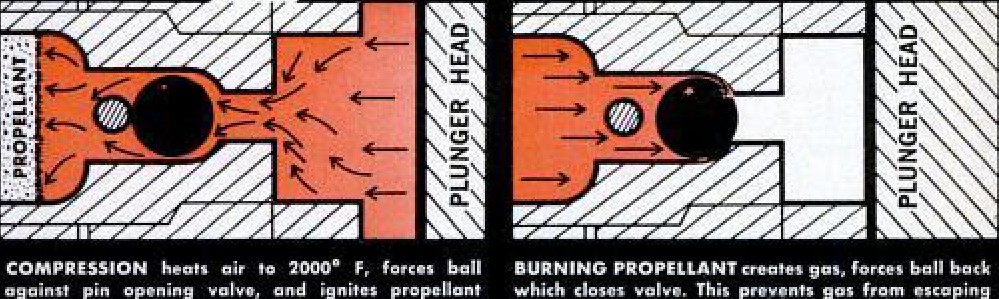
The Daisy V/L had none. A spring drove a piston down a cylinder, the trapped air heated by compression, and that hot air was directed through a check valve onto the exposed rear face of the propellant grain, which lit on surface contact. There was no primer, no cap, no pyrotechnic initiator, no battery, no electrical circuit. Nothing in the round was sensitive to impact at all. The entire ignition energy came from a mainspring, and the entire ignition mechanism was heat.
This is the strongest claim available about the Daisy V/L, and it is the note this series ends on: it is the only system in the entire caseless lineage with no primer of any kind.6
The correct analogy is not to another firearm. It is to a diesel engine, or to the fire piston — the ancient tool in which a sharp stroke down a closed tube compresses air hot enough to ignite a scrap of tinder. Van Langenhoven’s insight was that an ordinary spring-piston air rifle already produces enough heat to do this, and his original demonstration reportedly involved nothing more than a pinch of his compound placed behind a conventional pellet in a conventional springer.7 The patents specify compressed air in the range of 400 to 700 °F and a propellant designed to ignite on surface contact somewhere between 400 and 600 °F.8 Those are modest numbers. That is the point: the whole architecture works because the bar was set where a spring could reach it.
Making the propellant light off from mere hot air was the real invention, and it was a materials problem rather than a mechanical one. A dense nitrocellulose grain will not reliably ignite from surface contact with warm air. Van Langenhoven made the grain approximately 75 percent void — a controlled-porosity structure, formed by mixing in a removable filler and washing it out, so that hot air arriving at the face of the grain met an enormous internal surface area all at once. Ignition took about 0.6 milliseconds and the charge burned out completely in one to two.8
15.4 What the brass case is actually doing
The reason caseless keeps failing is that the cartridge case is doing four jobs simultaneously, and every one of them is invisible until it is gone.
It obturates. At the moment of firing, the brass expands against the chamber walls and seals the breech, then relaxes enough to be withdrawn. It is a gas seal that forms itself under pressure and releases itself afterwards. A caseless design has to build that seal permanently into the gun, out of metal that must survive it repeatedly.
It carries away heat. The case absorbs a share of the combustion heat and is then physically thrown out of the weapon, taking that heat with it. This is the least appreciated function of brass, and it is the one that kills caseless designs most reliably. Remove the case and the heat has nowhere to go but into the chamber, where it accumulates until a chambered round cooks off on its own — fires without the trigger being pulled. Cook-off is the recurring executioner of the whole concept. It is what constrained the G11’s sustained fire, and it is why every serious caseless programme spends most of its budget on thermal management.9
It protects the propellant. Brass is armour. It keeps the charge intact through the pocket, the pouch, the magazine, the loading cycle, and whatever handling the world applies in between. A bare propellant grain has no such protection. The V/L’s flaked and crumbled — one round in Gaylord’s 2021 chronograph session cracked simply from being pressed too firmly into the breech, and Daisy’s answer to the problem was to ship the ammunition in sealed plastic tubes, ten rounds at a time. That is the case’s protective function moved off the cartridge and onto the packaging, which works on a shelf and does not work in a pocket. H&K spent something close to two decades solving this properly for the G11.64
It makes a misfire clearable. If a conventional round fails to fire, the shooter works the action, the case is extracted, and the problem leaves the gun. A caseless round that fails to fire is a lump of propellant sitting in a hot chamber with no rim, no head, and nothing for an extractor to grip. Clearing it is a design problem in its own right, and it is the reason caseless rifles need dedicated ejection mechanisms for unfired rounds that conventional rifles get for free.
Brass, in other words, is not dead weight to be engineered away. It is a heat sink, a self-forming gas seal, a moisture barrier, structural armour, and a handle — five functions in a component that costs a few cents and is thrown on the ground. Every caseless design has to re-solve all of them inside the weapon instead, and so far every one has traded away more than it gained.
15.5 Where the V/L landed on each of the four
The V/L’s scorecard is more interesting than “it didn’t work,” which is the usual verdict and is wrong.
On sealing, it succeeded. The ball check valve seated in the movable breech is the single most important part of the gun: combustion pressure drives the ball back onto its seat, confining 12,000 to 30,000 psi to the firing chamber instead of letting it blow back down the air passage into the piston. It is what a conventional springer does not have and it is what makes the architecture possible at all. Van Langenhoven’s later work went further still — a 1969 patent, filed after Daisy’s rifle was already in trouble and assigned to a Swiss company rather than to Victor Comptometer, describes a thin-walled metallic sleeve of copper or phosphor bronze that expands radially under gas pressure to seal the chamber. That is, quite literally, a reusable cartridge case built permanently into the gun, and it is the most elegant idea in the whole patent family.10
On heat, it did not solve the problem. It avoided it. The V/L is a single-shot, spring-cocked rifle that requires a full underlever stroke of some 23 pounds between shots. It physically cannot generate the sustained fire that produces cook-off. This deserves stating plainly rather than apologetically: sidestepping a failure mode by architecture is legitimate engineering, and choosing an application where the defining problem does not arise is what competent designers do. The V/L dodged the killer of caseless ammunition by being slow.
On fragility and moisture, it lost. The propellant flaked, crumbled, and was hydrophilic — it took up water and degraded over time, with reported velocity spreads on aged ammunition running far wider than fresh.9 These are the two functions of brass that the plastic tube could only partly replace.
And on misfires, the record is genuinely surprising. Gaylord fired ammunition bought in 1969 through a chronograph in 2021 — fifty-two years old, exposed propellant, no case — and every round fired on the first strike, averaging 1,194 feet per second against a nominal 1,150. Not one misfire.6 For a caseless round with a bare nitrocellulose grain, that is remarkable, and it means the honest criticism of V/L ammunition is accuracy and physical durability, not ignition reliability.
15.6 The verdict
The caseless cartridge keeps failing because the brass case is a better piece of engineering than it looks, and because removing it converts one cheap disposable component into four permanent design problems inside an expensive weapon. Hunt could not get enough powder into a bullet. The Volcanic could not compete with the cartridge revolution it helped start. H&K solved nearly everything and ran out of Cold War. Voere built a working rifle that nobody wanted to buy batteries for.
And Daisy, in a plant in Rogers, Arkansas, on the strength of a Belgian engineer’s demonstration in a Paris shooting gallery, built a rifle that lit its propellant with nothing but hot air. It was expensive, single-shot, mediocre on paper, tied to ammunition only one company made, and it was on the market for something like eight months. But in a hundred and seventy years of people trying to get rid of the cartridge case, it remains the only one that also got rid of the primer.
15.7 Bibliography
Footnotes
-
Wikipedia, “Rocket Ball.” https://en.wikipedia.org/wiki/Rocket_Ball (confidence: high on the .31 and .41 calibres, the hollow powder-filled base, and the pierced waterproof cap). ↩ ↩2
-
Forgotten Weapons, “Original Volcanic Rocket Ball Cartridges.” https://www.forgottenweapons.com/original-volcanic-rocket-ball-cartridges/ (confidence: medium-high on the addition of the percussion cap and the self-priming distinction). ↩
-
The framing of the V/L as the second commercially offered caseless cartridge after the Volcanic, discounting paper and skin cartridges, is DennisK’s, stated in the International Ammunition Association forum thread “Daisy V/L Caseless Ammunition.” https://forum.cartridgecollectors.org/t/daisy-v-l-caseless-ammunition/9246 (confidence: medium; it is a collector’s characterisation rather than a survey, but no counterexample was located). ↩
-
Will Dabbs MD, “The Daisy V/L Caseless Rifle: Decades Ahead of Its Time,” Small Arms Review V17N3, September 2013. https://smallarmsreview.com/the-daisy-v-l-caseless-rifle-decades-ahead-of-its-time/ (confidence: medium; the source for the G11 comparison, the consumable primer, the square-section moulded block, and the H&K durability-testing anecdote. This article is unreliable on V/L numbers specifically - it gives a 40-grain bullet against the patent’s 29 - and is used here only for lineage material). ↩ ↩2
-
Wikipedia, “Voere VEC-91.” https://en.wikipedia.org/wiki/Voere_VEC-91 (confidence: medium-high on electrical ignition and on the rifle having reached production without reaching the mainstream). ↩
-
Tom Gaylord (B.B. Pelletier), “Daisy VL rifle: Part 1” and “Part 2,” Pyramyd Air, 14 and 21 May 2021. https://www.pyramydair.com/blog/2021/05/daisy-vl-rifle-part-1/ (confidence: high on the 2021 chronograph session - nine rounds of 1969 ammunition, 1,194 fps average, no misfires, one cracked propellant grain; the only modern instrumented testing located. Site blocks automated access; reached via the Wayback Machine). ↩ ↩2 ↩3
-
Gaylord, Part 1, reporting that Van Langenhoven first demonstrated the principle by placing a pinch of his compound behind a conventional diabolo pellet in a conventional spring-piston air rifle (confidence: medium; Gaylord is a serious historian but gives no source for this, and it is the conceptual heart of the invention, so it is worth flagging as uncorroborated). ↩
-
US Patent 3,854,400, “Caseless ammunition and propellant and method of making same,” Van Langenhoven, filed 19 December 1968, granted 17 December 1974. https://patents.google.com/patent/US3854400A/en (confidence: high; primary source for the 0.6 ms ignition time, the one-to-two-millisecond complete burn, the 12,000-30,000 psi chamber pressure, the 400-600 °F ignition temperature, and the 60-85 percent porosity with about 75 percent preferred). The 400-700 °F compressed-air range is from US Patent 3,951,038, https://patents.google.com/patent/US3951038A/en (confidence: high). Note that the widely repeated 2,000 °F figure appears in no primary source located and is not used here. ↩ ↩2
-
On cook-off as the defining caseless failure mode: https://warhistory.org/article/caseless-cartridge and the Voere entry at note 5 (confidence: medium-high on the mechanism, which is uncontested in the literature). On the hydrophilic propellant and the wide velocity spread in aged V/L ammunition, Dabbs at note 4 (confidence: medium; his reported 1,100-1,600 fps spread conflicts sharply with Gaylord’s 60 fps spread across nine rounds, which is most plausibly explained by different storage histories, and both are reported here). ↩ ↩2
-
US Patent 3,628,272, “Cylindrical breech with sleeved obturator,” Van Langenhoven, filed 24 July 1969, granted 21 December 1971, assigned to Engineering Developments Limited of Fribourg, Switzerland. https://patents.google.com/patent/US3628272A/en (confidence: high; the expanding thin-walled copper or phosphor-bronze sleeve, and the assignment to a Swiss entity rather than to Victor Comptometer, are both read directly from the patent). ↩
Comments (0)