Daisy · Volume 3
The Cast-Iron Era to the Mass Market, 1895-1940
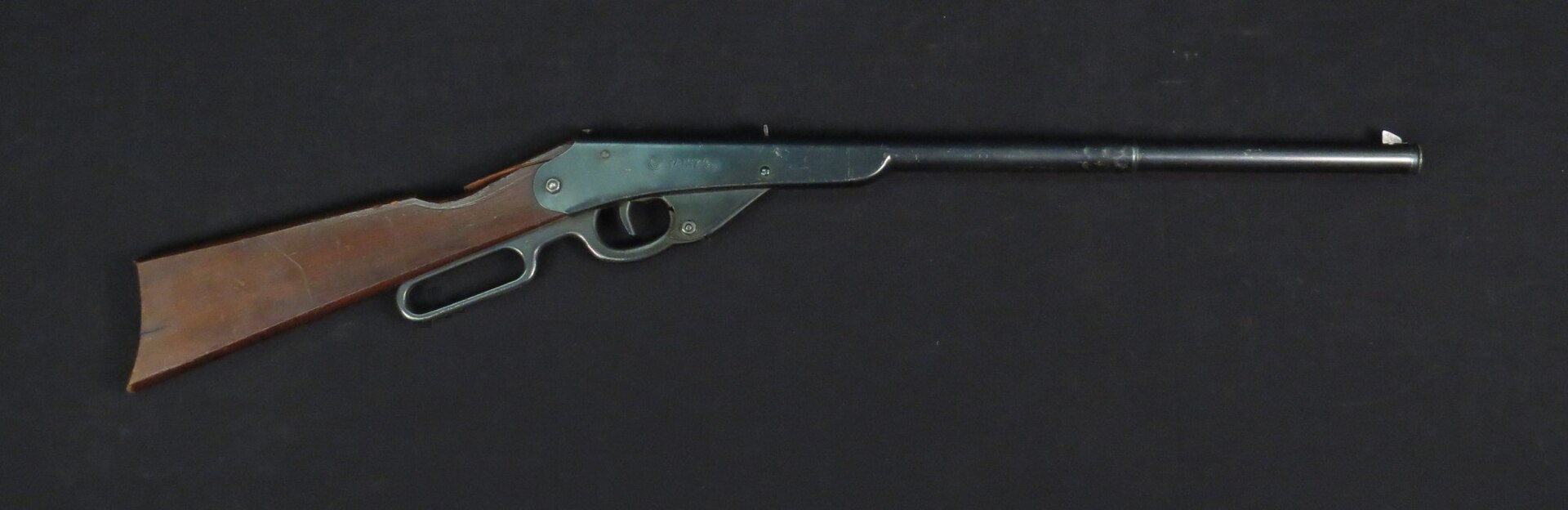
Between the rename of 1895 and the arrival of the Red Ryder in 1940, Daisy turned from a Michigan workshop that had stumbled onto a profitable sideline into a genuinely national consumer-products company. Two things drove that, and only one of them is about guns. The first is a manufacturing story: a steady migration from cast iron toward stamped sheet steel, which is what let Daisy reach price points that wood-and-casting competitors could not. The second, and arguably the more important, is a marketing story. Daisy spent money on advertising at a rate that would look aggressive today and was extraordinary in 1900, licensed characters before character licensing was a recognized discipline, and eventually published its own comic. It is reasonable to describe Daisy of this period as a mass-production pioneer. It is at least as reasonable to describe it as a mass-marketing pioneer.
3.1 From castings to stampings
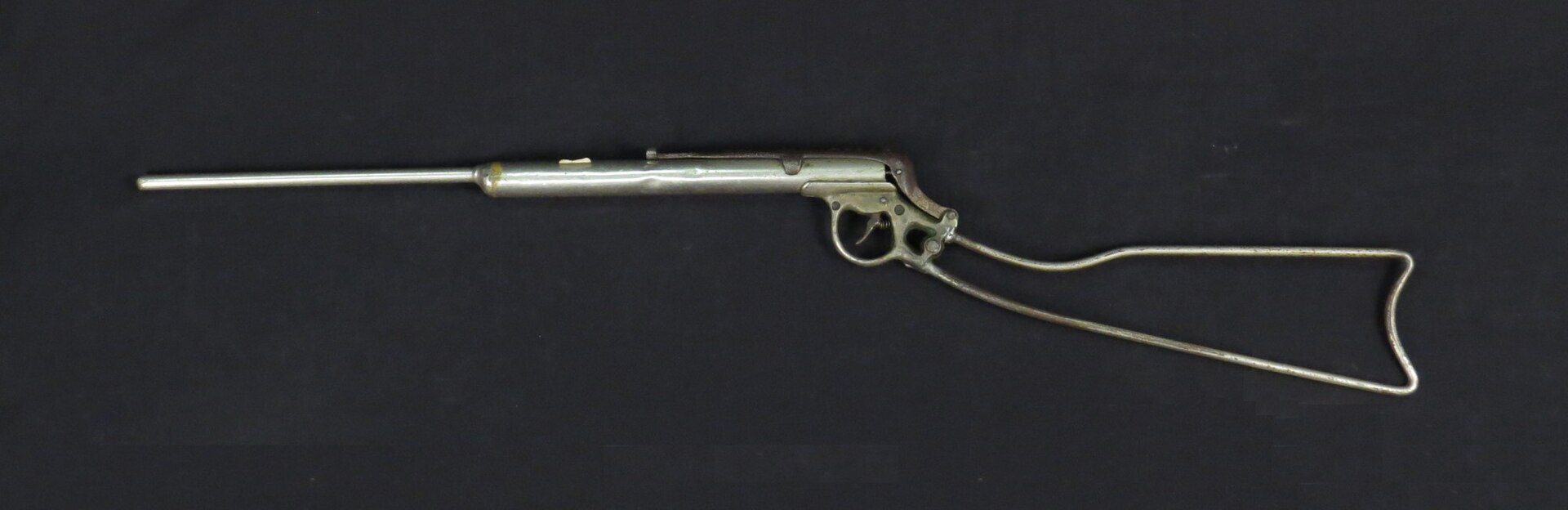
The technical thread running through these decades is the substitution of formed sheet metal for cast and machined parts. The earliest Daisy guns used cast-iron frames — the “20th Century” cast-iron models are a well-known collector category, and first-generation wire-stock guns are another documented type.12 Both of those citations come with a caveat worth stating plainly: the detailed collector write-ups on these models could not be retrieved directly during the research behind this series, so the specifics of individual model variations are held at medium confidence and are treated more fully in the collecting volume.
What is well-supported in outline, if imprecisely dated, is the direction of travel: from castings toward stamped sheet steel.3 The industrial logic is not subtle. A cast-iron frame requires a foundry, a pattern, cleanup, and machining of the mating surfaces. A stamped-steel frame requires a die, a press, and an operator, and after the die is paid for it produces parts at a cost per unit that castings cannot approach. Once the tooling exists, unit cost falls toward the cost of the material and the press stroke. That is why Daisy could sell a basic gun for a dollar in the middle of the Depression, and it is also — as the war years would show — a competency that transfers directly to entirely unrelated products.
The all-metal construction that Hamilton brought to the board in 1888 was therefore not merely a durability improvement over the wooden competition. It was the choice that put Daisy on the manufacturing curve it rode for the next half century.
3.2 The numbers, such as they are
Daisy’s growth over this period can be tracked through a handful of hard figures, none of them archive-grade but all of them consistent in direction.
Table 1 — The numbers, such as they are
| Year | Figure |
|---|---|
| 1890 | roughly 50,000 units a year, about 25 employees |
| 1900 | about 15 percent of sales revenue spent on posters and magazine space |
| 1909 | gross sales of $213,307; a repeater introduced firing up to 40 shots per loading |
| 1916 | first half-million-dollar sales year |
| 1928 | sales of $721,511 |
| 1930s | roughly a 30 percent Depression sales decline, but the company stayed profitable |
| 1935 | basic models at $1.00; the Golden Eagle repeater at $2.50 |
The 1909, 1928, and 1935 figures come from business-history compilations of medium confidence; the 1916 half-million-dollar year is widely repeated without a strong single anchor.43 What the table shows is a company roughly tripling in the two decades after 1909 and then absorbing the Depression without going under — a performance that says something about the price point. A one-dollar air rifle in 1935 is a purchase a family can still make when almost nothing else is being bought.
Two consolidations belong to this period as well. In 1916 Daisy acquired a controlling interest in the Markham Air Rifle Company, its crosstown rival from 1886. Markham was renamed the King Air Rifle Company in 1928. Sources disagree on the endgame: some give Daisy’s full acquisition of King as 11 August 1929, others as 1931, with 1931 being when the King plant closed and King-branded guns began coming out of Daisy’s own facility. The best reading is acquisition around 1929 and physical consolidation in 1931, held at medium confidence.3 Either way, by the early 1930s Plymouth’s three-company air-rifle industry had become one company.
3.3 Advertising as the actual product strategy
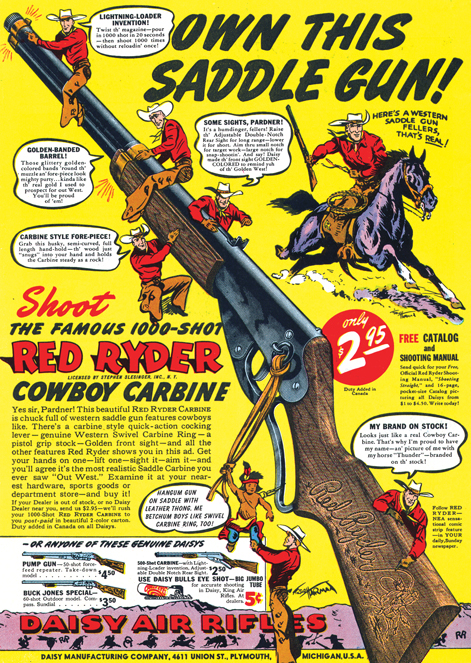
The marketing record is the strongest and best-supported part of Daisy’s industrial history, and it starts early. By 1900 the company was putting roughly 15 percent of sales revenue into posters and magazine space.4 For a manufacturer of a cheap durable good in 1900, that is a startling allocation, and it establishes the pattern for everything that follows: Daisy behaved less like a metalworking firm that happened to advertise and more like a marketing organization that happened to own a stamping plant.
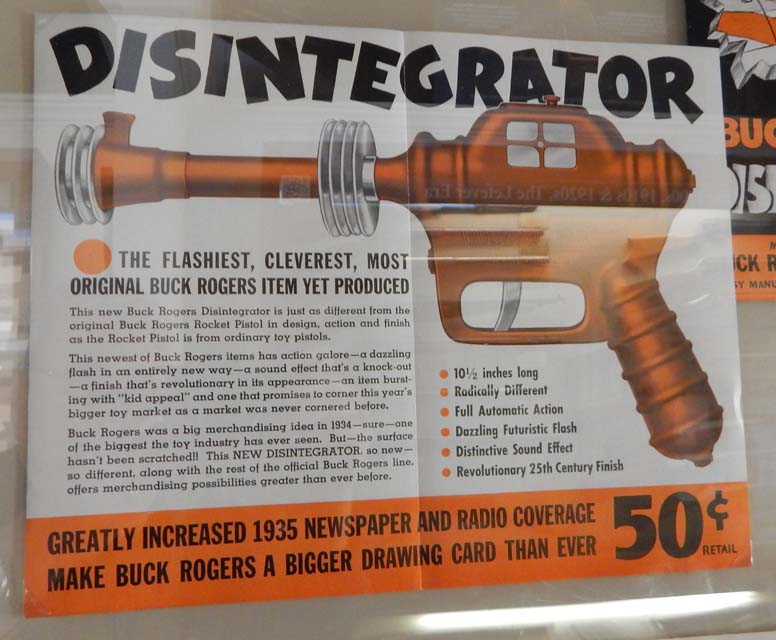
Celebrity endorsement came early and hard. Captain Eddie Rickenbacker, John Philip Sousa, and Tris Speaker all appeared in Daisy advertising — a flying ace, a bandmaster, and a ballplayer, aimed squarely at boys and their parents — often on comic-book covers and in youth publications.5 Character licensing followed as a core strategy rather than an occasional experiment: Buck Jones, Buzz Barton, and, in 1934, the Buck Rogers 25th Century Rocket Pistol, along with a Disintegrator and a water pistol. Demand for the Buck Rogers line reportedly came close to outpacing production in the middle of the Depression.6 A company selling a science-fiction ray gun to children in 1934 and struggling to keep up with orders has understood something about its market that its competitors had not.
The Red Ryder license of 1938 belongs to the following volume mechanically, but it belongs here commercially. It was based on Stephen Slesinger’s comic character, illustrated by Fred Harman, and the 1938 licensing agreement has been described as “believed to be the oldest, continually-in-force licensing agreement in the nation’s business history.”3 That phrasing should be read for what it is — a corporate boast carrying its own hedge, of low-to-medium confidence, not an established record.
Daisy’s most complete expression of the strategy was to stop buying advertising space and start publishing the vehicle. The Daisy Handbook of 1946 reprinted Fred Harman’s Red Ryder strips alongside Buck Rogers — the company producing its own comic as an advertising medium.7 And in 1947 Daisy issued an “American Boy’s Bill of Rights” to counter growing anti-gun sentiment, which is an early and quite explicit instance of a manufacturer conducting ideological brand defense on its own behalf.3
3.4 The house organs — the one unambiguous archival record
Amid a corporate history heavily contaminated by a single 1976 memoir, there is one body of evidence that is unambiguously archival and unambiguously industrial: Daisy’s internal employee magazines. The Daisy Idea ran monthly from May 1928 to April 1958, the whole of the later Plymouth era, and was succeeded by The Daisy Aim, which ran from November 1958 to December 1970 in Arkansas. The April 1958 issue was the last printed in Plymouth. These are held in the Plymouth Historical Museum’s Record Group 13 and are documented in the finding aid at high confidence.8
That matters for more than dating the move. A company that publishes a monthly magazine for its own workforce for thirty years is not a workshop. It is an industrial employer with a workforce large enough and stable enough to constitute an internal audience — and in Plymouth, Michigan, a town of that size, it was the industrial employer. The run of The Daisy Idea is the closest thing this history has to a continuous, contemporaneous, non-promotional record of the company from the inside.
3.5 What Daisy did not make
One correction belongs in any account of this period, because it recurs constantly. Daisy did not manufacture the well-known Second World War wooden training rifles. Those were made by the Parris-Dunn Corporation of Clarinda, Iowa, under Army and Navy contracts.9 Daisy’s own war work was of a different character entirely: BB-gun production was largely discontinued, and the facilities went over to subcontract metal work — 37 mm canisters, holders for aircraft flare pistols, motor armature laminates, and switches.10 That list is consistent across two related sources and sits at medium-high confidence.
Read it against the manufacturing story and it makes complete sense. Canisters, laminates, and switch components are stamping and forming work. The competency Daisy had spent forty years building to make cheap air rifles was, in 1942, exactly the competency the war economy wanted. Whether Daisy ever held a prime government contract for a dedicated military training rifle in either war could not be established in the research behind this series, and it should not be asserted. The First World War “Military Model No. 40,” a lever-action gun with a socket-style bayonet that contributed to the 1916 sales year, was a commercial consumer product riding wartime patriotism rather than a government item, and the period advertising claim that air guns had “taught America’s doughboys how to shoot” is advertising copy, not evidence of a training program.4
By 1940, then: a stamped-steel mass producer with a national advertising apparatus, its principal rival absorbed, its price points intact through the worst decade in American economic history, and a licensing agreement in hand for a cowboy character whose name would outlive everyone involved.
3.6 Bibliography

Footnotes
-
Pyramyd Air blog, “Daisy 20th Century cast iron BB gun.” https://www.pyramydair.com/blog/2021/10/daisy-20th-century-cast-iron-bb-gun-part-1/ (confidence: medium; direct fetch returned 403 during research, cited from search result metadata — details unverified). ↩
-
Pyramyd Air blog, “Daisy wire stock first BB gun.” https://www.pyramydair.com/blog/2010/01/daisy-wire-stock-first-bb-gun-part-1/ (confidence: medium; direct fetch returned 403 — details unverified). ↩
-
Encyclopedia.com, “Daisy Outdoor Products, Inc.” https://www.encyclopedia.com/books/politics-and-business-magazines/daisy-outdoor-products-inc (confidence: medium; source for the 1909 sales figure, the Markham/King consolidation dates, the 1938 licensing claim, and the 1947 “American Boy’s Bill of Rights”). ↩ ↩2 ↩3 ↩4 ↩5
-
FundingUniverse, “Daisy Outdoor Products Inc. History.” https://www.fundinguniverse.com/company-histories/daisy-outdoor-products-inc-history/ (confidence: medium; source for the 1928 and 1935 figures, the Depression performance, and the WWI advertising claim). ↩ ↩2 ↩3
-
Wikipedia, “Daisy Outdoor Products” — 1900 advertising spend and the Rickenbacker/Sousa/Speaker endorsements. https://en.wikipedia.org/wiki/Daisy_Outdoor_Products (confidence: medium-high). ↩
-
Encyclopedia.com and FundingUniverse on the Buck Jones, Buzz Barton, and 1934 Buck Rogers licensed lines (confidence: medium). ↩
-
MyComicShop listing for the Daisy Handbook (1946), reprinting Fred Harman’s Red Ryder and Buck Rogers strips. https://www.mycomicshop.com/search?TID=336041 (confidence: medium). ↩
-
Plymouth Historical Museum, Record Group 13 — Daisy Manufacturing Company finding aid; runs of The Daisy Idea (May 1928 - April 1958) and The Daisy Aim (November 1958 - December 1970). https://plymouthhistory.org/wp-content/uploads/2024/08/RG-13-Daisy-Manufacturing-Company-Finding-Aid.pdf (confidence: high; genuine archival holdings). ↩
-
International Military Antiques, original WWII US Army Victory Trainer 1942 training rifle by Parris-Dunn Corp. https://www.ima-usa.com/products/original-wwii-u-s-army-victory-trainer-1942-training-rifle-by-parris-dunn-corp (confidence: high). ↩
-
Encyclopedia.com and FundingUniverse, Daisy WWII output: “37 mm canisters, holders for aircraft flare pistols, motor armature laminates, and switches.” https://www.encyclopedia.com/books/politics-and-business-magazines/daisy-outdoor-products-inc (confidence: medium-high; consistent across two related sources). ↩
Comments (0)