Daisy · Volume 6
The .177 Steel BB: Why 'BB', and How It Is Made
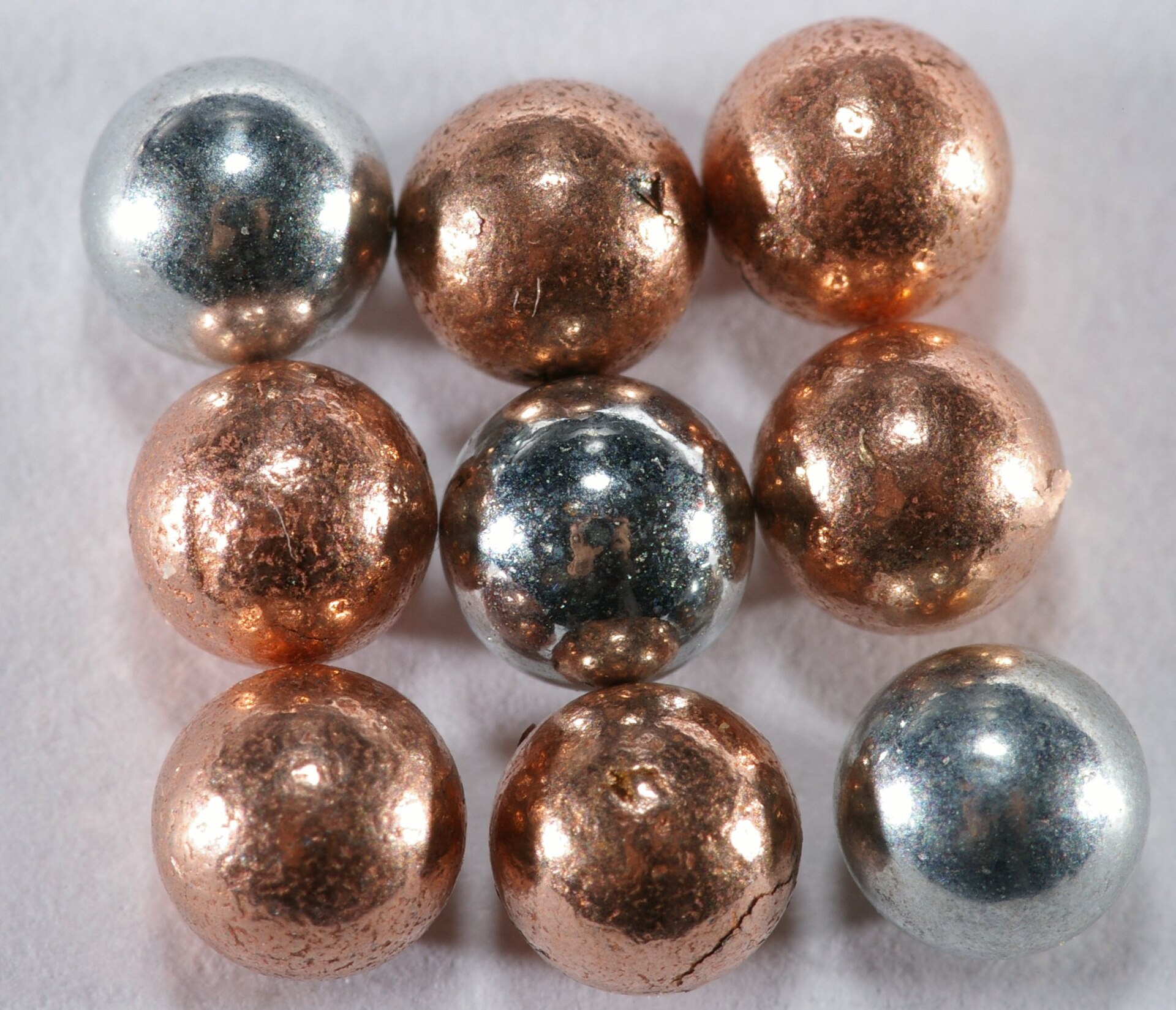
The projectile is the part of this story that everybody thinks they already know, and the part where the received wisdom is most reliably wrong. Three claims circulate freely: that “BB” stands for something (ball bearing, bullet ball, Daisy’s own initials in some tellings), that a BB is .177 calibre ammunition, and that BBs are made by pouring molten metal down a shot tower. The first is a folk etymology, the second is a dimensional error of about four thousandths of an inch that quietly explains the entire powerplant of Volume 5, and the third appears to be an era-conflation that this series cannot verify and will not assert.
6.1 Why “BB” — the Boring, Correct Answer
“BB” is a shotgun birdshot size designation. In the American shot-size ladder it sits between B and BBB — a run of nested sizes that has nothing whatever to do with air guns.1 Nominal BB birdshot measures 0.180 inch, about 4.6 mm.
The connection is entirely practical. The earliest air rifles of the 1880s needed cheap spherical ammunition in enormous quantity, and cheap spherical ammunition already existed by the barrel in every hardware store in America: loose lead birdshot. Shooters bought BB-size shot, poured it into the gun, and the size designation migrated from the ammunition to the gun that ate it. Within a generation nobody remembered it was a shotshell term, and within two the backronyms had arrived.
There is one further wrinkle worth stating, because it matters for the dimensional history below: shotshell shot was manufactured to loose tolerances and varied considerably around its nominal size.1 The 0.180 figure is a nominal, not a specification. That looseness is part of what drove air-rifle makers to stop buying birdshot and start making purpose-built ammunition.
6.2 Three Numbers, Not One
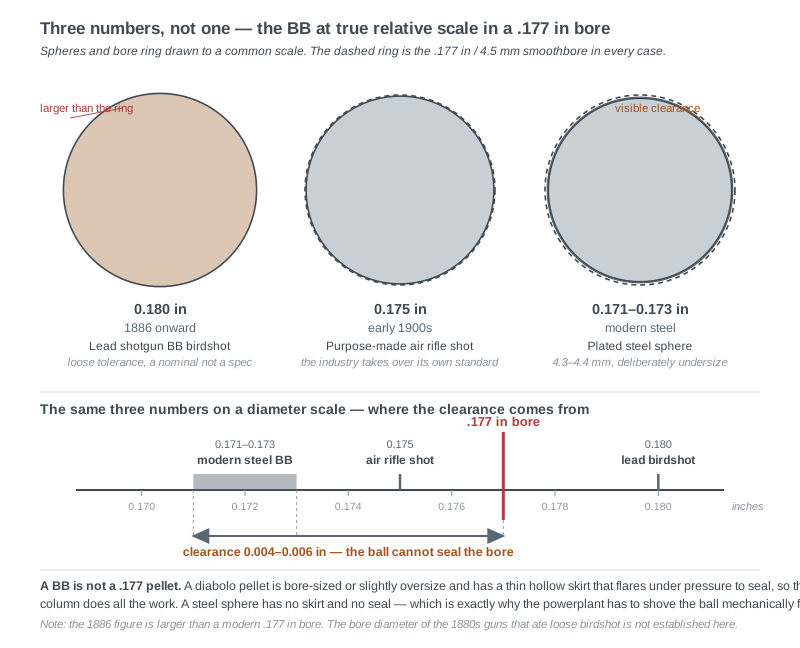
The single most useful thing to hold in mind is that the diameter of “a BB” changed twice, and the three figures should never be blurred together.
Table 1 — Three Numbers, Not One
| Era | Diameter | What it actually was |
|---|---|---|
| 1886 onward | 0.180 in | Genuine lead shotgun BB birdshot, as used by Markham and the earliest Daisys |
| Early 1900s | 0.175 in | A purpose-made “air rifle shot” — a deliberate shrink away from the shotshell size |
| Modern steel | 0.171–0.173 in (4.3–4.4 mm) | Plated steel spheres, fired from a 0.177 in / 4.5 mm smoothbore |
Those figures are consistent across the general reference literature, the Crosman house history, and Pyramyd Air’s dedicated treatment of the BB.2 The middle number is the one most often dropped from popular accounts, which then present the change as a single jump from birdshot to modern steel and lose the intermediate step in which the industry took control of its own ammunition standard.
6.3 The Correction: A Steel BB Is Not .177 Ammunition
Here is the cleanest technical correction in the whole subject. The bore is .177 inch, or 4.5 mm. The ball is 0.171 to 0.173 inch. The projectile is deliberately, systematically undersize — by something on the order of four to six thousandths of an inch.2
This is not sloppy manufacturing. It is the design requirement. A BB gun’s ammunition has to fall by gravity out of a reservoir, roll down a feed path, drop onto a seat, and travel a smoothbore barrel without ever binding. Every one of those operations wants clearance. A ball sized to the bore would jam, and a magazine of bore-sized balls would jam constantly.
Everything in Volume 5 follows directly from that clearance:
- The ball will roll straight out of a downward-pointed muzzle, so it must be held at the breech by a magnet.
- The ball cannot seal the bore, so a pure air column cannot drive it efficiently, so the powerplant has to shove the ball mechanically first and use the air blast as a booster.
- The fit varies from ball to ball and gun to gun, so muzzle velocity varies shot to shot, and the rated figure sits well above the measured one.
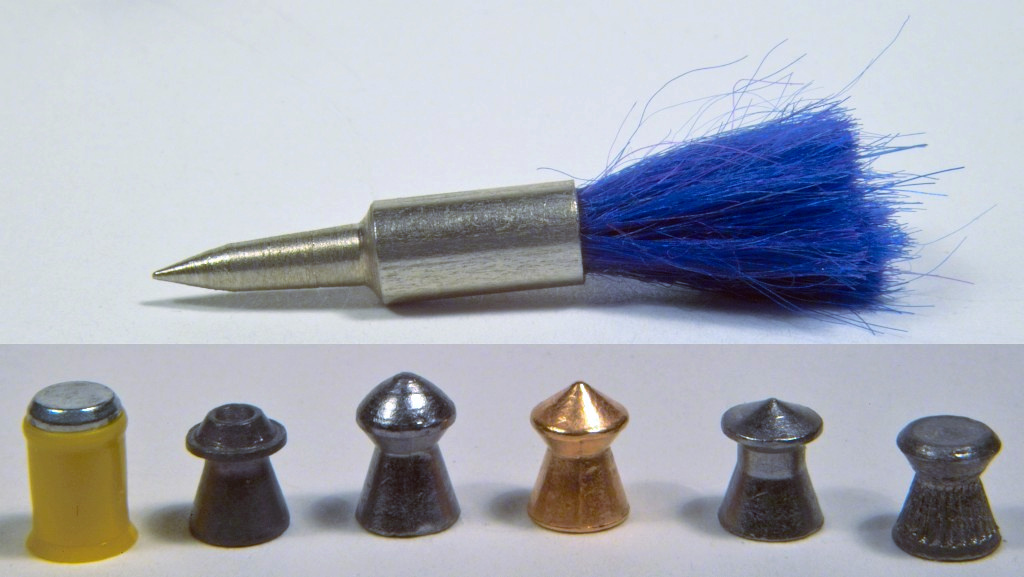
Contrast the .177 diabolo pellet, which is the other thing sold under that catalogue number. A pellet is bore-sized or slightly oversize; it has a thin hollow skirt that flares under pressure to seal; and it engages rifling. It is driven entirely by the air column, and it is dimensionally, materially, and ballistically a different projectile that happens to share a nominal calibre designation with a steel ball it does not resemble.
The practical consequence is one that catalogue copy tends to bury. Firing steel BBs through a rifled pellet barrel damages the rifling — a hard steel sphere swaging its way past soft lands does exactly what one would expect.3 This is why Daisy’s smoothbore youth guns and its rifled Powerline pellet guns are marketed as separate lines, and why the dual-ammunition Powerlines quote their BB and pellet velocities separately rather than giving one number.
There is a safety consequence too, and it is the real content behind the most famous warning in American Christmas cinema. Lead deforms on impact; steel does not. A steel BB ricochets off hard flat surfaces where a lead pellet would flatten and stop. The eye injuries that drove seventy years of BB-gun regulation are overwhelmingly ricochet injuries, and the material of the ball is the reason.3 Volume 16 takes the regulatory story up.
6.4 How They Are Made — and What Cannot Be Established
The manufacturing question turns out to be the weakest-sourced part of this volume, and the honest thing to do is say so rather than repeat a plausible story.
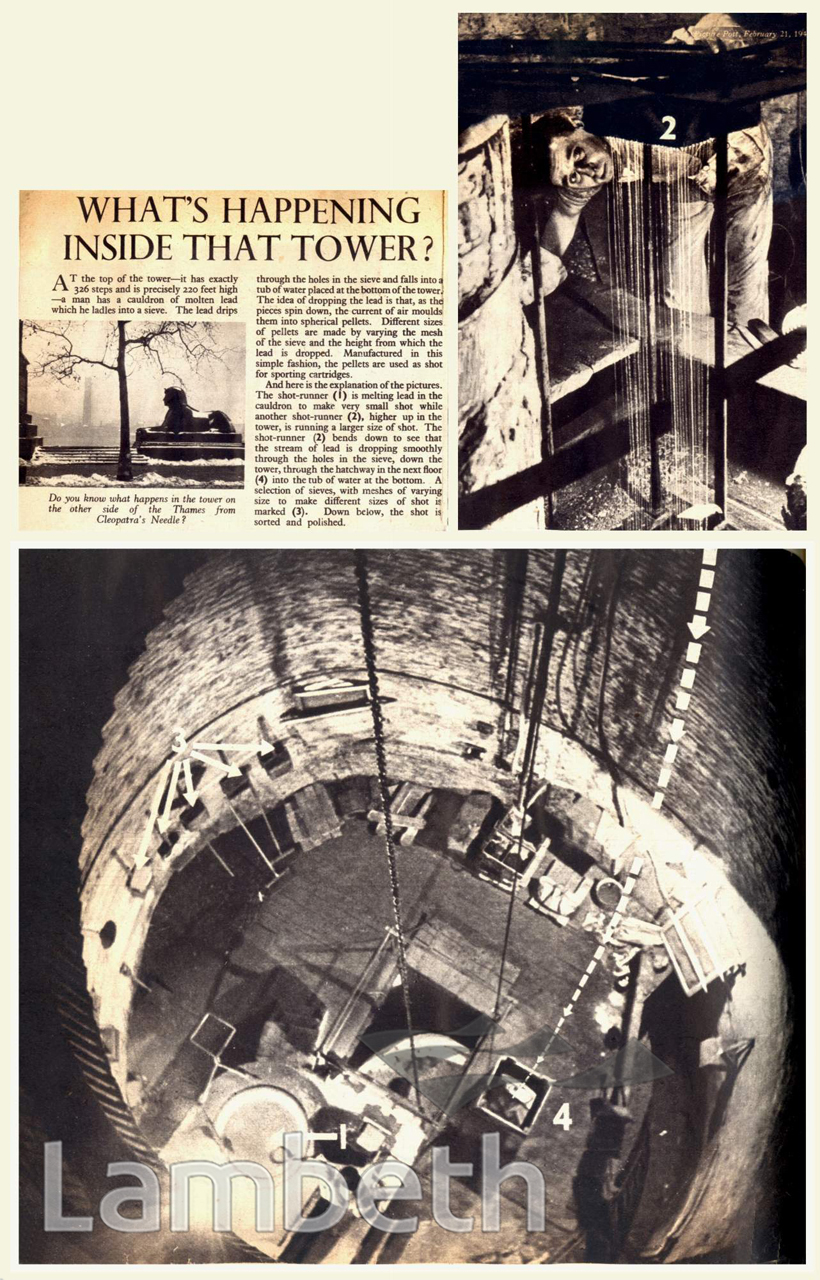
A premise circulates that Daisy manufactured its own BBs using a shot tower, the classic apparatus in which molten metal is dropped from height and forms spheres by surface tension during free fall before quenching in a water bath at the bottom. The research behind this series could not source any specific Daisy shot-tower operation, and there is a strong reason to suspect the premise is an era conflation.
A shot tower is a lead technology. It works because molten lead has the surface tension, density, and melting point to pull itself into a sphere during a few seconds of free fall. Steel does not behave that way at any practical tower height. Modern steel BBs are made by an entirely different route — cold-heading or wire-cutting from steel stock, tumbling to round, and then plating with copper or zinc for corrosion resistance.4
Both descriptions can be true of different eras. Lead-era BB ammunition of the 1880s and 1890s plausibly did come out of shot towers, because that was how all lead shot was made. Modern steel BBs demonstrably do not. What cannot be established from the sources consulted is whether Daisy itself ever operated such a tower, at what date, or for how long. The two manufacturing methods should not be run together into a single sentence about “how Daisy makes BBs,” and this series declines to do so. Settling it would take the Daisy Museum’s own records or the history sections of the Blue Book of Airguns; it is left open here deliberately.
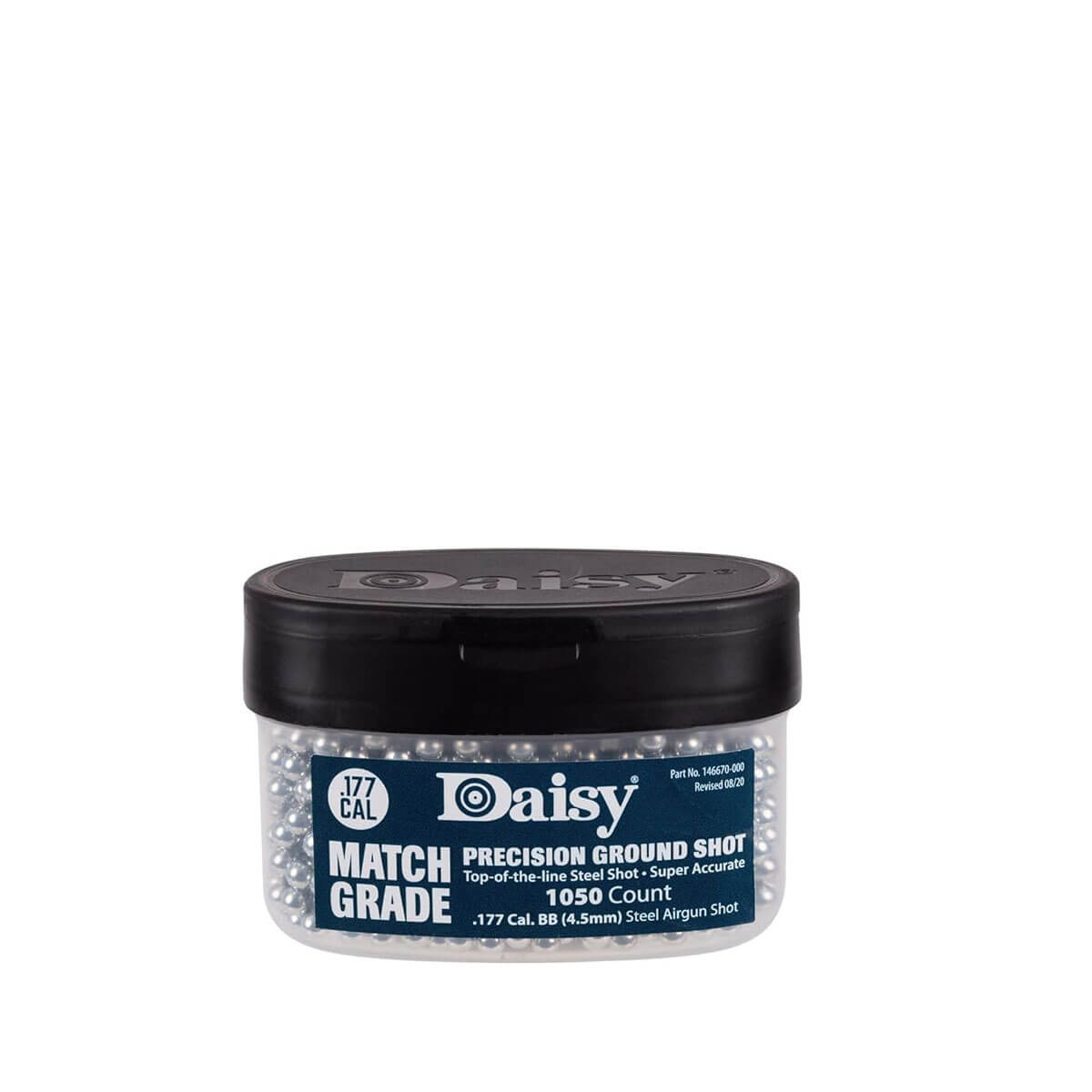
What is documented is the top of Daisy’s own ammunition line. Match Grade Avanti Precision Ground Shot is not merely formed to size but ground to a tighter tolerance, and it is the ammunition on which the accuracy of the 499B competition gun depends.5 The logic is exactly the logic of the clearance problem stated above, run in reverse: if the variability of the ball is what makes a BB gun inconsistent, then a ball with less variability makes a BB gun that is not. Volume 10 follows that thread into the Avanti line.
6.5 What to Carry Forward
Three things. “BB” is a birdshot size, not an acronym. The ball is 0.171 to 0.173 inch inside a 0.177 inch bore, and that deliberate undersize is the root cause of the magnet, the catapult powerplant, the low velocity, and the shot-to-shot inconsistency. And the manufacturing story splits cleanly along the lead-steel line, with the Daisy-specific half of it unestablished.
6.6 Bibliography
Footnotes
-
Wikipedia, “BB gun” — birdshot-size derivation, position between B and BBB, nominal 0.180 in, and the loose tolerances of shotshell shot. https://en.wikipedia.org/wiki/BB_gun (confidence: high). ↩ ↩2
-
Wikipedia, “BB gun”; Crosman, “When were BB guns invented? Air gun history with Crosman,” https://discover.crosman.com/blog/when-were-bb-guns-invented-air-gun-history-with-crosman ; Pyramyd Air, “The ubiquitous BB, Part 1,” January 2023, https://www.pyramydair.com/blog/2023/01/the-ubiquitous-bb-part-1/ (confidence: high on all three diameters; the framing of the undersize ball as the root cause of the powerplant design is this series’ synthesis). ↩ ↩2
-
Rifling damage from steel shot and the ricochet-versus-deformation distinction are consistent across the airgun literature cited above (confidence: medium). ↩ ↩2
-
The lead-tower / steel-cold-heading distinction is well established as general manufacturing history (confidence: medium). Any specific Daisy shot-tower operation is UNVERIFIED — the research behind this series found no citable source and the premise is flagged as a probable lead-era / steel-era conflation. ↩
-
Daisy, Match Grade Avanti Precision Ground Shot. https://daisy.com/ (confidence: medium). ↩
Comments (0)