Daisy · Volume 14
V/L IV: The Ruling That Killed It, and the Collector Market Since
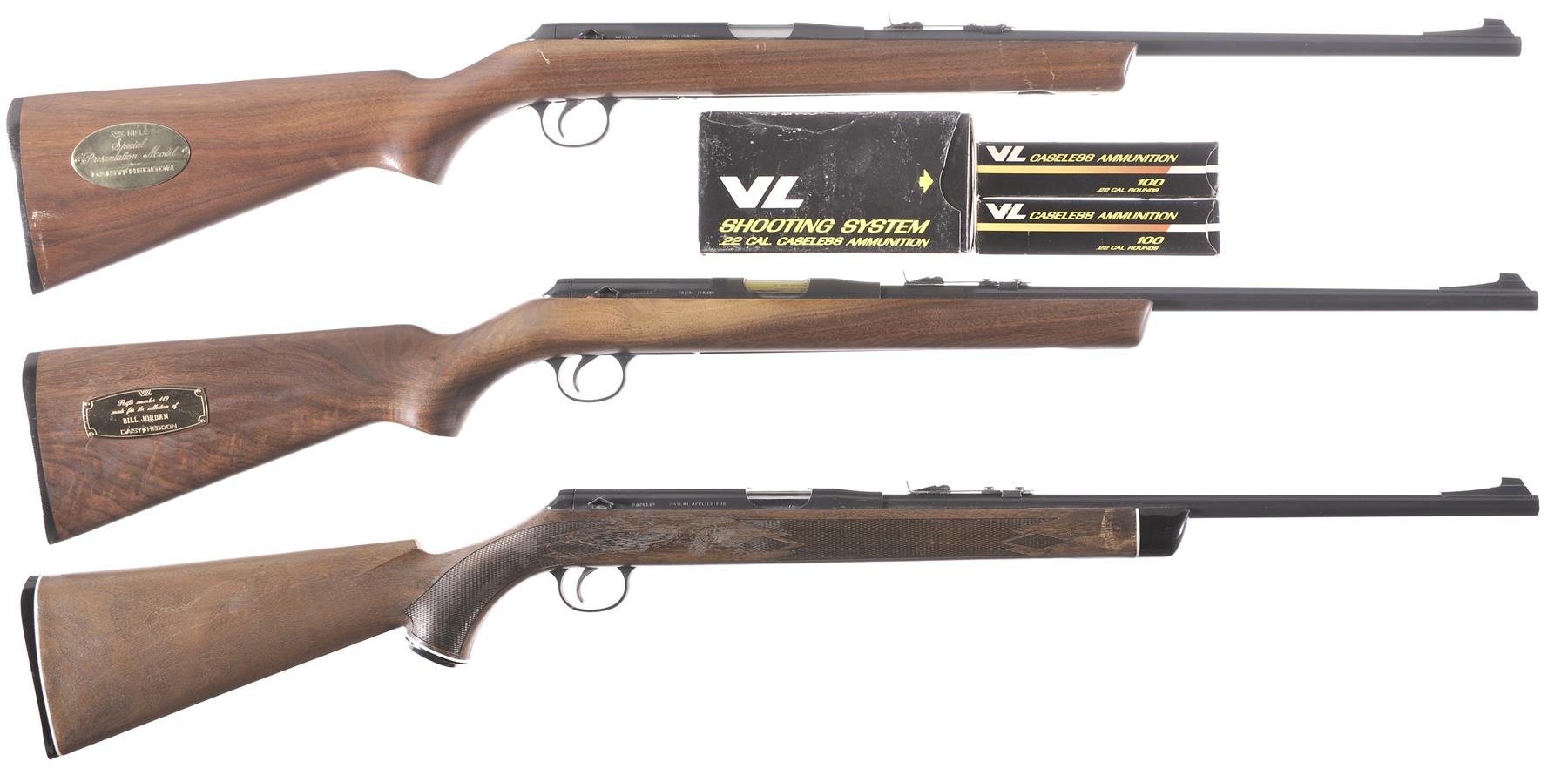
Every account of the Daisy V/L ends the same way. The Bureau of Alcohol, Tobacco and Firearms ruled that the rifle was a firearm rather than an air gun; Daisy, licensed only to make air weapons, chose to stop rather than restructure itself into a firearms manufacturer; production ceased in 1969 after something on the order of eight months. It is a clean story, it is repeated in essentially every article, auction listing, and forum post on the subject, and the remarkable thing about it is that nobody has ever produced the ruling.
That absence is worth taking seriously, because it is the one thing about the V/L that has not already been written twenty times. What follows separates three things that usually get welded together: what is documented, what is inferred, and what is simply repeated.
14.1 What is certain
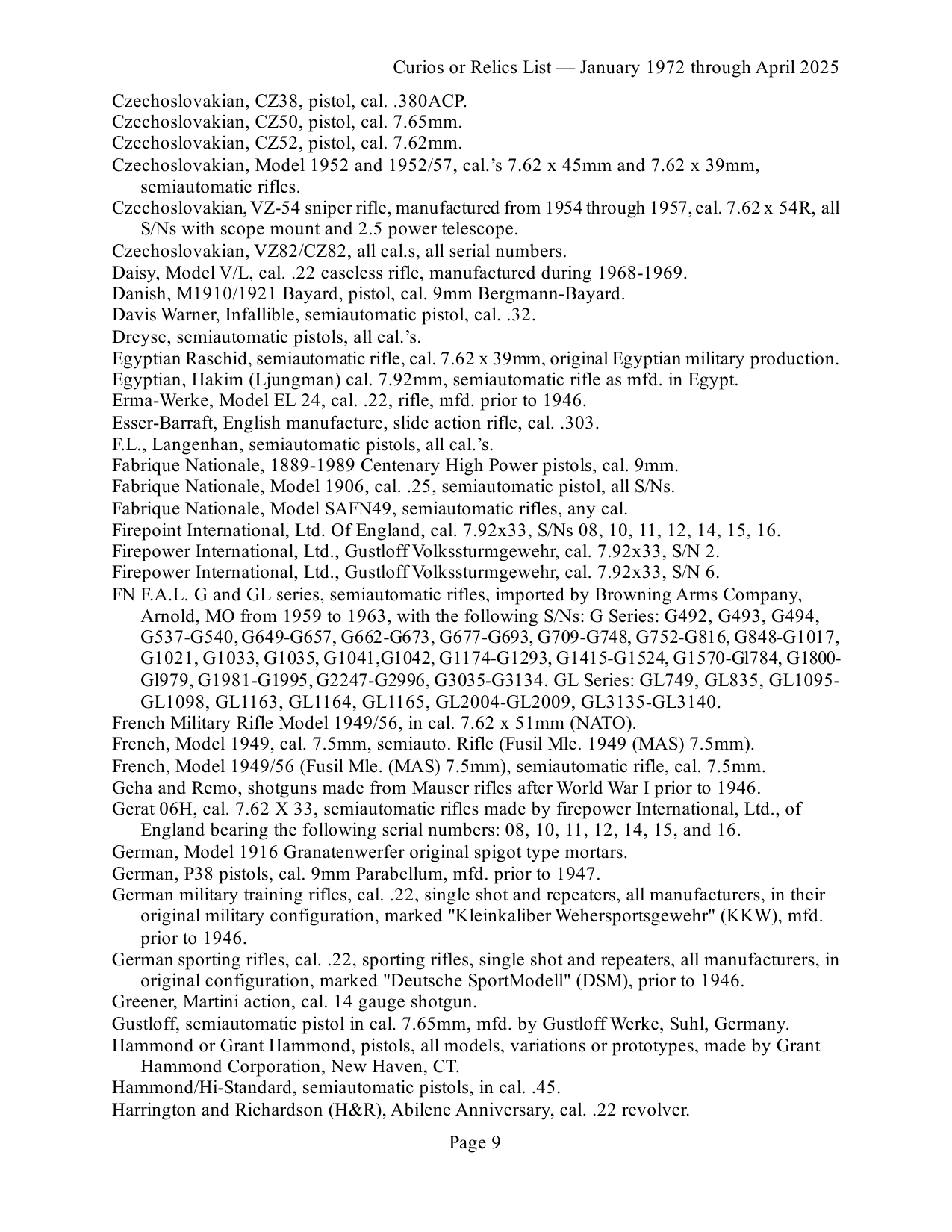
ATF treats the Daisy V/L as a firearm. This is not a matter of interpretation, and it does not depend on any 1969 document. The Bureau’s own Firearms Curios or Relics List — the standing publication that identifies firearms exempt from certain restrictions on account of age or collector interest — carries the entry verbatim:
“Daisy, Model V/L, cal. .22 caseless rifle, manufactured during 1968-1969.”1
The legal weight of that line comes from what the list is. A curio-or-relic designation under 27 CFR 478.11 is a classification applied to firearms. Non-firearms do not appear on it, because there would be nothing for the designation to do. So the V/L’s presence on the C&R list is direct, current, published evidence of ATF’s position that the rifle is a firearm — and it also fixes the manufacturing window, which is why this volume prefers “1968-1969” to the “1967-1969” that circulates elsewhere.2
The statutory hook is equally plain, and it is the same one that would have applied in 1968. Under the Gun Control Act of that year, 18 U.S.C. § 921(a)(3) defines a firearm as any weapon that will, is designed to, or may readily be converted to expel a projectile by the action of an explosive. The V/L’s projectile is expelled by burning nitrocellulose bonded to the base of the bullet. The compressed air does nothing but light it. Whatever Daisy hoped, the plain text of the definition reaches the gun without strain, and it is genuinely difficult to construct a reading under which it does not.3 This is reasoning from the statute rather than a quotation of any finding, and it should be read that way — but it is reasoning that has gone unrebutted for more than fifty years.
14.2 What is not established
No formal, numbered, published ATF or Treasury ruling on the Daisy V/L has ever been produced. Not by the research behind this series, and — more tellingly — not by the people best placed to find one.
In February 2011 the International Ammunition Association’s forum ran a long thread on the V/L populated by serious cartridge collectors, including John Moss, a well-regarded authority who supplied from his own files the manufacturing history, the production breakdown, and quotations from Daisy’s original introductory broadsheet. Moss made the obvious observation: ATF rulings are public record under the Freedom of Information Act, and a copy ought to be obtainable. Eight years later a researcher returned to the same thread having found nothing further, writing that the thread itself remained the only substantive discussion of the claim he could locate, and that while ATF had plainly classified the V/L as a firearm on the C&R list, he was still looking for more.4
The earliest traceable printed source for the ruling story is a single sentence in the February 1993 issue of Guns & Ammo, in Bob Forker’s “Classic Test Report” on the rifle: production was stopped when the federal Bureau of Alcohol, Tobacco and Firearms ruled that the caseless rifle was indeed a firearm, and that Daisy was at the time licensed to produce air weapons only.5 That is twenty-four years after the fact, with no date, no document number, and no citation. Everything since appears to descend from it or from the same oral tradition.
So the situation is this: the conclusion is almost certainly right, and the evidence for the mechanism is a documentary ghost.
14.3 Four versions, and which one the evidence supports
Table 1 — Four versions, and which one the evidence supports
| Version | The claim | What supports it | What weakens it |
|---|---|---|---|
| A. ATF formally ruled | ATF issued a ruling classifying the V/L as a firearm; Daisy, holding no firearms licence, quit rather than comply | The C&R listing; Guns & Ammo Feb 1993; Wikipedia and Small Arms Review follow it; the GCA ‘68 timing is exact | No ruling document, number, or date has ever surfaced, despite collectors searching in 2011 and again in 2019 |
| B. ATF advised, did not rule | ATF took its time deciding, concluded the V/L was a firearm, and Daisy “was advised that it would be better if they didn’t make any more” | Tom Gaylord’s careful wording; explains the absence of a published ruling neatly; explains the absence of enforcement | Informal advice leaves no record either way, so the version is unfalsifiable on present evidence |
| C. Substantially urban legend | The regulatory story grew in the retelling and may not reflect what happened | Two unanswered objections: no enforcement action was ever taken, and Daisy could simply have obtained a licence and continued | ATF’s firearm position is documented; the 1968 timing is too neat to be coincidence; nobody proposes an alternative cause of the abrupt stop |
| D. Commercial failure regardless | The gun was dying on price and would have gone away with or without the government | $39.95 against a $23.95 Winchester; a single-shot rifle needing proprietary ammunition; an ex-dealer’s recollection that it never sold well | Does not by itself explain why production stopped so abruptly, mid-stride, in 1969 |
Version B is the best-supported reading, and it is the one this series adopts. It accounts for every piece of evidence at once: ATF’s firearm position is documented, no published ruling exists because none may ever have been written, and no enforcement action was taken because none was required — a manufacturer that stops manufacturing is not a problem the Bureau needs to solve. Gaylord’s phrasing is worth reading closely, because it is the only account by a serious historian that does not simply repeat the 1993 sentence, and he says advised.6
He adds a detail that quietly damages the whole “the V/L was uniquely doomed” framing: he bundles the V/L with two other Daisy .22 projects, the Legacy and the Model 8, which “all went quietly away” at the same moment. If three Daisy .22 firearms vanished together, the operative fact is not a ruling about one caseless rifle. It is a corporate decision that Daisy was not going to be in the firearms business.
The skeptical case deserves its hearing rather than a dismissal. DennisK, who owns six V/L rifles and a large stock of the ammunition, put two questions on the record in 2011 that nobody has answered: if Daisy’s attorneys had not checked the regulatory position thoroughly before tooling up for a national product launch, that is extraordinary — and if the story is true, why did Daisy not simply comply and resume, and why did the Bureau take no punitive action for what would have been unlicensed manufacture?4 Those are good questions. Version B answers both. Version A does not.
14.4 The commercial case, which needs no government at all
Version D is independent of all of this, and it is strong. In 1969 the V/L Standard retailed at $39.95. A Winchester Model 121 — a bolt-action single-shot .22 rimfire that fed on ammunition available in every hardware store in America — was $23.95 at the same moment.6 Sixteen dollars was a very large gap in 1969, and the buyer was being asked to pay it for a gun that was also single-shot, that produced roughly the energy of a high-velocity .22 Short rather than the .22 Long Rifle Daisy compared it to, and that would only ever fire one proprietary cartridge sold by one company.
An ex-dealer’s memory, offered in the same IAA thread, is that the gun “never sold terribly well in the overall scheme of firearms sales at the time,” and that it could be that it had just about run its course anyway.4 The honest synthesis is not that regulation killed a healthy product. It is that a marginal product met a regulatory burden it had specifically been engineered to avoid, and its corporate owner — Victor Comptometer, an office-machine conglomerate — chose to walk away rather than restructure a subsidiary around it.
14.5 The Michigan line, drawn again in 2015
There is a closing symmetry here that is worth spelling out, because Daisy was a Michigan company for its first seventy-six years and the distinction that ended the V/L is now written into Michigan’s own statute books.
Michigan defines a firearm as a weapon that “will, is designed to, or may readily be converted to expel a projectile by action of an explosive.”7 That is the federal formula almost word for word. Separately, and by 2015 amendment, Michigan defines a “pneumatic gun” as “any implement, designed as a gun, that will expel a BB or pellet by spring, gas, or air” — a category the Legislature deliberately carved out and largely preempted to the state.7
Every gun Daisy ever made falls on the pneumatic side of that line: the Model 1888, the Red Ryder, the Model 25, the 880, the 499B. Exactly one falls on the other. The V/L is a firearm under Michigan law for precisely the reason it was a firearm under federal law in 1968 — an explosive drives the projectile — and Michigan wrote the distinction down forty-six years after it had already cost a Plymouth company its most interesting product.
14.6 The collector market
Production is best stated as about 24,000 rifles. The most defensible breakdown is the one Forker published in Guns & Ammo in February 1993: 19,000 Standard, roughly 4,000 Presentation, and 1,000 collector packages. It is the only figure with a named author, a named publication, and page numbers, and it is the only one that independently accounts for the three configurations that are known to exist.5 Gaylord’s widely quoted 19,000 plus 5,000 Presentation is very likely the last two collapsed into one; Wikipedia’s 23,000 is uncited, and Small Arms Review’s 25,000 is a rounding of the same tradition. All sources converge on roughly 24,000, which is the number to trust.6
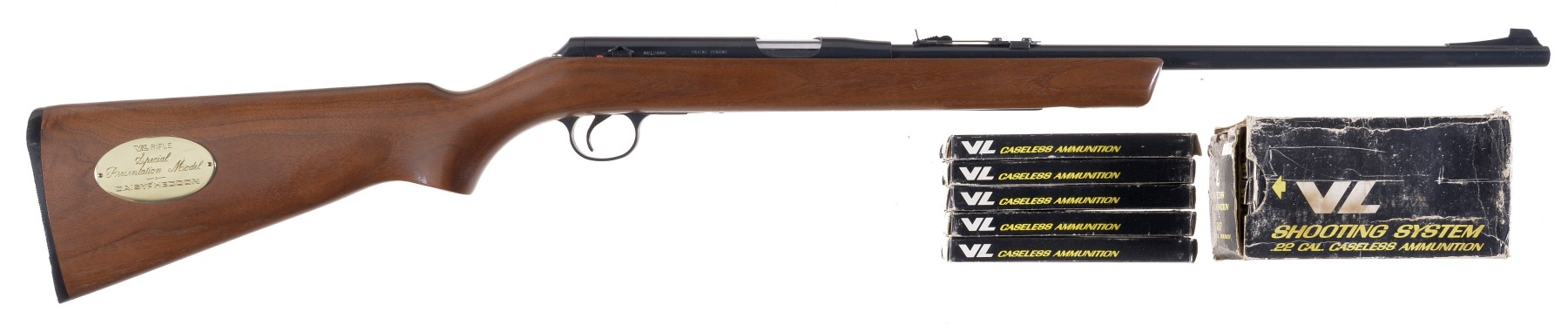
The Presentation Model sold for $125 and comprised an American walnut stock, a brass nameplate on the right side of the butt for inscription, a fitted presentation case, a brass display stand, and 1,000 rounds of ammunition. A certificate is frequently mentioned in casual accounts and is attested by no located source; this series does not claim one.6
Values today are best given as a range rather than a price, because completeness drives most of the spread. Standard rifles run roughly $200 to $400 — Rock Island Auction sold three with ammunition for about $200 each in 2017, and Small Arms Review put a decent example with a little ammunition at $250 to $300 in 2013. Presentation sets run roughly $500 to $1,000, with the case, the brass stand, and unfired ammunition accounting for the difference; Gaylord judged a caseless, standless Presentation listed at $650 to be a little high and $500 about right.896
The ammunition is the more interesting market. Canadian Industries Limited made something like 47 million rounds against 24,000 rifles — roughly two thousand rounds per gun ever built — and that overhang kept prices absurd for decades. Into the 1980s and beyond, a case of 10,000 rounds went for around a hundred dollars at airgun shows: one cent per round for caseless ammunition.6 Today a wholesaler lists a 100-round box at $15.95, out of stock. That is a sixteen-fold rise and intermittent availability. It is a real trend, and it is not yet rarity.10
14.7 The one thing that could settle it
Under the Freedom of Information Act, ATF’s classification correspondence is in principle obtainable. The Bureau’s files from 1968 and 1969 would show whether a formal ruling was issued, whether Daisy was informally advised, or whether the Bureau’s involvement was something else again. No evidence exists that anyone has ever filed such a request. Fifty-seven years of articles, auction catalogues, forum threads, and encyclopedia entries have all repeated a sentence that one records request could confirm or dissolve.
Until someone files it, the correct posture is the one this volume has taken: ATF’s position is documented, the ruling is not, and the difference between those two statements is the last unwritten chapter of the V/L story.
14.8 Bibliography
Footnotes
-
ATF, Firearms Curios or Relics List (ATF P 5300.11), entry: “Daisy, Model V/L, cal. .22 caseless rifle, manufactured during 1968-1969.” Verbatim text confirmed via a mirror of the ATF list at https://firearmsguide.com/index.php?Itemid=167&id=3084&option=com_content&view=article (confidence: high on the wording; medium-high overall, because direct retrieval of the ATF PDFs at https://www.atf.gov/media/19856/download and https://www.atf.gov/file/128116/download was blocked to automated access during this research and the entry should be re-verified against the Bureau’s own document). ↩
-
27 CFR 478.11, definition of “curios or relics.” The designation applies to firearms, which is why the listing is evidence of ATF’s classification position (confidence: high; this is an inference from the regulation’s structure, not a quoted finding). ↩
-
18 U.S.C. § 921(a)(3), Gun Control Act of 1968. https://www.law.cornell.edu/uscode/text/18/921 (confidence: high on the statutory text; the application to the V/L is presented as reasoning). ↩
-
International Ammunition Association forum, “Daisy V/L Caseless Ammunition,” thread opened February 2011 with a further contribution in 2019. https://forum.cartridgecollectors.org/t/daisy-v-l-caseless-ammunition/9246 (confidence: high that the quoted objections and the failed 2019 search were stated; the participants are experienced cartridge collectors, but this is a forum). ↩ ↩2 ↩3
-
Bob Forker, “Classic Test Report: Daisy VL Standard Caseless .22 Rifle,” Guns & Ammo, February 1993, pp. 84-86. Not obtained directly; relayed with page numbers by John Moss in the IAA thread at note 4 (confidence: medium-high; the only production figure and the earliest ruling reference with a named author, publication, and pagination). ↩ ↩2
-
Tom Gaylord (B.B. Pelletier), “Daisy VL rifle: Part 1” and “Part 2,” Pyramyd Air, 14 and 21 May 2021. https://www.pyramydair.com/blog/2021/05/daisy-vl-rifle-part-1/ (confidence: medium-high; the only modern instrumented testing located, and the source of the “advised” wording, the Winchester price comparison, the Presentation Model contents, and the surplus-ammunition prices; the site blocks automated access and was reached via the Wayback Machine). ↩ ↩2 ↩3 ↩4 ↩5 ↩6
-
Verified against the primary source. MCL 123.1101 (1990 PA 319, “Firearms and Ammunition”; amended by 2015 PA 29, effective 10 August 2015), Sec. 1: subsection (a) “‘Firearm’ means any weapon which will, is designed to, or may readily be converted to expel a projectile by action of an explosive”; subsection (d) “‘Pneumatic gun’ means any implement, designed as a gun, that will expel a BB or pellet by spring, gas, or air,” extended in the same subsection to paintball guns. MCL 750.222 (1931 PA 328, Michigan penal code; amended by 2015 PA 26, effective 1 July 2015), Sec. 222: subsection (e) carries the identical firearm wording, and subsection (g) does not restate the pneumatic-gun definition but incorporates it by reference to MCL 123.1101 — so the operative definition for both statutes is the one in 123.1101(d). Retrieved from https://www.legislature.mi.gov/Laws/MCL?objectName=mcl-123-1101 and https://www.legislature.mi.gov/Laws/MCL?objectName=mcl-750-222 , text current through 2026 PA 20 (confidence: high). ↩ ↩2
-
Rock Island Auction, “Three Daisy .22 Caseless V/L Single Shot Rifles,” 2017. https://www.rockislandauction.com/detail/2014/524/three-daisy-22-caseless-vl-single-shot-rifles (confidence: medium; a realised auction result for three guns as a lot). ↩
-
Will Dabbs MD, “The Daisy V/L Caseless Rifle: Decades Ahead of Its Time,” Small Arms Review V17N3, September 2013. https://smallarmsreview.com/the-daisy-v-l-caseless-rifle-decades-ahead-of-its-time/ (confidence: medium on values and market colour; the article contains at least one definite error elsewhere, giving the bullet weight as 40 grains against the patent’s 29, so its numbers are used cautiously). ↩
-
Miwall Corporation, “Daisy V/L Ammunition - .22 Caliber - Caseless - 100 Rounds,” listed at $15.95, out of stock. https://miwallcorp.com/daisy-v-l-ammunition-22-caliber-caseless-100-rounds/ (confidence: high for the listing itself; note it is a wholesaler list price rather than a collector realisation). ↩
Comments (0)