Daisy · Volume 5
How a BB Gun Works: Spring-Piston, Pneumatic, and CO2
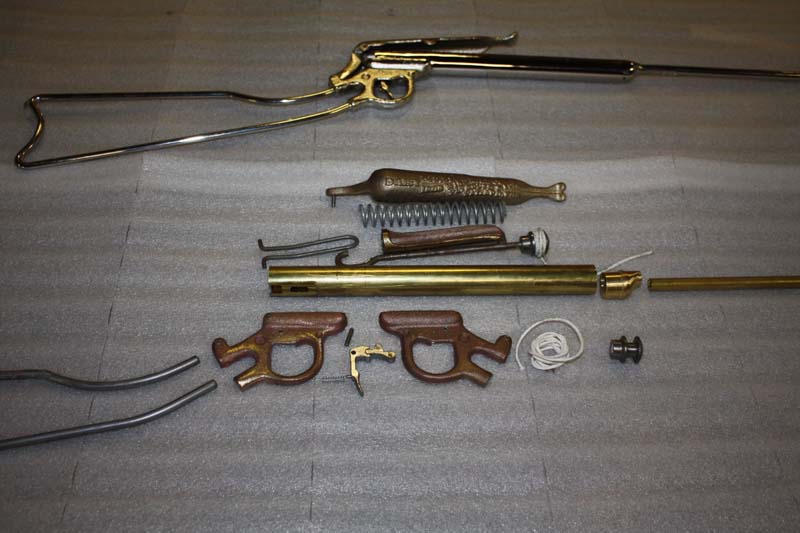
A Red Ryder is one of the most familiar mechanisms in American life and one of the least accurately described. Almost everyone who has written about it — including a fair number of people who should know better — reaches for the same shorthand: it is a little spring-piston air rifle, a scaled-down version of the German break-barrel springers that push a pellet to 900 fps. That description is wrong in a way that matters, because it makes the gun’s most interesting design decision invisible.
The Daisy lever gun is not a miniature spring-piston rifle. It is a catapult with an air booster. The distinction is not pedantry; it is the reason a seven-year-old can cock the thing.
5.1 The Problem the Design Solves
Start with the projectile, because the projectile dictates everything downstream. A steel BB is a loose sphere of roughly 0.171 to 0.173 inch rolling around inside a smoothbore of 0.177 inch. It does not seal. It cannot seal — there is no skirt to flare, no rifling to engage, nothing but a ball rattling in a slightly larger tube. Volume 6 takes up the dimensional history in detail; what matters here is the consequence.
A true spring-piston pellet rifle works by trapping a column of air behind a projectile that does seal. The piston slams forward, pressure spikes in the compression chamber, and because the pellet’s skirt is bore-sized or slightly oversize, essentially all of that pressure does useful work pushing the pellet down a rifled barrel. The seal is the whole trick. Take the seal away and the air simply blows past the projectile, and you get a puff of noise and a ball that dribbles out the muzzle.
Daisy’s engineers faced exactly that. They also faced a second constraint that the German springer makers did not: the customer is a child. A serious spring-piston rifle takes thirty to fifty pounds of cocking effort. A youth BB gun has to be cockable at something on the order of ten to fifteen pounds with one arm and a lever.
The solution was to stop asking air to do all the work.
5.2 The Four-Stage Cycle
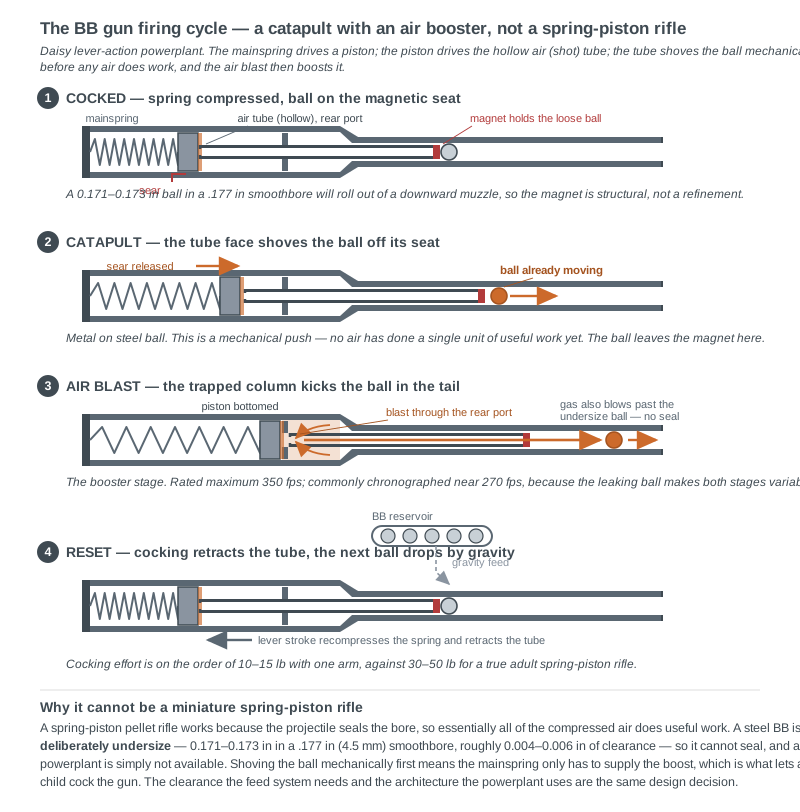
Tom Gaylord, writing as B.B. Pelletier, gives what is the authoritative plain-language description of the mechanism: “The BB gun powerplant is a hybrid of both the spring-piston and the catapult designs.”1 It runs in four stages.
Cocked. Working the lever compresses the mainspring and holds the piston back against the sear. The hollow air tube — the shot tube — is retracted so that its open forward end sits just behind the next BB. That BB has arrived by gravity from the reservoir and is sitting in the seat waiting. It is held there by a small permanent magnet, and it has to be: a loose steel ball in a smoothbore will simply roll out of the muzzle the moment the gun is pointed downhill. The magnet is not a refinement, it is a structural necessity of the loose-ball design.
Catapult. The sear releases, the mainspring drives the piston forward, and the air tube moves forward with the piston. The tube physically strikes the BB and shoves it off its magnetic seat. This is a mechanical push — metal on steel ball — and it happens before any air has done a single unit of useful work. The BB is already moving, propelled the way a stone is propelled by a sling arm.
Air blast. The piston reaches the end of its stroke and stops hard. The air trapped in the compression chamber has nowhere to go except through a hole at the rear of the air tube, and that blast catches the already-moving BB from behind — Gaylord’s phrase is that it “kicks the BB in the tail” — and boosts it to final muzzle velocity.1
Reset. Cocking retracts the tube, and the next BB drops onto the magnetic seat by gravity.
The design’s own engineering argument is stated by Gaylord as plainly as anyone could want: “The boost means that the mainspring can be made light enough for younger folks to cock, yet still supply adequate power to launch a BB.”1 His analogy is a booster rocket — the catapult stage gets the mass moving, the air stage adds the rest.
5.3 Why This Explains Everything Else About the Gun
Once the catapult-plus-booster model is in hand, the rest of the BB gun’s odd behaviour stops being odd.
Velocities are low. A springer that seals can put 800 or 900 fps behind a pellet. A BB gun that leaks around its projectile cannot, and Daisy did not try. Rated maxima across the youth line cluster around 350 fps.
Velocities are inconsistent shot to shot. The catapult contribution depends on where exactly the ball was sitting and how it left the seat; the air contribution depends on how much gas got past the ball before the ball cleared. Neither is tightly controlled. A springer with a sealed pellet is far more repeatable.
Cocking effort is a child’s-arm figure. The mainspring only has to supply the boost, not the whole launch.
The magnet is mandatory. Every loose-ball gravity-fed design needs some way to hold the ball at the breech until the shot. Magnetised bolt and tube tips are standard practice across the industry — the general principle is that “it is common to find guns that use a magnet in the loading mechanism to hold the BB at the rear of the barrel until it is fired,” and Gaylord documents the flat magnetised bolt tip specifically on the Daisy Model 35.2
It is worth being clear about what is and is not established here. The four-stage mechanism and the magnet are well documented. The comparative framing against true spring-piston pellet rifles — the argument that this is why velocities are low and inconsistent — is a synthesis rather than a quotation, and should be read as a sound inference rather than a factory statement.
5.4 Lever Versus Slide Is Not a Powerplant Difference
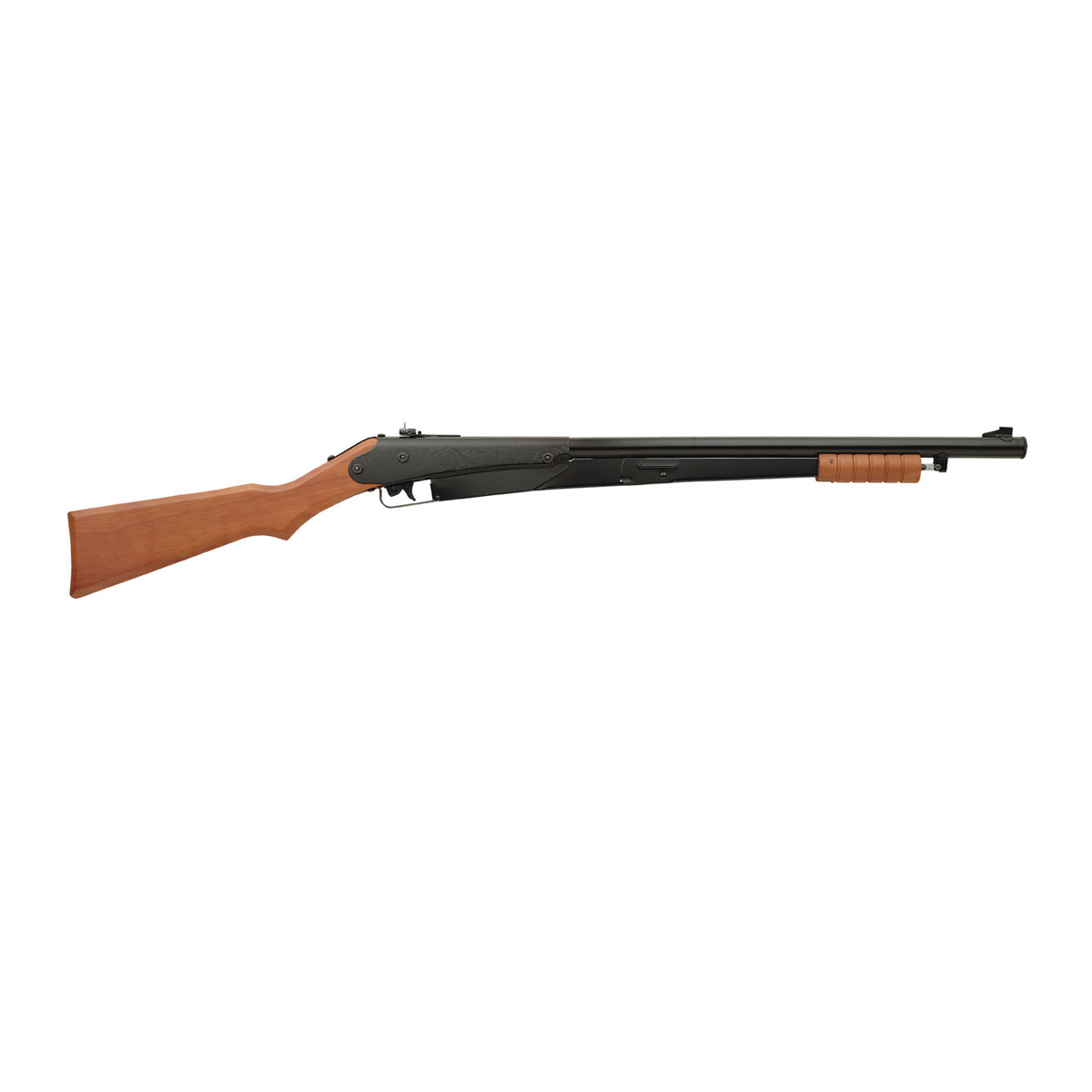
Daisy sold two visually distinct families of youth gun for most of a century: the lever-action guns culminating in the Red Ryder, and the slide-action Model 25 with its trombone pump handle. It is tempting to assume the pump gun is a pneumatic. It is not.
The Model 25’s slide is a cocking stroke, not a pumping stroke. One pull of the slide compresses the same mainspring the Red Ryder’s lever compresses, and the gun fires the same catapult-plus-blast cycle. The two cocking layouts are the same powerplant with different linkages.3 Volume 9 takes the Model 25 up in full; the point to carry from here is that “pump gun” in Daisy nomenclature describes the shooter’s hand motion, not the physics.
5.5 The Other Three Powerplants
Daisy’s catalogue is not one mechanism. Above the youth line sit three genuinely different ways of storing energy.
Multi-pump pneumatic. The shooter pumps ambient air into a reservoir across multiple strokes — the Powerline 880 accepts up to ten — and firing releases the stored charge through a valve. The defining feature is that velocity is selectable by pump count. Because energy accumulates across strokes instead of being capped by one spring’s stored energy, the ceiling is far higher: 750 fps with BBs and 715 fps with pellets on the 880.4 The trade-offs are that it is slow to shoot and that the valve is the wear point.
Single-stroke pneumatic. The Avanti 853 takes exactly one stroke of its aluminium lever, and it is mechanically impossible to put in a second. The charge is therefore a fixed volume every single time, which produces a constant velocity every single time — around 500 fps.5 That constancy is the entire reason the target line uses this powerplant. The price is that velocity is fixed and modest, and the cocking effort is heavy for what you get.
CO2. A 12-gram cartridge (or a bulk fill) is a self-pressurising reservoir of liquid and vapour. No pumping, fast repeat shots, high shot counts — the Powerline 008 manual states a minimum of 60 shots per cartridge, and the Avanti 887 match rifle is quoted at roughly 300 shots per fill.6 The trade-off is thermodynamic and unavoidable: CO2 vapour pressure falls with temperature, so a cold day is a slow gun, and rapid fire chills the cartridge enough to produce a visible velocity sag across a string. This is uncontroversial airgun physics rather than a Daisy-specific quirk.
5.6 The Numbers, and the Gap Between Rated and Real
Table 1 — The Numbers, and the Gap Between Rated and Real
| Gun | Powerplant | Published velocity |
|---|---|---|
| Red Ryder 1938B | spring-piston / catapult | 350 fps rated; commonly measured near 270 |
| Model 25 | spring-piston, slide-cocked | 350 fps |
| Model 105 Buck | spring-piston, lever | up to 350 fps |
| Avanti 499B | spring air, single-shot muzzle-load | 240 fps |
| Avanti 853C | single-stroke pneumatic | approximately 500 fps |
| Powerline 880 | multi-pump pneumatic | 750 fps BB / 715 fps pellet |
Every figure in that table is a rated maximum obtained with the manufacturer’s preferred ammunition under favourable conditions. Chronographed reality runs lower across the board, and the Red Ryder’s gap is the largest and the most discussed.
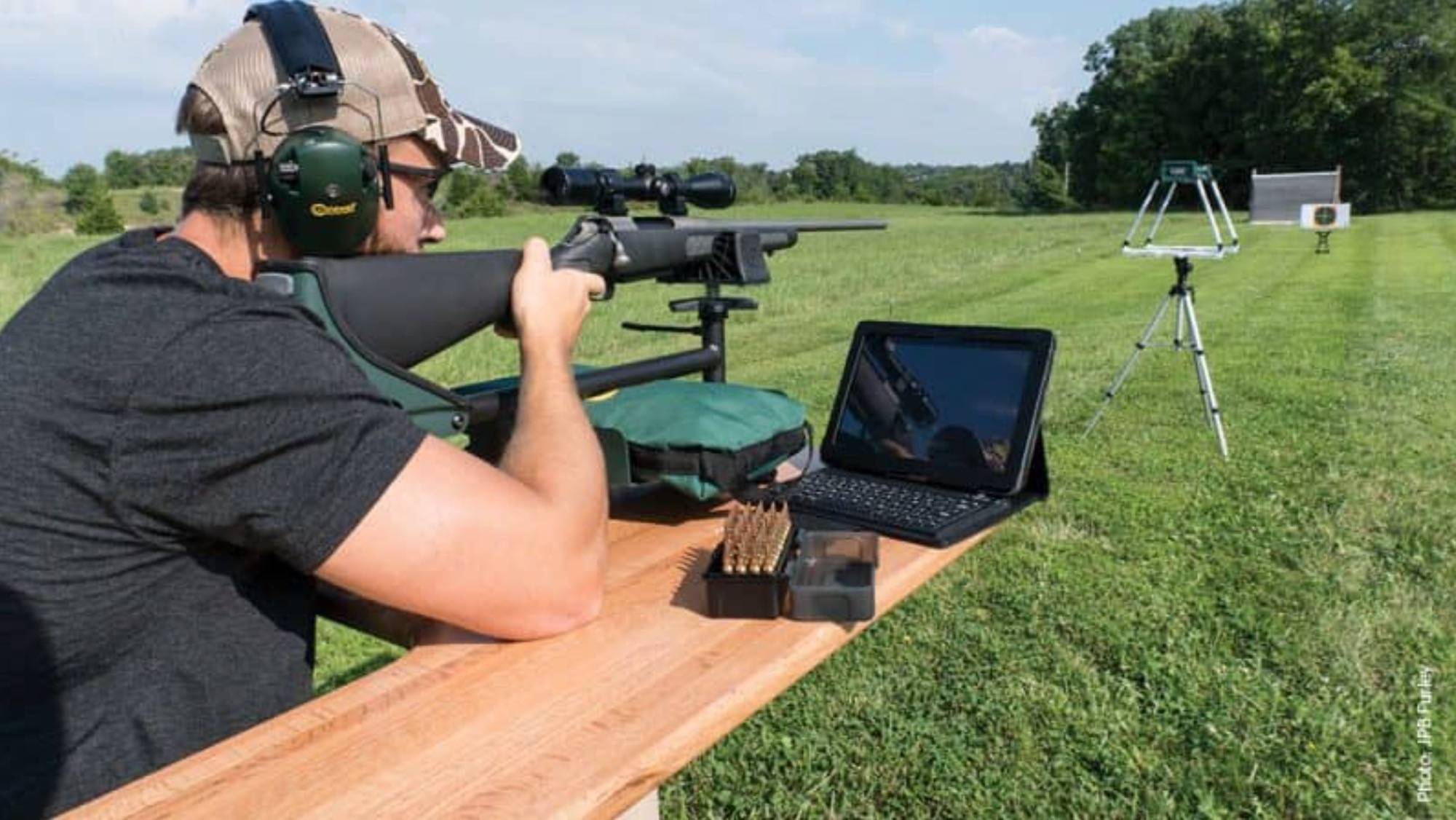
Daisy’s stated maximum for the current 1938B is 350 fps.7 Actual measured velocity is commonly around 270 fps, a discrepancy flagged explicitly on the Wikipedia entry for the company, with chronograph reports from users and reviewers typically landing in a 265 to 320 fps band depending on the age of the gun and the brand of BB.8 Neither number is a lie. The 350 is the ceiling; the 270 is the room. Any honest treatment gives both, and the reason the gap exists is precisely the leaky, catapult-assisted, loose-ball architecture described above — a mechanism whose output depends heavily on the fit of a ball that is deliberately not a fit at all.
There is one further engineering note worth recording. Daisy holds patents specifically on limiting and interlocking these powerplants — US 5,224,465, “Air gun with baffle for limiting maximum velocity,” and US 5,775,312, “Spring air gun with interlocking mechanism.”9 A company that patents a baffle whose purpose is to cap velocity is a company that has thought carefully about where on the power curve a youth gun ought to sit. That posture runs straight into Volume 16 and the regulatory history.
5.7 Bibliography
Footnotes
-
Tom Gaylord (B.B. Pelletier), “A look inside the BB gun powerplant,” Pyramyd Air, August 2009. https://www.pyramydair.com/article/A_look_inside_the_BB_gun_powerplant_August_2009/64 (confidence: high for the mechanism; the comparative framing against sealed-pellet springers is this series’ synthesis). ↩ ↩2 ↩3
-
Tom Gaylord, “What is a bolt action?”, Pyramyd Air blog, July 2013 — documents the magnetised flat bolt tip on the Daisy Model 35 and the general practice. https://www.pyramydair.com/blog/2013/07/what-is-a-bolt-action/ (confidence: high). ↩
-
Pyramyd Air, “The BB gun powerplant: how it works,” February 2007. https://www.pyramydair.com/blog/2007/02/the-bb-gun-powerplant-how-it-works/ ; Model 25 powerplant classification at https://www.pyramydair.com/product/daisy-model-25-pump-action-bb-gun?m=2057 (confidence: high). ↩
-
Daisy, Powerline 880 Multi-Pump Pneumatic product page. https://daisy.com/product/daisy-powerline-880-multi-pump-pneumatic/ (confidence: high). ↩
-
Tom Gaylord, “The Daisy 853, Part 1,” Pyramyd Air blog, May 2016. https://www.pyramydair.com/blog/2016/05/the-daisy-853-part-1/ ; specifications at https://www.airgundepot.com/daisy-avanti-853c.html (confidence: high). ↩
-
Daisy Powerline 008 factory manual. https://www.pyramydair.com/airgun-resources/manuals/Daisy_008_Manual.pdf ; Avanti 887 Gold Medalist specifications, https://www.airgunsofarizona.com/co2/daisy-avanti-gold-medalist-887-co2-air-rifle/ (confidence: high). The temperature-dependence and rapid-fire sag are standard airgun physics rather than sourced Daisy claims (confidence: medium). ↩
-
Daisy, Red Ryder product page. https://daisy.com/product/red-ryder/ (confidence: high). ↩
-
Wikipedia, “Daisy Outdoor Products” — notes the gap between the rated and measured Red Ryder velocity. https://en.wikipedia.org/wiki/Daisy_Outdoor_Products (confidence: medium for the 265–320 fps reviewer band). ↩
-
US Patent 5,224,465, “Air gun with baffle for limiting maximum velocity”; US Patent 5,775,312, “Spring air gun with interlocking mechanism.” https://image-ppubs.uspto.gov/dirsearch-public/print/downloadPdf/5224465 ; https://image-ppubs.uspto.gov/dirsearch-public/print/downloadPdf/5775312 (confidence: high). ↩
Comments (0)