Daisy · Volume 12
V/L II: The Mechanism — Ignition by the Heat of Compressed Air
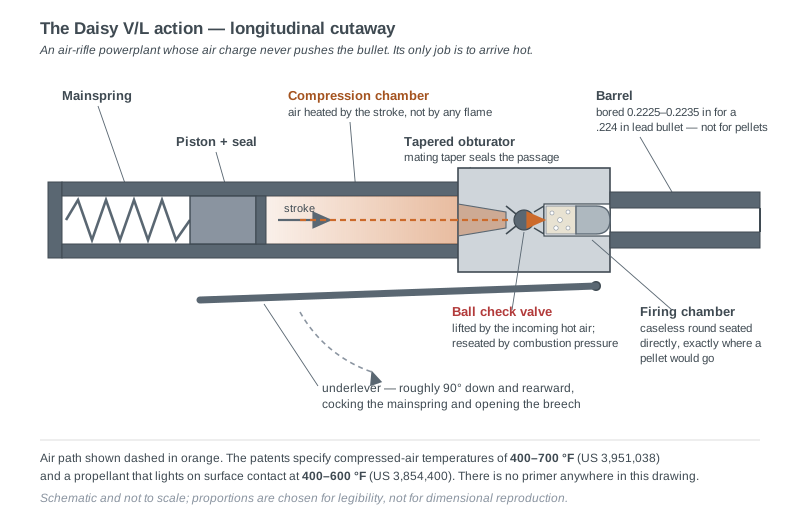
This is the volume the rest of the series exists for. The Daisy V/L is the only production firearm ever sold to the American public that fires without a primer of any kind — no percussion cap, no rimfire priming compound, no consumable primer pellet, no electrical igniter. It lights its propellant with nothing but hot air, and the air gets hot for the same reason the end of a bicycle pump gets hot: it has been squeezed, quickly, by a piston.
That sentence is easy to say and easy to get wrong, and almost every popular account of the V/L gets some part of it wrong. So this volume proceeds slowly. It walks the firing sequence step by step from the patents, it identifies the one component that makes the architecture possible, it contrasts the gun rigorously against a normal spring-piston air rifle on one side and a primer-fired cartridge on the other, and it corrects the most widely repeated number in the entire V/L literature.
12.1 What it fundamentally is
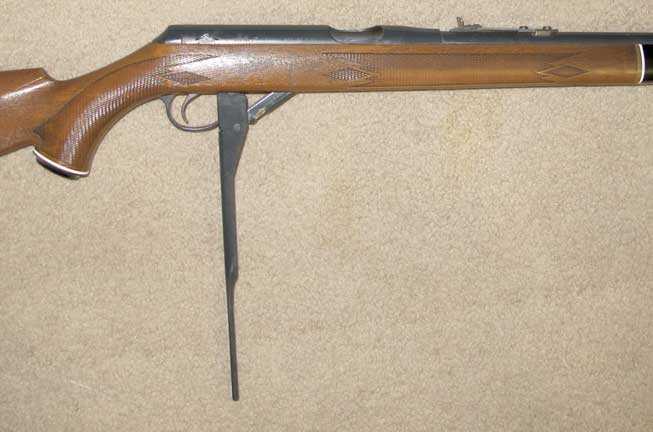
The V/L is a .22-calibre single-shot underlever spring-piston air rifle whose compressed-air charge is used not to push the projectile but to ignite a propellant charge. The burning propellant does the work of driving the bullet.1
Both halves of that sentence matter. The powerplant is, mechanically, an air rifle’s powerplant — a coil mainspring, a piston, a cylinder, a sear, an underlever that cocks it. Gaylord’s own summary is exactly the paradox: “Today BB looks at a firearm that’s actually a spring-piston air rifle.”1 But the air never touches the bullet in any load-bearing way. Its entire job is to arrive somewhere hot. A description that calls the V/L “an air rifle that shoots .22” has the physics backwards, and a description that calls it a conventional rifle misses that there is no primer anywhere in it.
The closest familiar analogy is not another gun at all. It is a diesel engine, or a fire piston — the ancient Southeast Asian tube-and-plunger device that lights tinder by a single sharp compression stroke. A commenter on Gaylord’s blog reached for that comparison and it is the right one.1 The V/L is a fire piston that happens to have a barrel bolted to the front of it.
12.2 The firing sequence, step by step
The following is assembled from US 3,521,523 and US 3,951,038 as primary sources, with the Rock Island Auction operational description filling in handling detail.234
One — cocking. The underlever is pulled down and rearward through roughly ninety degrees. This compresses the mainspring and drives the piston rearward until the sear catches it. The same stroke moves the sliding compression chamber back, which opens the breech and the loading port, and it resets the rifle’s automatic safety. There is no ratchet detent on the lever — the stroke is all or nothing, which is unusual for an underlever and means the shooter cannot pause partway.
Two — charging the air chamber. As the lever is closed, the breech seats and the air chamber refills through an intake hole regulated by a ball check valve. Remember that valve; the rest of this volume turns on it.
Three — loading. The round goes directly into the breech, in Gaylord’s phrase, “exactly where a pellet would be loaded.”1 There is no case to extract afterwards and nothing to eject. The breech is simply closed on a bullet with a cylinder of propellant on its tail.
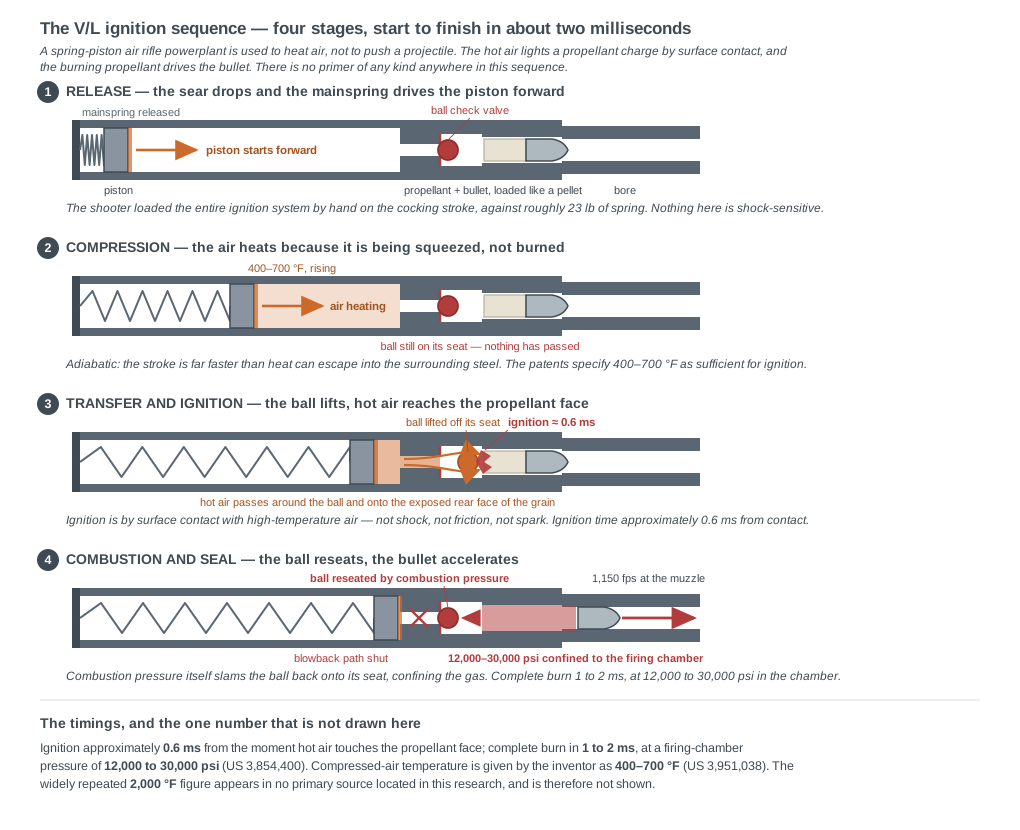
Four — release. The trigger drops the sear, the mainspring drives the piston forward, and the compression stroke begins. The patent language is plain: “piston means movably mounted in said cylinder means for movement between a retracted position and an extended position during an air compression stroke.”2
Five — adiabatic heating. Compression happens far faster than heat can escape into the surrounding steel, so the work done on the gas goes into the gas itself and its temperature climbs sharply. This is the physical core of the invention, and the temperature it reaches is the most disputed number in the story — dealt with in its own section below.
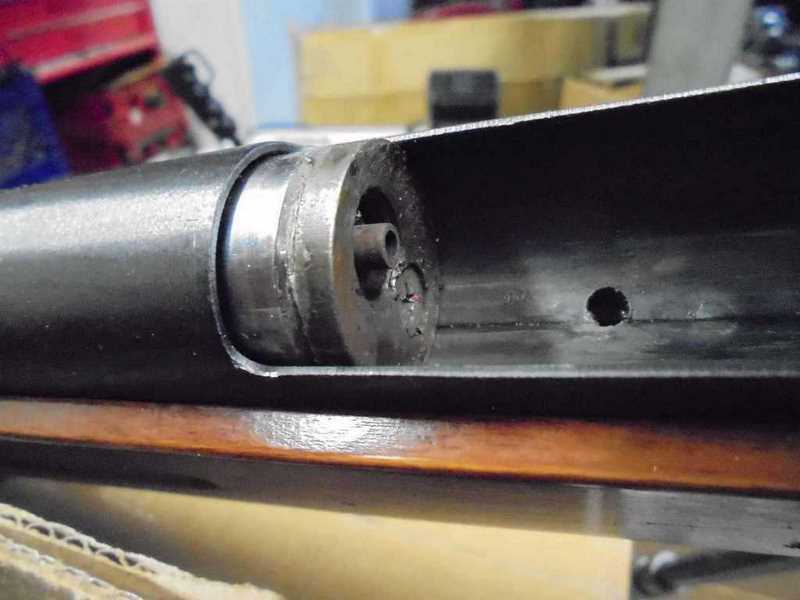
Six — transfer. The heated air is forced through a restriction and past an obturator passage, and a ball valve seated in the movable breech lifts to admit it axially into the firing chamber, directed onto the exposed rear face of the propellant charge.2
Seven — ignition by surface contact. The patents describe the propellant as “mounted in a cavity at the rear of the plug with a surface exposed for surface contact with high temperature air.”2 Ignition is not by shock, not by friction, not by spark. It is a hot gas touching an exposed face. Ignition time is approximately 0.6 milliseconds from contact.3
Eight — combustion and sealing. This is the step that makes everything else possible. The pressure of the combustion gases reseats the ball valve, which the patent says “provide[s] a positive reaction surface in the valve chamber so that the gases generated by ignition of the propellant are confined to the firing chamber.”2 Complete burn takes one to two milliseconds, at firing-chamber pressures of 12,000 to 30,000 psi.3
Nine — the shot. The 29-grain bullet leaves the muzzle at a nominal 1,150 feet per second.
12.3 The ball check valve is the whole architecture
A conventional spring-piston air rifle has no valve between its compression chamber and its pellet. It does not need one. The pressure it develops is a few hundred psi at most, it acts on the pellet for a fraction of a millisecond, and the piston is still travelling forward while it happens. Air goes one way, briefly, and the event is over.
The V/L has to do something that no springer has ever had to do: survive its own shot.
Consider the position of the piston at the instant of ignition. It is at or near the end of its stroke, with a mainspring behind it and a column of very hot, very compressed air in front of it, connected by an open passage to a chamber that is about to reach somewhere between 12,000 and 30,000 psi. That is a pressure one to two orders of magnitude above anything a spring-piston airgun generates. Without something to close that passage, the combustion event would vent straight back down it — into the transfer port, into the compression chamber, and onto the face of the piston. The result would be a wrecked piston seal at best and a catastrophic reverse-driven piston at worst, and either way the bullet would receive a fraction of the energy intended for it, because the propellant gases would have somewhere else to go.
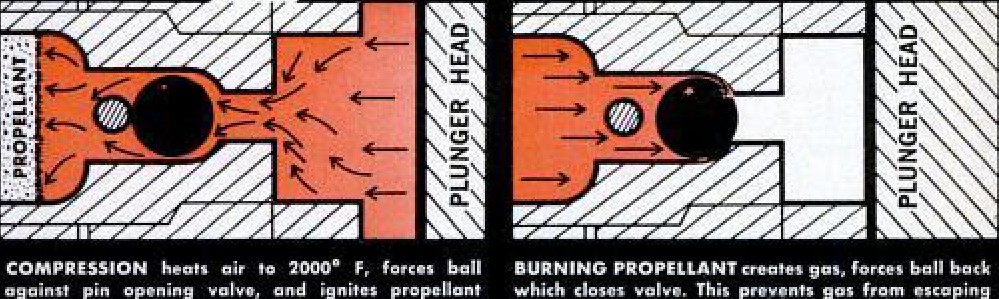
The ball check valve closes that passage, and it does so using the combustion event itself as the actuating force. Hot air pushes the ball off its seat on the way in; combustion pressure slams it back onto that seat on the way out. It is a one-way door that the shot itself locks behind it. No timing, no linkage, no cam — the valve is operated by the very pressure it exists to contain, which means it cannot be out of time with the event it is sealing.
This is the component a conventional airgun does not have, and it is the reason the V/L is possible at all. Every other part of the gun is an air rifle part doing an air rifle job. The ball valve is the part that converts an air rifle into something that can contain a firearm’s combustion, and it does it with a sphere and a seat.
The valve is not doing the sealing job alone. The family shows two distinct approaches to obturation — the business of sealing the breech against escaping gas — and both appear alongside it. US 3,521,523 describes a tapered obturator plug: “the outer surface of the obturator 694 is tapered to provide a mating fit with the wall of the enlarged tapered obturator chamber 692.”2 US 3,951,038 is more old-fashioned and specifies “obturation means in the form of a suitable packing 134 of leather, rubber, or the like” — leather, the classic airgun piston-seal material, in a firearm.4
And then, in 1969, from La Hulpe, comes the idea that should have been in the gun from the start. US 3,628,272 describes a thin-walled metallic obturator jacket — copper or phosphor bronze, roughly 0.5 mm wall for high pressure and 0.1 to 0.2 mm for low, ends soldered with lead solder for low-pressure work and silver or brass solder for high — that expands radially under gas pressure to seal the firing chamber and relaxes afterwards.5 That is a cartridge case. It is precisely and explicitly what a brass case does at the moment of firing, rebuilt as a permanent component of the gun. It is the most elegant idea in the entire family and it arrived after the last V/L was built.
12.4 The temperature: correcting the most-repeated number in the story
Almost every account of the V/L on the internet says the compressed air reaches 2,000 °F. Wikipedia says it, citing Nonte in Popular Mechanics, October 1967.6 Rock Island says it: “Compression heated the air; in this case, to 2,000 ℉.”7 It appears in forum posts, auction descriptions, magazine features, and video scripts, always as a flat statement of fact.
That figure appears in no primary source located in this research.
What Van Langenhoven’s own patents say is this. US 3,951,038 specifies compressed air temperatures “in the range of 400 °F to 700 °F” as sufficient for propellant ignition.4 US 3,854,400 describes a propellant that “is ignitable by surface contact with high temperature air” and performs well “at temperatures of 400°–600 °F.”3 Two independent documents, written by the inventor, describing the same system from opposite ends — the air side and the propellant side — and they agree with each other within a hundred degrees. Air at four to seven hundred; a propellant designed to light at four to six hundred. That is what an engineering specification looks like when the two halves have been designed to meet.
Where does 2,000 °F come from, then? The trail points to a single origin. Both the Wikipedia figure and the Rock Island figure almost certainly descend from the same October 1967 Popular Mechanics article by Major George C. Nonte Jr., and/or from Daisy’s own marketing material of the period — and have been copied outward from there for more than fifty years. The Popular Mechanics article itself was not obtained in this research, so what Nonte actually wrote, and what he was told by Daisy, remain unread. The figure is therefore unverified: it could not be traced to any primary document.
The two numbers are not necessarily in contradiction, and the fairest reading holds them apart rather than collapsing them. It is entirely possible that 2,000 °F describes a transient peak air temperature at the instant of maximum compression — a spike, existing for a fraction of a millisecond in a small volume of gas — while 400–700 °F describes the working ignition temperature the propellant was designed around, the temperature the system is specified to deliver reliably across a range of conditions, tolerances, and ambient temperatures. Those are different quantities and a well-designed system would show a healthy margin between them. Peak temperatures in a rapid adiabatic compression can be startlingly high.
But that reconciliation is a hypothesis, and it should be labelled as one. What can be said with confidence is narrower and more useful: only the 400–700 °F range is documented in a primary source, and the man who designed the system is the one who wrote it down. The 2,000 °F figure is a secondary-literature number of unknown provenance, traceable to a 1967 magazine article and probably to a press kit before that. Anyone stating it as fact is repeating a marketing figure at fifty-eight years’ remove. State both, attribute both, and do not merge them into a single answer.
12.5 Against a normal spring-piston air rifle
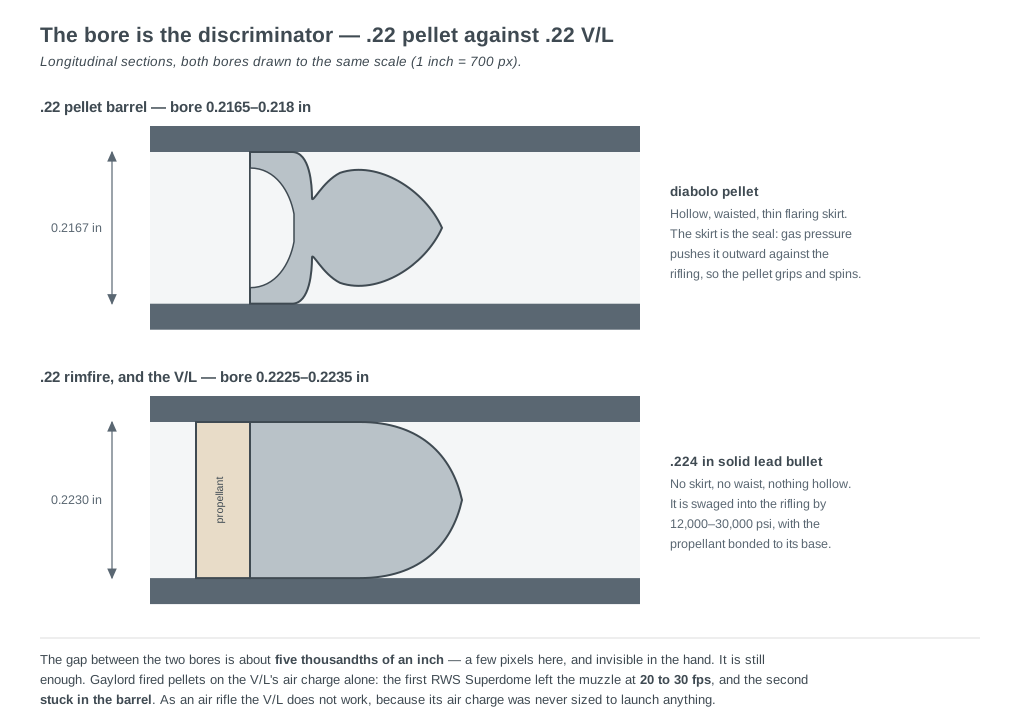
The cleanest technical discriminator is not the valve, the pressure, or the noise. It is the bore.1
A .22 pellet barrel runs 0.2165 to 0.218 inches. A .22 rimfire barrel — and a V/L barrel — runs 0.2225 to 0.2235 inches. The V/L is bored for a .224-inch lead bullet, not for a .22 diabolo pellet, and the difference of roughly five thousandths of an inch is enough to make the gun useless as an airgun even if you try. Gaylord did try, loading pellets and firing them on the V/L’s air charge alone. The first RWS Superdome exited the muzzle at twenty to thirty feet per second. The second stuck in the barrel.1 Will Dabbs, writing in Small Arms Review, reports getting around 300 fps with pellets.8 The two figures disagree badly and probably reflect different pellets and different fits, but both experiments reach the same conclusion by different roads: as an air rifle, the V/L does not work. Its air charge is not sized to launch anything. It is sized to arrive hot.
The other differences follow from that. The ball check valve, absent from any springer. Combustion pressures an order of magnitude above what any spring-piston gun develops. And the noise: this is a five-pound rifle that Gaylord measured at 111.9 dB, which is to say about as loud as any ordinary .22 rimfire.1 Nothing that sounds like that is an air rifle.
12.6 Against a primer-fired cartridge
A conventional cartridge stores its ignition energy chemically. The primer is a small charge of shock-sensitive compound; a firing pin deforms it, the compound detonates, and a jet of hot gas and burning particles is sprayed into the main powder charge. The energy that starts the process was put into the primer at the factory and has been sitting there ever since, waiting.
The V/L stores its ignition energy mechanically, in a spring, and the shooter puts it there by hand on the cocking stroke. The 23-pound cocking effort of a V/L is not just moving a piston into position — it is loading the entire ignition system. Nothing in a V/L cartridge is shock-sensitive at all. This has a consequence worth stating: a box of V/L ammunition cannot be set off by dropping it, striking it, or crushing it in the way a box of rimfire can. The sensitivity was moved out of the ammunition and into the gun.
Set against the other well-known caseless systems, the V/L’s uniqueness comes into focus. The H&K G11 of the 1980s used a conventional firing pin and a consumable primer, with the propellant moulded as a square-section block around an embedded bullet, and it could fire semi-automatically, at 600 rpm in full auto, or in three-round bursts at around 2,000 rpm.8 The Voere VEC-91 of 1991 used electronic ignition. Walter Hunt’s Rocket Ball of 1848 was lit by an external primer through a hole in its base cap; the Volcanic of the 1850s added a percussion cap to that base seal. Every one of them has an igniter of some kind.
The V/L is the only one with no primer whatsoever, and that is its actual claim on history. It is usually understated in favour of the caseless angle, but caseless ammunition has been tried a dozen times. Primerless has been sold to the public exactly once.
The comparison also shows what the V/L gave up. The G11’s characteristic failure mode is cook-off — heat accumulating in the chamber until a chambered round self-ignites — because the brass case that used to carry heat out of the gun after every shot is no longer there. The V/L never faced that problem, and the reason is unflattering: it is a single-shot rifle that must be cocked by hand against 23 pounds of spring for every round. It sidestepped caseless ammunition’s defining problem by being slow. Its own failure modes are different ones, and Volume 13 takes them up.
12.7 Why this is a firearm in physics, not just in law
Volume 14 deals with the regulatory ending. But the physics has to be settled first, because the legal conclusion follows from it rather than the other way round.
Under the Gun Control Act of 1968, at 18 U.S.C. § 921(a)(3), a firearm is any weapon which will or is designed to or may readily be converted to expel a projectile by the action of an explosive. The V/L’s bullet is expelled by the combustion of a nitrocellulose charge nitrated to 13.2–13.5 percent nitrogen — high-nitrogen guncotton — burning to completion in one to two milliseconds and generating 12,000 to 30,000 psi in the firing chamber. That is an explosive propellant doing exactly the work that an explosive propellant does in a .22 rimfire.
The compressed air is not the powerplant. It is the match. It contributes essentially nothing to the projectile’s energy — Gaylord’s pellet experiment measured that contribution at twenty to thirty feet per second — while the propellant contributes something on the order of 85 foot-pounds. Ninety-nine-point-something percent of the muzzle energy of a V/L comes out of a chemical reaction.
So when the federal government took the position that the V/L was a firearm, it was not making a technicality out of a toy. It was reading a statute correctly against a machine whose own inventor had documented, in patent after patent, that it generated firearm-grade chamber pressures by burning a firearm-grade propellant. Under the plain text of the statute it is difficult to see how the V/L could have been classified as anything else.
12.8 Fouling, erosion, and the argument about durability
One question about the mechanism has no settled answer, and both sides of it should be reported.
Daisy’s claim, relayed by Rock Island, is that “a test of 50,000 rounds was completed without cleaning the gun at all; no jams were reported.”7 That is a manufacturer’s claim and carries a manufacturer’s weight.
The owners tell a different story. DennisK, an International Ammunition Association forum member who owns six V/L rifles, writes that “it is generous to state that accuracy is poor, beyond a few shots right after the bore is cleaned.”9 Gaylord’s engineering assessment points the same way and adds a mechanism: “you will never see a worn out VL rifle. They look like they will be shot out before they wear out. The thin metal parts around the breech will erode from the hot gasses and eventually fail.”1 He is explicit that this is his own assessment rather than a documented finding.
The two positions contradict each other directly, and the tension is itself informative. A caseless design has hot combustion gas in direct contact with breech metal that a brass case would otherwise have shielded, and residue accumulating in a bore that no case mouth is sealing. Both effects are real and both would be expected. Whether Daisy’s 50,000-round test measured what its marketing implied, or measured only that the gun did not jam, cannot be resolved from what survives.
12.9 Bibliography
Footnotes
-
Tom Gaylord (B.B. Pelletier), “Daisy VL rifle: Part 1 and Part 2,” Pyramyd Air, 14 and 21 May 2021. https://www.pyramydair.com/blog/2021/05/daisy-vl-rifle-part-1/ and https://www.pyramydair.com/blog/2021/05/daisy-vl-rifle-part-2/ (confidence: high on the measured bore figures, the 111.9 dB sound reading, and the pellet experiment; medium on the erosion assessment, which he labels as his own opinion). ↩ ↩2 ↩3 ↩4 ↩5 ↩6 ↩7 ↩8
-
US Patent 3,521,523, “Air operated projectile firing apparatus.” https://patents.google.com/patent/US3521523A/en (confidence: high; source of the compression-stroke language, the ball valve in the movable breech, the surface-contact ignition description, and the tapered obturator). ↩ ↩2 ↩3 ↩4 ↩5 ↩6
-
US Patent 3,854,400, “Caseless ammunition and propellant and method of making same.” https://patents.google.com/patent/US3854400A/en (confidence: high; source of the 12,000-30,000 psi chamber pressure, the ~0.6 ms ignition time, the 1-2 ms complete burn, and the 400-600 °F propellant ignition range). ↩ ↩2 ↩3 ↩4
-
US Patent 3,951,038, “Air operated projectile firing apparatus.” https://patents.google.com/patent/US3951038A/en (confidence: high; source of the 400-700 °F compressed-air range and the leather or rubber packing obturation). ↩ ↩2 ↩3
-
US Patent 3,628,272, “Cylindrical breech with sleeved obturator.” https://patents.google.com/patent/US3628272A/en (confidence: high; the expanding thin-walled metallic obturator jacket, its materials, wall thicknesses, and solders). ↩
-
Wikipedia, “Daisy V/L.” https://en.wikipedia.org/wiki/Daisy_V/L (confidence: medium that it reports 2,000 °F; the underlying Nonte article in Popular Mechanics, October 1967, was not obtained, so the figure itself is unverified). ↩
-
Rock Island Auction blog, “Daisy/Heddon V/L Rifle: The Caseless Ammo .22.” https://www.rockislandauction.com/riac-blog/daisy-heddon-v-l-rifle-the-caseless-ammo-22/ (confidence: medium; source of both the 2,000 °F repetition and the Daisy 50,000-round no-cleaning claim, the latter explicitly a manufacturer claim). ↩ ↩2
-
Will Dabbs MD, “The Daisy V/L Caseless Rifle: Decades Ahead of Its Time,” Small Arms Review V17N3, September 2013. https://smallarmsreview.com/the-daisy-v-l-caseless-rifle-decades-ahead-of-its-time/ (confidence: medium; good on the caseless lineage and the G11 comparison, but the article contains at least one definite numerical error — see Volume 13). ↩ ↩2
-
International Ammunition Association forum, “Daisy V/L Caseless Ammunition,” February 2011 onward — DennisK, owner of six V/L rifles. https://forum.cartridgecollectors.org/t/daisy-v-l-caseless-ammunition/9246 (confidence: medium; a first-hand owner report, uninstrumented). ↩
Comments (0)