Daisy · Volume 4
Plymouth to Rogers: the 1958 Move, the Owners, and the Museum

In the spring of 1958 Daisy Manufacturing Company left Plymouth, Michigan for Rogers, Arkansas, and that move turns out to be the hinge of the company’s entire corporate history. Within three years of the relocation Daisy was no longer independent. Over the following six decades it passed through a conglomerate, a second conglomerate, a management buyout that created an entirely new legal entity, two private-equity owners, and finally into a position of near-monopoly over American air-gun manufacture. The brand ran continuously through all of it. The corporation did not. Keeping those two facts apart is the single most useful thing a reader can carry out of this volume.
4.1 Why Arkansas
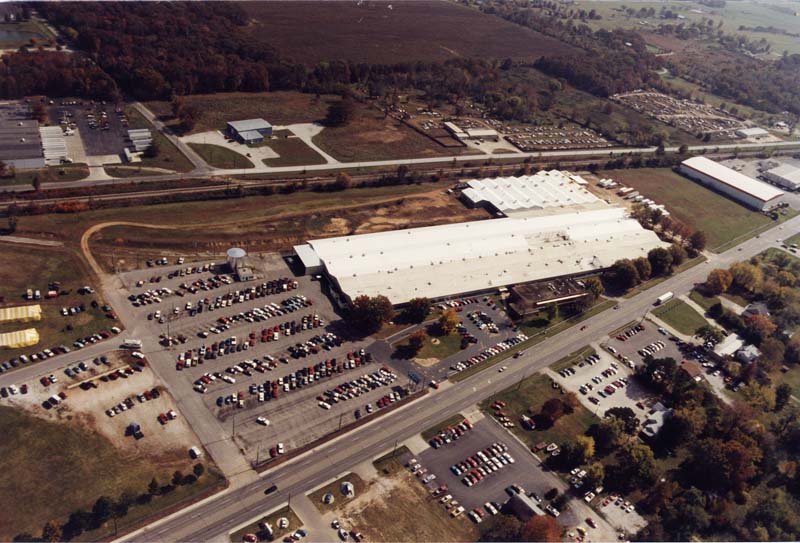
The stated reasons are straightforward and, read carefully, revealing. By 1956 the Plymouth facility, though it had been expanded, was described as antiquated and inadequate.1 The Rogers plant offered 250,000 square feet against Plymouth’s 150,000 — a genuine capacity argument.2
The site-selection criterion Daisy itself gave is the interesting part. The company said it sought “an ideal location of a new facility in a market that would offer an economical labor pool with a strong work ethic.”2 Read plainly, that is a description of a low-wage, non-union, rural-Southern relocation. Daisy was doing in 1957 what a great deal of northern American manufacturing did in the postwar decades, and “strong work ethic” is period euphemism for the same thing. This is an interpretation rather than a sourced claim, but it is not a strained one. What could not be established is whether Arkansas or Benton County offered any tax abatement, bond issue, or incentive package; the Encyclopedia of Arkansas account details none, and the Rogers Chamber of Commerce and Benton County records would be the place to look.
The timeline of the move itself is unusually well documented, partly because the company’s own employee magazine dated it:
- 10 December 1957 — symbolic groundbreaking in Rogers.2
- April 1958 — the last issue of The Daisy Idea printed in Plymouth.3
- 30 April 1958 — Michigan operations permanently closed.1
- 26 June 1958 — the first gun completed in Rogers, reportedly “four days ahead of schedule.”1
- November 1958 — The Daisy Aim begins publishing in Arkansas.3
The two employee-magazine dates come from the Plymouth Historical Museum’s archival finding aid and carry high confidence. The “four days ahead of schedule” flourish is company-newsletter texture and should be enjoyed as such.
4.2 What Plymouth was left with
The plant stood on Union Street in Plymouth.3 It survived the company’s departure by nearly half a century and was demolished in 2005, replaced by a condominium complex named — without apparent irony — Daisy Square.4 A local preservation effort around a surviving “Daisy wall” and a Red Ryder exhibit is documented.5 For a reader in southeast Michigan this is worth a detour: the site is about twenty-five miles from Detroit, and what is there now is housing with a name.
The more substantial survival is paper. The Plymouth Historical Museum holds Record Group 13, five manuscript boxes covering 1888 to 2000, with the bulk running 1933 to 1970 — employee magazines, news releases, articles, advertisements, photographs, Red Ryder material, factory blueprints, and company books. The finding aid was first compiled on 16 March 2005 by Elizabeth Kelley Kerstens and updated through 4 October 2017.3 This is the best untapped primary archive on Daisy anywhere, and it is the collection most likely to settle the founding-legend questions raised in the second volume of this series. The company went to Arkansas. Its records stayed home.
4.3 The ownership chain
Popular accounts of Daisy are at their worst here. Wikipedia’s article covers essentially nothing between 1895 and 1993, and the standard business-history compilations omit both Victor Comptometer and Kidde entirely. The reliable spine comes instead from an unlikely place: a federal appellate opinion, Daisy Manufacturing Co. v. NCR Corp., 29 F.3d 389 (8th Cir. 1994), which recites the chain as legal fact because the case turned on exactly that question.6
Table 1 — The ownership chain
| Period | Owner or entity |
|---|---|
| 1882-1895 | Plymouth Iron Windmill Company |
| 1895 to c. 1958-60 | Daisy Manufacturing Company, independent, Hough-family managed |
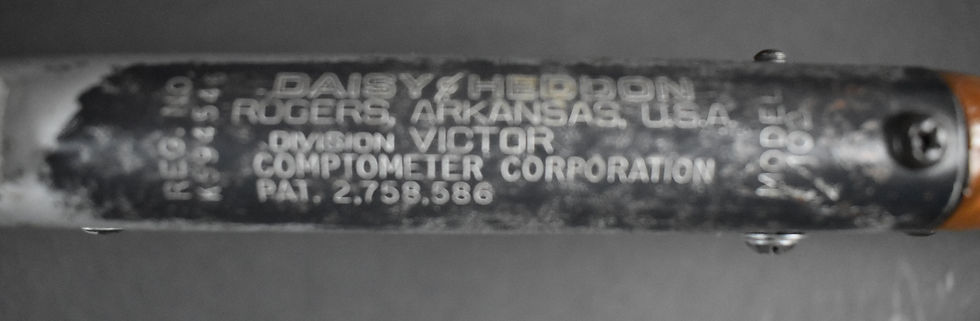
| by 1961 to c. 1977-79 | Victor Comptometer Corporation; Daisy operated as the “Daisy Heddon” division |
| 1976 | ”Daisy Division Victor Comptometer Corporation” signs a universal agreement with NCR |
| c. 1977-1983 | Kidde, via Kidde Recreation Products, Inc. |
| 15 November 1983 | New entity Daisy Manufacturing Company, Inc. purchases the Daisy Division assets from Kidde |
| 1993 | Charter Oak Capital Partners acquires Daisy in a $60 million niche-manufacturing roll-up |
| 1995 / 1997 | Acquires paintball maker Brass Eagle, then divests paintball |
| 2016 | Sold to Bruckmann, Rosser, Sherrill & Co.; combined with Gamo Outdoor |
| 30 April 2024 | Daisy acquires Crosman from Velocity Outdoor / Compass Diversified |
Several of those rows need commentary.
Victor Comptometer owned Daisy by 1961, not in the late 1960s as is often written. The relationship is documented as of that year, when Cass S. Hough was president of the Daisy Heddon division of Victor Comptometer — Heddon being the fishing-tackle brand, also Victor-owned.78 The exact acquisition date could not be pinned down and is a genuine research gap; the likely window is 1958 to 1961. That window is itself the point. Daisy left Michigan and lost its independence within about three years, and it is hard to read those as unrelated events. A family firm that has just spent everything on a new plant in a new state is a firm with a thin balance sheet.
Kidde acquired Victor Comptometer as part of a conglomerate buying spree — ten businesses in 1979, though some sources place the Victor deal in 1977. That conflict is unresolved and the row is held at medium confidence.9
The 1983 transaction is the one that matters legally. The Eighth Circuit’s opinion states that “On November 15, 1983, Daisy Manufacturing Company, Inc., was created and ‘purchased certain of the assets of the Daisy Division’” from Kidde Recreation Products.6 That is a new Delaware corporation buying assets, not a change of ownership in an existing company. Business continuity was seamless — same plant, same town, same product, same senior management, with Frank Tarr staying on as VP of Finance and Administration in the same role — and Daisy never formally notified NCR of the transition, with both parties using the old and new names interchangeably afterward. That informality is precisely what the 1994 litigation was about.
The consequence is worth stating carefully. “Daisy Manufacturing Company” after 1983 is not the same corporate person as the company renamed in Plymouth in 1895. The brand, the trademarks, the factory, the workforce, and the product line are continuous. The legal entity is not. Anyone writing that Daisy has operated continuously since 1882 is describing a brand, and should say so.
The last row is the current story. On 30 April 2024, Daisy Manufacturing Company — a Bruckmann, Rosser, Sherrill portfolio company — acquired Crosman from Velocity Outdoor. The resulting brand house spans Daisy, Red Ryder, Crosman, Benjamin, BSA, GAMO, and Winchester air guns, reported as an “Iconic Outdoor Group.”1011 Daisy and Crosman were the two poles of the American air-gun market for most of a century. They are now the same company. The regulatory and competitive implications of that are taken up in the volume on safety and regulation.
4.4 The Daisy Airgun Museum
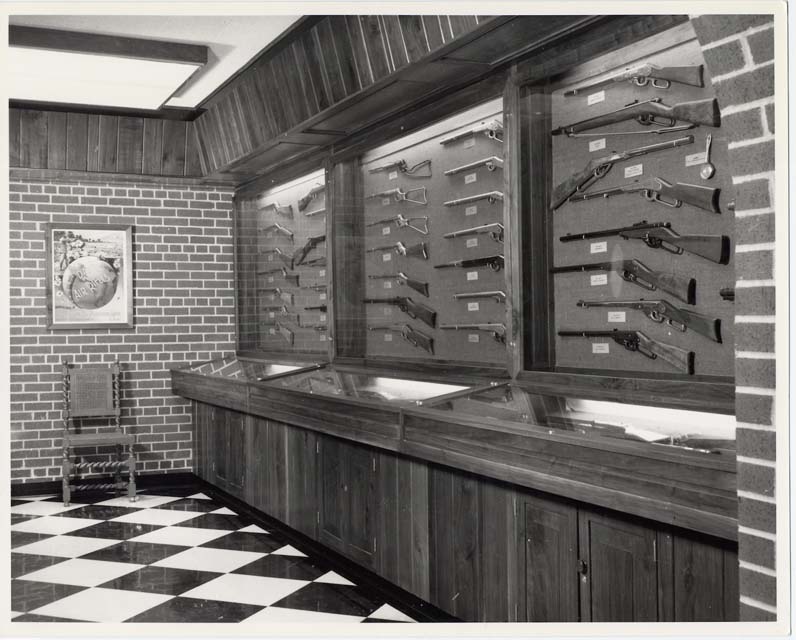
Daisy’s Rogers offices housed an airgun collection from about 1960, and in 1999 the company decided to turn it into a public museum and tourism attraction. It opened in March 2000 in a 1906 bank building at 114 South First Street, a space with archways and a mosaic tile floor; Arkansas First Lady Janet Huckabee opened it by shooting a balloon tied to a ribbon strung across the entrance.1
Two changes followed in 2004. The museum became an independent non-profit corporation as of 1 January 2004, and on 25 October 2004 it relocated to the southwest corner of Second and Walnut, into an 1896 building that had been the former Rexall Drug store.1 The two dates are compatible rather than contradictory: the nonprofit was formed in January, the physical move happened in October. The site carries a historical marker.12
The separation into an independent nonprofit is more meaningful than it looks. Given how much of Daisy’s history has come down through a single corporate-family memoir, an institution that holds the objects but is not owned by the company is a structurally better custodian than a corporate display case — even if, in practice, its published history still draws on the same lineage. The museum in Rogers has the guns. The archive in Plymouth has the paper. Neither town has both.
4.5 Bibliography

Footnotes
-
Daisy Airgun Museum, history page — Plymouth facility condition, 30 April 1958 closure, 26 June 1958 first Rogers gun, and the museum’s own founding, opening, nonprofit conversion, and 2004 relocation. https://daisymuseum.com/history/ (confidence: medium to medium-high). ↩ ↩2 ↩3 ↩4 ↩5
-
Encyclopedia of Arkansas, “Daisy Outdoor Products” — the site-selection quote, the 250,000 vs 150,000 square-foot comparison, and the 10 December 1957 groundbreaking. https://encyclopediaofarkansas.net/entries/daisy-outdoor-products-2735/ (confidence: high on the quote, medium-high on the figures). ↩ ↩2 ↩3
-
Plymouth Historical Museum, Record Group 13 — Daisy Manufacturing Company finding aid; Union Street location, employee-magazine runs and the April 1958 last Plymouth issue, collection scope 1888-2000, finding aid compiled 16 March 2005 by Elizabeth Kelley Kerstens and updated to 4 October 2017. https://plymouthhistory.org/wp-content/uploads/2024/08/RG-13-Daisy-Manufacturing-Company-Finding-Aid.pdf (confidence: high). ↩ ↩2 ↩3 ↩4
-
Plymouth MI Discoveries, on the 2005 demolition of the plant and the Daisy Square condominium complex. https://plymouthmidiscoveries.com/2013/06/26/this-is-all-that-remains-of-the-original/ (confidence: medium-high). ↩
-
Patch, “Saving the Daisy Wall: Daisy’s Plymouth Roots Run Deep.” https://patch.com/michigan/plymouth-mi/saving-the-daisy-wall-daisy-s-plymouth-roots-run-deep (confidence: medium). ↩
-
Daisy Manufacturing Co. v. NCR Corp., 29 F.3d 389 (8th Cir. 1994). https://law.resource.org/pub/us/case/reporter/F3/029/29.F3d.389.93-3738.html (confidence: high; court record, and the best evidence for the entire ownership chain). ↩ ↩2
-
Wikipedia, “Daisy V/L” — Cass S. Hough as president of the Daisy Heddon division of Victor Comptometer in 1961. https://en.wikipedia.org/wiki/Daisy_V/L (confidence: medium-high). ↩
-
GUNS Magazine, “When Rimfire Went Caseless.” https://gunsmagazine.com/guns/rifles/when-rimfire-went-caseless/ (confidence: medium-high on the Victor-era corporate framing). ↩
-
Encyclopedia.com, “Kidde, Inc.” https://www.encyclopedia.com/books/politics-and-business-magazines/kidde-inc (confidence: medium; the 1977 vs 1979 conflict on the Victor acquisition is unresolved). ↩
-
SGB Online, “Daisy Manufacturing Acquires Compass Diversified’s Crosman Air Gun Division.” https://sgbonline.com/daisy-manufacturing-acquires-compass-diversifieds-crosman-air-gun-division/ (confidence: medium-high). ↩
-
Robert W. Baird transaction record for the Crosman divestiture. https://www.rwbaird.com/transactions/investment-banking/dealcard/6341/ (confidence: medium-high). ↩
-
Historical Marker Database entry for the Daisy Airgun Museum. https://www.hmdb.org/m.asp?m=93335 (confidence: medium). ↩
Comments (0)