Daisy · Volume 11
V/L I: Jules Van Langenhoven and the Idea of a Caseless .22
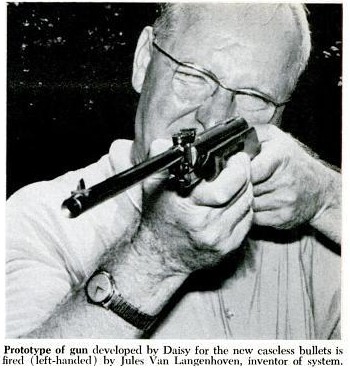
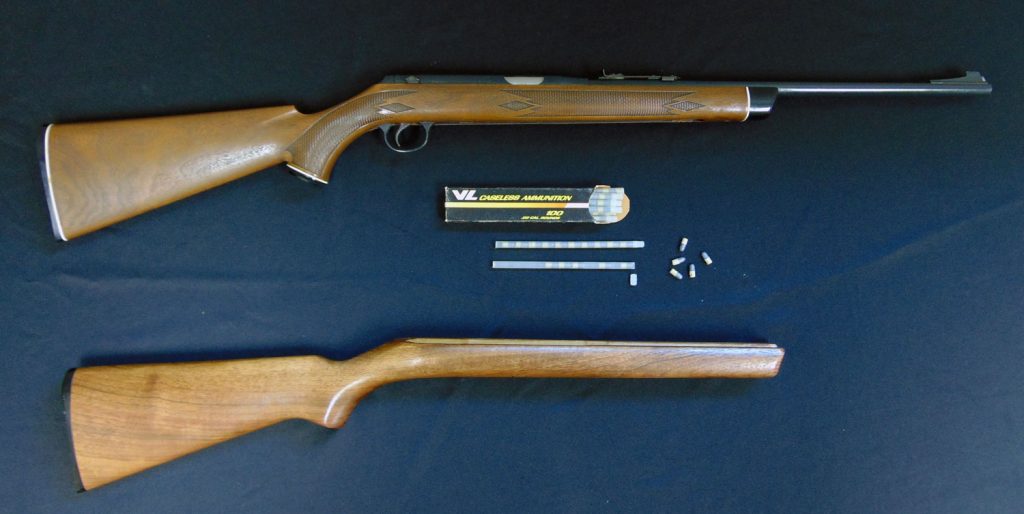
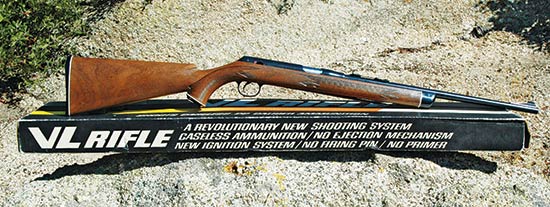
Somewhere in Paris in 1961, a Belgian walked into a shooting gallery with a rifle that did not need a primer. Seven years later a Michigan-born, Arkansas-based toy company was selling that rifle in American sporting-goods stores for $39.95, and eighteen months after that it had stopped. The volumes that follow take the machine apart, examine the ammunition, and deal with the ending. This one is about the man whose initials are on it, and about the only body of evidence that survives him in any quantity: a family of United States patents.
That evidence is thinner than the story deserves, and it is important to say so at the start. Jules Edmond Van Langenhoven is described in the literature as a “Belgian chemist” or a “Belgian chemical engineer,” and the sources split on which.12 No curriculum vitae, obituary, biographical entry, birth date, or death date was located in the research behind this series. What he did before 1961 and what he did after about 1971 are both unknown here. Anyone who states his dates is stating something this dive could not confirm, and this dive will not invent them.
What does survive is a paper trail with addresses on it, and addresses are biography if you read them carefully.
11.1 The Paris demonstration, and a documentary anchor for it
The origin story is told consistently across the secondary literature and traces back to a small number of retellings, principally a Rock Island Auction blog account. In 1961, it goes, a Belgian chemical engineer uncased a rifle in a Parisian shooting gallery and began shooting while Cass Hough — president of the Daisy/Heddon division of Victor Comptometer Corporation — looked on, and Hough agreed to buy the design on the spot.3
Two things about that paragraph need separating. The name is right: Cass S. Hough, grandson of the Lewis Cass Hough of the founding anecdote in Volume 2, a wartime test pilot and by then a senior Daisy executive. Rock Island renders him “Case Hough” and the error has propagated.
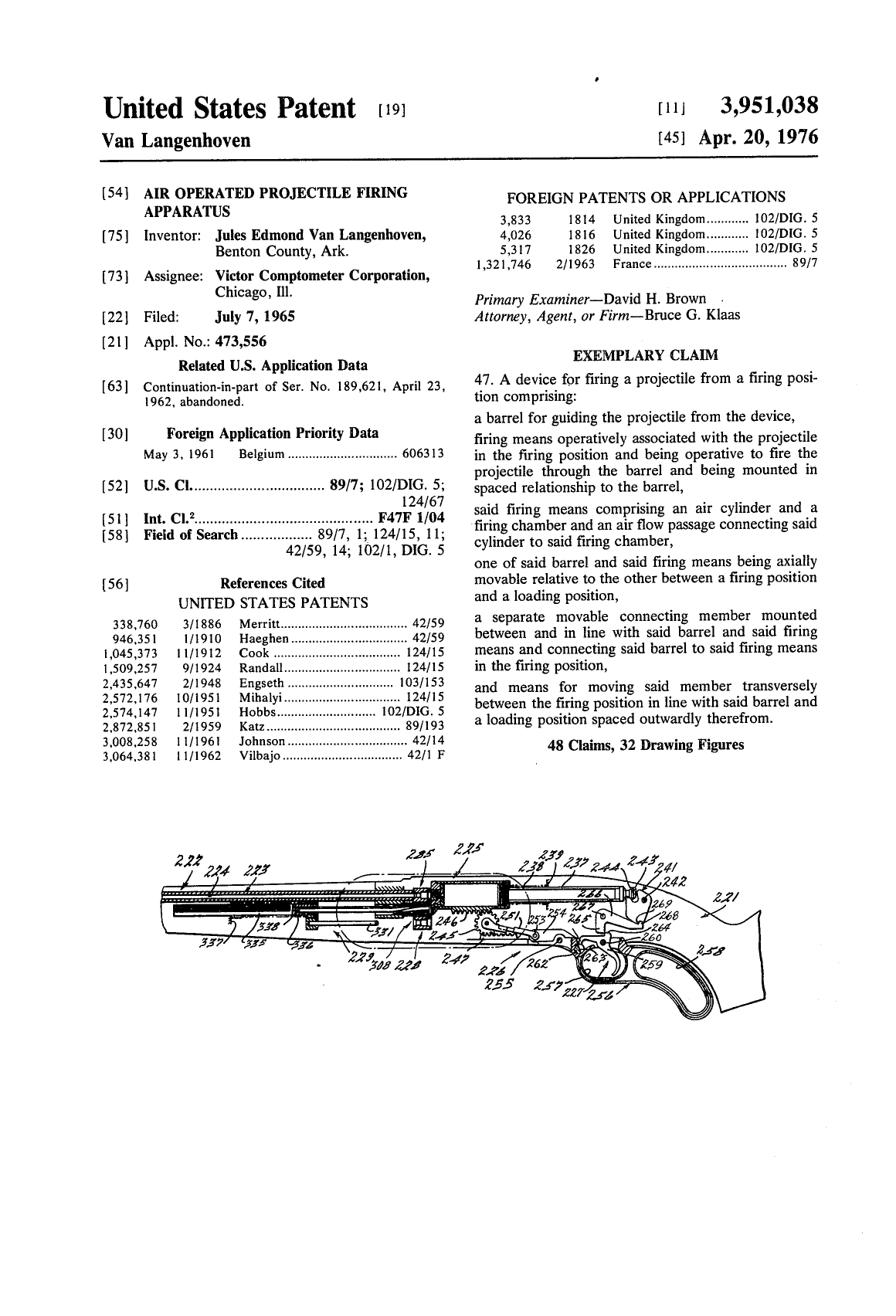
The date is a different matter, and here the patents do something unusual: they corroborate the folklore. US 3,951,038, “Air operated projectile firing apparatus,” carries a priority date of 3 May 1961.4 That is an independent documentary anchor for a 1961 origin, arrived at from a completely different direction than the anecdote, and it is the single best reason to believe the Paris story is broadly true even if its staging is theatrical. A related and weaker thread runs through Popular Mechanics of October 1967, cited by Rock Island for a patent filed in December 1961 and a public introduction on 20 August 1962; the August 1962 introduction is otherwise unattested and sits oddly against a 1968 retail launch, so it is noted here rather than led with.3
11.2 The best-sourced detail in the whole story
Tom Gaylord, whose 2021 instrumented test is the most useful modern work on the V/L and recurs throughout these volumes, reports something about the original demonstration that reframes the entire invention. Van Langenhoven’s compound did not initially have to be bonded to a bullet at all. He demonstrated the principle by pinching off a small piece of it, placing it behind an ordinary diabolo pellet, and firing the result from a conventional spring-piston air rifle.1
Gaylord gives no source for this, so it sits at medium confidence. But it is the conceptual heart of the thing, and it explains why the invention is an ammunition invention rather than a gun invention. An ordinary springer already makes enough heat. Every spring-piston air rifle in the world has been briefly heating its air charge to several hundred degrees since the nineteenth century — the phenomenon is familiar to airgunners as dieseling, the puff of smoke and the sharp crack when stray lubricant ignites in the compression chamber. Van Langenhoven’s insight was not that compression makes heat. It was that a propellant could be formulated to reliably light off that heat, every time, on demand, and that if it could, the primer and the brass case both became optional. Volume 13 deals with how he made a nitrocellulose grain that would do it.
11.3 The addresses: Belgium, Arkansas, Belgium
The patent filings track a man moving across the Atlantic and back, and the sequence is legible.
Three applications filed on the same day, 18 July 1968 — US 3,521,523, US 3,545,333, and US 3,577,921 — give the inventor’s residence as Benton County, Arkansas.567 Daisy’s plant is in Rogers, which is in Benton County. By the summer of 1968, in other words, Van Langenhoven was not a consultant in Belgium sending drawings across the ocean. He had relocated to Daisy’s home county for the development years, and he filed a coordinated cluster of three applications from there covering the apparatus, the method of making the ammunition, and the ammunition itself. That is what a development programme looks like on paper.
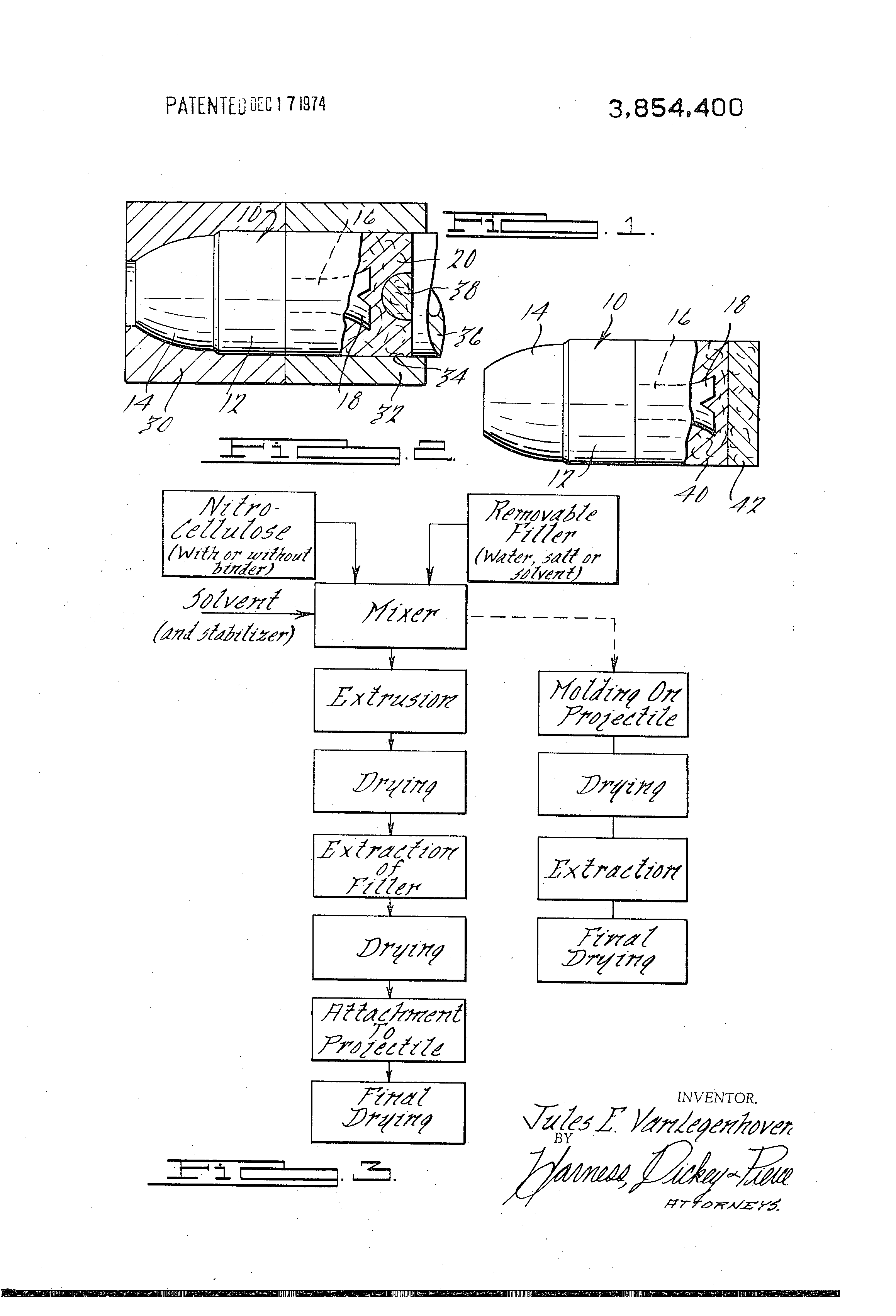
A fourth, US 3,854,400, was filed from the same period on 19 December 1968, and a fifth in the family — US 3,520,400 on the packaging — was filed a week earlier, on 12 December 1968, by a different inventor, David W. Gates of Rogers, Arkansas.89 Gates is worth naming. His patent is for the ammunition package and container, and as Volume 13 argues, on a caseless round the package is not trivia: it is doing part of the job that brass used to do.
Then the address changes. US 3,628,272, “Cylindrical breech with sleeved obturator,” was filed on 24 July 1969, and it gives the inventor’s residence as La Hulpe, Brussels, Belgium. The assignee is not Victor Comptometer. It is Engineering Developments Limited of Fribourg, Switzerland.10
Read plainly, that filing says that by the middle of 1969 — the year the V/L project ended — Van Langenhoven was back in Belgium and assigning his work to an entirely different entity. It is the only documentary trace located of what he did next, and it does not say much, but it says that he did not stop. The mechanism inside that patent is, by some distance, the most elegant idea in the family: a thin-walled metallic sleeve of copper or phosphor bronze that expands radially under gas pressure to seal the firing chamber and contracts again afterwards. It is, in effect, a permanent reusable cartridge case built into the gun, doing the sealing job that brass does and then staying put for the next shot. It arrived after Daisy’s production rifle, and nothing came of it.
11.4 The name
“V/L” is Van Langenhoven’s initials. This is universally agreed and needs no hedging; Gaylord puts it in a parenthesis — “Jules Van Langenhoven (VL — get it?)” — and everyone else concurs.1 It is a small thing, but it means Daisy put an unknown Belgian’s initials on the receiver of the only firearm it ever sold, rather than a model number, a bird, or a cowboy. Whatever the commercial relationship was, the naming suggests the company thought it had bought something more like a principle than a product.
11.5 Seven patents, and the irony of their grant dates
The full family located in this research is as follows. All were read directly on the public patent record except US 3,520,400, which is confirmed from search results rather than a full reading.
Table 1 — Seven patents, and the irony of their grant dates
| Patent | Title | Filed | Granted | Assignee |
|---|---|---|---|---|
| US 3,951,038 | Air operated projectile firing apparatus | 7 Jul 1965 (priority 3 May 1961) | 20 Apr 1976 | Victor Comptometer / Daisy Mfg |
| US 3,521,523 | Air operated projectile firing apparatus | 18 Jul 1968 | 21 Jul 1970 | Victor Comptometer / Daisy Mfg |
| US 3,545,333 | Methods of manufacturing caseless ammunition for air ignition systems | 18 Jul 1968 | 8 Dec 1970 | Victor Comptometer / Daisy Mfg |
| US 3,577,921 | Caseless ammunition for firearms and the like | 18 Jul 1968 | 11 May 1971 | Victor Comptometer / Daisy Mfg |
| US 3,628,272 | Cylindrical breech with sleeved obturator | 24 Jul 1969 | 21 Dec 1971 | Engineering Developments Ltd, Fribourg |
| US 3,854,400 | Caseless ammunition and propellant and method of making same | 19 Dec 1968 | 17 Dec 1974 | Victor Comptometer |
| US 3,520,400 | Caseless ammunition package and container | 12 Dec 1968 | — | Victor Comptometer (inventor David W. Gates) |
Look down the grant column. 1970, 1970, 1971, 1971, 1974, 1976. Every single one of them issued after the product was already dead.
Daisy launched the V/L in 1968 and stopped making it in 1969, and it did the whole thing on patents-pending. The oldest application in the family had been sitting in the office since 1961 and did not issue until 1976 — fifteen years after the priority date, seven years after the last rifle was built, and by then the assignment had passed from Victor Comptometer to Daisy Manufacturing. A company that had spent the better part of a decade acquiring and prosecuting a patent portfolio around compression ignition received the bulk of that portfolio as a collection of documents describing something it no longer made. Whatever the exclusivity was worth in 1961, by the time it was legally enforceable there was nothing to enforce it against.
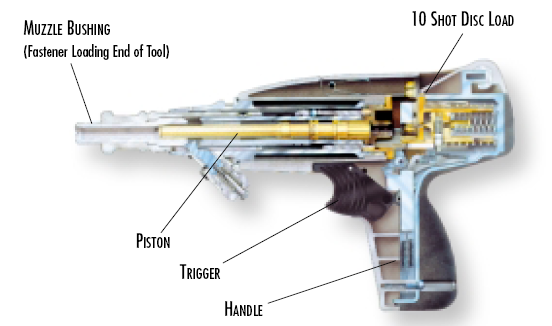
One patent in the family points somewhere other than at rifles, and it is worth flagging here because it changes the reading of the inventor. US 3,521,523 is framed as a powder-actuated stud-driving tool — the same air-ignition principle aimed at the construction-fastener market.5 A stud driver shoots hardened nails into concrete using what is essentially a blank cartridge; compression ignition would have removed the need for a primed cartridge in the tool entirely. Nothing came of that either. But it shows that Van Langenhoven understood what he had as a general-purpose ignition system rather than as a gun feature, and that Victor Comptometer was willing to pay to protect it across markets. The idea was bigger than the rifle. The rifle is simply the only place it ever reached a customer.
11.6 What is left of him
The honest summary is that Jules Van Langenhoven exists in this story almost entirely as an inventor of record. He appears in Paris in 1961 with a working demonstration, he is resident in Benton County, Arkansas through the development years, he signs a cluster of applications in July and December 1968 that between them describe a rifle, a cartridge, a propellant, and two ways of making it, and in July 1969 he files from La Hulpe under a Swiss assignee. After that the record located here goes quiet.
There is no shortage of places to look. The patent file wrappers, Belgian civil registration, Victor Comptometer’s corporate records, and the International Cartridge Collector article of July–August 1980 — which one very well-regarded cartridge authority calls the most comprehensive treatment ever written on the subject — are all plausible sources that this research did not reach.11 Until somebody does reach them, the fairest thing to say is that the V/L is named after a man about whom almost nothing is known, that the only sustained account he left of himself is a set of technical specifications, and that those specifications turn out to be unusually clear about what they are doing and why. The next volume takes them at their word.
11.7 Bibliography
Footnotes
-
Tom Gaylord (B.B. Pelletier), “Daisy VL rifle: Part 1,” Pyramyd Air, 14 May 2021. https://www.pyramydair.com/blog/2021/05/daisy-vl-rifle-part-1/ (confidence: medium-high; the only modern instrumented test located, but the pinched-off-compound origin detail is given without a source). ↩ ↩2 ↩3
-
Wikipedia, “Daisy V/L.” https://en.wikipedia.org/wiki/Daisy_V/L (confidence: low-medium; thin, and its two real citations are Nonte in Popular Mechanics and Walker, Cartridges and Firearm Identification). ↩
-
Rock Island Auction blog, “Daisy/Heddon V/L Rifle: The Caseless Ammo .22.” https://www.rockislandauction.com/riac-blog/daisy-heddon-v-l-rifle-the-caseless-ammo-22/ (confidence: medium on the Paris narrative; legend on the “on the spot” framing; renders Cass Hough as “Case Hough”). ↩ ↩2
-
US Patent 3,951,038, “Air operated projectile firing apparatus.” https://patents.google.com/patent/US3951038A/en (confidence: high; source of the 3 May 1961 priority date). ↩
-
US Patent 3,521,523, “Air operated projectile firing apparatus.” https://patents.google.com/patent/US3521523A/en (confidence: high; Benton County, Arkansas residence, and the stud-driving-tool framing). ↩ ↩2
-
US Patent 3,545,333, “Methods of manufacturing caseless ammunition for air ignition systems.” https://patents.google.com/patent/US3545333A/en (confidence: high). ↩
-
US Patent 3,577,921, “Caseless ammunition for firearms and the like.” https://patents.google.com/patent/US3577921A/en (confidence: high). ↩
-
US Patent 3,854,400, “Caseless ammunition and propellant and method of making same.” https://patents.google.com/patent/US3854400A/en (confidence: high). ↩
-
US Patent 3,520,400, “Caseless ammunition package and container,” inventor David W. Gates of Rogers, Arkansas, filed 12 December 1968 (confidence: medium-high; patent number and inventor from search results, not read in full). ↩
-
US Patent 3,628,272, “Cylindrical breech with sleeved obturator.” https://patents.google.com/patent/US3628272A/en (confidence: high; source of the La Hulpe residence and the Engineering Developments Ltd, Fribourg assignment). ↩
-
John Moss, International Ammunition Association forum, “Daisy V/L Caseless Ammunition,” February 2011, citing International Cartridge Collector issues 295–296, July–August 1980. https://forum.cartridgecollectors.org/t/daisy-v-l-caseless-ammunition/9246 (confidence: medium-high for Moss’s reporting; the 1980 article itself was not obtained). ↩
Comments (0)