Daisy · Volume 10
Powerline, Avanti, and the Modern Line
Everything to this point has been a youth gun: a spring-piston catapult throwing an undersize steel ball at 350 rated feet per second, sold to a parent for a child. That is the business Daisy built, and it is still the business Daisy is best known for. But above the youth line sit two other Daisys — Powerline, the higher-power line, and Avanti, the competition line — and they run on entirely different powerplants toward entirely different goals. One chases velocity. The other chases the exact opposite.
10.1 Powerline
Powerline is Daisy’s higher-power, higher-accuracy family, marketed for ages 16 and up, with rifled barrels for pellets — a deliberate separation from the smoothbore youth guns.1 The rifling matters for more than accuracy: as Volume 6 set out, steel BBs fired through a rifled barrel damage the lands, which is why the dual-ammunition guns in this line quote their two velocities separately and why their manuals are particular about what goes down the bore.
10.1.1 The 880, and the Number That Is Not a Velocity
The Model 880 is the flagship multi-pump pneumatic and one of the longest-running best-sellers in American airgunning. Its published figures are 750 fps with BBs and 715 fps with .177 pellets, from a 50-shot BB reservoir, single-shot with pellets, on up to 10 pumps with velocity scaling by pump count.2
Now, the trap. Retail listings for this gun routinely advertise it as “880 fps.” That figure is a retailer conflating the model number with a velocity, and it should not be repeated.3 Daisy’s own headline marketing has also used “up to 800 fps,” which is a marketing ceiling rather than the published specification. The defensible numbers are 750 for BBs and 715 for pellets, and any treatment of the gun should say which ammunition it means — a great deal of confusion about the 880 comes from quoting one figure without naming the projectile.
The mechanical logic of the multi-pump is worth restating. The shooter forces ambient air into a reservoir across multiple strokes, and firing releases the whole stored charge through a valve. Because energy accumulates across strokes rather than being capped by one spring’s stored energy, the ceiling is far higher than any spring-piston BB gun can reach. The cost is that it is slow to shoot — ten strokes per shot, at the top of the range — and the valve is the wear point over a long life. Tom Gaylord’s teardown series remains the best technical documentation of the gun’s internals.4
10.1.2 The 856 and the 977
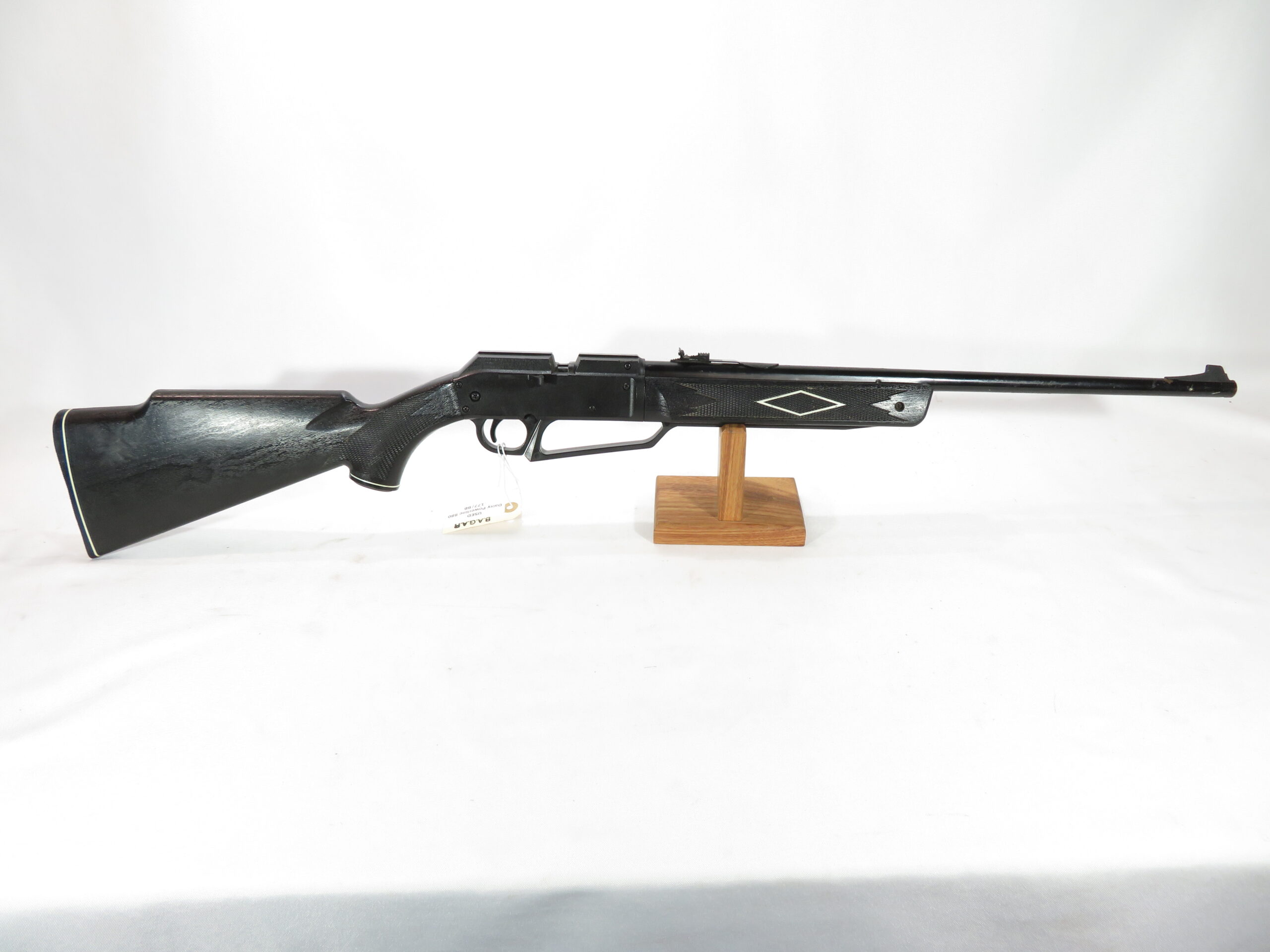
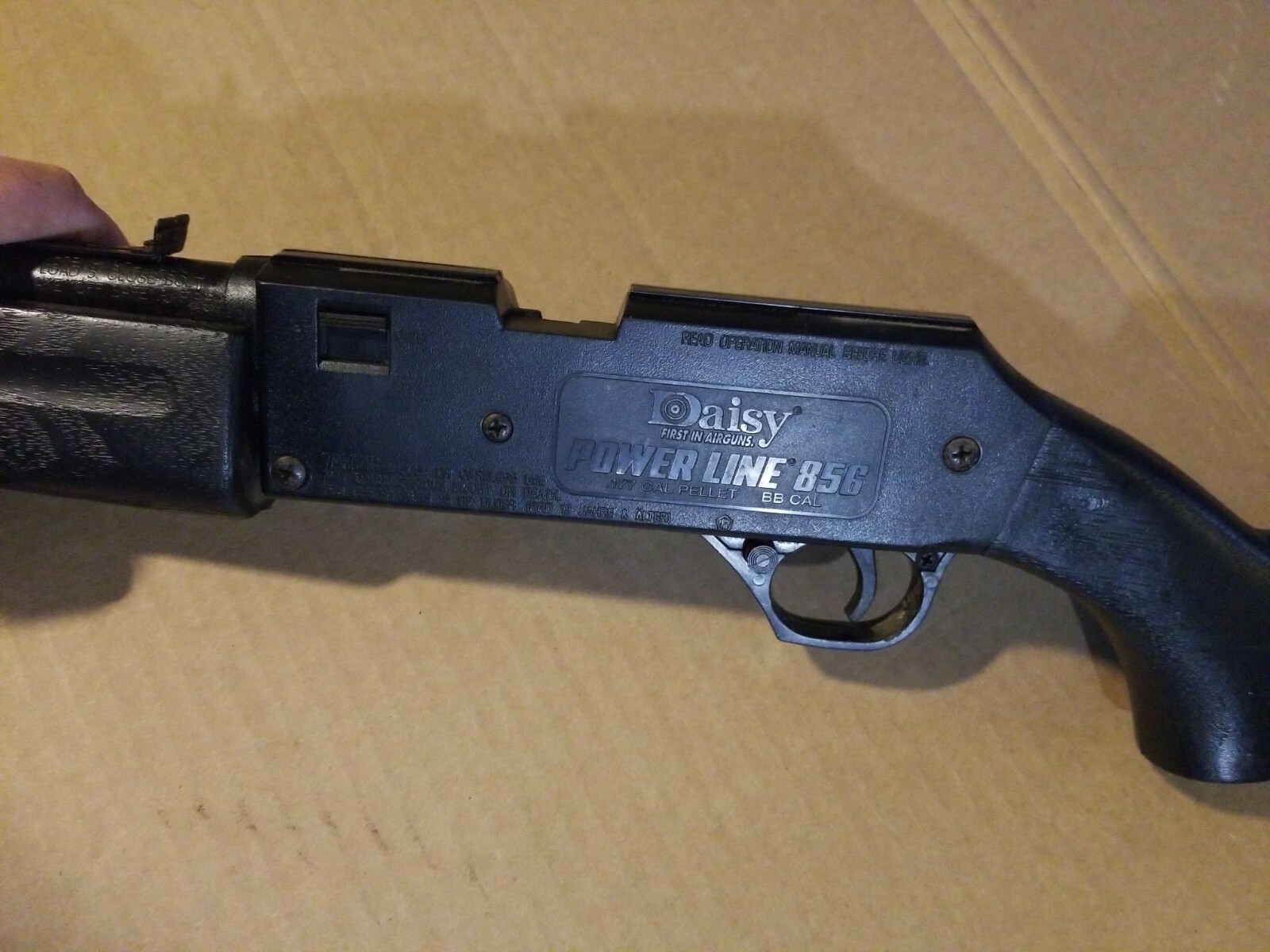
The Model 856 was manufactured 1985 to 2006 and is discontinued: a multi-pump pneumatic and close sibling to the 901. It carries a real variant trap for buyers — some versions are BB-and-pellet capable and some are pellet-only, with no BB reservoir at all.5 Model number alone will not tell you which one is in the box.
The Model 977 is a genuine gap. It shares the 880 and 901 pump-piston assembly, placing it in the same multi-pump family, but that is parts-listing evidence only — the research behind this series found no proper specification or production-date record for it.6 It is recorded here as a member of the family and nothing more.
10.2 CO2
Daisy’s CO2 guns are mostly pistols, and they exist for a reason the pneumatics cannot supply: speed of repeat fire. A 12-gram cartridge is a self-pressurising reservoir requiring no pumping at all.
The Powerline 1200 “Custom” is a long-running vintage staple.7 The Powerline 008 and 5008 are CO2 BB pistols whose factory manual states a minimum of 60 shots per cartridge.8 The Powerline 415 and 426 are the current CO2 pistols.9
The trade-off is thermodynamic and was set out in Volume 5: CO2 vapour pressure falls with temperature, so velocity is strongly temperature-dependent, and rapid fire chills the cartridge enough to sag the velocity across a string. Nothing about that is Daisy-specific — it is what CO2 does.
10.3 Avanti, and the Inversion
The Avanti competition line is where Daisy’s engineering priorities turn upside down. Every gun discussed so far has been sold on velocity. The Avanti guns are sold on consistency, and two of the three are conspicuously slow.
10.3.1 The 853
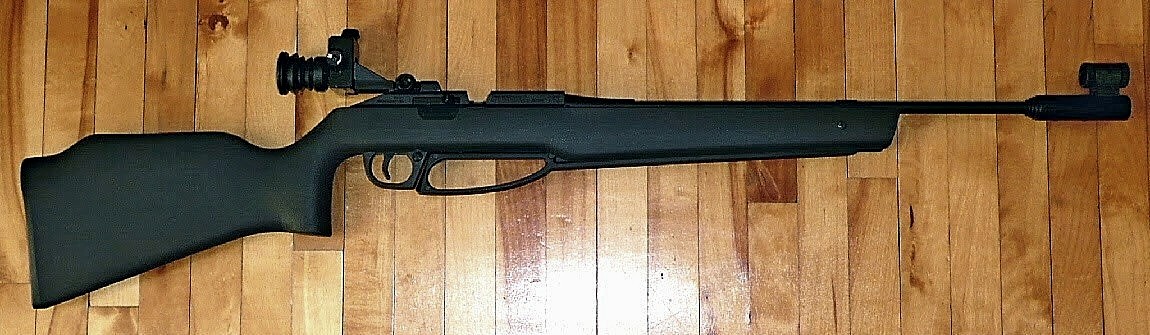
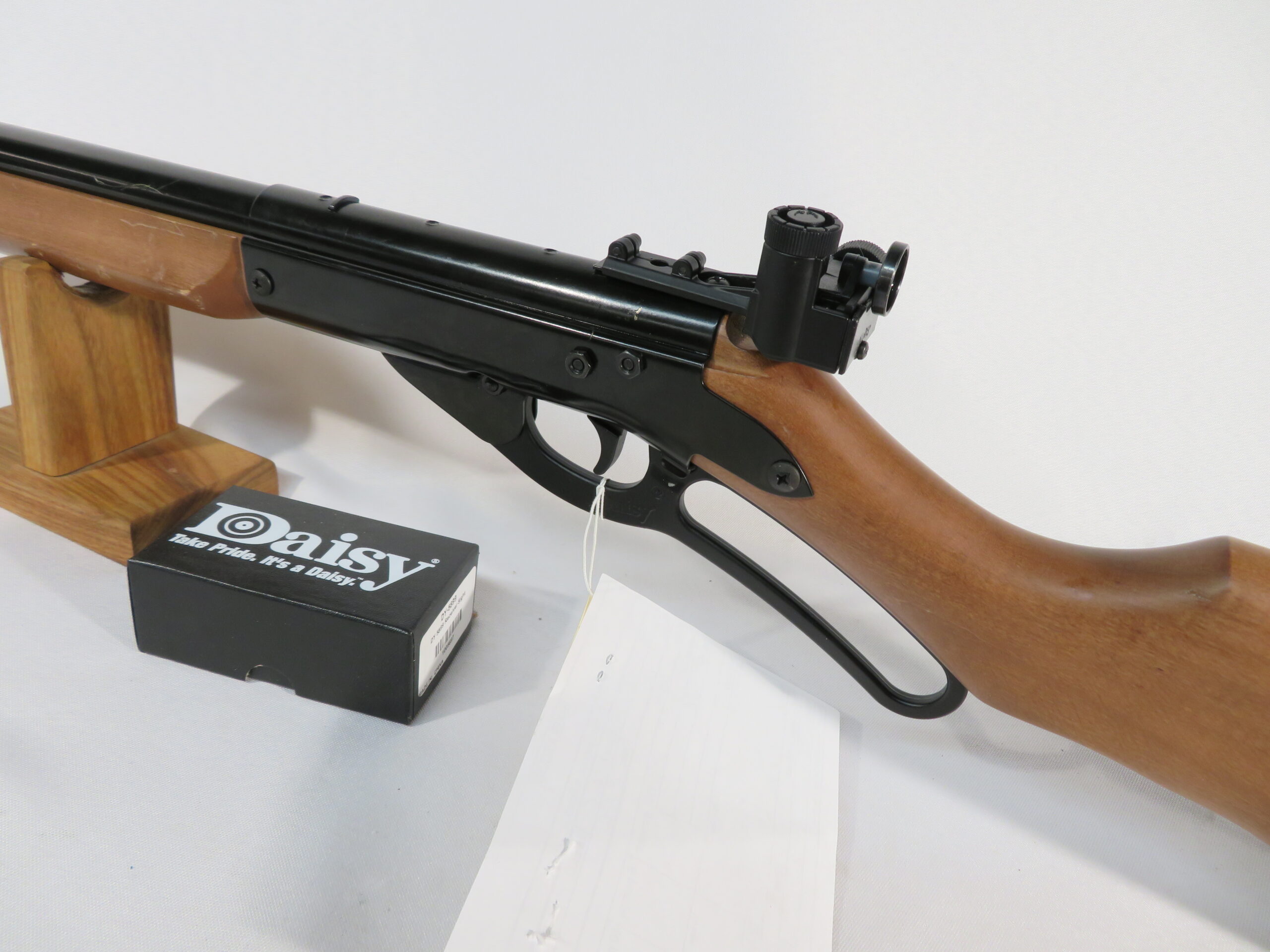
The Model 853 and 853C are single-stroke pneumatics. One pull of the aluminium lever charges the gun, and it is mechanically impossible to put in a second. That constraint is the entire design. A fixed volume every time means a constant charge every time, which means a constant velocity every time — and for target work, a repeatable 500 fps beats a variable 750.10
The published figure is approximately 500 fps in .177, with a 38.5-inch overall length, a 20.88-inch rifled barrel, 5.5 pounds, and a wood stock.10 A figure of 510 fps circulates; the published number is 500, and 500 or “about 500” is the right thing to write.
The 853 was the workhorse of American junior shooting for decades — 4-H, JROTC, and CMP programmes — which is a large part of why the model is so widely encountered second-hand.11
10.3.2 The 887 and the 753S
The Model 887 Gold Medalist is the CO2 match rifle: up to roughly 300 shots per fill, a Lothar Walther crowned barrel precision-bored for .177 match pellets with 12 lands and grooves, right-hand twist, a length of pull adjustable from 12 to 13.75 inches, and a trigger adjustable to 2.0 pounds-force.12 Its current successor is the Model 753S Elite.13 The Model 717 is the line’s single-stroke pneumatic target pistol.14
10.3.3 The 499B, and a Claim Worth Examining Carefully
The Model 499B Champion is where the inversion completes. Daisy’s exact wording is that it is “the most accurate BB gun in the world,” or in the fuller version, the most accurate 5-metre competition BB gun in the world.15
Reviewers do consistently find it exceptionally accurate at five metres. But the claim requires a specific caveat, and stating it is not a slight on the gun. The 499B is the only BB gun approved for the Daisy National BB Gun Championship Match. It is Daisy’s claim about Daisy’s gun, validated by a competition Daisy governs, in which no other gun is permitted to appear.15 That is a governing-body monopoly, not an independent test. The honest formulation is: Daisy says it, the mechanism by which the claim is confirmed is one Daisy controls, and reviewers who shoot it independently agree it is very good indeed.
The engineering behind the accuracy is the interesting part, because it is the opposite of what intuition suggests. The 499B is single-shot, muzzle-loading, spring air, roughly 240 fps, 36.25 inches overall with a 9-inch smoothbore barrel, 3.10 pounds, about 3 pounds of cocking effort, with a globe front sight taking interchangeable inserts and an aperture rear.16
Read that specification against Volume 5 and the design becomes clear. Every source of inconsistency in an ordinary BB gun has been removed:
- No gravity reservoir, so no scatter in how the ball arrives.
- No magnetic feed seat, so no variability in how the ball leaves it.
- Muzzle loading, so the shooter seats the ball the same way every shot.
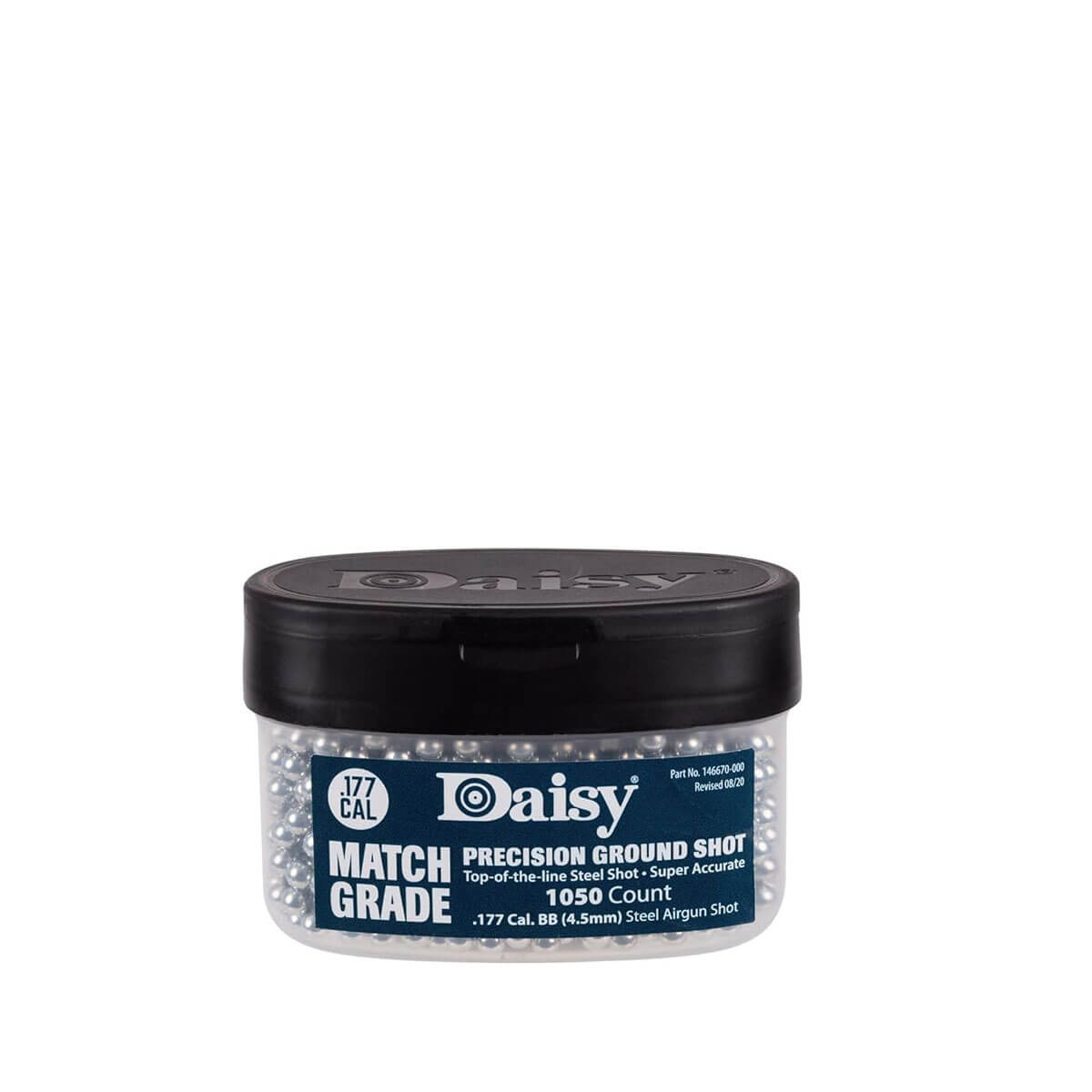
- A bore sized to grip a premium match ball — Daisy Match Grade Avanti Precision Ground Shot, ground rather than merely formed — so the clearance problem that defines every other BB gun is minimised.
- Low velocity, which keeps the projectile well away from any transonic nonsense and reduces the leverage of small energy variations.
Low speed, tight fit, consistent seating. That combination beats power at five metres, and the 499B is the proof.16
10.4 The Nationals
The Daisy National BB Gun Championship Match — the Daisy Nationals — dates its official history to 1966. A date of 1965 circulates and is one year early against the organisers’ own history page.17 It is a three-day team competition for shooters aged 8 to 15, in which all competitors use the 499B. Jaycees teams were historically central; 4-H and other youth organisations carry it today.
Daisy’s competition ladder — the 499B at five metres, then the 853 or 753 at ten — was a genuine feeder into American junior air-rifle shooting. That is a fair characterisation rather than a sourced statistic, and one boundary should be drawn firmly around it: the 853 and 887 are training and junior guns, not Olympic-class rifles. Olympic 10-metre air rifle means Feinwerkbau, Anschütz, and Walther. No direct Daisy-at-the-Olympics claim could be verified, and “Olympic involvement” must not be allowed to slide into “Olympic guns.”
10.5 The Velocity Table, and What It Is Worth
Table 1 — The Velocity Table, and What It Is Worth
| Gun | Powerplant | Published velocity |
|---|---|---|
| Powerline 880 | multi-pump pneumatic | 750 fps BB / 715 fps pellet |
| Powerline 856 | multi-pump pneumatic | discontinued 2006; BB-and-pellet or pellet-only by variant |
| Avanti 853C | single-stroke pneumatic | approximately 500 fps |
| Avanti 887 | CO2 | roughly 300 shots per fill; velocity not headlined |
| Avanti 499B | spring air, single-shot muzzle-load | 240 fps |
| Red Ryder 1938B | spring-piston / catapult | 350 fps rated; commonly measured near 270 |
Every figure is a rated maximum with the manufacturer’s preferred ammunition, and chronographed reality runs lower across the board. The instructive thing about the table is not the ceiling but the spread: the fastest gun on it and the most accurate gun on it are separated by a factor of three, and it is the slow one that wins matches.
10.6 Bibliography
Footnotes
-
Wikipedia, “Daisy Outdoor Products” — Powerline line positioning, ages 16+, rifled barrels. https://en.wikipedia.org/wiki/Daisy_Outdoor_Products (confidence: high). ↩
-
Daisy, Powerline 880 Multi-Pump Pneumatic. https://daisy.com/product/daisy-powerline-880-multi-pump-pneumatic/ (confidence: high). ↩
-
An example of the erroneous “880 fps” listing: https://bvoutdoors.com/products/daisy-powerline-880-bb-pellet-multi-pump-action-air-rifle-bbs-177-cal-880-fps . The figure is a retailer conflating the model number with a velocity and should not be repeated. ↩
-
Tom Gaylord, “Daisy 880, Part 1,” Pyramyd Air blog, March 2014. https://www.pyramydair.com/blog/2014/03/daisy-880-part-1/ (confidence: high). ↩
-
Blue Book of Airguns, Daisy Model 856 Powerline, https://bluebookofgunvalues.com/products/daisy-model-856-powerline ; Gateway to Airguns thread on the BB-versus-pellet-only variants, https://www.gatewaytoairguns.org/GTA/index.php?topic=56646.0 (confidence: medium). ↩
-
Parts-compatibility evidence only; no specification or production-date record located. UNVERIFIED. https://www.ebay.com/itm/153161212998 (confidence: low). ↩
-
Powerline Model 1200 CO2 BB pistol manual. https://www.manuallib.com/download/2023-10-17/Power%20Line%20Model%201200%20CO2%20B%20B%20Pistol%20%E6%93%8D%E4%BD%9C%E8%AF%B4%E6%98%8E%E4%B9%A6.pdf (confidence: medium). ↩
-
Daisy Powerline 008 factory manual. https://www.pyramydair.com/airgun-resources/manuals/Daisy_008_Manual.pdf (confidence: high). ↩
-
Daisy, Powerline pistols. https://daisy.com/product-category/pistols/powerline-pistols/ ↩
-
Air Gun Depot, Daisy Avanti 853C, https://www.airgundepot.com/daisy-avanti-853c.html ; Tom Gaylord, “The Daisy 853, Part 1,” May 2016, https://www.pyramydair.com/blog/2016/05/the-daisy-853-part-1/ (confidence: high). A circulating “510 fps” figure is close but the published number is 500. ↩ ↩2
-
Airguns.net, Daisy 853 review. https://www.airguns.net/reviews_daisy853.php (confidence: medium). ↩
-
Airguns of Arizona, Daisy Avanti Gold Medalist 887 CO2 air rifle, https://www.airgunsofarizona.com/co2/daisy-avanti-gold-medalist-887-co2-air-rifle/ ; Air Gun Depot, https://www.airgundepot.com/avanti-887-gold-medalist-target-pellet-rifle.html (confidence: high). ↩
-
Daisy, Match Grade Rifle Model 753S Elite. https://daisy.com/product/daisy-match-grade-rifle-model-753s-elite/ ↩
-
Wikipedia, “Daisy Outdoor Products” (confidence: medium). ↩
-
Daisy, Model 499B Champion Competition Rifle, https://daisy.com/product/daisy-model-499b-champion-competition-rifle/ ; independent reviews at https://hardairmagazine.com/reviews/daisy-model-499b-champion-bb-gun/ and https://shoot-on.com/tested-daisy-499b-champion-competition-air-rifle/ (confidence: high on the wording of the claim and on the single-gun rule at the Nationals). ↩ ↩2
-
Specifications from Daisy as above and https://www.airgundepot.com/daisy-avanti-499.html (confidence: high). The engineering explanation for the accuracy is synthesised from the reviews cited (confidence: medium/high). ↩ ↩2
-
Daisy Nationals, “History of Nationals.” https://daisynationals.com/history-of-nationals ; American Rifleman, “Daisy announces 56th National BB Gun Championship,” https://www.americanrifleman.org/content/daisy-announces-56th-national-bb-gun-championship/ (confidence: high; the frequently seen 1965 date is one year early). Any direct Daisy-at-the-Olympics claim is UNVERIFIED and is not made here. ↩
Comments (0)