Daisy · Volume 13
V/L III: The .22 V/L Caseless Cartridge
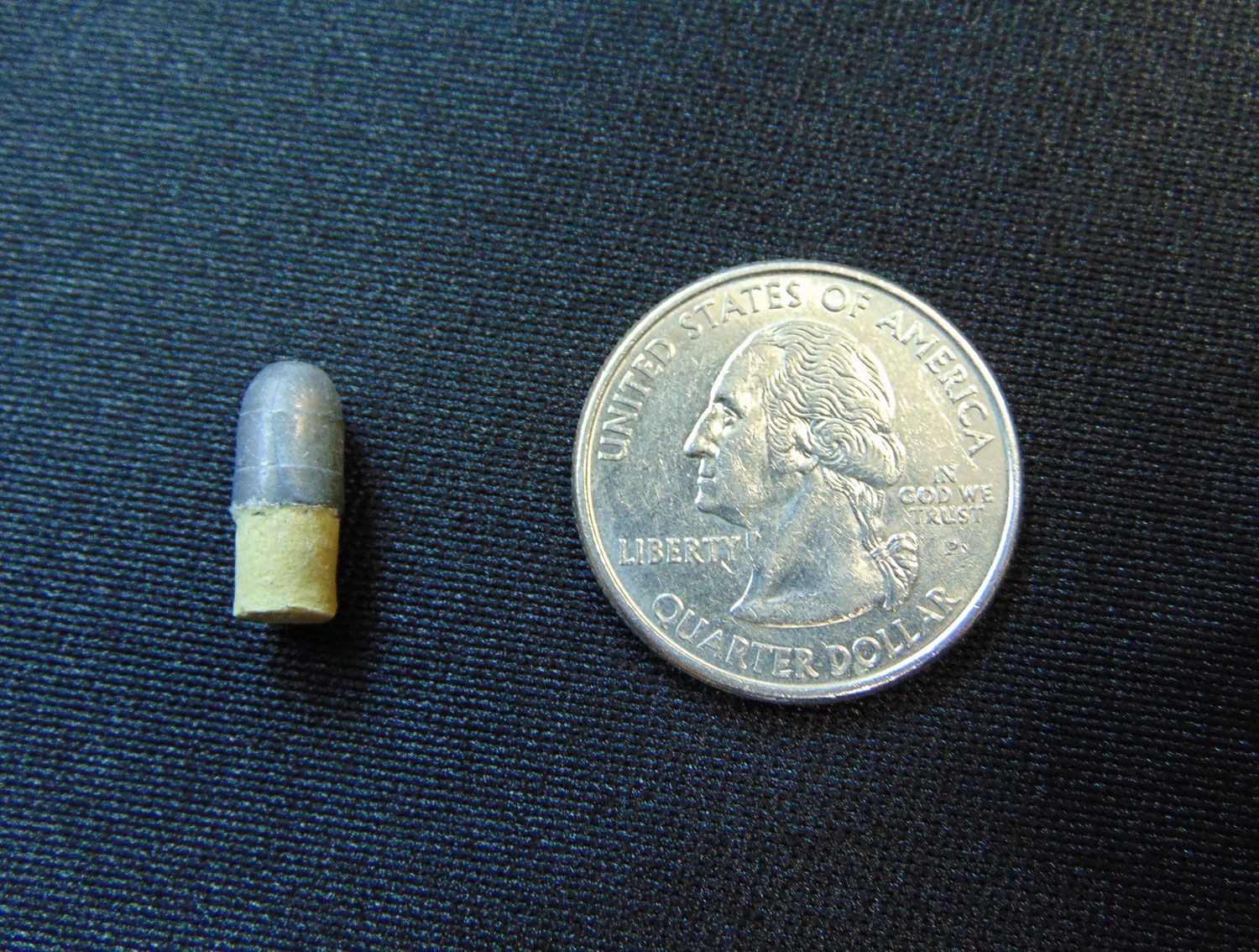
The round is half an inch long. A lead bullet of ordinary .224-inch diameter sits at the front, and behind it, where a brass case would be, there is a short pale cylinder of solid propellant with nothing around it. No rim, no case mouth, no primer pocket, no head stamp. Roughly half a gram of nitrocellulose, exposed to the air, waiting to be touched by something hot.
That is what Daisy sold, in tubes of ten, for about a cent and a half a round. This volume is about how it was made, how it performed, who actually manufactured it, and why the received wisdom about its failure is close to backwards.
13.1 Physical specifications
Every figure below that is marked to a patent comes from Van Langenhoven’s own filings and can be treated as settled.
Table 1 — Physical specifications
| Property | Value | Source |
|---|---|---|
| Bullet weight | 29 grains, lead | US 3,854,400; Daisy broadsheet; Gaylord |
| Bullet diameter | .224 in (same as .22 rimfire) | Gaylord; Rock Island Auction |
| Nominal muzzle velocity | 1,150 ± 40 fps | US 3,854,400 |
| Muzzle energy | 85.2 ft-lb at 1,150 fps | arithmetic from the above |
| Firing-chamber pressure | 12,000–30,000 psi | US 3,854,400 |
| Ignition time | approximately 0.6 ms | US 3,854,400 |
| Complete burn | 1–2 ms | US 3,854,400 |
| Propellant charge mass | 35–80 mg, 50–60 mg preferred | US 3,854,400 |
| Overall round length | approximately 0.5 in | US 3,854,400 |
| Propellant portion length | 0.232 in | US 3,854,400 |
| Propellant tube dimensions | approximately 0.220 in OD, 0.045 in ID | US 3,577,921 |
| Porosity | 60–85% voids, approximately 75% preferred | US 3,854,400 |
Two corrections belong here rather than in a footnote.
The bullet weighs 29 grains. Small Arms Review states 40 grains, twice, in an article that is otherwise useful.1 That figure contradicts the inventor’s own patent, Daisy’s own introductory broadsheet, and every other source located. It is wrong, and because Small Arms Review is a serious publication the error has been repeated. Use 29 grains.
The propellant colour is unresolved. Small Arms Review describes “yellow cake propellant.” Gaylord, with photographs, describes “a small cylinder of white material glued to the base.”2 Gaylord has pictures, which is a strong argument, but aged and discoloured examples are plausible and so is production variation. This dive cannot resolve it and does not pretend to; both reports are recorded.
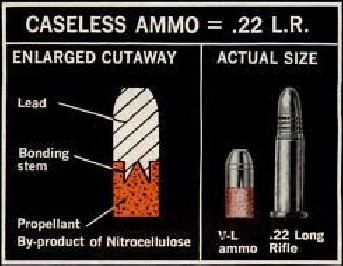
The round is, as Gaylord puts it, “half the length of a .22 long rifle.”2 Set one beside a .22 LR cartridge and the visual argument for caseless ammunition makes itself: the same bullet, the same velocity class, half the length, none of the brass.
13.2 The porosity is the invention
Everything else in the V/L follows from one materials problem, and the answer to it is the reason the gun exists.
Hot air is a feeble igniter. It carries very little energy per unit volume, it dumps that energy only where it makes contact, and it cools the instant it touches anything. A solid, dense grain of nitrocellulose presented to a blast of 400–700 °F air offers it a small flat face of a few hundredths of a square inch. The air heats the outermost skin of that face, loses its heat doing so, and the ignition either fails or is slow and inconsistent — which in a firearm is nearly as bad. This is precisely why every other cartridge in the world uses a primer: a primer does not warm the propellant, it sprays burning solid particles into it, reaching a large mass at once.
Van Langenhoven’s solution was to make the propellant grain itself behave like the inside of a sponge. The patents specify 60 to 85 percent voids, with approximately 75 percent preferred.3 Three quarters of the charge, by volume, is empty space — an interconnected network of pores running through the whole grain.
The consequence is that “surface contact” no longer means contact with a small external face. Hot air entering the pore network at the exposed rear surface finds an enormous internal surface area available to it simultaneously, deep inside the charge, all at once. Ignition ceases to be a slow inward-creeping process from one flat face and becomes something closer to a volumetric event. That is what buys the 0.6-millisecond ignition time and the 1-to-2-millisecond complete burn, and it is what makes ignition reliable enough to sell.
The porosity is not a manufacturing side effect. It is the invention. Strip it out and you have a lump of guncotton that hot air will not reliably light, and the entire architecture of Volume 12 collapses.
13.3 Formulation, from the patents
The base is nitrocellulose nitrated to 13.2–13.5 percent nitrogen — high-nitrogen guncotton, not the lower-nitrogen “safety base” material. It is ungranulated and colloided, and formed as one single large porous grain, explicitly “one relatively large homogeneous porous solid ungranulated” charge in the language of US 3,577,921.4 That is worth pausing on: conventional smokeless powder is thousands of small grains whose collective surface area governs the burn rate. The V/L charge is one object.
Two example formulations are disclosed, distinguished by how the pores are made.
US 3,545,333, the water-filler system: 200 g nitrocellulose at 13.35 percent nitrogen, 5 g hydroxyethyl cellulose as binder, 10 g potassium nitrate as accelerator and oxidiser, 1 g diphenylamine as stabiliser, 110 cc acetone as solvent, and 50 cc water as a removable filler.5
US 3,854,400, the removable-solid-filler system: 100 g nitrocellulose, 200 g potassium nitrate particles sieved through No. 100 and retained on No. 120, 1 g diphenylamine, and 160 cc acetone. The preferred nitrocellulose-to-potassium-nitrate ratio is 1:2.3
The process in both cases starts the same way: nitrocellulose plus solvent plus filler are worked into what the patent calls “a wet uniformly mixed doughy gelantinized mass,” which is then extruded or moulded directly onto the rear of the projectile. Then the filler comes out, and this is where the two methods diverge.
In the solid-filler method, the moulded charges are washed in water at roughly room temperature for about four days, dissolving out the potassium nitrate particles and leaving a void network in the shape of the crystals that were there. The patent notes something neat about this: residual potassium nitrate left behind in the pores “will act as an oxidizing agent during burning.”3 The filler does double duty — it creates the porosity on its way out, and whatever fails to wash out becomes part of the propellant chemistry.
In the liquid-filler method, the pellets are boiled in a 2 percent potassium nitrate solution for approximately fifteen minutes and then dried at 140 °F.3
Either way the result is dried hard: a rigid, self-supporting, three-quarters-empty cylinder of guncotton that has to be strong enough to be handled, boxed, shipped, and pushed into a breech by a shooter’s thumb. Hold that requirement in mind — it becomes the round’s undoing.
13.4 How it is attached to the bullet
The common shorthand says the propellant is “glued to the base of the bullet.” That is not what the patents describe, and the real answer is better engineering.
The bullet has “a reduced-diameter support post means centrally protruding from the rear,” carrying “radially extending portions providing flange means” that axially locate the charge, and the propellant is “mounted on and permanently attached thereto.”4 In plain terms: a flanged stub shaft projects from the bullet’s base, and the propellant is moulded around it while it is still a doughy mass. When it dries and hardens it is mechanically keyed onto that shaft, with the flanges preventing it from sliding off axially.
This matters for two reasons. It means the propellant cannot separate from the bullet under ordinary handling loads — the bond is a mechanical interlock, not an adhesive joint. And it means the round is manufactured as a single operation in which the propellant is formed in place on the projectile, which is why US 3,545,333 is titled a methods-of-manufacturing patent. The cartridge is not assembled. It is grown onto the bullet.
13.5 Who made it, and how much of it
This is the best find in the research behind this volume, and it comes from John Moss, a very well-regarded cartridge authority, posting on the International Ammunition Association forum in February 2011 and drawing on his own files and on International Cartridge Collector issues 295–296 of July–August 1980.6
Prototype and development ammunition was made by Daisy itself, with Omark Industries playing what Moss calls “an important part in the testing and development of propellants for it.” That is a serious name — Omark is the parent of CCI and Speer, which is to say the American rimfire and component-bullet industry — and it means Daisy did not attempt the chemistry alone.
But all production ammunition was made by Canadian Industries Limited (C-I-L) of Canada, and by the end of the project approximately 47 million rounds had been made.
Two caveats. This is a forum post, however well-credentialed the poster, so it sits at medium-high confidence rather than high; and DennisK, the collector who started the thread and holds a large stock of the ammunition, noted that there is no CIL marking anywhere on the packaging he has. Independently, Small Arms Review states that “while the rifle was manufactured in Rogers, Arkansas the ammunition was produced in Canada,” which corroborates the country if not the firm.1
Now do the arithmetic, because it is the most under-reported number in the entire V/L story.
Roughly 24,000 rifles were built. Roughly 47 million rounds were made. That is about 2,000 rounds per rifle ever manufactured.
Two thousand rounds is not a supply. It is a lifetime for a single-shot rifle that has to be cocked against 23 pounds of spring for every shot — twenty full 100-round boxes for every gun that left the factory, sitting in a warehouse for a product that had a retail life of about eighteen months. This is not the inventory profile of a company that could not get its ammunition made. It is the inventory profile of a company that had bet very heavily on a much larger rifle market than it got, tooled a Canadian ordnance manufacturer up to serve that market, and then stopped selling rifles.
It also disposes of a theory that circulates in discussions of the V/L’s ending: that Daisy was unable to find anyone willing to manufacture caseless ammunition under firearms licensing, and that this was the real blocker. No source located in this research supports that, and the 47-million-round figure points hard the other way. CIL made it, in Canada, in quantities that swamped demand by orders of magnitude. Whatever killed the V/L — and Volume 14 takes that up — the supply of ammunition was not it.
The overhang explains the decades that followed. Case lots turned up cheap in the early 1980s, apparently as Daisy cleared its warehouse, and Gaylord recalls that at airgun shows “one hundred dollars would buy a case of 10,000 rounds.”2 That is one cent per round for caseless ammunition, twenty years after the last rifle was built.
13.6 The package is part of the cartridge
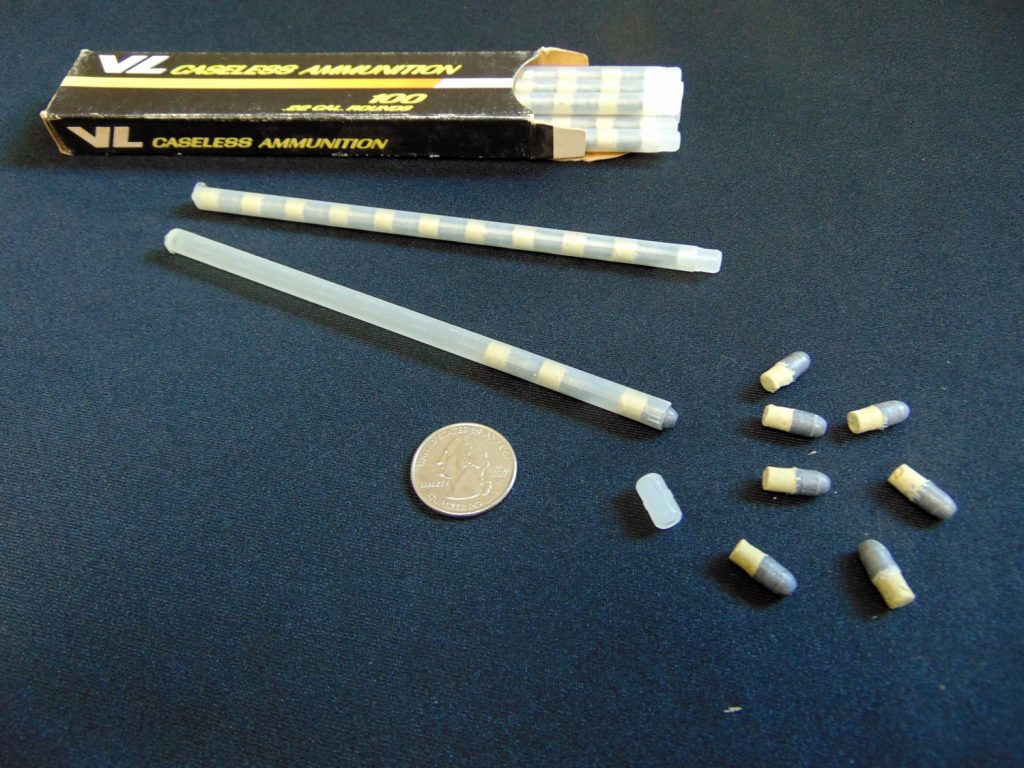
Ten rounds to a plastic tube, ten tubes to a 100-round box, ten boxes to a 1,000-round case.21 One end of each tube is heat-sealed; the other is closed with a removable, reversible plastic plug. The boxes were designed so the front folds open for counter display.
This looks like ordinary retail packaging and it is not. On a conventional cartridge, the brass case is a moisture barrier and a suit of armour around the propellant; you can carry rimfire loose in a pocket for a week and lose nothing. A bare porous nitrocellulose grain, three quarters air, cannot survive that treatment — the propellant flakes and crumbles. Daisy’s answer was to move the protective function out of the cartridge and into the package. The tube is the case. It is simply no longer attached to the round.
That Daisy understood this is clear from the fact that it patented the packaging: US 3,520,400, “Caseless ammunition package and container,” filed 12 December 1968 by David W. Gates of Rogers, Arkansas, assigned to Victor Comptometer.7
Pricing when new is reported inconsistently, and both figures come from the same source. Rock Island gives $1.40 per 100 rounds in one place and roughly $17 per 1,000-round brick in another, which imply $14 and $17 per thousand respectively.8 The honest statement is “on the order of $1.40 to $1.70 per hundred.” Dabbs, to his credit, simply says he has no idea what it cost.
13.7 Ballistics, honestly compared
Daisy’s marketing claimed the power of a .22 Long Rifle. Gaylord does the arithmetic and reaches a different conclusion: “in truth it’s more like a high speed .22 short. Twenty-nine grains at 1150 f.p.s. is 85.18 foot-pounds — a trifle over what a high speed short produces and less than a standard speed 40-grain long rifle bullet.”2 Guns & Ammo reached the same place in February 1993, describing it as about the same muzzle energy as a high-velocity .22 Short.
At the nominal figures, then, the V/L is a Short, not a Long Rifle, and Daisy’s claim was optimistic. But the real ammunition performed better than the nominal figures — see the range results below — and at measured velocities the energy comes to 91.8 ft-lb against roughly 100 ft-lb for standard .22 LR. The gap is much smaller than the specification suggests.
Variant loads existed, though only one was ever sold. Daisy’s introductory broadsheet said that “VL Test ammo has been manufactured to fire at lower and much higher controlled velocities, so potential variations are virtually unlimited.”6 US 3,577,921 discloses both 1,100 and 1,200 fps formulations, plus a deliberately reduced load combining an inert charge of “projectile diameter by .130 long” with a propellant charge of “projectile diameter by .090 long” for approximately 700 fps.4 Rock Island reports prototypes reaching 3,000 fps, which is plausible given the range the patents discuss but is unverified — no primary confirmation of that specific figure was located.
Only the 1,150 fps load reached the market. DennisK, with a large stock and six rifles, is definitive: he has never seen any other, and his chronograph reads exactly 1,150.9
13.8 Fifty-two-year-old ammunition, and what actually failed
In 2021 Tom Gaylord fired ammunition purchased in 1969 and chronographed the results. This is the best modern data on V/L ammunition in existence.2
Nine rounds recorded. Average 1,194 fps, low 1,173, high 1,233 — a spread of 60 fps. Energy at the average: 91.8 ft-lb. Sound: 111.9 dB, “about as loud as any regular .22 rifle.” And the two sentences that matter most:
“And every round fired the first time. There were no misfires.”
“All of them went out faster than Daisy advertised.”
Nine of nine, first strike, at 52 years old, above the original specification, on a caseless round whose propellant has been sitting in open air since Richard Nixon’s first year in office. There is no other caseless ammunition in history with a documented result like that.
One round’s propellant cracked during loading when it was pressed too hard. It still fired, and it was the slowest round recorded.
Will Dabbs, firing ammunition stored sealed in a steel can, reports a different picture: failures to fire are uncommon, but typical velocities ranged from 1,100 to 1,600 fps and “the rifle disperses vertically based on inconsistent velocities.” He attributes this to the propellant being hydrophilic and deteriorating over time — “the propellant cakes are starting to crumble a bit and that no doubt accounts for the wide variation in velocities” — and describes the rifle as never really tack-driving accurate “due to inevitable inconsistencies with propellant burn and quality control.”1 DennisK, with six rifles, is blunter still: “it is generous to state that accuracy is poor, beyond a few shots right after the bore is cleaned.”9
The velocity spreads disagree badly — 60 fps across Gaylord’s nine rounds against Dabbs’s 500 fps range — and different storage histories are the obvious explanation. Both are reported here. Where they can be adjudicated, Gaylord’s figures are preferred: he chronographed, and on the sound question in particular he had an instrument where Dabbs had an impression.
The synthesis is the opposite of the usual verdict on the V/L, and it deserves stating plainly.
Ignition reliability aged superbly. The thing everyone assumed would fail — a primerless round lit by nothing but hot air, formulated in the 1960s, stored for half a century — is the thing that held up. The compression-ignition principle works, and it still works after fifty years.
What failed was accuracy and physical fragility. Velocity scatter produces vertical stringing on target. The bore fouls quickly because there is no case mouth sealing it and no case to carry residue away. The propellant is hydrophilic, and a porous grain three-quarters composed of open void is the worst possible geometry for keeping moisture out. It flakes in a pocket, crumbles with age, and cracks if a thumb presses it into a breech too firmly.
Every one of those is a case problem. Brass is not dead weight; it is simultaneously a heat sink, a gas seal, a moisture barrier, and structural armour around the propellant. The V/L solved the sealing problem with the ball check valve of Volume 12, dodged the heat problem by being a single-shot, and lost outright on moisture and fragility. Van Langenhoven’s porous grain was clever enough to ignite on hot air and too delicate to survive being ammunition. Volume 15 shows that this is not a Daisy failure so much as the recurring shape of every caseless programme that has ever been attempted.
13.9 Bibliography
Footnotes
-
Will Dabbs MD, “The Daisy V/L Caseless Rifle: Decades Ahead of Its Time,” Small Arms Review V17N3, September 2013. https://smallarmsreview.com/the-daisy-v-l-caseless-rifle-decades-ahead-of-its-time/ (confidence: medium; good on lineage and range experience, but contains a definite error at 40 grains and a probable one on propellant colour). ↩ ↩2 ↩3 ↩4
-
Tom Gaylord (B.B. Pelletier), “Daisy VL rifle: Part 1 and Part 2,” Pyramyd Air, 14 and 21 May 2021. https://www.pyramydair.com/blog/2021/05/daisy-vl-rifle-part-1/ and https://www.pyramydair.com/blog/2021/05/daisy-vl-rifle-part-2/ (confidence: high; the 2021 chronograph data, the packaging description, the surplus-era pricing, and the .22 Short comparison). ↩ ↩2 ↩3 ↩4 ↩5 ↩6
-
US Patent 3,854,400, “Caseless ammunition and propellant and method of making same.” https://patents.google.com/patent/US3854400A/en (confidence: high; bullet weight, velocity, chamber pressure, ignition and burn times, charge mass, dimensions, porosity range, and the removable-solid-filler formulation and process). ↩ ↩2 ↩3 ↩4
-
US Patent 3,577,921, “Caseless ammunition for firearms and the like.” https://patents.google.com/patent/US3577921A/en (confidence: high; the single-large-porous-grain language, the propellant tube dimensions, the flanged stub-shaft attachment, and the 1,100 / 1,200 / 700 fps variant loads). ↩ ↩2 ↩3
-
US Patent 3,545,333, “Methods of manufacturing caseless ammunition for air ignition systems.” https://patents.google.com/patent/US3545333A/en (confidence: high; the water-filler formulation). ↩
-
John Moss, International Ammunition Association forum, “Daisy V/L Caseless Ammunition,” 23 February 2011, drawing on his files and on International Cartridge Collector issues 295–296, July–August 1980. https://forum.cartridgecollectors.org/t/daisy-v-l-caseless-ammunition/9246 (confidence: medium-high; source of the Omark development role, the CIL production attribution, the 47-million-round figure, and the Daisy broadsheet quotation. Moss is a highly regarded authority but this is a forum post, and the thread’s originator notes no CIL marking on his packaging). ↩ ↩2
-
US Patent 3,520,400, “Caseless ammunition package and container,” inventor David W. Gates of Rogers, Arkansas, filed 12 December 1968, assigned to Victor Comptometer (confidence: medium-high; patent number and inventor from search results, not read in full). ↩
-
Rock Island Auction blog, “Daisy/Heddon V/L Rifle: The Caseless Ammo .22.” https://www.rockislandauction.com/riac-blog/daisy-heddon-v-l-rifle-the-caseless-ammo-22/ (confidence: medium; the two internally inconsistent price figures, and the unverified 3,000 fps prototype claim). ↩
-
International Ammunition Association forum, “Daisy V/L Caseless Ammunition,” February 2011 onward — DennisK, owner of six V/L rifles and a large ammunition stock. https://forum.cartridgecollectors.org/t/daisy-v-l-caseless-ammunition/9246 (confidence: medium-high on his chronographed 1,150 fps and on his never having seen another load; medium on the accuracy assessment, which is uninstrumented). ↩ ↩2
Comments (0)